@nukcole-xinluo9510/pi-critic-guy
Pi extension — spawn a second-opinion reviewer by typing "critic"
Package details
Install @nukcole-xinluo9510/pi-critic-guy from npm and Pi will load the resources declared by the package manifest.
$ pi install npm:@nukcole-xinluo9510/pi-critic-guy- Package
@nukcole-xinluo9510/pi-critic-guy- Version
0.2.0- Published
- Jun 18, 2026
- Downloads
- not available
- Author
- nukcole
- License
- MIT
- Types
- extension
- Size
- 14.2 KB
- Dependencies
- 0 dependencies · 1 peer
Pi manifest JSON
{
  "extensions": [
    "./extensions"
  ],
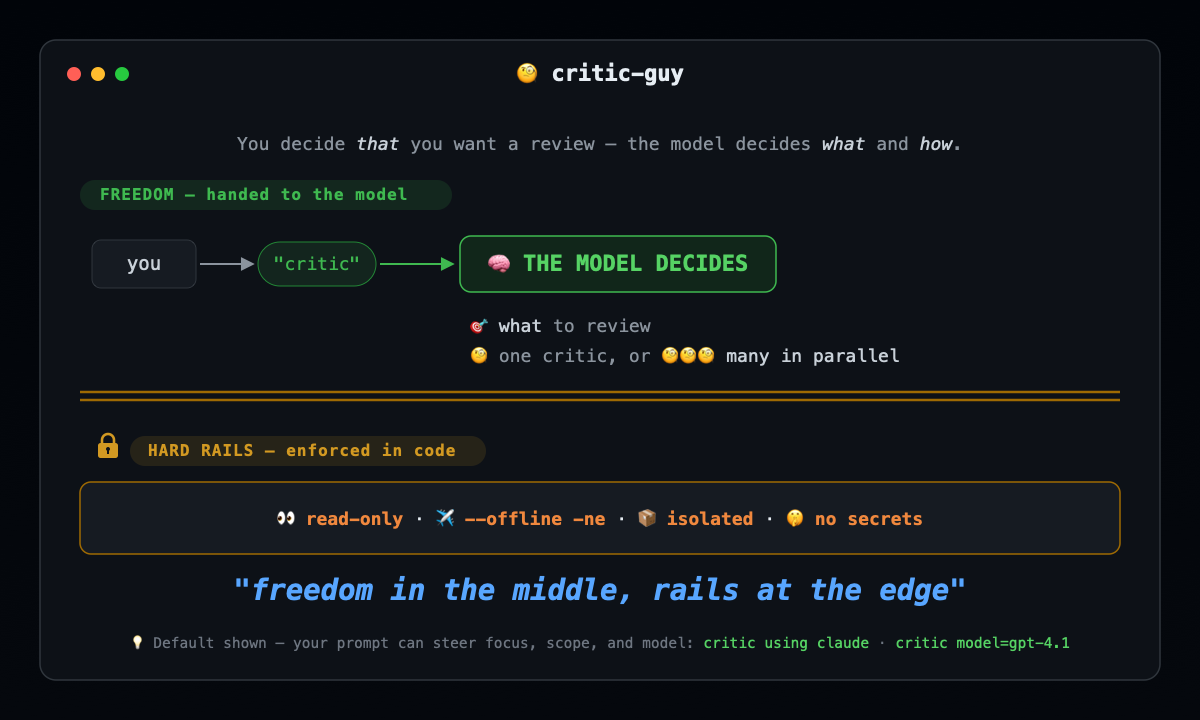
  "image": "https://raw.githubusercontent.com/luoxin9510/pi-critic-guy/main/assets/philosophy.png"
}
Security note
Pi packages can execute code and influence agent behavior. Review the source before installing third-party packages.
README
🧐 Critic Guy
A pi extension that trusts the model. Type critic in any pi session and get a
second opinion — from an independent, read-only reviewer you spawn with a single word.
No extra tools. No agent files. No configuration. Just say critic.
critic
critic review the auth code
critic using claude check for race conditions
critic model=deepseek-v4-flash review the error handling
Why it's different — built the pi way
pi's core bet is simple: the model is capable — give it good context and good tools, then get out of the way. Critic Guy is built on exactly that bet.
It does not wrap reviewing in a rigid tool with fixed modes and schemas. It teaches the model a capability and hands over the judgment:
- What to review? The model picks the most valuable target from your conversation — you don't have to spell it out.
- One critic or several in parallel? The model decides, splitting large scope into focused reviewers however it sees fit.
The only thing Critic Guy locks down is the boundary — and it locks it down with mechanism, not by asking the model nicely:
- The critic spawns as a fresh
pi -psession with read-only tools (read,grep,find,ls) — it physically cannot edit files, write files, or run shell commands. --offline -nemeans the child never hangs on startup network calls and never re-loads this extension (so no runaway nesting).- Its persona refuses to read credentials, secrets, or dotfiles.
Freedom in the middle, hard rails at the edge. Judgment goes to the model; safety is enforced in code.
That's the whole philosophy — and it's why Critic Guy stays a tiny prompt injection instead of a 1000-line tool. It's the most pi-native way to get a critic.
Highlights
- 🪶 Zero dependencies, zero config — no companion extension, no
reviewer.md, nothing to install beyond this package. - 🔒 Safe by construction — the reviewer is read-only and isolated; the boundary is
enforced by
--tools, not by trust. - 🧠 Model-driven — you decide that you want a review; the model decides what and how.
- 💸 Zero overhead when idle — instructions are injected only on turns where you
actually type
critic. Silent the rest of the time. - 🎯 Model-aware — resolves the reviewer model from your current session, or one you
name with
using <name>/model=<id>.
Install
# From npm
pi add npm:@nukcole-xinluo9510/pi-critic-guy

# Or from a local checkout during development
pi add /path/to/pi-critic-guy
That's it. No other setup.
Usage
In any pi session, just mention critic:
| You type | What happens |
|---|---|
critic |
Model picks the most valuable thing from the conversation and reviews it |
critic review the auth code |
Targeted review of what you point at |
critic using claude |
Spawn the critic on a model matching "claude" |
critic model=deepseek-v4-flash |
Spawn the critic on an exact model id |
Word-boundary matching means critical, criticism, etc. will not trigger it —
only a standalone critic.
How it works
Critic Guy hooks before_agent_start. On any turn where you mention critic:
- It resolves the reviewer model (your current model, the registry, or one you named).
- It appends a short "Capability: Critic Guy" section to the system prompt — the capability, the resolved model id, and one spawn command with the hard-boundary flags.
- The model spawns one or more critics:
pi -p --offline -ne --no-session -nc --model "<resolved>" \ --tools read,grep,find,ls \ --append-system-prompt "<reviewer persona>" \ "Task: review <files> ..." - Each critic reads the named files in its own isolated context and returns a critique, which the model relays to you.
If the system prompt is already very large, Critic Guy skips injection that turn and says so — it never silently no-ops.
Requirements
- pi 0.79+
(Yes, that's the whole list.)
Development
npm run check   # tsc --noEmit
npm test        # node --test (matchModel + parseModelQuery)
License
MIT