@nukcole-xinluo9510/pi-extension-guy
Pi extension — a control panel to hot enable/disable your local extensions by typing /extensions
Package details
Install @nukcole-xinluo9510/pi-extension-guy from npm and Pi will load the resources declared by the package manifest.
$ pi install npm:@nukcole-xinluo9510/pi-extension-guy- Package
@nukcole-xinluo9510/pi-extension-guy- Version
0.1.0- Published
- Jun 25, 2026
- Downloads
- 115/mo · 12/wk
- Author
- nukcole
- License
- MIT
- Types
- extension
- Size
- 211.3 KB
- Dependencies
- 0 dependencies · 2 peers
Pi manifest JSON
{
  "extensions": [
    "./extensions/extension-guy/index.ts"
  ],
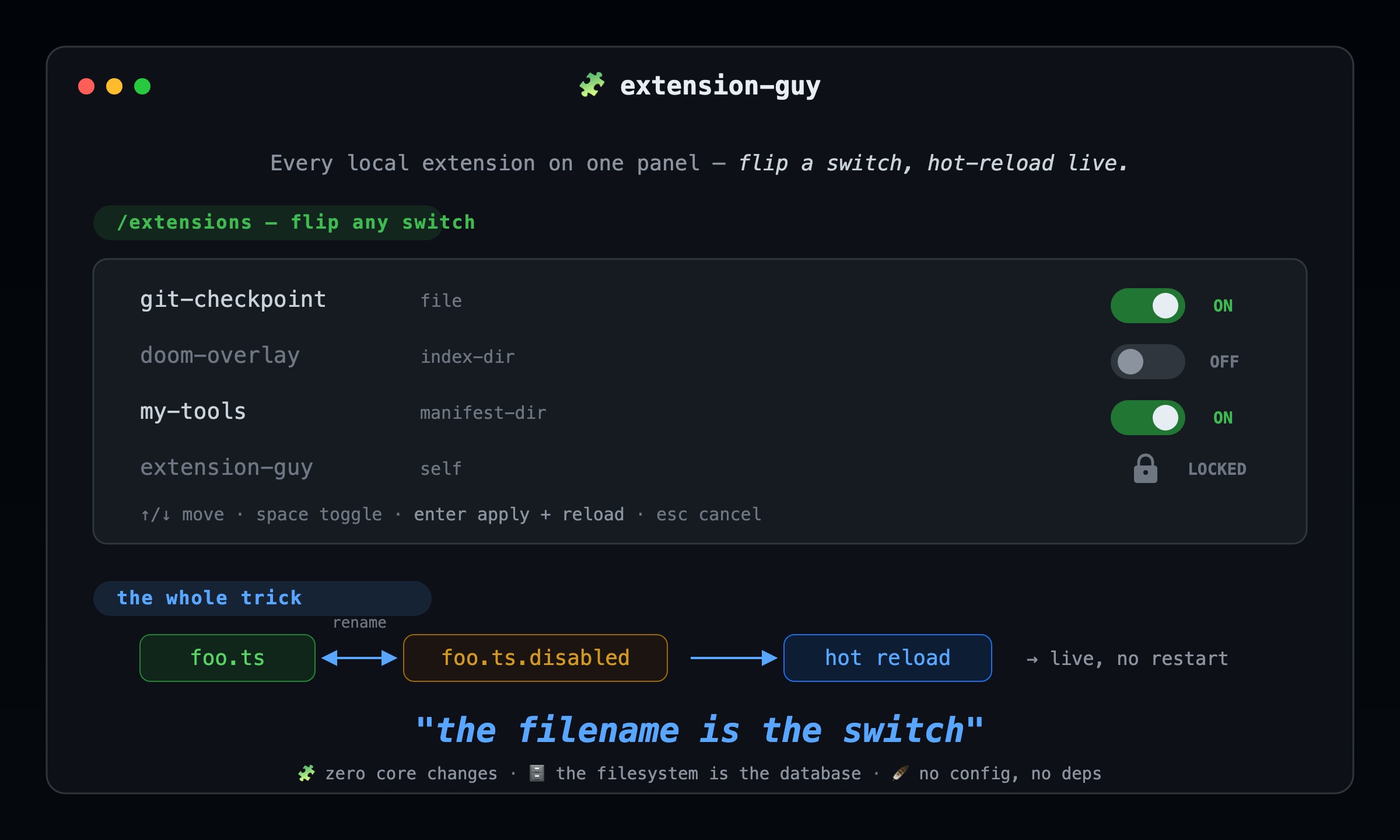
  "image": "https://raw.githubusercontent.com/luoxin9510/pi-packages/main/packages/pi-extension-guy/assets/switchboard.png"
}
Security note
Pi packages can execute code and influence agent behavior. Review the source before installing third-party packages.
README
🧩 Extension Guy
A pi extension that flips other extensions. Run /extensions in any pi
session and get a live control panel — every local extension on one screen,
each on a switch you can flip on or off and hot-reload on the spot.
pi already hot-reloads everything at once with /reload. Extension Guy makes
it per-extension: toggle one off, hit enter, and it's gone from the running
session — no restart, no rm, no config file, no hidden registry.
/extensions
┌─ Extensions (managed dirs only) ────────────┐
│  ── GLOBAL  (~/.pi/agent/extensions) ──      │
│  ▶ [x] git-checkpoint     file               │
│    [ ] doom-overlay       index-dir   *      │
│    [x] my-tools           manifest-dir       │
│    [-] extension-guy      (self)             │
│  ── PROJECT  (.pi/extensions) ──             │
│    [x] repo-linter        file               │
│                                              │
│  ↑/↓ move   space toggle                     │
│  enter apply+reload   esc cancel             │
└──────────────────────────────────────────────┘
Why it's different — built the pi way
pi already ships the two mechanisms you need: it discovers extensions by
filename, and it hot-reloads them with /reload. Extension Guy doesn't
fork the core or invent a new system — it just composes what pi already has.
To turn an extension off, it renames the file so the loader stops finding it
(foo.ts → foo.ts.disabled), then runs pi's own reload. That's the whole
trick. Which means the most important design decision is what it doesn't add:
- No new state. The on-disk filename is the switch.
foo.tsis on,foo.ts.disabledis off. Nothing to keep in sync, nothing to corrupt. - No database, no config schema, no daemon. Want to know what's enabled?
ls. Want it to survive a restart? It already does — the files are the truth. - No core changes. Pure public
ExtensionAPI(registerCommand,ctx.ui.custom,ctx.reload) plusfs. It runs on stock pi.
No new state — the filename is the switch. It composes pi's mechanisms instead of replacing them.
That's why the panel never lies: its [x] / [ ] is computed by replicating
pi's actual loader rules, not by trusting a side-file that could drift.
Highlights
- 🎛️ One panel — see every local extension; arrow to move, space to flip, enter to apply.
- 🔥 Per-extension hot reload — pi reloads everything at once; Extension Guy flips one extension and hot-reloads it live in the current session, no restart.
- 🗄️ Filesystem is the database — the filename is the state. Inspect with
ls, survives restarts, no hidden registry to desync. - 🧩 Zero core changes — built entirely on the public extension API; works on unmodified pi.
- 🪶 Zero config, zero deps — install and run. Nothing to set up.
- 🔒 Safe by construction — the manager locks itself, leaves symlink-escape and unmanageable entries read-only, and rolls back a multi-file rename if any step fails, so a directory is never left half-toggled.
- 🪞 Honest state —
[x]/[ ]mirrors pi's real loader (isExtensionFile+resolveExtensionEntries), including manifest dirs that resolve to nothing.
Install
# From npm
pi add npm:@nukcole-xinluo9510/pi-extension-guy

# Or from a local checkout during development
pi add /path/to/pi-extension-guy
That's it. No other setup. Then run /extensions in any session.
Usage
| Key | Action |
|---|---|
↑ / ↓ |
move selection (skips section headers) |
space |
toggle the selected item — pending only; * marks unsaved |
enter |
apply all pending toggles to disk, then reload |
esc |
cancel — discard pending changes, touch nothing |
Toggles are batched: flip several, then apply once for a single reload.
How it works
Extension Guy registers one command, /extensions. When you run it:
It scans the two managed dirs —
~/.pi/agent/extensions/and<cwd>/.pi/extensions/— and classifies each entry (single file, index directory, orpackage.jsonmanifest directory).It opens a TUI overlay (
ctx.ui.custom) listing each extension with its real enabled/disabled state. Toggling only flips an in-memory flag.On enter, it performs all renames first — purely on disk:
Shape Disable Enable single file foo.ts→foo.ts.disabledreverse index dir index.tsandindex.js→*.disabledreverse manifest dir package.json(+ any siblingindex.*) →*.disabledreverse Then it calls
ctx.reload()— the same flow as/reload— and returns. The reload re-discovers extensions, so disabled ones vanish and enabled ones come back, live in the current session.
Renames are prechecked and rolled back per item, so a concurrent change produces a clean error instead of a half-renamed directory.
The boundary (enforced, not asked)
Some rows are deliberately read-only, locked in code:
- 🔒 self — Extension Guy can't disable itself.
- 🔗 symlink — entries whose real target escapes the managed dirs.
- 🚫 unloadable — a manifest whose
pi.extensionsresolve to nothing.
And what it honestly won't manage (because pi exposes no API to enumerate
loaded extensions): npm/git packages installed via pi add, and extensions
added through settings.json paths. Those live outside the managed dirs, so they
aren't shown. The panel header says "managed dirs only" — it never pretends the
list is exhaustive.
One more honest note: a toggle is global. The rename changes discovery for every pi process and future session; other running instances pick it up on their next reload.
Requirements
- pi 0.79+
(That's the whole list.)
Development
npm run check   # tsc --noEmit against real pi types
npm test        # node --test (scan classification, toggle rename + rollback)
Layout:
extensions/extension-guy/
  index.ts   # /extensions command: scan → panel → apply → reload
  scan.ts    # disk discovery, mirrors pi's resolveExtensionEntries
  toggle.ts  # rename engine: precheck + per-item rollback
  panel.ts   # TUI overlay (Focusable component)
License
MIT