@patimweb/pi-mindplace
Sherlock's Mind Place for your codebase — build a queryable knowledge graph that saves tokens on every session. Maps code structure via tree-sitter AST into a navigable graph with community detection and token-budget-aware queries.
Package details
Install @patimweb/pi-mindplace from npm and Pi will load the resources declared by the package manifest.
$ pi install npm:@patimweb/pi-mindplace- Package
@patimweb/pi-mindplace- Version
1.3.0- Published
- Jul 13, 2026
- Downloads
- not available
- Author
- patimwep
- License
- MIT
- Types
- extension
- Size
- 3.4 MB
- Dependencies
- 13 dependencies · 1 peer
Pi manifest JSON
{
  "extensions": [
    "./index.ts"
  ],
  "image": "https://raw.githubusercontent.com/Smotherer007/pi-mindplace/main/screenshot.png"
}
Security note
Pi packages can execute code and influence agent behavior. Review the source before installing third-party packages.
README
pi-mindplace
"I walk into my mind place. The codebase is organized. Every function has its place."
Sherlock's Mind Place for your codebase. A pi extension that builds a queryable knowledge graph from your source code using tree-sitter AST parsing. Every function, class, and module becomes a node; calls, imports, and inheritance become edges. Query the graph in natural language instead of re-reading files, saving tokens on every session.
How it works
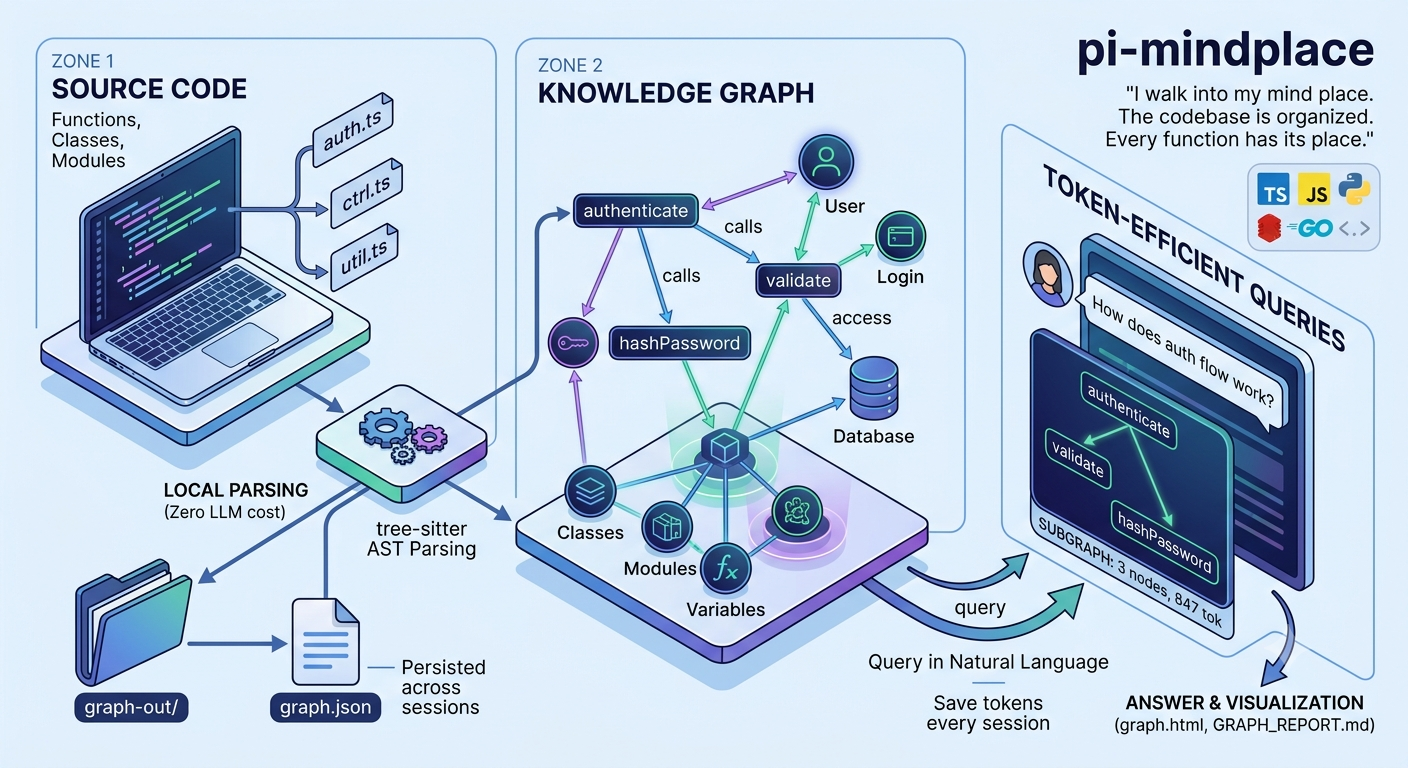
mindplace_buildparses your source files locally with tree-sitter (zero LLM cost), extracting functions, classes, imports, and call relationships into a knowledge graphmindplace_queryuses TF-IDF scoring and BFS traversal to find the most relevant subgraph within your token budgetmindplace_explaindrills into a single entity and shows all its connections
Token savings mechanism
When graph-out/graph.json exists, the extension injects graph-first instructions into pi's system prompt. The agent follows a 3-layer query rule:
- First: use
mindplace_queryto understand code structure (cheap subgraph) - Second: use
mindplace_explainfor specific entities - Third: only read raw files when editing or when the graph doesn't have the answer
This mirrors graphify's PreToolUse hook but adapted to pi's extension model via before_agent_start. The graph is built once (one-time token cost) and every subsequent codebase question is answered from the graph instead of re-reading files.
Supported languages
JavaScript, TypeScript, Python, Go, Java, Rust, C++, Ruby, Kotlin, Scala, Bash, JSON
Install
pi install npm:@patimweb/pi-mindplace
Or for local development:
pi -e /path/to/pi-mindplace/index.ts
Requirements: Node.js 26+, tree-sitter (auto-installed as dependency).
Usage
Build the mind place
mindplace_build
Scans all supported files in the current directory and creates graph-out/ with:
| File | Description |
|---|---|
graph.json |
The full knowledge graph, queryable across sessions |
GRAPH_REPORT.md |
Audit report with god nodes, communities, suggested questions |
graph.html |
Interactive D3.js visualization (open in browser) |
cache/ |
SHA256 cache for incremental rebuilds |
Options:
mindplace_build path="./src"              # scan specific directory
mindplace_build force=true                # force rebuild ignoring cache
mindplace_build update=true               # incremental: only re-extract changed files
mindplace_build directed=true             # preserve edge direction
mindplace_build noViz=true                # skip HTML visualization
mindplace_build noReport=true             # skip report generation
Query the graph
mindplace_query question="How does authentication flow work?" budget=4000
Returns a scoped subgraph of relevant nodes and their relationships, formatted as markdown.
Explain a node
mindplace_explain name="authenticateUser"
Shows detailed info about a specific entity: where it's defined, what it connects to, and what calls it.
Command shortcuts
The /mindplace command provides quick access:
/mindplace              # show status
/mindplace "auth flow"  # query shortcut
/mindplace build        # rebuild
Architecture
pi-mindplace/
+-- index.ts                  Extension entry point + token savings hooks
+-- src/
|   +-- types.ts              Core data interfaces and language support map
|   +-- detect.ts             File scanner and language detection
|   +-- extract.ts            tree-sitter AST extraction with SHA256 caching
|   +-- graph.ts              KnowledgeGraph class (PageRank, Louvain, directed mode)
|   +-- query.ts              TF-IDF scorer + BFS/DFS traversal with token budget
|   +-- report.ts             GRAPH_REPORT.md generator
|   +-- viz.ts                D3.js standalone graph.html generator
|   +-- tools/
|       +-- mindplace-build.ts
|       +-- mindplace-query.ts
|       +-- mindplace-explain.ts
+-- tests/
    +-- detect.test.ts
    +-- extract.test.ts
    +-- graph.test.ts
    +-- query.test.ts
    +-- fixtures/
Design decisions
- Zero Python: pure TypeScript/Node.js, no Python required
- Zero LLM cost for building: tree-sitter AST parsing is deterministic and local
- Minimal dependencies: only
tree-sitterand language grammars. No numpy, no scikit-learn, no networkx - PageRank without numpy: pure JS power iteration in ~25 lines
- TF-IDF without scikit-learn: hand-rolled with smoothed IDF and camelCase/snake_case tokenization plus substring matching
- Louvain without networkx: greedy modularity optimization in ~50 lines
- Token-budget-aware: BFS traversal that stops when the budget is exhausted
- Incremental builds: SHA256 content hashing, unchanged files skip re-extraction
- Standalone visualization: D3.js graph.html with search, community coloring, and drag interaction
License
MIT