@pi-archimedes/ask
Structured question tool with tabbed multi-question flow and inline note editing
Package details
Install @pi-archimedes/ask from npm and Pi will load the resources declared by the package manifest.
$ pi install npm:@pi-archimedes/ask- Package
@pi-archimedes/ask- Version
2.7.0- Published
- Sep 12, 2026
- Downloads
- 1,738/mo · 340/wk
- Author
- danmademe
- License
- unknown
- Types
- extension
- Size
- 71.3 KB
- Dependencies
- 1 dependency · 3 peers
Pi manifest JSON
{
  "image": "https://raw.githubusercontent.com/danielcherubini/pi-archimedes/main/docs/images/ask-subagent.png",
  "extensions": [
    "./src/index.ts"
  ]
}
Security note
Pi packages can execute code and influence agent behavior. Review the source before installing third-party packages.
README
@pi-archimedes/ask
Keep the decisions. Delegate the work.
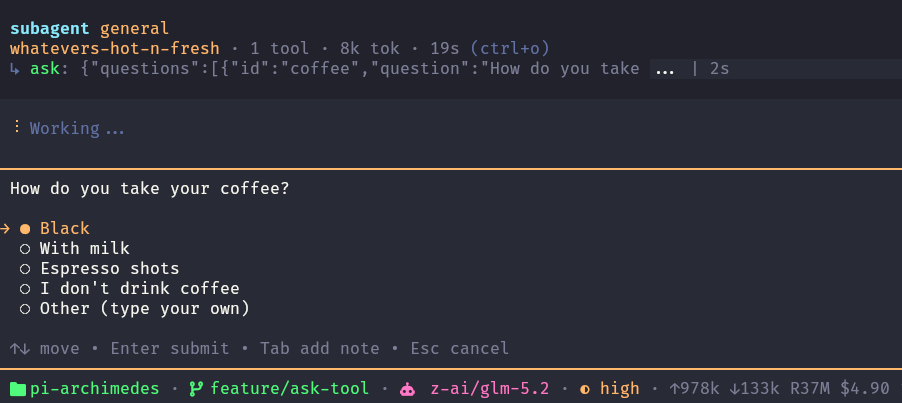
When an agent needs you, ask turns the need into a structured prompt right in the terminal — options, inline notes, a freeform fallback — so the answer carries your exact intent back. From subagents, too: their questions surface in the parent TUI, the agent waits, and the work carries on with your choice. No copy-pasting messages between panes to stay involved.
Install
Standalone:
pi install npm:@pi-archimedes/ask
Or the full suite instead:
pi install npm:pi-archimedes
New to Pi? Pi itself is a one-time global install and needs Node.js ≥ 22.19.0:
npm install -g --ignore-scripts @earendil-works/pi-coding-agent
After installing Pi, choose one installation command above, then cd into your project and run pi. Inside the session, /login signs you in and /model picks a model — the setup section covers the first run. /reload picks the tool up in a running session.
What you get
- Tabbed multi-question flows — arrow keys move between related questions; a final batch review submits the whole set in one step.
- Single-question picker — for fast multiple-choice questions, keyboard-driven: up/down to move,
Enterto submit,Escto cancel. Nothing requires a mouse. - Inline note per option —
Tabopens a note editor on the hovered option;Entersubmits it. Notes travel back with the answer, so context and constraints ride along. - Multiple selection —
multi: truecollects several answers from one question. - Built-in "Other (type your own)" — whenever the options don't cover it, a freeform response field is always available.
- Markdown context — the agent can attach formatted descriptions, headers, and code blocks above the options, so the question presents context you can actually read.
Tool usage
Single quick question
{
  "questions": [{
    "id": "framework",
    "question": "Which framework should we use?",
    "options": [
      { "label": "React" },
      { "label": "Vue" },
      { "label": "Svelte" }
    ]
  }]
}
Multi-question flow with markdown context and multiple selection
{
  "questions": [
    {
      "id": "priority",
      "question": "What is the implementation priority?",
      "description": "Choose the initial focus area for this milestone.",
      "recommended": 0,
      "options": [
        { "label": "Core architecture first" },
        { "label": "Unit tests first" },
        { "label": "CLI interface first" }
      ]
    },
    {
      "id": "constraints",
      "question": "Select applicable constraints:",
      "multi": true,
      "options": [
        { "label": "No breaking changes" },
        { "label": "Zero external dependencies" },
        { "label": "Strict backward compatibility" }
      ]
    }
  ]
}
An option the agent marks recommended is flagged in the UI; description renders as markdown above the options.
Subagent relay
When a subagent dispatched by @pi-archimedes/subagent calls ask, the same prompt relayed over the bidirectional IPC channel appears in your live terminal, even mid-stream — the subagent blocks while you answer and resumes carrying your exact choices. It works alongside the live streaming and cost tracking, no temp files or pipes. This relay only applies to Archimedes-dispatched subagents; a question from a directly-called agent simply renders in-line.
On/off is managed by the suite: toggle via /plugins (archimedes.ask.enabled, default on).