@pi-archimedes/subagent
Subagent dispatch with live TUI streaming and cost tracking
Package details
Install @pi-archimedes/subagent from npm and Pi will load the resources declared by the package manifest.
$ pi install npm:@pi-archimedes/subagent- Package
@pi-archimedes/subagent- Version
2.7.0- Published
- Sep 12, 2026
- Downloads
- 1,846/mo · 330/wk
- Author
- danmademe
- License
- unknown
- Types
- extension
- Size
- 228.8 KB
- Dependencies
- 2 dependencies · 4 peers
Pi manifest JSON
{
  "extensions": [
    "./src/index.ts"
  ],
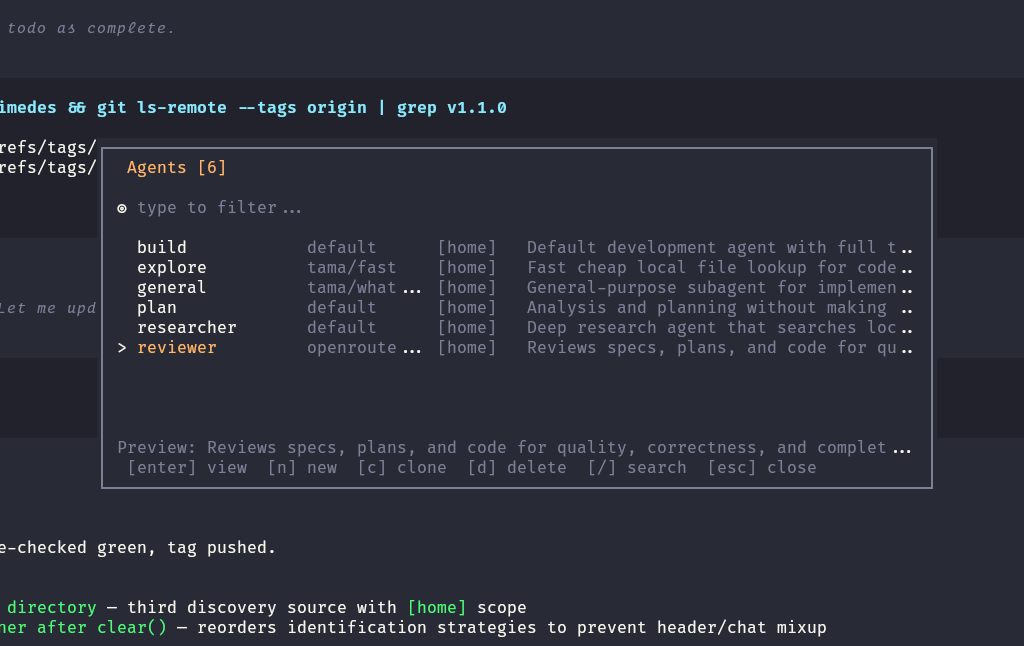
  "image": "https://raw.githubusercontent.com/danielcherubini/pi-archimedes/main/docs/images/subagents-main-view.png"
}
Security note
Pi packages can execute code and influence agent behavior. Review the source before installing third-party packages.
README
@pi-archimedes/subagent
Give your agent some backup.
Big thinking and multi-file refactors are expensive to do in the main line. Subagent lets your agent delegate that work: it dispatches child agents — singly or in parallel — with a model and tool set of your choice per role, streams their progress live, and books their tokens and costs into the same status bar. You watch the whole team at once.
Install
Standalone:
pi install npm:@pi-archimedes/subagent
Or the full suite instead:
pi install npm:pi-archimedes
New to Pi? Pi itself is a one-time global install and needs Node.js ≥ 22.19.0:
npm install -g --ignore-scripts @earendil-works/pi-coding-agent
After installing Pi, choose one installation command above, then cd into your project and run pi. Inside the session, /login signs you in and /model picks a model — the setup section covers the first run. /reload picks the dispatch tool up in a running session.
Dispatching
Config-less — omit agent
The agent field is optional — omitting it is not a built-in default agent, and no agents are shipped with the package. Without an agent file, the model falls back to the per-call model override and then the parent's active model, and tools follow Pi's normal selection at spawn — except the subagent tool itself is always excluded, so a worker can't spawn workers:
{
  "task": "review the uncommitted changes and list the risks",
  "model": "openrouter/anthropic/claude-sonnet-4",  // optional per-call override
  "cwd": "/path/to/project"                        // optional working directory
}
The dispatch waits. A call — single or parallel — blocks until every task completes and returns the combined results, each optionally carrying the child's childSessionId. There is an async field in the schema; the implementation ignores it, so don't plan on fire-and-forget: batch the work into tasks and let the call block on all of it.
Model and thinking resolution
Per dispatch, the model resolves in order: the agent config's model, then the per-call model, then the parent's active model (the first entry doesn't apply to config-less dispatch).
The thinking level is not inherited from the parent session's active thinking. It comes from the agent file's explicit thinking when present; otherwise Pi works out its own (the selected model, its configuration, or the model's default).
Agent files
Named agents are .md files with YAML frontmatter — a complete definition:
---
name: reviewer
description: Reviews diffs and flags risks before code lands
model: openrouter/anthropic/claude-sonnet-4
tools: read, bash
thinking: medium
---
You are a meticulous code reviewer. Read the diff, flag real risks,
and name the lines you checked.
nameanddescriptionare required — a file without them is skipped.toolsis a comma-separated string. The markdown body is the agent's system prompt.- Scopes, in precedence order: project (
<repo>/.pi/agents/), user (~/.pi/agent/agents/), and global — the repository's.agents/agents/or, falling back,~/.agents/agents/. - Unknown frontmatter fields are preserved on edit, not interpreted.
- Model and thinking picked in the
/agentsTUI are saved to~/.pi/agent/agents.local.json(machine-local, not committed), take precedence over the frontmatter, and are stripped from the.mdon save. Hand-writtenmodel:/thinking:in frontmatter remain the fallback.
Named agents
With an agent name, the dispatch runs under that defined agent file — no agents are bundled, so the name must exist in one of these files. Unknown names are refused and list the available agents, so a typo fails cheap:
{
  "agent": "reviewer",
  "task": "review the PR diff"
}
Parallel work
Independent tasks go in a tasks array — mix defined agents and config-less tasks, distinct models, one call:
{
  "tasks": [
    { "agent": "reviewer", "task": "review the proposed migration plan" },
    { "task": "find all usages of the deprecated API" }   // config-less — the model/tools fall back as above
  ]
}
The /agents command
Available with the suite (and subagent enabled), /agents opens the interactive manager: a searchable list, model and tool pickers, cross-scope collision warnings, and dirty-tracking on save.
Part of the suite
The full suite is the supported connected setup. With the relevant components loaded together, subagent token and cost events flow over core's bus into the footer, subagent tasks get their own columns on the todo board, and subagent ask questions surface in your terminal. On/off is managed by the suite: toggle via /plugins (archimedes.subagent.enabled, default on).