@pi9/subagent
Asynchronous, resumable, and recursive subagent conversations for Pi with exact-run retrieval and live progress.
Package details
Install @pi9/subagent from npm and Pi will load the resources declared by the package manifest.
$ pi install npm:@pi9/subagent- Package
@pi9/subagent- Version
0.7.1- Published
- Jul 23, 2026
- Downloads
- 1,305/mo · 524/wk
- Author
- chasec
- License
- MIT
- Types
- extension
- Size
- 424.8 KB
- Dependencies
- 0 dependencies · 4 peers
Pi manifest JSON
{
  "extensions": [
    "./src/index.ts"
  ],
  "skills": [],
  "prompts": []
}
Security note
Pi packages can execute code and influence agent behavior. Review the source before installing third-party packages.
README
@pi9/subagent
Delegate focused work from Pi to context-isolated child conversations. The single subagent tool provides agent discovery, side-effect-free inventory, asynchronous runs, blocking retrieval, explicit cleanup, recursive delegation, and live progress.
Install
pi install npm:@pi9/subagent
Define agents
Agent markdown is discovered from the user ${PI_AGENT_DIR ?? ~/.pi/agent}/agents directory and the nearest project .pi/agents. Project definitions override same-named user definitions by default.
For example, .pi/agents/scout.md defines a project-local read-only agent:
---
name: scout
description: Read-only codebase reconnaissance
model: anthropic/claude-sonnet-4
tools: read, bash
---

Inspect the repository and return concise, evidence-backed findings.
| Frontmatter | Required | Meaning |
|---|---|---|
name |
yes | Runtime agent name. |
description |
yes | Non-blank discovery summary. |
model |
no | provider/model or an unambiguous model id. |
thinking |
no | off, minimal, low, medium, high, xhigh, or max. |
tools |
no | Comma-separated allowlist; include subagent for recursive delegation. |
skills |
no | Comma-separated default skills. A spawn-task value replaces this list. |
The body becomes the child system prompt. Spawn tasks require agent and prompt; label is optional, and tasks may override supported execution options such as model, thinking, working directory, and skills. A model requested by either the task or agent definition must resolve; an unknown or malformed value fails that task instead of falling back. When neither specifies a model, the child inherits the parent's model. An explicit task cwd is resolved relative to the parent's working directory and must identify an existing directory. Follow-up tasks identify a conversation and provide a prompt; the conversation's agent and execution context remain fixed.
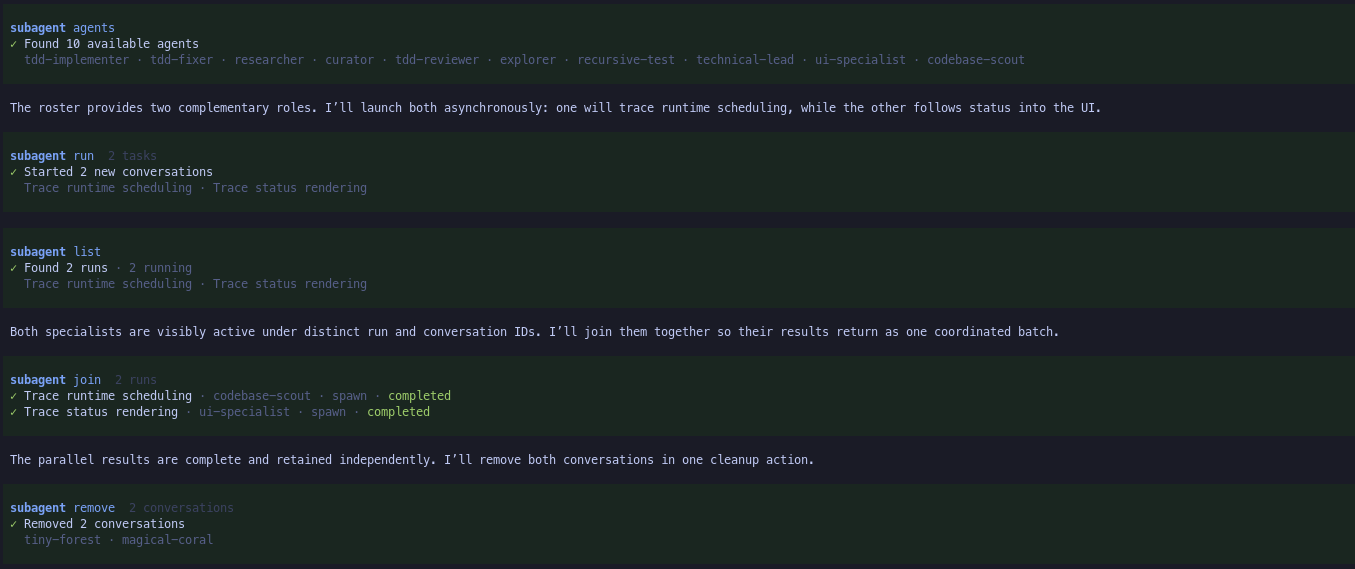
Tool actions
| Action | Behavior |
|---|---|
agents |
Discover agent definitions and their resolved defaults. |
list |
Return a lightweight inventory of conversations and runs without run output. It is pure: it acknowledges nothing and changes no lifecycle state. |
run |
Start one or more well-formed tasks asynchronously and return one ordered outcome per task, including identifiers for accepted tasks and errors for semantic or startup failures. |
join |
Block until every explicitly requested exact run settles, then return and acknowledge exactly those runs. There is no timeout. Cancelling join stops only the wait; it does not stop the underlying runs. |
remove |
Clean up the specified conversations, aborting active work if necessary, deleting resumable child session state, and hiding them from list. |
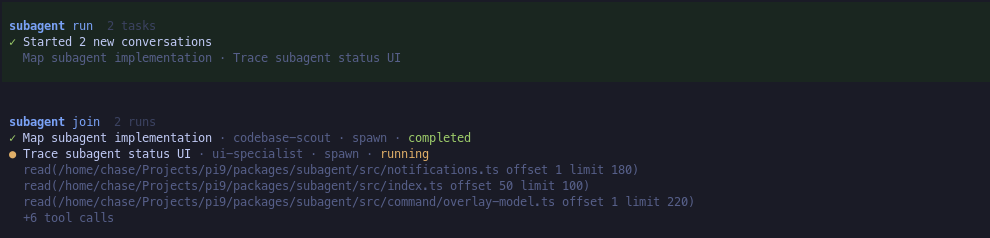
Parallel runs stream their current status and recent tool activity independently:
Each task is handled independently after the tool call passes SDK schema validation. Task-level parsing and startup failures—such as a missing agent, an unknown agent, an invalid model, or a missing working directory—return an ordered { ok: false, inputIndex, error } outcome without preventing valid sibling tasks from starting. Invalid outer invocations—including a missing or unknown action, absent or empty tasks, and batch-limit violations—remain global errors. Provider-level schema violations may reject the tool call before execution.
For example, a three-task batch can return a successful start, a task-level failure, and another successful start in input order:
[
  { "ok": true, "inputIndex": 0, "conversationId": "quiet-otter", "runId": "search-boldly" },
  { "ok": false, "inputIndex": 1, "error": "Task must carry exactly one of agent (spawn) or conversationId (resume)." },
  { "ok": true, "inputIndex": 2, "conversationId": "calm-fox", "runId": "inspect-carefully" }
]
Rejected tasks receive no conversationId or runId and do not appear in list; only accepted tasks enter the run lifecycle.
A run belongs to one conversation. Spawning creates both; a follow-up creates another run in an existing conversation. Every conversation remains available in the runtime inventory until explicitly removed, including after successful, failed, or interrupted work.
canResume becomes true only after a completed run or an interrupted run that preserved its conversation context. It remains false while work is queued or active, and after failures or interruptions that did not preserve context.
join is keyed by runId, not merely by conversation. A root/top-level join waits for, returns, and acknowledges exactly the requested runs, even when one of their conversations has newer work. A join issued by a child may target only runs spawned anywhere beneath that child's exact owner run; sibling, ancestor, and unrelated runs are rejected.
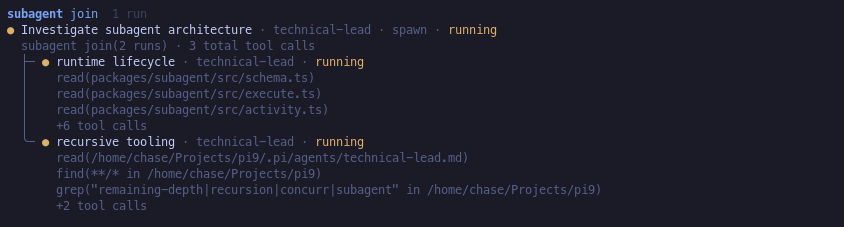
Only descendants named in an explicit nested join block that caller. Unjoined descendants continue independently and detach when their parent finishes. Nested answers are returned directly to the child that joined them, but their output is omitted from ancestor tree rendering; ancestor views retain lifecycle and identity context without copying target answers. Nested join-attempt history is runtime-local and is not restored after restart or extension reload.
After remove, compact terminal run results remain joinable by runId, including the aborted result of work that was active when removed, even though the conversation and resumable session state are gone. Use remove with conversation identifiers when the whole conversation is no longer needed.
Capacity and concurrency
Concurrency is shared across the entire recursive delegation tree. maxConversations defaults to 100. Once that many conversations are present, new spawns are rejected until one or more conversations are removed; existing conversations can still be inspected, joined, or cleaned up.
Settings are stored at ${PI_AGENT_DIR ?? ~/.pi/agent}/subagent/settings.json. The widget defaults to summary mode, a one-line count of running, queued, and all retained conversations; progress mode instead shows active queued/running rows and respects the Progress rows limit in /subagents settings. Retained conversations remain counted after they settle until explicit remove. Existing widgetLayout: "columns" or "stacked" settings migrate to progress mode, while "auto" (or no legacy value) becomes summary; saved settings use widgetMode.
Notifications, UI, and lifecycle
Completion notifications concern settled runs that have not yet been acknowledged. Listing inventory does not acknowledge them. Joining a run acknowledges that exact run; cleanup also clears notifications associated with the removed conversations.
/subagents opens the conversation, agent, and settings UI. It provides live status and progress, access to completed output, follow-up prompts when canResume is true, and explicit conversation cleanup.
The package emits lifecycle updates for queued, started, and completed work. Nested join changes emit subagent:updated with kind: "nestedJoin" and the owner conversation snapshot; they do not create additional queued, started, or completed milestones. Identifiers, run records, child conversation context, and nested join-attempt history are runtime-local only. They are not restored after a process restart or extension reload.
run remains asynchronous regardless of recursive delegation. These join semantics do not change the scope or behavior of /subagents or its widget.
Major-version migration
There is no compatibility layer for the previous lifecycle API.
| Previous term or behavior | New contract |
|---|---|
foreground / background dispatch |
run always starts asynchronously; use join when blocking retrieval is needed. |
results action |
join waits for and retrieves an exact run. |
sessionId |
Use conversationId for conversation lifecycle and runId for exact-run retrieval. |
retainConversation |
Every conversation remains in the runtime until explicit remove. |
widgetLayout |
Use widgetMode: legacy columns/stacked becomes progress; auto becomes the default summary. |
Architecture
src/agents.tsowns agent definitions, discovery, parsing, and requested configuration.src/conversation.tsandsrc/activity.tsown persistent conversations, exact runs, lifecycle state, and live SDK activity.src/runtime.tsowns the conversation catalog, joining, scheduling, queue limits, and retained run results;src/execute.tsowns child SDK session execution.src/schema.tsandsrc/tool.tsown provider-facing validation and tool actions.src/notifications.ts,src/widget.ts, andsrc/command/own the three user-facing presentation surfaces.src/settings.ts,src/identifiers.ts, andsrc/index.tsown configuration, runtime-local identifiers, and Pi extension composition respectively.