@progmruansilva/omp-web
Web UI for Oh My Pi Coding Agent
Package details
Install @progmruansilva/omp-web from npm and Pi will load the resources declared by the package manifest.
$ pi install npm:@progmruansilva/omp-web- Package
@progmruansilva/omp-web- Version
1.202608.0- Published
- Aug 3, 2026
- Downloads
- 178/mo · 15/wk
- Author
- progmruansilva
- License
- MIT
- Types
- extension
- Size
- 3.7 MB
- Dependencies
- 28 dependencies · 3 peers
Pi manifest JSON
{
  "extensions": [
    "./extensions"
  ],
  "image": "https://raw.githubusercontent.com/ProgmRuanSilva/omp-web/main/docs/assets/omp-web-banner.png"
}
Security note
Pi packages can execute code and influence agent behavior. Review the source before installing third-party packages.
README
OMP WEB




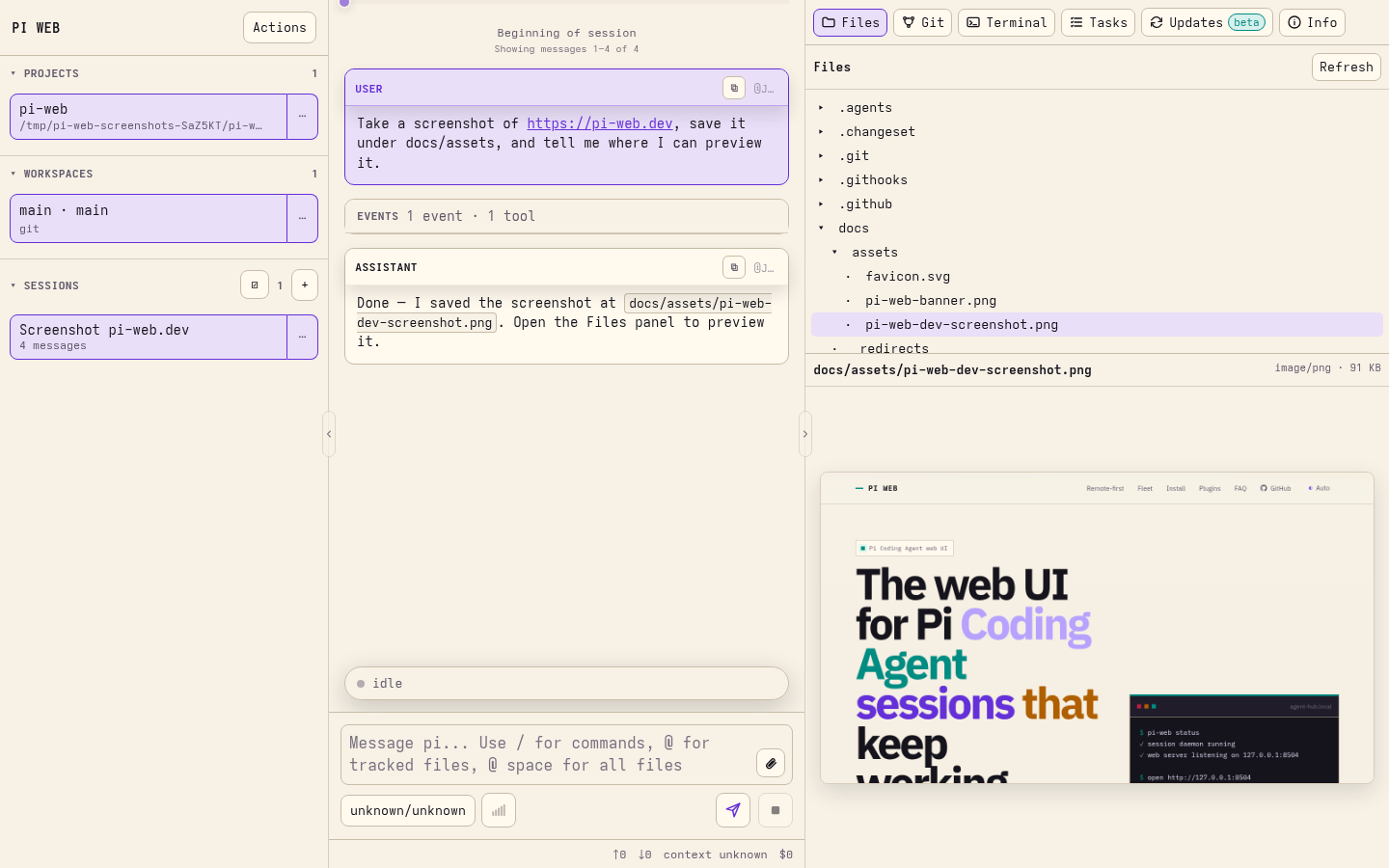
OMP WEB is a web UI for Pi Coding Agent that keeps agent sessions running in real workspaces on your machine or server.
Run agents where your code, tools, credentials, and build caches live. Supervise them from any browser.
Website and docs: https://omp-web.dev/
Why OMP WEB?
Agentic development works better when the work environment is persistent.
OMP WEB lets you:
- keep Oh My Pi Coding Agent sessions alive after browser disconnects;
- run agents inside real repositories and git worktrees;
- supervise multiple sessions in parallel;
- switch between laptop, phone, tablet, and desktop;
- use a server, workstation, or remote dev box as your agent runtime;
- manage projects, workspaces, files, terminals, sessions, and remote machines from one web UI.
Your browser is the control surface. The work stays where it can keep running.
Quick start
Requirements:
- Bun 1.1 or newer
- Oh My Pi Coding Agent configured for your user
- git and the development tools your agents need
Install and start OMP WEB as per-user services:
bun install -g @progmruansilva/omp-web
omp-web install
omp-web doctor
Then open:
http://127.0.0.1:8504
Useful commands:
omp-web status
omp-web logs
omp-web restart
omp-web doctor
omp-web version
omp-web uninstall
For more install options, including one-line install, Pi package install, WSL/manual usage, and remote access, see the installation guide.
Core model
OMP WEB organizes work like this:
Machine     a local or remote OMP WEB runtime endpoint
Project     a folder on that machine
Workspace   a git worktree, or the project folder for non-git projects
Session     a Pi Coding Agent chat running inside a workspace
A typical flow:
- Add a project.
- Choose a workspace or git worktree.
- Start a session.
- Let the agent work.
- Come back later from any browser.
Remote-first development
OMP WEB is designed for remote AI-driven development.
Instead of tying agent work to your laptop session, run OMP WEB on a machine that stays available: a server, desktop, cloud VM, home lab machine, or remote dev box.
Use a private network, SSH tunnel, trusted reverse proxy, or federated OMP WEB machine setup when accessing it remotely.
Read more: Remote-first development
Machines and fleets
OMP WEB can register other OMP WEB runtimes as remote machines. One browser-facing OMP WEB instance can proxy projects, files, git state, sessions, terminals, activity, Pi package management, and selected-machine settings from trusted remote machines.
When a remote machine is selected, Settings tabs label their target. Pi packages, OMP WEB plugin enablement, session daemon toggles, external file access, and upload defaults target the selected machine. Gateway/server settings such as host, port, allowed hosts, registered machines/tokens, and keyboard shortcuts stay local to the gateway/browser.
Read more: Fleet and machines guide
Plugins
OMP WEB supports trusted browser-side OMP WEB plugins that can add actions, workspace panels, and workspace metadata.
Pi packages are managed separately through Pi's package manager or Settings → Pi packages. In a federated setup, the Pi packages panel targets the selected machine and labels where installs, updates, or removals will run. Use Settings → OMP WEB plugins to enable or disable discovered browser plugins on the selected machine.
After installing, updating, or removing a Pi package, type /reload in each idle OMP WEB session on that machine to refresh Pi runtime resources such as extensions, skills, prompt templates, themes, and context/system prompt files. Reload the browser page separately for newly discovered or changed OMP WEB plugins.
Read more: Plugin API
Configuration
Global config lives at:
$OMP_WEB_CONFIG
~/.config/omp-web/config.json
Project-local OMP WEB config lives at:
<project>/.omp-web/config.json
Common configuration includes host/port, path access, uploads, OMP WEB plugin enablement, shortcuts, and session daemon options. In Settings, machine-affecting config targets the selected machine; gateway host/port/allowed-hosts, remote machine registration, tokens, and keyboard shortcuts stay local.
Read more: Configuration reference
Development
Clone the repository and run:
bun install
bun run dev
Open the Vite URL, usually:
http://localhost:8505
For the split development setup:
bun run dev:sessiond
bun run dev:web
bun run dev:client
Validate changes with:
bun run verify
Security model
OMP WEB assumes trusted users, trusted repositories, and trusted server paths.
It is not a sandbox, permission system, or multi-tenant platform. Do not expose it directly to the public internet without a trusted network, firewall, VPN, SSH tunnel, or authenticated reverse proxy.
Documentation
License
MIT © 2026 Federico Jaramillo Martinez. See LICENSE.