@quandev104/pi-style
A native-layout, cohesive visual style package for Pi.
Package details
Install @quandev104/pi-style from npm and Pi will load the resources declared by the package manifest.
$ pi install npm:@quandev104/pi-style- Package
@quandev104/pi-style- Version
0.2.4- Published
- Aug 23, 2026
- Downloads
- 1,980/mo · 470/wk
- Author
- quandev104
- License
- MIT
- Types
- extension, theme
- Size
- 2.4 MB
- Dependencies
- 0 dependencies · 5 peers
Pi manifest JSON
{
  "extensions": [
    "./extension-src/pi-style/pi/index.ts"
  ],
  "themes": [
    "./themes"
  ]
}
Security note
Pi packages can execute code and influence agent behavior. Review the source before installing third-party packages.
README
@quandev104/pi-style


Pi extension for a cohesive, native-layout visual system across the startup view, status line, editor, messages, and tool presentation. Pi keeps ownership of the feed, scrolling, selection, and terminal layout; pi-style installs components into supported surfaces.
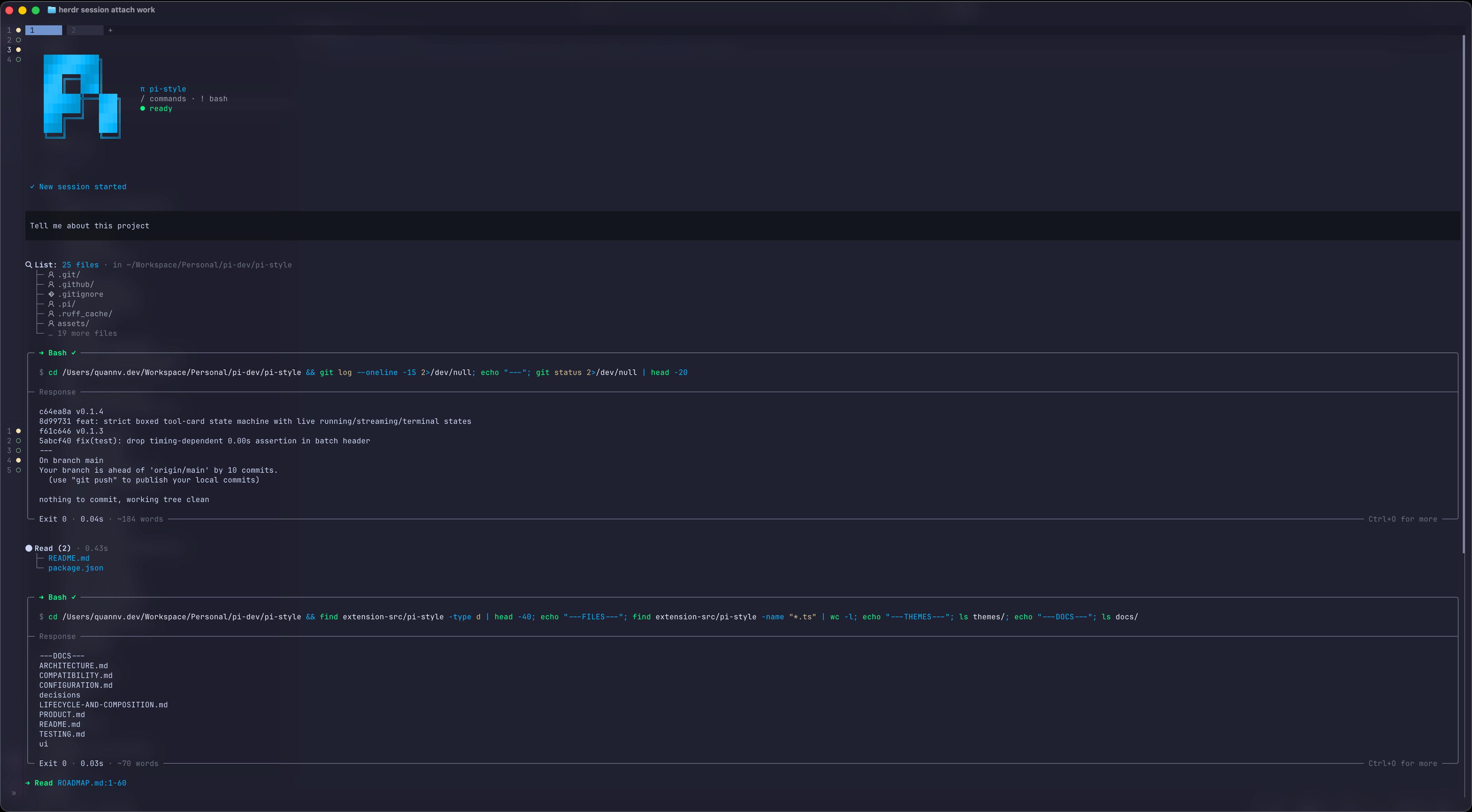
Features
- Status line — responsive segment layout (model, thinking, path, Git, context, usage, cost, time, extension statuses) through native widgets above or below the editor.
- Editor — compact/boxed/dock
CustomEditortreatments with prompt glyph, metadata rows, and thinking-level border, preserving Pi keybindings and autocomplete. - Startup — compact gradient logo header and optional overlay with System & Context / Available Tools panels, rendered from snapshot data collected before mount.
- Messages — assistant prefix and boxed compaction/skill/branch/MCP special blocks, and certified tool call/result selectors with pending/running/error markers.
- Interim narration hiding — the text of assistant messages that also carry tool calls is hidden (
messages.hideInterimText): the feed shows only the tool blocks, the run summary, and the final answer. - Turn summaries — when a turn completes, its finalized tool blocks collapse into one summary line (
➔ Read 2 files, ran 4 shell commands · 3.1s); errors and interrupted turns stay visible, and Pi's global Ctrl+O toggle expands everything again (tools.collapseAfterTurn). - User-prompt image previews — images attached to your prompt render inline below your message as display-only session entries (never sent to the LLM) with
#N · WxHlabels tying each image to its marker; multiple images lay out side-by-side on kitty-capable terminals (up to 3 columns, stacked fallback elsewhere), sized bymessages.previewMaxWidth(default 30) with Pi's global Ctrl+O expanding to 60 (messages.showImagePreviews). - Clipboard image input — the built-in
Ctrl+Vbecomes a full image-paste flow with no other extension required: a sync native probe checks the clipboard at keystroke time, an[Image #N]marker appears instantly in the editor (bytes attach asynchronously — no temp-file flash), backspacing right after a marker deletes it as one unit (discarding the image, image-paste semantics), and submit attaches real image attachments; raw pasted paths that bypass the editor still upgrade to[image]+ attachment (messages.clipboardImages). - Auto theme — the
titaniumpalette is applied at TUI session start when no other theme is active (configurable viatheme.autoApply, disable with"off"). - One visual system — shared semantic theme, glyph sets (Nerd/Unicode/ASCII), and ANSI-safe rendering across every surface.
All certified surfaces are on by default. The single OFF switch is:
{ "compatibility": { "allowCorePatches": false } }
Install
pi install npm:@quandev104/pi-style
Run a real TUI session with the extension source (development):
pi -e ./extension-src/pi-style/pi/index.ts
Quick start
No configuration is required. The default preset enables:
- primary status row below the editor (
placement: "below"), secondary row when it has content; dockeditor (rounded input box) with metadata ownership resolved so the status line and editor do not duplicate text;compactstartup header (gradient logo block only; resource chips are opt-in);- the
titaniumtheme auto-applied at session start (theme.autoApply, default"titanium"; set"off"to keep your active Pi theme); - certified message prefixes and boxed tool presentation when the runtime surface identity matches a recorded fingerprint;
- the complete image-paste flow out of the box:
Ctrl+V→ instant[Image #N]marker → submit → attachment + inline side-by-side preview below your message.
Override any documented leaf through global/project piStyle settings, environment, or session commands. Precedence:
defaults < global < project < env < session override
Example settings file (.pi/pi-style or global config):
{
  "piStyle": {
    "preset": "full",
    "placement": "above",
    "editor": { "style": "boxed", "frame": "line" },
    "startup": { "mode": "overlay", "showResources": true },
    "theme": { "autoApply": "titanium-light" }
  }
}
Invalid values never break startup: they fall back safely and appear in /pi-style doctor diagnostics.
Presets
| Preset | Behavior |
|---|---|
default |
Balanced status line, rounded-box editor, compact startup, restrained message/tool styling. |
minimal |
Path/Git/context essentials, native-like editor, no startup overlay, low decoration. |
compact |
High information density for medium terminals. |
full |
Broad status data and all compatible visual surfaces. |
ascii |
No Nerd Font assumptions and conservative separators. |
native |
Active Pi theme kept as-is (theme.autoApply: "off") plus only low-risk status enhancements. |
Configuration
The full schema, precedence, persistence, and migration policy live in docs/CONFIGURATION.md. Summary:
Environment variables
| Variable | Description |
|---|---|
PI_STYLE_DISABLED=1 |
Disable all surfaces for emergency recovery. |
PI_STYLE_NERD_FONTS=1|0 |
Force glyph mode. |
PI_STYLE_EDITOR=native|compact|boxed|dock |
Temporary editor override. |
PI_STYLE_STATUS=above|below|off |
Temporary status placement/state. |
PI_STYLE_OSC11=1|0 |
Force terminal background sync policy. |
PI_STYLE_THEME=<name|off> |
Override the auto-applied theme (off keeps the active Pi theme). |
PI_STYLE_DEBUG=1 |
Enable bounded diagnostics. |
CLI flags
Tier C surfaces are immutable session authorizations, not persisted config:
--pi-style-core-patches
--pi-style-message-assistant
--pi-style-message-special-blocks
--pi-style-tools
--pi-style-readonly-tools
--pi-style-ascii
Commands
| Command | Description |
|---|---|
/pi-style |
Show active preset, surfaces, placement, glyph mode, and compatibility summary. |
/pi-style on|off |
Toggle the package for the current session or selected persistence scope. |
/pi-style preset <name> |
Apply a named preset. |
/pi-style placement above|below |
Move the primary status row. |
/pi-style editor <style> [frame] |
Select compact, boxed, dock, or native editor. |
/pi-style startup <off|compact|overlay> |
Select startup mode. |
/pi-style surface <name> on|off |
Toggle startup/status/editor/messages/tools. |
/pi-style set <path> <JSON> |
Set one documented leaf after validation, e.g. set statusLine.layout.left ["model","git"]. |
/pi-style persist global|project set <path> <JSON> |
Persist the same validated mutation to the selected durable scope. |
/pi-style reload |
Re-read configuration and reinstall affected surfaces. |
/pi-style doctor |
Show capability/conflict/fallback diagnostics. |
Ordinary mutations are session-only; persistence requires an explicit global or project scope, and project writes require trust.
Compatibility
- Public Pi APIs (widgets, editor, header, footer bridge) are preferred and enabled by default.
- Tier C core patches (message prefixes, special blocks, tool selectors) are identity-certified per surface against recorded fingerprints (Pi
0.83.0/0.84.0observed), isolated, reversible, and flag/config gated; any surface whose runtime identity is not recorded falls back natively on its own. - No render-time I/O: filesystem, Git, settings, and session data flow through cached providers into immutable snapshots.
- Terminal-global background synchronization is unsupported/off for technical v1; explicit cell backgrounds and Pi theme APIs remain supported.
- Terminal multiplexers gate kitty graphics: in herdr, previews (and Pi's own tool-result images) require
experimental.kitty_graphics = truein~/.config/herdr/config.tomlplus a server restart; tmux disables images upstream.
Architecture
shared → domain → features → app → pi
extension-src/pi-style/
├── shared/     ANSI/width, box, elapsed, split-diff, render-budget, theme extras
├── domain/     config, theme, status presets/renderer, authorization
├── features/   status-line, editor, startup, messages, tools
├── app/        runtime, snapshot, scheduler, providers, commands, doctor
└── pi/         Pi event handlers, session coordinator, compatibility probe
Layer boundaries are enforced by dependency-cruiser.
Documentation
Start with docs/README.md, then the product, architecture, and testing contracts. UI surface contracts live under docs/ui/, and accepted decisions under docs/decisions/. The phase-by-phase plan is in ROADMAP.md.
Development
npm ci
npm run typecheck
npm run lint
npm run depcruise
npm test
npm run build
npm run check
npm run check runs all required automated gates in order.
Current test suite: 817 tests across 41 files.