@r3b1s/pi-repair-layer
Tool-input repair layer for the pi coding agent: validate-then-repair for built-in tool calls, ported from the behavior of commandcode's repair layer
Package details
Install @r3b1s/pi-repair-layer from npm and Pi will load the resources declared by the package manifest.
$ pi install npm:@r3b1s/pi-repair-layer- Package
@r3b1s/pi-repair-layer- Version
0.4.3- Published
- Jul 21, 2026
- Downloads
- 883/mo · 883/wk
- Author
- r3b1s
- License
- MIT
- Types
- extension
- Size
- 346.8 KB
- Dependencies
- 1 dependency · 2 peers
Pi manifest JSON
{
  "extensions": [
    "./dist/index.js"
  ]
}
Security note
Pi packages can execute code and influence agent behavior. Review the source before installing third-party packages.
README
pi-repair-layer
pi-repair-layer repairs the small, predictable tool-call mistakes that can derail an otherwise productive pi turn. Install it for pi's built-in tools, or follow the tool-owner integration guide to bring the same repair pipeline to tools in your own extension.
No LLM calls. No network requests. No uploaded telemetry.
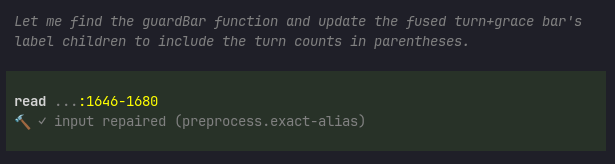
Example: Deepseek v4 Pro
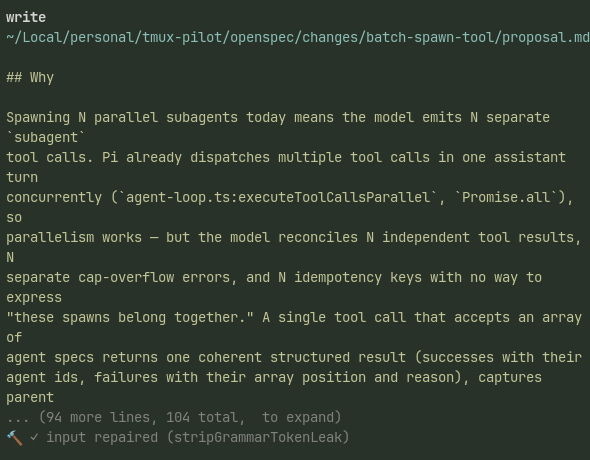
Example: GLM 5.2
Contents
- Why use it?
- Install
- Terms in plain English
- What it repairs
- Safe by design
- Use it in your own extension
- Settings and local telemetry
- Documentation
- Prior art
- Limitations
- Development
Why use it?
Models often understand the task but miss a detail of the tool contract:
| Model sends | Tool expects |
|---|---|
{file_path: "/x"} |
{path: "/x"} |
{include: "src"} |
{include: ["src"]} |
{offset: null} |
omit optional offset |
'{"command":"ls"}' |
{command: "ls"} |
flat old_string / new_string fields |
an edits array |
Without a pre-validation repair seam, pi may reject the call or convert a bad
value into valid-looking garbage. pi-repair-layer fixes only configured or
schema-proven cases, validates the result, executes it, and returns a
<repair_note> so the model learns the correct shape for its next call.
It covers pi's read, bash, edit, write, grep, find, and ls tools.
Already-valid input takes the fast path and is returned untouched.
Install
pi install npm:@r3b1s/pi-repair-layer
Or install directly from GitHub:
pi install git:github.com/r3b1s/pi-repair-layer
pi will show a one-time warning that built-in tools were overridden. The extension reuses pi's real schemas, executors, renderers, and runtime modules; it adds the pre-validation repair step.
Terms in plain English
- Tool call — the model asking the agent to run a tool with structured arguments.
- Schema / validation — the rules for those arguments and the check that they fit.
- Silent coercion — a bad value being converted into a valid-looking but unintended value.
- Grammar leak — the model printing a tool call as text instead of making the call.
- Anchor bleed — stray
^or$grammar characters attached to a non-regex value. - Phantom tool call — a tool-use signal that contains no actual call to run.
- Repair note — a short explanation returned to the model after a repair.
- Fast path — returning valid input without changing or cloning it.
- Path selector — an address such as
/pathor/edits/*/oldTextfor one configured location. - Preprocessor — an explicit cleanup that runs at a path selector before validation.
- Invariant — a safety rule that must remain true for every input.
- Fail closed — rejecting input when the pipeline cannot prove a safe, valid repair.
What it repairs
The default adaptive policy handles:
- exact field aliases such as
file_path→path,cmd→command, andold_string→oldText; - JSON-stringified objects and arrays, singleton object envelopes, and bare strings where a configured object or array is expected;
- invalid optional
nullvalues and empty object placeholders; - markdown auto-links in configured filesystem paths;
- the legacy flat edit shape used by several coding agents; and
- model-gated anchor bleed and leaked argument tokens at configured locations.
Unknown keys are not fuzzily renamed or generically deleted. See How repair works for the ordered pipeline, complete repair catalog, grammar handling, and the reasoning behind the hook placement.
Safe by design
The pipeline recovers the outer argument envelope, chains the tool owner's compatibility hook, applies explicitly scoped preprocessing, validates strictly, repairs only reported schema issues, and validates again before returning a repaired result.
- Valid input stays untouched unless an explicitly configured valid-value transform applies.
- Every mutation carries a stable rule ID and model-facing note.
- Repair work is bounded, deterministic, and covered by property and seeded-fuzz tests.
- Unrepairable input produces a model-readable retry error rather than
{}or guessed values. - Telemetry stays local and excludes arguments, paths, commands, content, and note text.
- Turning assistant text into an executable tool call always requires explicit
recovermode.
| Profile | Tool arguments | Grammar text | Promotion |
|---|---|---|---|
conservative |
exact, schema-guided repair | observe only | never |
adaptive (default) |
adds validated/model-gated recovery | strip known tools | never |
recover |
same as adaptive | strip known tools | safety-gated |
Unknown or unavailable tool grammar is preserved by default in every profile. The behavior and safety reference explains the gates and invariants in detail.
Use it in your own extension
Tools registered by other extensions are not intercepted automatically: their
owner must opt in at the prepareArguments boundary.
Working with a coding agent? The integration is packaged as the
pi-tool-repair-integration agent
skill: npx skills add r3b1s/pi-dev-skills --skill pi-tool-repair-integration.
import { adaptToolDefinition } from "@r3b1s/pi-repair-layer/pi";

pi.registerTool(
  adaptToolDefinition(definition, {
    policy: "adaptive",
    preprocessors: [
      { kind: "alias", selector: "/path", aliases: ["file_path"] },
    ],
  }),
);
The adapter chains an existing owner hook and fails closed by default. The
full integration guide covers selectors,
custom transforms, the side-effect-free /core API, call-ID correlation,
<repair_note> attachment, privacy, and integration tests.
Public subpaths are compiled ESM with declarations and source maps:
@r3b1s/pi-repair-layer/pi— tool-owner adapter;@r3b1s/pi-repair-layer/core— pure pipeline, policy, lifecycle, and formatting APIs; and@r3b1s/pi-repair-layer/grammar— pure grammar parsing and recovery helpers.
Node 22+ is supported; pi 0.80.6 is the verified baseline. Documented exports
follow semantic versioning, and the existing repairToolInput API remains
supported for the current major.
Settings and local telemetry
All telemetry stays on your machine and is used only for debugging and tracing tool-call repairs; nothing is sent or uploaded.
/repair-settingschanges the policy, grammar mode, unknown-tool text policy, TUI indicator, and visible repair notes./repair-statssummarizes local repair outcomes by model, tool, and rule.PI_TOOL_REPAIR_LOG=1prints decisions to stderr.PI_TOOL_REPAIR_TELEMETRY=offdisables local telemetry.PI_TOOL_REPAIR_PASSTHROUGH=1restores pi's native behavior for unrepairable input.
Settings persist under ~/.pi/agent/tool-repair/. See the
operations guide for paths, record contents, privacy,
diagnostics, and verification commands.
Documentation
- Integrating extension-owned tools
- How repair works: behavior, safety, and limitations
- Operations, settings, telemetry, and verification
- Source-backed pi integration research
Prior art
The value-strip rules and grammar-recovery approach originate in Tom X Nguyen's
MIT-licensed monotykamary/pi-tool-repair.
This project adapted its anchor/token cleanup and grammar parsers, then scoped
the transforms, added reporting, and gated executable promotion.
The key integration difference is mechanical: pi runs
prepareArguments → validation → tool_call → execute. A malformed call fails
before tool_call, so this extension hooks the owning tool's
prepareArguments; the sequence and propagation behavior are verified in
research Claims 1–4.
See How repair works for the
full adaptation notes and comparison.
Limitations
- Another extension's tools require owner opt-in through
/pior/core. - Two extensions overriding the same built-in do not compose; load order wins.
- Similar but unconfigured aliases are not guessed.
- Phantom tool calls are not synthesized into calls.
- Grammar promotion is limited to recognized, non-empty calls for active or explicitly allowed tools and never runs on truncated output.
Development
pnpm install
mise run ci              # typecheck + lint + tests
pnpm run test:package    # packed clean-consumer smoke test
pnpm run test:fuzz       # deterministic bounded fuzz campaign
test/run-chaos.sh        # scripted real pi-loop exercise
Larger fuzz runs and replay instructions are in the operations guide.