@rkbkosp/pi-provider-clone
Clone Pi model providers under separate provider IDs and credential scopes
Package details
Install @rkbkosp/pi-provider-clone from npm and Pi will load the resources declared by the package manifest.
$ pi install npm:@rkbkosp/pi-provider-clone- Package
@rkbkosp/pi-provider-clone- Version
0.2.1- Published
- Aug 9, 2026
- Downloads
- 106/mo · 21/wk
- Author
- rkbkosp
- License
- MIT
- Types
- extension
- Size
- 69.1 KB
- Dependencies
- 0 dependencies · 2 peers
Pi manifest JSON
{
  "extensions": [
    "./index.ts"
  ],
  "image": "https://raw.githubusercontent.com/rkbkosp/pi-provider-clone/main/docs/preview.png"
}Security note
Pi packages can execute code and influence agent behavior. Review the source before installing third-party packages.
README
Pi Provider Clone


A Pi extension that clones an existing model provider under a new provider ID and credential scope.
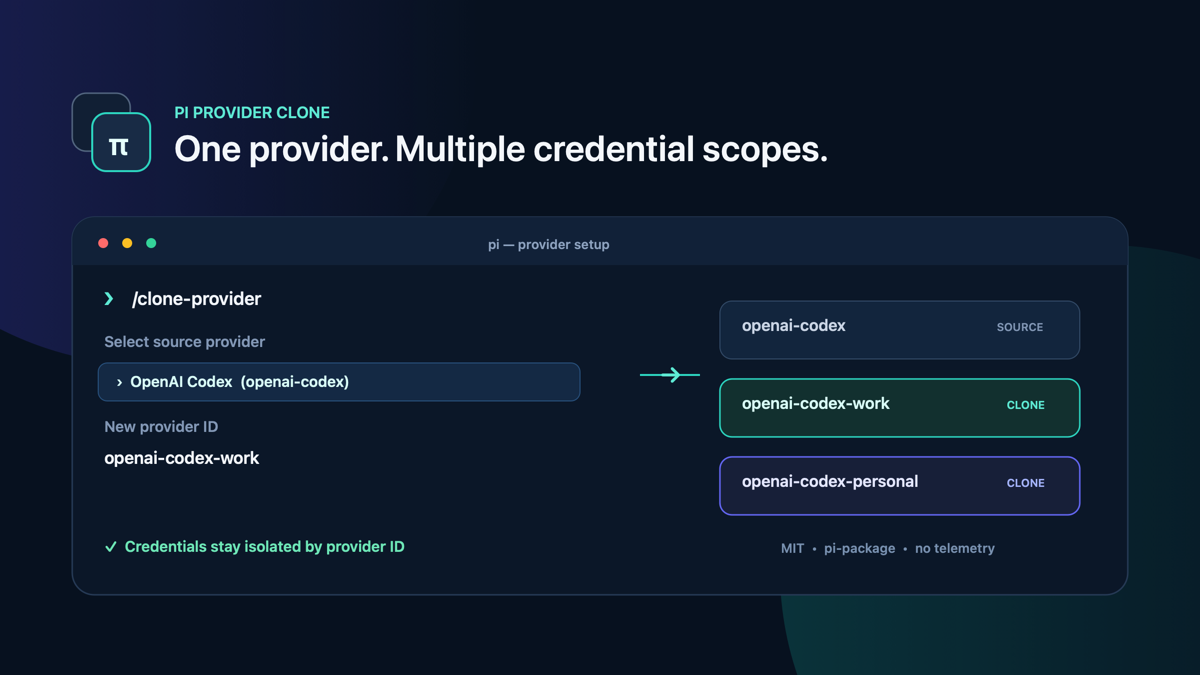
openai-codex/gpt-5.5
openai-codex-personal/gpt-5.5
openai-codex-work/gpt-5.5
Each clone reuses the source provider's authentication flow, API implementation, endpoints, headers, and model definitions. Model IDs, names, capabilities, limits, and pricing stay unchanged; only model.provider is rewritten so Pi can store and select credentials independently.
Why
Pi keys credentials by providerId. One provider therefore maps to one stored OAuth session or API key. This extension lets you keep multiple accounts side by side without forking model definitions or implementing custom authentication.
| Goal | How this extension helps |
|---|---|
| Personal and work OAuth accounts | Clone once per account, then run /login for each clone |
| Multiple API keys for one vendor | Store each key under a separate provider ID |
| Native model selection | /model shows the same model under every provider ID |
Requirements
- Pi
0.82.1or a compatible newer release - Node.js
22.19.0or newer, matching Pi's runtime requirement
Install
npm
pi install npm:@rkbkosp/pi-provider-clone
Try it without a persistent install:
pi -e npm:@rkbkosp/pi-provider-clone
GitHub
pi install git:github.com/rkbkosp/pi-provider-clone
Pin a release when reproducibility matters:
pi install git:github.com/rkbkosp/pi-provider-clone@v0.1.0
Local checkout
git clone https://github.com/rkbkosp/pi-provider-clone.git
cd pi-provider-clone
npm ci
pi -e .
For a persistent local install, run pi install . from the repository root.
Usage
Start Pi with the extension loaded.
Run
/clone-provider.Select a source provider.
Enter a target provider ID such as
openai-codex-personal.Authenticate the clone:
/login openai-codex-personalOpen
/modeland search by provider ID orprovider/modelId.
Target provider IDs must match:
^[a-z0-9][a-z0-9._-]*$
The target must differ from the source, must not already be registered, and must not be another clone target. Cloning a clone is not supported in v1.
Delete a clone
Run:
/delete-cloned-provider
Select a saved clone and confirm the deletion. The command immediately unregisters a clone owned by this extension and removes its definition from provider-clones.json. If the target ID is currently occupied by another provider, only the saved clone definition is deleted; the conflicting provider is left untouched.
Pi credentials are stored separately and are not deleted by this command. Run /logout and select the clone ID if you also want to remove its saved OAuth session or API key. If the deleted clone was active, use /model to select another model before sending the next prompt.
Storage and privacy
Clone definitions are stored at:
${PI_CODING_AGENT_DIR:-~/.pi/agent}/provider-clones.json
The extension writes only sourceId, targetId, and createdAt. It creates the file with mode 0600 where the platform supports POSIX permissions and does not read or modify project files. Cross-process updates use a short-lived lock plus atomic replacement so concurrent Pi sessions do not overwrite each other's clone definitions.
During its async factory, the extension creates an isolated, offline Pi model runtime with in-memory credential and model stores. This lets it resolve built-in and models.json source providers before initial model selection. The runtime may read Pi's model configuration, but it does not read auth.json or the cached model catalog and does not perform a model-catalog network refresh.
The extension does not:
- read, copy, log, or persist tokens and API keys;
- read or modify Pi's
auth.json; - modify Pi's
models.jsonor cached model catalog; - add telemetry or analytics;
- contact any new network endpoint; or
- execute shell commands.
Credentials remain in Pi's normal credential store under each clone's provider ID. Model requests are delegated to the selected source provider implementation and therefore use that provider's configured endpoint and privacy terms. A source provider's environment-variable credential fallback is also inherited; run /login <clone-id> to store a distinct credential.
Behavior and limitations
- Saved clones are rebuilt and registered during the async extension factory, before Pi performs initial model selection. They therefore work as configured default models and appear in
pi --list-models. - Clones use a static model snapshot rebuilt on Pi startup or
/reload. - Source authentication behavior is reused, including environment-variable fallbacks.
- Streaming and tool-call context are bridged so Responses-style item IDs stay paired with the source implementation.
- Clones cannot be cloned again.
- Source providers must be discoverable from Pi's built-ins or
models.jsonduring factory initialization. Providers contributed only by another extension are not offered as clone sources, and interactive creation uses the same factory source that will be used after restart. - Pi does not expose other extensions' pending factory registrations. If another extension later registers the same target provider ID, normal Pi extension load-order precedence applies; use unique clone IDs to avoid collisions.
- Clones can be deleted with
/delete-cloned-provider; clone rename is not supported in v1. - There is no credential copying, account rotation, automatic failover, or telemetry.
- Changes to the source model catalog appear after restart or
/reload. - Removing the package does not delete
provider-clones.json; remove that file manually if you also want to erase saved clone definitions.
Update and uninstall
pi update npm:@rkbkosp/pi-provider-clone
pi remove npm:@rkbkosp/pi-provider-clone
Pinned npm versions, Git tags, and commits do not drift during normal package updates. Install a new explicit version or ref to move a pinned installation.
Development
npm ci
npm run lint
npm run typecheck
npm test
npm run check
npm pack --dry-run
Pi loads TypeScript extensions directly, so this package has no separate build artifact. The Pi packages imported at runtime are declared as "*" peer dependencies and are supplied by Pi; exact development versions are pinned only for repeatable tests.
See DEV.md for design constraints and CONTRIBUTING.md for contribution guidelines.
Support and security
- Bugs and feature requests: GitHub Issues
- Security vulnerabilities: follow SECURITY.md and use a private GitHub Security Advisory
- Release history: CHANGELOG.md
License
MIT © 2026 rkbkosp