@runkids/figlens
Give your coding agent the design details to build, compare and follow changes from a saved Figma .fig: layout, text, variables, assets, reference renders, screenshot comparison and revision diffs. Offline: no Dev Mode seat, login or API quota. Pi, OpenCo
Package details
Install @runkids/figlens from npm and Pi will load the resources declared by the package manifest.
$ pi install npm:@runkids/figlens- Package
@runkids/figlens- Version
0.13.0- Published
- Nov 4, 2026
- Downloads
- 5,185/mo · 2,673/wk
- Author
- runkids
- License
- MIT
- Types
- extension, skill
- Size
- 355 KB
- Dependencies
- 0 dependencies · 7 peers
Pi manifest JSON
{
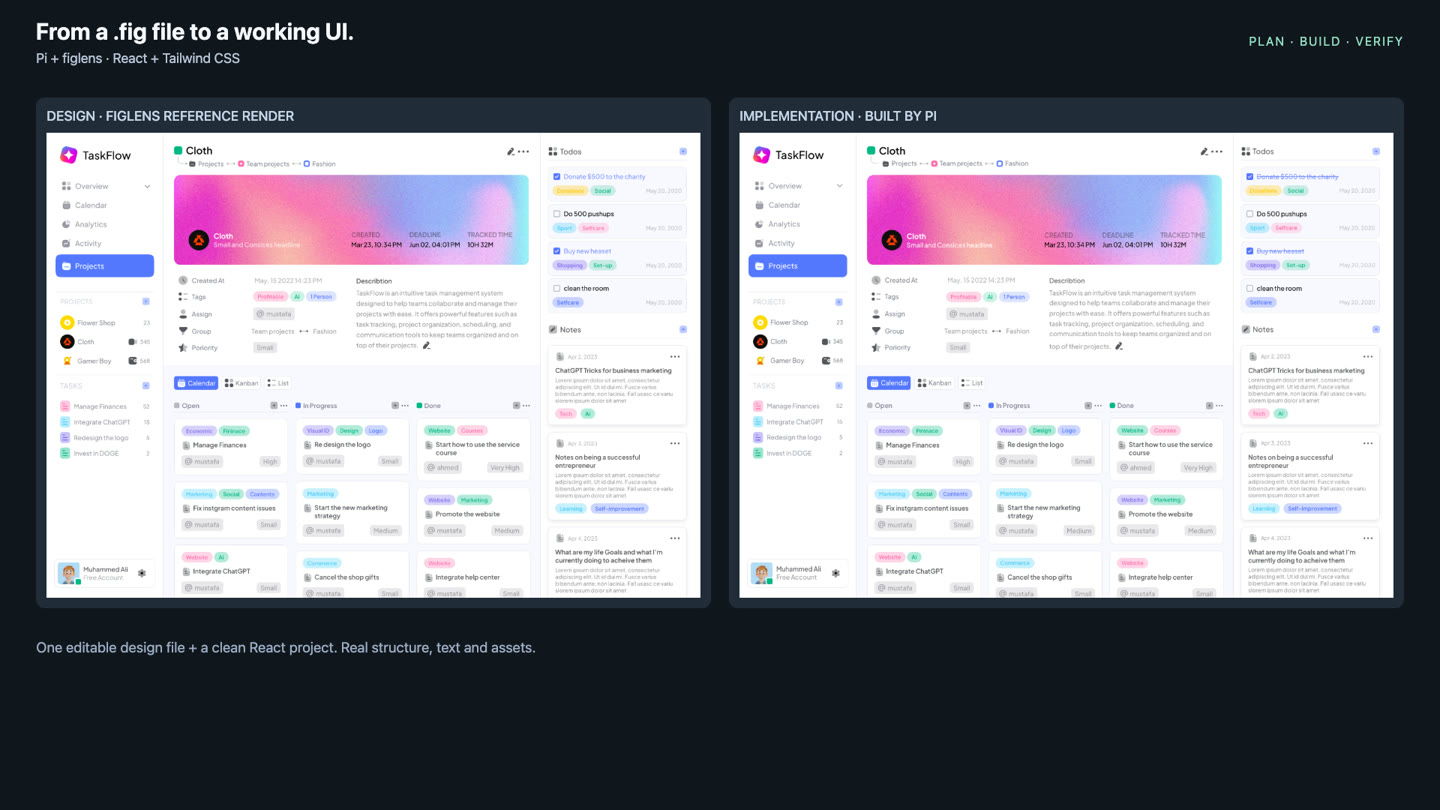
  "image": "https://raw.githubusercontent.com/runkids/figlens/v0.10.1/assets/taskflow-demo-poster.jpg",
  "video": "https://raw.githubusercontent.com/runkids/figlens/v0.10.1/assets/taskflow-demo.mp4",
  "skills": [
    "./skills"
  ],
  "extensions": [
    "./pi/index.ts"
  ]
}
Security note
Pi packages can execute code and influence agent behavior. Review the source before installing third-party packages.
README
Give your coding agent the design details to build, compare and follow changes
Website · Docs · Pi guide · GitHub
figlens turns saved Figma files into design context your coding agent can act on, not just a screenshot to interpret.
- Build from the source details. Read layout, text, styles and variables; export vector icons as SVG and images as assets. A frame bundle brings the structured design, assets and reference render together for a portable handoff.
- Compare the running UI.
compare-imagecompares your screenshot with figlens's render and names the layers under differing regions. Review those differences and rendering warnings; it is not a pixel-perfect guarantee. - Follow design changes.
diffcompares saved revisions;changesandwatchreport updates to tracked local scopes;freshnesstells when a saved copy is older than the online file, andpullsaves a new copy through your own browser sign-in. Save a new.figfrom Figma to pick up design edits; this is not live Figma sync.
Give your agent a saved .fig. figlens reads it on the machine where the agent runs, including a remote host or CI, with no Figma app, Figma sign-in or Figma API calls (only the opt-in freshness check, with your FIGMA_TOKEN, and pull, through your browser sign-in, reach Figma).
Start with Pi
Requires Pi 1.3.0+. The package includes the CLI, MCP connection, extension and agent skill:
pi install npm:@runkids/figlensRestart Pi or run /reload, then ask. Replace "task board" with a screen from your design:
Build the task board from ./design.fig in this project.
Find the matching frame, use this project's components and image workflow,
then compare the running UI with the design and fix confirmed differences.
Report missing assets and any checks you could not run.
Export design.fig with Figma's File > Save local copy and place it in the project on the agent's machine. Pi resolves frame IDs itself; no manual /figlens open or separate global CLI install is required. With no saved copy, copy the layers in Figma (right-click > Copy) and run npx @runkids/figlens clipboard copied.fig. The copy keeps node IDs and used components but carries no images or vector outlines, which figlens reports as missing.
| Your task | Pi command |
|---|---|
| Plan only the requested scope | /figlens plan <request> |
| Plan, implement, check and correct | /figlens yolo <request> |
| Browse a saved design | /figlens preview ./design.fig |
The packaged skill guides the agent to follow existing project conventions, check fonts and image delivery, compare the running UI with the design and fix confirmed differences. It reports remaining gaps and checks it could not run. YOLO asks the agent to remove only its run-created temporary plan and scratch exports, and stop the processes it started, after successful verification; existing plans, other .figlens files and failed or blocked work are preserved. These are agent instructions, not a guarantee of model behavior or visual fidelity.
Pi walkthrough · Pi package catalog
See Pi build the screen
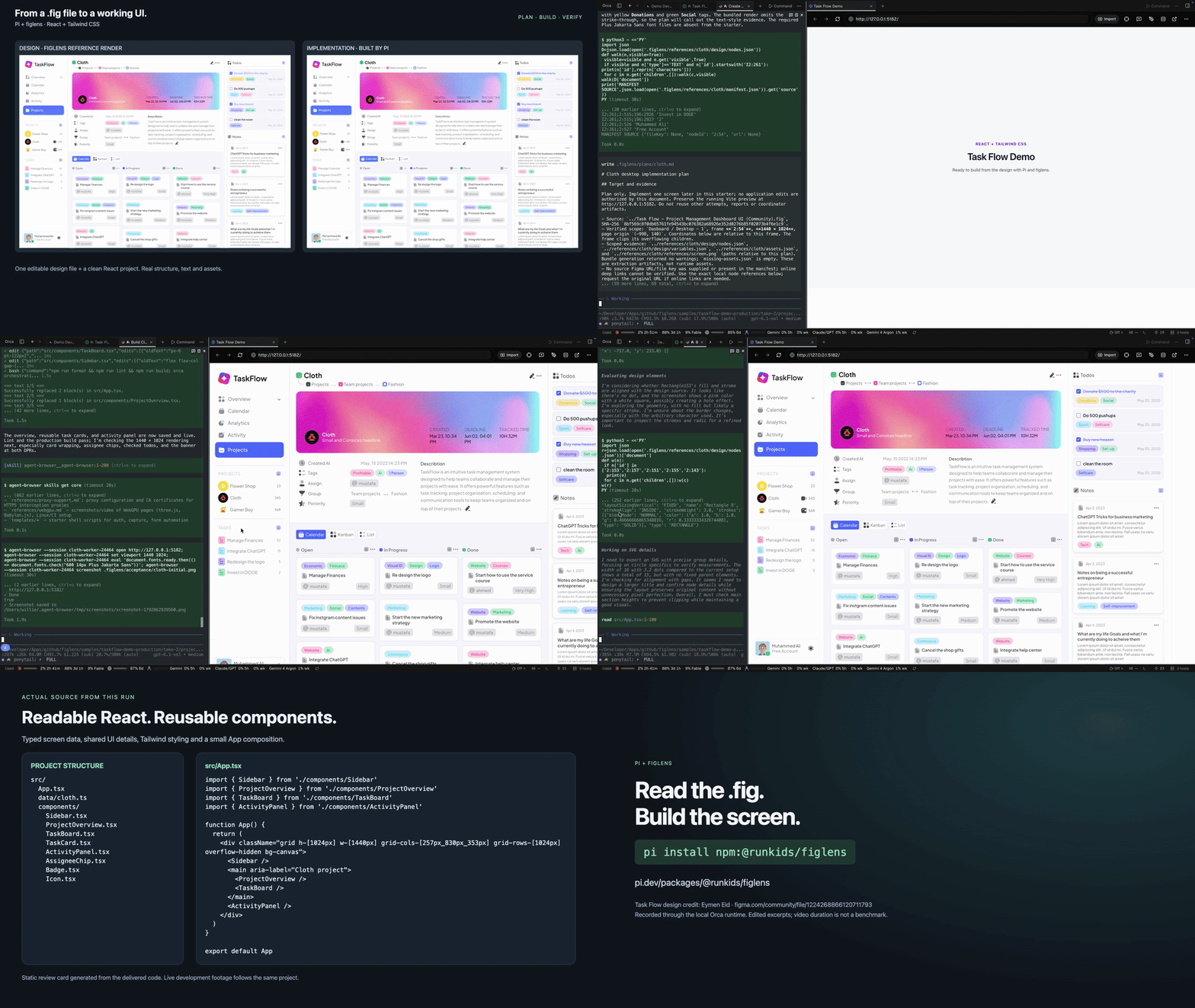
Looping GIF at 3× the edited video’s playback speed. Click it for the full 78-second video.
Watch the 78-second demo. Pi uses /figlens plan to read one Cloth dashboard frame from a local .fig, builds it with React and Tailwind CSS, then checks and corrects the running UI. The video shows Pi and the live browser together, followed by the actual component structure. Edited time-lapse; video length is not a performance benchmark or a promise of pixel-perfect output. Design credit, source and recording notes.
OpenCode V2 and OMP
The same package includes independent entries for OpenCode V2 2.2.0 and OMP 18.13.2. OpenCode V2: opencode plugin add @runkids/figlens. OMP: omp plugin install @runkids/figlens.
In Herdr, the figlens panel lists a design's screens beside your agents and hands one to the agent on the left after a confirm dialog; it shows which screen each agent reads and tracks every screen on a board. It needs no separate install of this package.
The integrations share the CLI launcher, skill and component mapping file. Restart the host, then run /figlens help.
Use with another agent
Connect the local MCP server to your client:
{ "mcpServers": { "figlens": { "command": "npx", "args": ["-y", "@runkids/figlens", "mcp"] } } }For Claude Code on macOS/Linux:
claude mcp add --transport stdio --scope local figlens -- npx -y @runkids/figlens mcpFor Codex CLI on macOS/Linux:
codex mcp add figlens -- npx -y @runkids/figlens mcpStart a new session and check /mcp. The MCP workflow tool includes on-demand guidance for design reading, project reuse, existing-UI audits, image preparation, scoped planning and explicitly requested autonomous implementation. It shares the portable skill's sources; no separate skill install is required for MCP use. The agent carries out the task with its own project/browser tools and host permissions; reading a guide does not execute the workflow.
Run the CLI
Node.js 18+; macOS, Linux and Windows:
npx @runkids/figlens preview design.fig
npx @runkids/figlens tree design.fig --depth 2
npx @runkids/figlens nodes design.fig 12:345 > frame.json
npx @runkids/figlens bundle design.fig 12:345 frame.zip
npx @runkids/figlens export design.fig 12:345 icon.svg
npx @runkids/figlens export design.fig 12:345 frame.png --scale 2
npx @runkids/figlens clipboard copied.fig               # the selection copied in Figma
npx @runkids/figlens workflow build   # agent guidance, same as the MCP workflow tool
npx @runkids/figlens workflow audit   # compare existing UI; fixes require a fix request
Replace 12:345 with a node ID from the tree. A bundle contains design JSON, variables, assets, reference render and context.md instructions. The viewer also exports a standalone offline HTML snapshot: preview design.fig 12:345 --out preview.html.
The first launch downloads the matching native release binary, verifies it against the release's SHA256SUMS and caches it. Initial setup needs npm and GitHub access; subsequent local parsing works offline. Your model provider and project dependencies may still require network access. You can also install once with npm install -g @runkids/figlens and run figlens.
What to check
.fig is a snapshot: design updates need a new export. Some assets and fonts may be unavailable, and the independent parser/renderer has known gaps, including Dev Mode measurements. Check the source, output and missing-asset report before claiming a visual match. Exporting or sharing a design requires its owner's permission; the tool's MIT license does not license the design or its assets.
Full documentation, limitations and standalone installs · Report a reproducible issue
MIT license.