@scottrbk/pi-agentshell-extension
Delegate Pi tasks to other coding agents through AgentShell
Package details
Install @scottrbk/pi-agentshell-extension from npm and Pi will load the resources declared by the package manifest.
$ pi install npm:@scottrbk/pi-agentshell-extension- Package
@scottrbk/pi-agentshell-extension- Version
1.2.0- Published
- Sep 22, 2026
- Downloads
- 329/mo · 37/wk
- Author
- scottrbk
- License
- MIT
- Types
- extension
- Size
- 2.3 MB
- Dependencies
- 0 dependencies · 4 peers
Pi manifest JSON
{
  "extensions": [
    "./extensions/agentshell.ts"
  ]
}
Security note
Pi packages can execute code and influence agent behavior. Review the source before installing third-party packages.
README
Pi AgentShell Extension
A Pi extension for delegating tasks to other coding harnesses, including Pi, through AgentShell.

Architecture
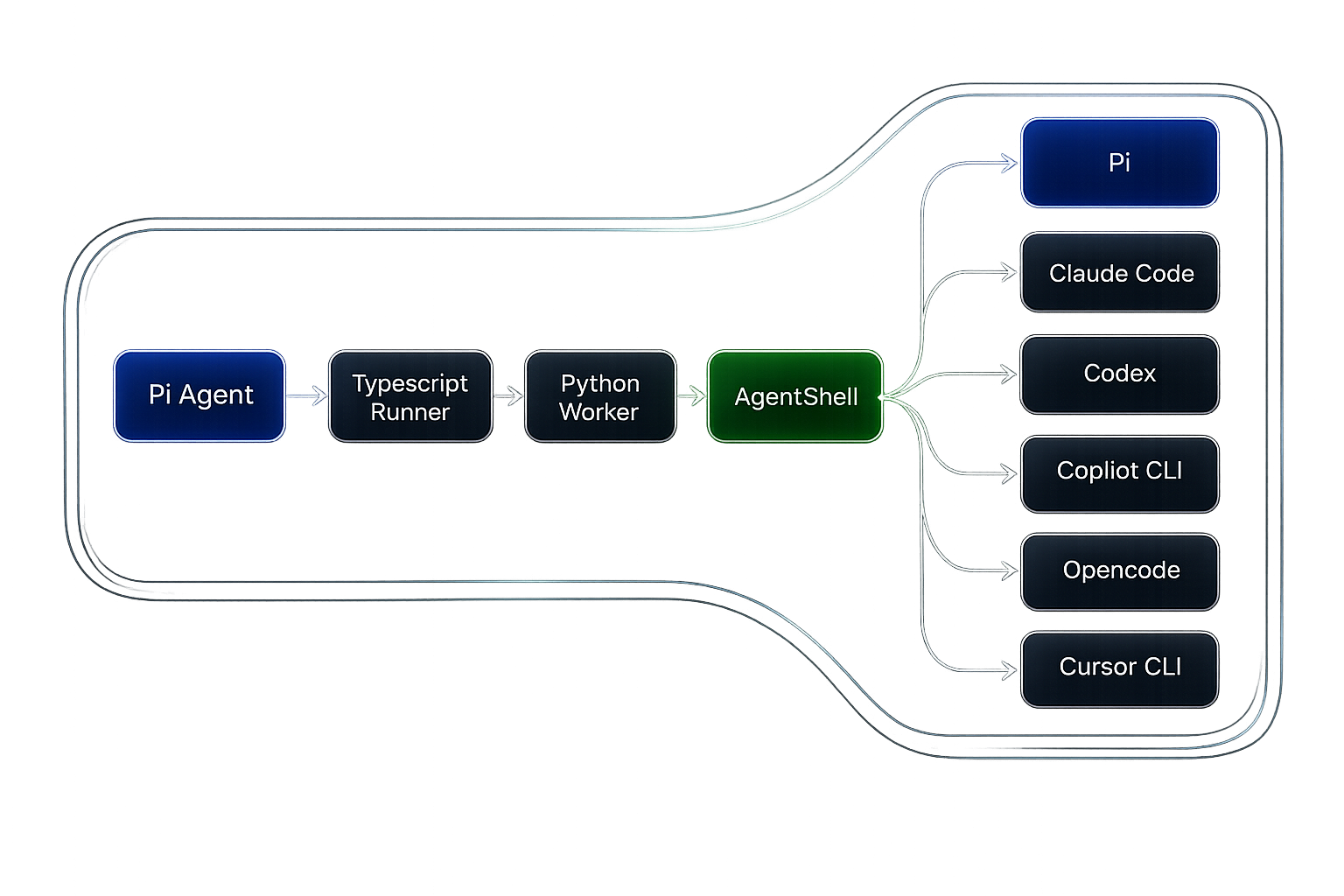
Pi submits each delegation to a session-scoped job registry. The existing TypeScript runner and Python worker execute it in the background through AgentShell. Completion is then delivered back to Pi as a conversation message.
Requirements
- Linux, macOS, or WSL2
- Pi
- uv
- Python 3.12 or newer, which uv can provide
- The chosen coding-agent CLI installed and authenticated, such as Codex, Claude Code, or Grok
Installation
pi install npm:@scottrbk/pi-agentshell-extension
To install the latest source from GitHub instead:
pi install git:github.com/ScottRBK/pi-agentshell-extension
Getting Started
The first time Pi starts with the extension installed, it will:
- Check whether
uvis available - Ask for permission to run
uv sync --locked, which installs AgentShell - Register the tool immediately after setup
Usage
Once in a Pi session, you can ask it to delegate a task to another coding agent.
For example:
Ask Codex to review this project and identify any bugs.
See AgentShell's list of supported agent types.
The tool accepts the following parameters:
| Parameter | Required | Description |
|---|---|---|
agent_type |
Yes | AgentShell agent type, such as claude_code, codex, or grok. |
task_name |
Yes | Short display name for the job, from 1 to 40 characters. |
prompt |
Yes | Task given to the subagent. |
cwd |
No | Working directory; defaults to Pi's current working directory. |
model |
No | Model identifier passed to AgentShell. |
effort |
No | Reasoning effort; supported values depend on the agent. |
resume_session_id |
No | Prior session ID; omit or use null for new sessions. |
auto_approve |
No | Allows automatic tool approval; defaults to false. |
allowed_tools |
No | Tool allow-list; support varies by agent. |
disallowed_tools |
No | Tool deny-list; support varies by agent. |
interactive |
No | Open the native agent UI in a neighbouring tmux pane; default false. |
stay_open |
No | Keep the interactive pane after delivering its result; default false. |
inactivity_timeout |
No | Seconds of inactivity before inferred completion; default 60. |
inactivity_enabled |
No | Enable inactivity completion for agents without a reliable event. |
AgentShell warnings are included in the completion message when an agent cannot enforce a control.
Interactive Tmux Panes
Start Pi inside tmux, then ask it to launch a subagent with interactive: true. The native agent UI
opens in a pane to the right. Switch to that pane using your normal tmux bindings to watch progress,
answer permission prompts, or type steering directly to the agent. Headless delegation remains the
default. Requesting interactive mode outside tmux produces an error.
For example:
Ask Codex to review this project in a tmux pane, and keep the pane open when it finishes.
Pi should pass interactive: true and stay_open: true for that request. Normally the pane closes
when the result is delivered. With stay_open, Pi receives the first result while the native UI
remains available for further conversation while the agent is running, or viewing after it exits.
Later turns in that pane do not send additional job results to Pi. Retained panes are closed when
their owning Pi session shuts down.
Completion uses a reliable agent event when available. Otherwise, the extension waits for sustained inactivity: 60 seconds by default. Observable activity, including visible steering, resets the timer. Recognised permission and login prompts prevent automatic closure. Inactivity is an estimate: a quiet agent can still be working, and unfamiliar prompts or busy indicators may not be recognised. Increase the timeout for tasks with long quiet periods. Results inferred from inactivity carry a warning.
Structured answer text is returned when available. Otherwise, the result contains a labelled terminal capture, which can include interface text and may omit output that has scrolled away.
Known constraint: interactive Codex uses terminal capture. Its completion notifications can
contain a background-generated title instead of the requested answer. As an interim measure, the
extension ignores those notifications and returns terminal text after sustained inactivity, using
the same configurable 60-second default. New interactive Codex runs do not return a verified session
ID for resumption. Monitoring, steering, and stay_open remain available.
Headless Codex is unaffected.
With inactivity_enabled: false, these runs wait for process exit or cancellation instead of
inferred completion. Process exit alone is not treated as a successful answer.
Track removal of this workaround in extension issue #6, linked to
Codex issue #43384.
Structured Codex results will be restored only after a released upstream fix has been validated
against background title notifications and normal answers.
Interactive mode keeps native permission prompts enabled. auto_approve: true and
disallowed_tools are rejected; allowed_tools is supported only where the interactive agent
adapter can enforce it. The AgentShell interactive API is experimental and requires v0.4.0.
Set defaults in ~/.pi/agent/extensions/agentshell.json (or the same path under your custom Pi
agent directory). These are the built-in values:
{
  "interactive": {
    "enabled": false,
    "stay_open": false,
    "inactivity_timeout": 60,
    "inactivity_enabled": true
  }
}
Overrides may be partial, and this section can sit alongside the output-limit settings below.
Launch arguments override configuration; configuration overrides built-in defaults. Run /reload
after changing the file. Setting inactivity_enabled: false disables inferred completion; agents
without reliable completion events then remain active until they exit or are cancelled.
Discovering Models
Use subagent_list_models to find the exact model selectors currently advertised for an agent:
subagent_list_models({
  agent_type: "codex",
  cwd: "/path/to/project"
})
cwd is optional and defaults to Pi's current working directory. The tool returns a JSON array;
pass a returned string unchanged as subagent's model value. The list is account- and
workspace-aware, but it does not prove that a model has credentials, quota, or provider health.
An empty array is a valid result. If an existing runtime predates model discovery, the normal
subagent tools remain available and Pi explains how to update the runtime.
Asynchronous Jobs
The subagent tool returns immediately with a session-scoped Job ID. The parent agent and user can
continue their conversation while the delegated agent runs in the background.
When the job finishes, its response is delivered to the parent as a follow-up message. If the parent is idle, this starts a turn immediately. If the parent is already working, Pi queues the completion until that work finishes. Do not poll the process or run sleep commands while waiting.
Use these commands to list, inspect, or cancel active jobs. The job list includes each task name, harness, model, effort, status, full Job ID, and latest activity when available:
/agentshell-jobs
/agentshell-inspect <job-id>
/agentshell-cancel <job-id>
Parent agents can inspect a known job without repeatedly polling it:
subagent_status({
  job_id: "job-..."
})
The status result contains a bounded activity tail with tool use, assistant text, warnings, and
errors. Once a result is queued for delivery, inspection reports delivering without repeating the
final text. Parent agents can cancel a known Job ID through subagent_cancel, so neither inspection
nor cancellation requires the user to enter a slash command.
While jobs are active, Pi shows a compact widget above the editor. Each row identifies the task by
name, harness, model, effort, and shortened Job ID. When AgentShell reports activity, a second line
shows a short Last activity description. Known tool names receive friendly descriptions; shell
commands are shown as short, truncated commands. This is the most recent observable event, not a
guarantee that the action is still running.
The widget displays the three oldest jobs and summarises any additional jobs as +N more running.
Cancelling jobs remain visible until their workers stop. Finished jobs then show delivering… until
Pi starts displaying their queued follow-up messages. The widget disappears when no jobs or pending
results remain.
A Job ID only identifies the background job; it is not a resumable subagent session ID. The real session ID arrives with a successful completion result. Only active jobs remain in the registry. Completed, failed, and cancelled jobs are removed after their result is delivered because the result is already stored in Pi's conversation history. Live activity is held only in memory and is removed with the job; the extension does not create its own transcript files. Job IDs and active jobs belong to the current Pi session. Session shutdown cancels remaining work.
Silent Mode
Run /agentshell-silent to hide successful subagent responses in Pi. Run it again to restore normal
output. Silent calls display ✓ Completed, while warnings and errors remain visible.
The parent agent still receives the complete response. Silent mode does not hide the live activity
widget, /agentshell-inspect, or subagent_status; it only changes successful final-message
rendering. Each job captures the output mode when it is submitted. The setting belongs to the
current Pi session and survives /reload and session resumption. New sessions start with normal
output.
Preferred Subagent Roster
Define preferred agent roles in ~/.pi/agent/extensions/agentshell.json:
{
  "roster": {
    "enabled": false,
    "roles": [
      {
        "name": "reviewer",
        "description": "Review code for defects",
        "agent_type": "codex",
        "model": "your-model-selector",
        "effort": "high"
      }
    ]
  }
}
Run /agentshell-roster to switch the roster on or off for all Pi sessions. The command saves
roster.enabled in this file; the default is off. When on, subagent_roster lists the roles and
the subagent tool suggests checking it before delegation. The roster is advisory: the parent
agent chooses a role and passes its agent_type, model, and effort through the existing
subagent arguments. It can also choose other settings. Role names and descriptions are for the
parent agent; they do not change how AgentShell launches a subagent.
The switch takes effect immediately in the current Pi process. Run /reload in any other open Pi
process to pick up the new setting.
Every role needs all five fields shown above. Names must be unique. Use an AgentShell agent type
and a model selector that your runtime supports; subagent_list_models can show current selectors.
Run /reload after editing roles by hand.
Resuming a Subagent
Every successful completion message ends with the subagent's session ID:
Warning: Interactive subagents are an exception: a session ID is not always guaranteed. The harness may not provide one before inactivity completion. Interactive Codex currently omits notification IDs because they may belong to a background title task instead of your conversation. Without a session ID, Pi cannot offer resumption of that run.
Reviewed the project and found two bugs.

Session ID: 0199f0c1-9a2b-7c3d-8e4f-5a6b7c8d9e0f
For a new task, omit resume_session_id so AgentShell starts a fresh session. If a tool-call
interface requires every property, use null instead. To continue the same subagent conversation,
pass the exact session ID back as resume_session_id:
Ask Codex to fix the bugs it found, resuming session 0199f0c1-9a2b-7c3d-8e4f-5a6b7c8d9e0f.
The value must come from an earlier successful subagent result. Do not pass new, a background Job
ID, or a newly generated UUID.
The subagent harness owns the stored session; this extension only forwards the ID.
Output Limits
The extension stops a subagent if any of these limits are exceeded:
| Setting | Default | What it limits |
|---|---|---|
maxOutputBytes |
64 KiB | Text returned to Pi and each job's live activity tail. |
maxProtocolBytes |
2 MiB | Total data sent by the AgentShell worker. |
maxMessageBytes |
256 KiB | One message sent by the AgentShell worker. |
maxStderrBytes |
256 KiB | Diagnostic output from the AgentShell worker. |
When subagent text output exceeds its limit, the failed completion message includes a UTF-8-safe
truncated prefix. A model list that exceeds maxOutputBytes is not returned.
To override the defaults, create ~/.pi/agent/extensions/agentshell.json:
{
  "maxOutputBytes": 131072,
  "maxProtocolBytes": 4194304,
  "maxMessageBytes": 524288,
  "maxStderrBytes": 524288
}
Overrides may be partial. Values are positive whole numbers in bytes. maxOutputBytes and
maxMessageBytes cannot exceed maxProtocolBytes. Run /reload after changing the file.
Safety and Limitations
- Child processes run with the user's permissions
- Approval bypass is disabled by default
- Child Pi sessions do not receive the subagent tool, preventing recursive delegation
- Active jobs are cancelled when their owning Pi session shuts down
- Stopping a parent turn does not stop background jobs; use
/agentshell-cancelwhen needed
Removal
pi remove npm:@scottrbk/pi-agentshell-extension
Development Tests
Install Pi, uv, and tmux, then run:
uv sync --project python --locked
env -u PI_AGENT_SHELL_CHILD npm test
npm run test:python
Interactive integration tests use dedicated tmux sockets and deterministic CLI fixtures. They exercise real pane input, result delivery, and cleanup without making model requests. Never run test cleanup against your normal tmux server.