@senad-d/branchme
Pi extension for verified current-repository Git branch, worktree, integration, retirement, push, and pull request workflows.
Package details
Install @senad-d/branchme from npm and Pi will load the resources declared by the package manifest.
$ pi install npm:@senad-d/branchme- Package
@senad-d/branchme- Version
0.2.0- Published
- Aug 23, 2026
- Downloads
- 271/mo · 41/wk
- Author
- senad-d
- License
- MIT
- Types
- extension
- Size
- 1.2 MB
- Dependencies
- 0 dependencies · 4 peers
Pi manifest JSON
{
  "extensions": [
    "./src/extension.ts"
  ],
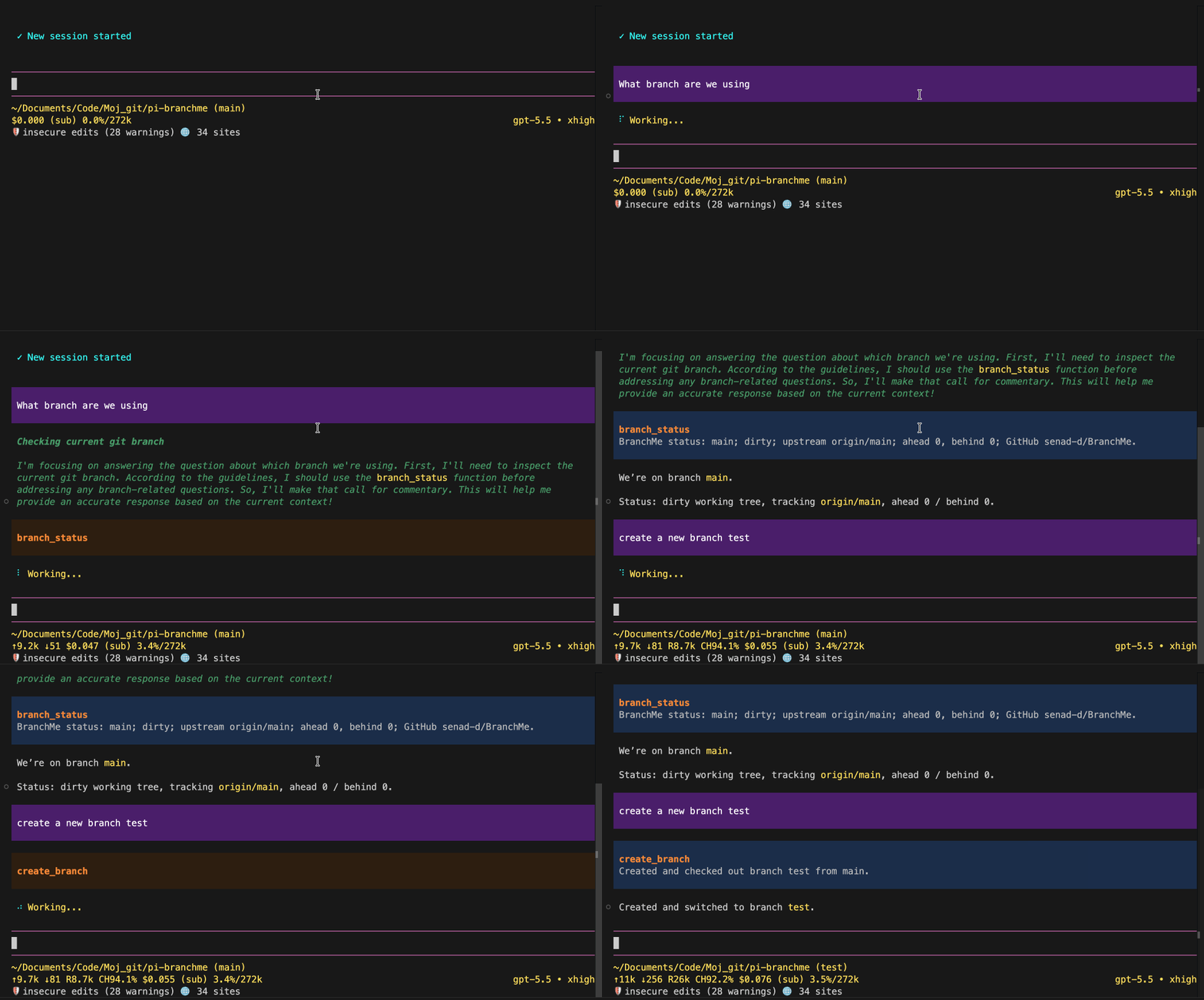
  "image": "https://raw.githubusercontent.com/senad-d/BranchMe/main/img/demo.gif"
}
Security note
Pi packages can execute code and influence agent behavior. Review the source before installing third-party packages.
README
BranchMe is a Pi extension for safe branch and worktree workflow automation. Before each agent run, it appends a bounded, read-only snapshot of the current Git repository to the system prompt. It also adds an informational /branchme command and thirteen agent-callable tools that refresh state, manage, integrate, and retire local branches, inspect/create/remove linked worktrees, push the current branch, and create GitHub pull requests.
- Context-aware: every agent run starts with bounded branch, working-tree, related-PR, and recent-commit metadata; repository metadata is untrusted data, not instructions.
- Repository-scoped: Git and GitHub operations resolve from the checkout where pi is running. Linked worktree directories may be outside that checkout, but must be verified members of the same repository.
- Explicit history rewrites:
rebase_branchruns only when explicitly requested, requires a clean current branch with an upstream, disables autostash and multi-ref updates, and automatically attempts to abort on failure. - Verified worktree handoff:
create_worktreeverifies path, branch,HEAD, and cleanliness before returning an absolutehandoff.cwd; starting another Pi session or subagent there remains the caller's responsibility. - Commit-safe: context collection is read-only, and BranchMe never stages files, creates user-authored commits, accepts or generates commit messages, force-pushes, resets, or edits files directly. An explicit
integrate_branchcall may let Git create its standard merge commit for divergent local histories. - Strict tools: tool schemas reject undocumented properties such as
stash,discard,owner,repo,path, orbaseRef; the only force decision is the required boolean onretire_branch, and every tool accepts only its documented fields. - PR-ready: create GitHub pull requests from existing local branches after verifying the
headBranchmatches GitHub and the base is visible. PR fields can stay explicit, or configured autofill can derive omitted fields from the current branch, default branch, and commit subjects.
Security: pi packages run with your full system permissions. BranchMe runs local
gitcommands, may create or remove verified linked-worktree directories outside the active checkout, may integrate local history or retire one exact local branch ref, may make an automatic authenticated GitHub request to find a related open pull request, can update branches and remotes, and can create GitHub pull requests. Repository-configured hooks—includingreference-transactionhooks invoked by retirement—merge drivers, filters, and signing policy may run commands or contact networks outside BranchMe's direct argv guarantees. ReadSECURITY.md.
Table of Contents
- Quick Start
- Installation
- Repository and GitHub Setup
- Configuration
- Commands
- Tools
- Workflow and Boundaries
- GitHub Actions
- Troubleshooting
- Diagnostics
- Update and Uninstall
- Development
- Publishing
- License
Quick Start
pi install npm:@senad-d/branchme
cd /path/to/your/git/repo
pi
Inside pi:
/branchme
/branchme help
A normal prompt can use the automatic start-of-run snapshot without a tool call. Ask for an explicit refresh when needed, for example:
Refresh the repository state with branch_status, then create a branch named feature/update-docs with create_branch.
A typical BranchMe flow is:
- Use the automatic snapshot to understand state at the start of the agent run.
- Use
branch_statuswhen you explicitly need fresh state, especially after a Git mutation in the same run. - Switch to the local base branch with
change_branch. - Update it from its configured upstream with
pull_branch, which requires a clean worktree and uses fast-forward-only semantics. - Create from the updated
HEADwithcreate_branch. - Make edits and commit outside BranchMe.
- Push the current branch with
push_branch. - After
push_branchcompletes and GitHub can see the branches, create a pull request withpull_request.
For isolated work, a specialized Git subagent can use the explicit worktree workflow:
- Call
list_worktreesto inspect the current repository's bounded worktree inventory. - Ask the user to provide or approve an exact absolute destination and call
create_worktreewithbranchMode: "new"or"existing". - Wait for the result and require
details.handoff.ready === true. - Have the caller or orchestrator start a separate Pi session or subagent with its working directory set to the returned absolute
details.handoff.cwd. - After that session finishes, remove or preserve any staged, unstaged, untracked, unmerged, or ignored local files, then explicitly call
remove_worktreeif removal was requested. Removal retains the local branch. - If the user separately asks to retire that retained branch, obtain its fresh exact
HEAD, verify it against an exact local target, and callretire_branchonly after worktree removal has completed.
BranchMe does not change the active Pi process's cwd, start Pi or other processes, create sessions, copy .env or other ignored/untracked files, or automatically retire a branch when removing its worktree. For credentials needed by agents in linked worktrees, prefer process-level environment variables rather than copying repository-root secrets.
To refresh the current branch's configured remote-tracking ref without changing the local branch or working tree, use fetch_branch. To reconcile the clean current branch by rewriting its local commits, run fetch_branch, wait for it to complete, and then run rebase_branch. Both tools require a configured upstream; rebase_branch automatically attempts git rebase --abort if rebasing fails.
BranchMe is tool-based. The slash command is informational only and never changes or updates branches, creates or removes worktrees, changes cwd, starts processes/sessions, fetches, rebases, pushes, commits, stages, edits files, or opens pull requests.
Installation
| Scope | Command | Notes |
|---|---|---|
| Global | pi install npm:@senad-d/branchme |
Loads in every trusted pi project. |
| Project-local | pi install npm:@senad-d/branchme -l |
Writes to .pi/settings.json in the current project. |
| One run | pi -e npm:@senad-d/branchme |
Try without changing settings. |
| Git | pi install git:github.com/senad-d/branchme@<tag> |
Pin a tag or commit. |
| Local checkout | pi --no-extensions -e . |
Develop or test this repository in isolation. |
Once loaded, BranchMe collects automatic Git context before each agent run. This happens for ordinary prompts; there is no /branchme context command and no additional tool to enable it.
Source checkout:
git clone https://github.com/senad-d/branchme.git
cd branchme
npm install --ignore-scripts
npm run validate
pi --no-extensions -e .
Use the checkout globally while developing:
pi install /absolute/path/to/branchme
Repository and GitHub Setup
BranchMe does not bundle Git and does not create repositories. Start pi from inside the repository you want BranchMe to manage:
cd /path/to/your/git/repo
git status
git remote get-url origin
pi
For pull requests, the repository must resolve to GitHub from local origin and/or GITHUB_REPOSITORY:
git remote set-url origin git@github.com:OWNER/REPO.git
# or
export GITHUB_REPOSITORY=OWNER/REPO
For automatic related-PR lookup and pull_request, set a token in the process environment before starting pi:
export GITHUB_TOKEN=github_pat_...
# or
export GH_TOKEN=ghp_...
pi
Or copy .env.example to .env in the repository root, fill in one token value, and optionally enable PR field autofill:
cp .env.example .env
$EDITOR .env
# Set BRANCHME_PR_AUTOFILL=true in .env if desired.
pi
fetch_branch, pull_branch, and push_branch use your normal Git remote credentials. BranchMe does not inject GITHUB_TOKEN into git fetch, git pull, or git push. rebase_branch operates on the locally available configured upstream ref and makes no network request itself.
When the current branch already has an upstream, BranchMe pushes an explicit HEAD:<upstream-branch-ref> refspec to the configured upstream remote instead of relying on a bare git push.
Run pull_request only after push_branch has completed; pull_request preflights the GitHub headBranch and baseBranch before creating the PR and fails with retry guidance if a branch is not visible yet or the GitHub headBranch commit does not match the local branch.
Configuration
BranchMe has no separate project config file. It reads process environment variables and supported keys from a local .env file in the verified git root. Token lookup checks process.env.GITHUB_TOKEN, then process.env.GH_TOKEN; if neither is set, BranchMe checks the matching .env keys. Pull request field autofill checks BRANCHME_PR_AUTOFILL in the process environment first, then .env, and defaults to disabled.
| Variable | Meaning |
|---|---|
GITHUB_TOKEN |
Preferred token for automatic related-PR lookup and pull_request; process environment first, then local .env fallback. |
GH_TOKEN |
Fallback token for automatic related-PR lookup and pull_request; process environment first, then local .env fallback. |
BRANCHME_PR_AUTOFILL=true |
Allow pull_request to fill omitted PR fields. Accepts true/false, 1/0, yes/no, or on/off; disabled by default. |
GITHUB_REPOSITORY=owner/repo |
Optional CI fallback and boundary check for the current GitHub repository; process environment only. |
BranchMe reads only GITHUB_TOKEN, GH_TOKEN, and BRANCHME_PR_AUTOFILL from a small regular .env file; it rejects directories, symlinks, special files, and oversized files. BranchMe does not import other .env keys, read shell profiles, GitHub CLI credentials, or local credential stores. Token values are redacted from automatic context, errors, tool content, and tool details.
With autofill enabled, omitted fields are resolved as follows:
headBranch: current local branch.baseBranch: the branch named byorigin/HEADwhen it exists locally, falling back to an existing localmain,master,trunk, ordevelopbranch.title: first commit subject inbaseBranch..headBranch, falling back to a title derived from the head branch name.body: a bounded Markdown summary of commit subjects inbaseBranch..headBranch.draft:false.
Explicit tool arguments always take precedence. Autofill does not create a PR by itself: the user must still ask the agent to create one.
If local origin and GITHUB_REPOSITORY both resolve but disagree, pull_request fails closed.
Commands
| Command | Description |
|---|---|
/branchme |
Show a compact status panel or fallback message with current branch, GitHub repository resolution, token presence, and workflow notes. |
/branchme help |
Show concise BranchMe workflow help and runtime requirements. |
/branchme --help |
Alias for /branchme help. |
/branchme -h |
Alias for /branchme help. |
Commands are informational only. BranchMe actions are performed by agent-callable tools. /branchme uses the TUI panel in TUI mode, notifications in RPC mode, plain text only in print mode, and stays stdout-silent in JSON mode to avoid corrupting protocol output. Unsupported non-empty /branchme arguments return guidance to use /branchme help where the current mode can display it safely.
Tools
| Tool | Schema | Behavior |
|---|---|---|
branch_status |
{ "ancestry"?: { "sourceBranch": string, "targetBranch": string } } |
Explicitly refreshes the same bounded context used at agent start. An optional strict ancestry query captures both exact local branch HEADs and reports whether the source commit is an ancestor of the target commit. It is read-only; automatic Git context does not run ancestry queries. |
list_worktrees |
{} |
Runs a bounded, read-only inventory of the current repository's main and linked worktrees, including path, branch/detached state, HEAD, current/main, locked, prunable, and omitted-entry details. Automatic Git context does not include this inventory. |
create_worktree |
{ "worktreePath": string, "branchName": string, "branchMode": "new" | "existing" } |
Creates and verifies a linked worktree at an explicitly approved absolute path. new creates a local branch from current HEAD; existing requires an existing local branch not checked out elsewhere. It returns a ready handoff with the exact canonical absolute cwd and local branch identity. |
remove_worktree |
{ "worktreePath": string } |
Force-free removal of an explicitly selected, verified clean linked worktree. It rejects the main/current, detached, locked, prunable/missing, dirty, ignored-file-containing, or foreign worktree and verifies that the local branch remains at the same commit. |
retire_branch |
{ "branchName": string, "expectedHead": string, "targetBranch": string, "force": boolean } |
Deletes only the exact unoccupied local branch ref when its direct ref matches the supplied full commit ID and its relationship to the exact local target has been verified. Unmerged retirement requires explicit force: true; remote and remote-tracking refs are untouched. |
change_branch |
{ "branchName": string } |
Validates branchName, requires refs/heads/<branchName> to exist locally, rejects dirty worktrees, and runs git switch <branchName>. |
fetch_branch |
{} |
Requires a current branch with a configured upstream and runs git fetch --no-tags --no-recurse-submodules <upstream-remote> <upstream-branch-ref>:<remote-tracking-ref>; only that tracking ref is refreshed without changing local branches or working-tree files. |
pull_branch |
{} |
Requires a clean current branch with a configured upstream and runs git pull --ff-only --no-rebase --no-autostash <upstream-remote> <upstream-branch-ref>; divergence fails without rebasing or creating a merge commit. |
rebase_branch |
{} |
Requires a clean current branch with a configured upstream and runs git rebase --no-autostash --no-update-refs <upstream>; it rewrites local commits and automatically attempts git rebase --abort on failure. |
integrate_branch |
{ "sourceBranch": string, "targetBranch": string } |
Integrates one exact existing local source branch into one distinct existing local target branch. The clean active control worktree must already have the target checked out. It returns already_integrated, fast_forward, merge_commit, or a conflict only after automatic abort and verified restoration. It never fetches or pushes. |
create_branch |
{ "branchName": string } |
Validates branchName, rejects existing local branches, and runs git switch -c <branchName> from current HEAD. |
push_branch |
{} |
Pushes the current branch to its configured upstream remote with an explicit HEAD:<upstream-branch-ref> refspec, or publishes it with git push --set-upstream origin <currentBranch> when no upstream exists. |
pull_request |
{ "headBranch"?: string, "baseBranch"?: string, "title"?: string, "body"?: string, "draft"?: boolean } |
Preflights GitHub branch visibility and verifies the GitHub headBranch commit matches the local branch, then creates a pull request in the resolved current repository. Omitted fields require BRANCHME_PR_AUTOFILL=true; branch refs must be distinct, exist locally, and cannot use owner:branch. |
All schemas reject additional properties. change_branch never accepts baseRef, force, stash, discard, create, owner, repo, or path inputs. fetch_branch, pull_branch, and rebase_branch have strict empty schemas and never accept a branch, remote, refspec, force, autostash, or arbitrary rebase target. integrate_branch requires exactly sourceBranch and targetBranch; it accepts no repository, path, remote, strategy, message, squash, signing, commit, continuation, abort, force, fetch, push, deletion, or worktree controls. create_worktree requires exactly worktreePath, branchName, and branchMode; remove_worktree requires exactly worktreePath. No worktree tool accepts force, move, prune, repair, lock, unlock, detached, orphan, remote, refspec, or arbitrary start-point controls. retire_branch requires exactly branchName, a full 40- or 64-hex-character expectedHead, a distinct local targetBranch, and the boolean force decision; it accepts no repository, path, remote, refspec, pattern, branch list, prune, remote-delete, worktree-removal, or inferred-target control. pull_request never accepts owner, repo, or owner-prefixed branch refs; BranchMe resolves the repository from local origin and/or matching GITHUB_REPOSITORY. continue_merge and abort_merge are not available.
Workflow and Boundaries
Automatic context and freshness
Before each agent run, BranchMe appends an Automatic Git Context snapshot to the existing system prompt. The snapshot contains these fields in order:
- current branch or detached
HEAD, plus upstream and ahead/behind counts when available; - working-tree state and staged, unstaged, and untracked counts;
- up to 20 unstaged or untracked change entries with Git status, path, and original path for renames/copies;
- related open PR status and, when found, its number, title, repository, head/base branches, URL, state, and draft flag;
- whether pull request field autofill is enabled;
- up to 5 recent commits with short hash, date, and subject.
Collection defaults are a 5-second timeout per local Git command, a 4-second related-PR lookup timeout, at most 512 characters per metadata value, and at most 4,000 characters for the rendered snapshot. GitHub response bodies are limited to 64 KiB. The formatter can further shorten values or omit entries to stay within the total limit.
The snapshot is fresh at agent start but is not live. A fetch, branch switch, pull, rebase, integration, commit, file change, push, or other mutation later in the same run can make it stale. branch_status performs an explicit current-state refresh through the same shared collector and remains read-only; it does not mutate files, Git state, or GitHub state. Its optional ancestry object requires exact sourceBranch and targetBranch fields together, captures both local branch commit IDs, and reports isAncestor. This targeted proof is explicit only: automatic Git context remains unchanged. Run it after integrate_branch completes, never in the same parallel tool batch.
Related-PR metadata does not come from Git alone. When repository, branch, and credentials resolve, automatic collection and explicit branch_status may make an authenticated GET /repos/{owner}/{repo}/pulls?state=open&head={owner}:{branch}&per_page=1 request. Without a token there is no unauthenticated fallback or GitHub request; the PR field is reported as unavailable while local Git context remains usable.
Repository paths, commit subjects, branch names, and PR titles are treated as untrusted metadata. BranchMe redacts token values, escapes control characters, quotes and bounds values before prompt insertion, and never captures diffs or file contents. Staged files contribute only to the staged count; the path list is limited to unstaged and untracked entries.
Use BranchMe from pi prompts or automation that drives pi with explicit tool calls:
Use branch_status.
Switch to the base branch with change_branch, then use pull_branch after the switch completes.
Fetch the current branch upstream with fetch_branch, wait for it to complete, then rebase with rebase_branch.
Create branch feature/docs-refresh from the updated current HEAD with create_branch.
Push the current branch with push_branch.
After push_branch completes, create a draft pull request from feature/docs-refresh to main titled "Refresh docs" with this body: "...".
If pull request field autofill is enabled, after push_branch completes create a pull request and fill any details I did not provide.
Verified local branch integration
integrate_branch requires explicit intent and exactly two distinct existing local branch names: sourceBranch and targetBranch. The active Pi worktree is the control worktree; it must be clean, have no merge/rebase/cherry-pick/revert/sequencer operation in progress, and already have targetBranch checked out. BranchMe never switches to the target or infers one. A source checked out in another dirty linked worktree is allowed because integration reads only its committed local ref. Remote-only refs, commit IDs, paths, repositories, remotes, and owner-prefixed refs are rejected.
For a source not already reachable from the target, BranchMe runs this fixed normal-merge policy from the verified worktree root:
git -c rerere.enabled=false merge --ff --no-edit --no-autostash --no-rerere-autoupdate --no-overwrite-ignore refs/heads/<sourceBranch>
This policy permits a fast-forward or lets Git create a standard two-parent merge commit for divergent histories. BranchMe does not create user-authored commits, accept a merge message, or expose strategy, squash, unrelated-history, signing, force, or commit controls. Before mutation, it rejects a non-empty branch.<targetBranch>.mergeOptions setting because those branch-specific defaults could silently change the fixed policy. Autostash is disabled, rerere is disabled so recorded resolutions are not applied or updated, and ignored files may not be overwritten. Repository-configured hooks, custom merge drivers, clean/smudge filters, and signing policy remain active; those Git extension points may execute arbitrary local commands or network operations under the user's identity.
The structured status is one of:
already_integrated: no merge ran and both branch refs remained stable;fast_forward: the target advanced exactly to the captured source commit;merge_commit: Git created an exact normal two-parent merge whose parents are the captured prior target and source;conflict: bounded, exact repository-relative conflict paths were captured,git merge --abortsucceeded, and repository identity, current target, exact source/target refs, clean state, and absence of operation state were verified.
All outcomes include captured before/after source and target commit IDs plus final source and prior-target ancestry proof. Failed non-conflict merges remain errors after cleanup. BranchMe uses no reset-based rollback; if abort or postcondition checks are inconclusive, or a ref moves unexpectedly, it reports that integration may have completed and tells the caller to inspect the repository before retrying.
The same-repository mutation queue covers preflight, merge, cleanup, and verification, but it exists only inside the current BranchMe process. It does not lock another Pi session or an external Git process. integrate_branch itself does not fetch, pull, push, delete branches, remove worktrees, start agents, ask questions, continue a merge, or resolve semantic conflicts. A Mission or other orchestrator may explicitly call it; after a verified conflict, that separate workflow decides whether to delegate analysis to an integration agent or ask the developer about semantic intent.
For an independent read-only proof after integration, call:
{ "ancestry": { "sourceBranch": "feature/example", "targetBranch": "main" } }
with branch_status only after integrate_branch has returned. Do not batch the calls.
Linked worktree verification and handoff
create_worktree requires a non-blank absolute path with no control characters. Its immediate parent must already be a directory. BranchMe resolves that parent to build a canonical destination, rejects any existing file, directory, or symlink there, and rejects destinations inside a registered worktree or the repository's common Git directory. Before mutation, the canonical path and local branch must be returnable without redaction, escaping, Unicode alteration, or truncation: canonical paths are limited to 4,096 characters and branch identities to 512 characters, and credential-like token text is rejected. A dirty source worktree is allowed because creation does not switch or overwrite it.
For branchMode: "new", BranchMe creates the requested local branch from the current HEAD only. For branchMode: "existing", it uses only an existing local branch that is not checked out in another worktree; it never infers a local branch from a remote. After Git succeeds, BranchMe re-lists worktrees and verifies the canonical path, local branch, HEAD, and clean checkout. A representative structured result subset is:
{
  "action": "create_worktree",
  "handoff": {
    "cwd": "/absolute/path/to/branchme-feature",
    "branch": "feature/worktree-docs",
    "head": "<full-commit-id>",
    "ready": true,
    "summary": "Worktree ready at /absolute/path/to/branchme-feature on branch feature/worktree-docs at <full-commit-id>."
  }
}
The full details also distinguish requested input from verified before/after state. Successful handoff.cwd and handoff.branch values are the exact identities verified against Git; BranchMe never substitutes [REDACTED], escaped control sequences, or a truncation ellipsis in these machine-readable fields. Display content, summaries, and worktree inventory remain sanitized and bounded separately. An orchestrator may use handoff.cwd only after ready is true, and must start the next Pi session or subagent itself with that exact working directory. BranchMe never changes the active process's cwd or starts another process/session.
remove_worktree canonicalizes the approved absolute path and requires an exact match in a fresh inventory for the current repository. It accepts only a present, unlocked, non-prunable, non-bare, branch-attached linked worktree that is neither main nor current, then rejects staged, unstaged, untracked, unmerged, or ignored entries. The canonical path and retained branch must pass the same pre-mutation lossless-identity checks used for creation. The ignored-entry preflight is bounded and does not return ignored paths. Removal uses git worktree remove <verified-path> without force, verifies the entry is gone, and returns the exact retained branch identity after confirming it still points to the captured commit:
{
  "action": "remove_worktree",
  "handoff": {
    "cwd": null,
    "branch": "feature/worktree-docs",
    "head": "<full-commit-id>",
    "ready": false,
    "summary": "Worktree directory /absolute/path/to/branchme-feature was removed; local branch feature/worktree-docs was retained at <full-commit-id>."
  }
}
Ignored and untracked files—including a repository-root .env—are not copied into a new linked worktree. Prefer credentials inherited through the new agent process environment. Git documents support for multiple worktrees of a superproject containing submodules as incomplete; BranchMe adds no force-based submodule cleanup. There is no force, move, prune, repair, lock, unlock, detached, orphan, or remote-inference worktree behavior.
Verified local branch retirement
retire_branch is a separate, explicit lifecycle step after integration and any linked-worktree removal. It accepts exactly:
{
  "branchName": "feature/example",
  "expectedHead": "<full-40-or-64-hex-commit-id>",
  "targetBranch": "main",
  "force": false
}
Obtain or supply a fresh exact HEAD for branchName and verify its ancestry against the exact local targetBranch; branch_status.ancestry can provide both captured commit IDs and the read-only proof. Run that refresh and retire_branch sequentially, never in the same parallel tool batch. The retiring and target names must be distinct direct local refs. Any registered worktree that names the retiring branch blocks deletion, including main, current, linked, locked, prunable, or missing records. Removing an occupying linked worktree is a separate explicit remove_worktree call; wait for its verified result before retirement.
Merged retirement uses force: false. If the retiring commit is not an ancestor of the captured target, retirement fails unless the user explicitly authorizes unmerged data loss with force: true. Forced unmerged retirement can remove that commit's last local branch reference. Object recovery is not guaranteed: normal reflog expiry and Git garbage collection can eventually make the commit unreachable.
After validating the expected commit, complete worktree inventory, target ancestry, and repository identity, BranchMe deletes only the exact local ref with an expected-old-value lease:
git update-ref --no-deref -d refs/heads/<branchName> <capturedRetiringHead>
The captured commit lease prevents deletion if the retiring ref moves after preflight. BranchMe does not use git branch -d or git branch -D because those commands do not provide this expected-HEAD lease and their default merge target does not satisfy the explicit targetBranch contract. Retirement never performs bulk or pattern deletion, infers a target, removes a worktree, fetches, pushes, deletes a remote branch or local remote-tracking ref, or recreates/resets a ref as rollback. Local branch.<branchName>.* configuration remains untouched in the initial contract; it can affect a later branch recreated with the same name.
The retirement preflight, immediate reinspection, leased deletion, and postcondition verification share a process-local mutation-queue window keyed by the canonical active worktree root. That queue coordinates BranchMe mutations invoked from the same active checkout, but it does not lock another active worktree, Pi process, or external Git process. The expected-old-value lease protects the retiring ref; target and worktree checks detect other observable movement. After deletion is attempted, BranchMe verifies repository identity, target stability, local-ref absence, and zero occupancy without using a cancelled caller signal. Contradictory or inconclusive outcomes produce a bounded uncertain error stating retirement may have completed; inspect the repository, target ref, retiring ref, and complete worktree inventory manually before retrying. BranchMe does not automatically recreate, reset, switch, merge, or force-update a branch as rollback.
Repository-configured reference-transaction hooks can run during git update-ref. Such hooks are inside the repository trust boundary and can execute arbitrary commands or contact networks; that behavior is distinct from BranchMe's direct local-only, no-remote-delete argv contract.
BranchMe operates only on the repository where pi is running:
- Automatic collection and
branch_statusrun bounded, read-only Git commands from the verified git root. - Git commands use
pi.exec("git", args, { cwd, signal, timeout })with argv arrays; repository mutations run from the verified git root. change_branchswitches only to existing local branches and has noforce,stash,discard, remote, or path input.fetch_branchrequires a configured upstream, uses an explicit source-to-remote-tracking refspec with tags and submodule recursion disabled, and does not change local branches or working-tree files.pull_branchrequires a clean worktree and configured upstream, updates only the current branch withgit pull --ff-only --no-rebase --no-autostash, and has no branch, remote, force, or rebase input.rebase_branchrequires a clean worktree and configured upstream, rewrites only the current branch onto the locally available upstream with autostash and multi-ref updates disabled, and automatically attempts to abort on failure.integrate_branchmerges one captured local source ref into the already-current clean local target with the fixed policy documented above. It verifies repository identity, refs, ancestry, clean state, and cleanup without fetching or pushing.create_branchcreates from the currentHEADonly and has nobaseRefinput.list_worktreesis an explicit, read-only repository inventory; it is intentionally absent from automatic active-worktree context.create_worktreemay create a linked checkout outside the active checkout only after canonical path and current-repository boundary checks; dependent worktree calls must wait for its verified handoff.remove_worktreepasses Git only a freshly verified canonical linked-worktree path, never uses force, and retains the branch.retire_branchdeletes only one exact unoccupied direct local ref with the supplied expected-HEADlease after captured target ancestry verification; it leaves remote refs, remote-tracking refs, worktrees, and branch configuration untouched.push_branchpushes only the current branch, uses no bare upstreamgit push, and has nobranchNameinput.pull_requestcreates PRs only for the resolved current GitHub repository, requires resolvedheadBranchandbaseBranchvalues to be distinct and exist locally, requires the GitHubheadBranchcommit to match the local branch, queues behind in-flight same-repository git mutation windows when possible, and rejectsowner:branchhead refs. Missing PR fields fail unlessBRANCHME_PR_AUTOFILL=true.- If local
originandGITHUB_REPOSITORYboth resolve but disagree,pull_requestfails closed.
BranchMe intentionally does not stage files, create user-authored commits, accept or generate commit messages, force checkout, stash changes, discard changes, force-push, reset, edit files directly, copy ignored/untracked files between worktrees, or delete branches during worktree removal. Rebase-driven rewriting occurs only through explicit rebase_branch; a Git-generated standard merge commit is possible only through explicit integrate_branch for divergent histories; one exact local ref can be deleted only through explicit retire_branch under the leased boundary above.
GitHub Actions
GitHub Actions example:
name: branchme-smoke
on:
  workflow_dispatch:

permissions:
  contents: write
  pull-requests: write

jobs:
  branchme:
    runs-on: ubuntu-latest
    env:
      GITHUB_TOKEN: ${{ secrets.GITHUB_TOKEN }}
      GITHUB_REPOSITORY: ${{ github.repository }}
    steps:
      - uses: actions/checkout@v4
        with:
          fetch-depth: 0
      - uses: actions/setup-node@v4
        with:
          node-version: 22
      - run: npm install -g --ignore-scripts @earendil-works/pi-coding-agent
      - run: pi --no-extensions -e npm:@senad-d/branchme --help
Ensure the token and Git credentials have permission for the branch and pull request operation you ask BranchMe to perform.
Troubleshooting
| Problem | Try |
|---|---|
| Not a git repository | Start pi from inside a git checkout. |
Detached HEAD |
Use change_branch to switch to an existing local branch, or checkout a branch before fetch_branch, pull_branch, rebase_branch, create_branch, or push_branch. |
| Branch already exists | Choose a new local branch name for create_branch, or use change_branch to switch to it. |
| Branch does not exist locally | Create a local branch first; change_branch and create_worktree existing mode do not infer local branches from remote branches. |
| Worktree destination rejected | Provide an exact absolute path whose immediate parent exists; the destination must not exist or be inside another registered worktree or the repository's common Git directory. Its canonical path and branch identity must also fit the documented limits without credential-like token text or characters that require escaping. |
| Existing worktree branch is occupied | Choose another existing local branch or remove its other linked checkout after cleaning it; BranchMe does not force multiple checkouts. |
| Worktree removal rejected | Use list_worktrees, select a non-main/non-current linked worktree, and remove or preserve staged, unstaged, untracked, unmerged, and ignored files outside the checkout. Locked, detached, prunable/missing, bare, and foreign paths are not removable. |
| Linked-worktree agent cannot find credentials | Pass credentials through the process environment. BranchMe does not copy repository-root .env or other ignored/untracked files. |
| Dirty worktree before branch switch, pull, rebase, or integration | Commit, stash, or discard changes outside BranchMe before using change_branch, pull_branch, rebase_branch, or a target control worktree for integrate_branch. |
| Fetch, pull, or rebase has no upstream | Configure the current branch upstream outside BranchMe, then retry the tool. |
| Pull is not a fast-forward | Run fetch_branch, wait for it to complete, then explicitly run rebase_branch if rewriting local commits is intended; otherwise reconcile outside BranchMe. |
| Rebase fails or conflicts | rebase_branch automatically attempts git rebase --abort. Inspect repository state before continuing if automatic cleanup also fails. |
| Integration target mismatch or missing local branch | Check out the exact local targetBranch in the active control worktree and ensure both distinct branch refs already exist locally; integrate_branch never switches, fetches, or accepts remote-only refs. |
| Integration rejects branch-specific merge options | Clear branch.<targetBranch>.mergeOptions outside BranchMe before retrying; options such as --no-commit, --squash, --no-verify, or a custom strategy would change the fixed policy. |
Integration reports conflict |
The initial merge was automatically aborted and exact restoration was verified. Use the returned conflict paths for separate analysis; BranchMe has no continue_merge tool and does not resolve semantic conflicts. |
| Integration is uncertain or cleanup fails | Inspect branch refs, HEAD, worktree status, and Git operation state manually before retrying. BranchMe does not use reset-based rollback. |
Retirement expected HEAD is stale |
Refresh the exact local branch commit and target ancestry, confirm the intended commit, then make a new sequential retire_branch call. Never reuse a stale commit identity. |
| Retirement branch is occupied | Remove the occupying linked worktree separately only after its own safety checks pass. Current, main, locked, prunable/missing, and any other registered occupancy block retirement. |
| Retirement rejects unmerged history | Preserve or integrate the commits, or obtain explicit user authorization for the data-loss risk before a separate call with force: true. |
| Retirement outcome is uncertain | Retirement may have completed. Manually inspect the repository identity, target ref, retiring local ref, and complete worktree inventory before retrying; do not recreate or reset a branch as automatic rollback. |
| Push fails | Confirm the current branch is correct and your normal Git remote credentials can push. |
| Related PR is unavailable | Set GITHUB_TOKEN or GH_TOKEN before starting pi if related-PR context is wanted. Without a token, BranchMe keeps local context and intentionally makes no unauthenticated GitHub request. |
| PR auth fails | Set GITHUB_TOKEN or GH_TOKEN before starting pi, or copy .env.example to .env and fill in one token. |
| Missing PR fields | Provide all five fields, or set BRANCHME_PR_AUTOFILL=true in the process environment or repository .env. |
| Autofill cannot infer the base | Ensure origin/HEAD names an existing local branch, keep a local main, master, trunk, or develop branch, or provide baseBranch explicitly. |
| PR branch does not exist locally | Create or fetch/check out the local headBranch and baseBranch branches first; BranchMe does not use remote-only or cross-repository PR refs. |
| PR branch is not visible or is stale on GitHub | Run push_branch, wait for it to complete, then retry pull_request; do not batch push_branch and pull_request in the same assistant tool call. |
| Repository mismatch | Make origin and GITHUB_REPOSITORY refer to the same owner/repo. |
| Need a user-authored commit | Use CommitMe or normal Git commands. BranchMe does not stage files, accept commit messages, or create user-authored commits; only integrate_branch may let Git create a standard merge commit. |
| Other extensions interfere | Test with pi --no-extensions -e .. |
Diagnostics
From a source checkout:
npm run validate
npm run check:pack
printf '/branchme help\n/quit\n' | pi --no-extensions -e .
Validation covers TypeScript typechecking, formatting checks, automatic context collection and prompt injection, mocked GitHub lookup, isolated real-Git worktree, branch-integration, and leased branch-retirement lifecycle tests, package checks, checkout Pi runtime smoke, and package-content verification. The checkout smoke loads BranchMe through Pi, then uses a temporary verifier command to confirm all thirteen BranchMe tools are visible through pi.getAllTools() with strict schemas and prompt metadata, including integrate_branch, retire_branch, and targeted branch_status.ancestry, with no merge-continuation tool. Runtime smoke inspects retirement registration and schema but never executes branch retirement. Smoke-test notes are recorded in docs/SMOKE_TEST.md, and TUI/help captures are stored in docs/TUI_CAPTURE.md.
Refresh TUI captures intentionally with:
UPDATE_TUI_CAPTURE=1 node --test test/tui-capture.test.mjs
Update and Uninstall
pi update --extensions                  # update installed pi packages
pi update npm:@senad-d/branchme        # update BranchMe only
pi remove npm:@senad-d/branchme        # remove global install
pi remove npm:@senad-d/branchme -l     # remove project-local install
Development
npm install
npm run typecheck
npm run format:check
npm run test
npm run check:pack
npm run validate
npm run smoke:pi:packed
pi --no-extensions -e .
npm run check:pack verifies the npm package does not include local state, specs, caches, node_modules, real environment files, or other private development artifacts. The safe .env.example template is included.
npm run smoke:pi is the checkout runtime smoke and verifies BranchMe command output plus real Pi tool registration metadata.
npm run smoke:pi:packed is the release-gate smoke: it packs the npm artifact into a temporary directory, installs it with production dependency settings, and runs pi against the installed package.
Publishing
BranchMe publishes to npm as @senad-d/branchme. You need an npm account with publish access to the @senad-d scope.
npm login
npm whoami
npm run release:check # optional preflight; every publish path runs this gate
node scripts/publish-npm.mjs
npm run release:check is the canonical release gate: it runs checkout validation and then installs and loads the packed npm artifact in isolation. Both the local publish script and the GitHub Publish to npm workflow run this gate before npm publication; a failure prevents publication and the workflow's Git tag creation.
The publish script requires a clean working tree, asks for the version number, runs npm run release:check, runs npm version <version> to update package.json and package-lock.json, creates the v<version> git tag, publishes with npm publish --access public, and then offers to push the release commit and tag.
Run it only from a clean working tree after updating CHANGELOG.md.
License
MIT