@senad-d/commitme
Pi extension that gathers git diff and project context to draft or create clear Conventional Commit messages.
Package details
Install @senad-d/commitme from npm and Pi will load the resources declared by the package manifest.
$ pi install npm:@senad-d/commitme- Package
@senad-d/commitme- Version
0.2.8- Published
- Jul 15, 2026
- Downloads
- 1,790/mo · 82/wk
- Author
- senad-d
- License
- MIT
- Types
- extension
- Size
- 152.1 KB
- Dependencies
- 0 dependencies · 3 peers
Pi manifest JSON
{
  "extensions": [
    "./src/extension.ts"
  ],
  "image": "https://raw.githubusercontent.com/senad-d/commitme/main/img/commitme.png"
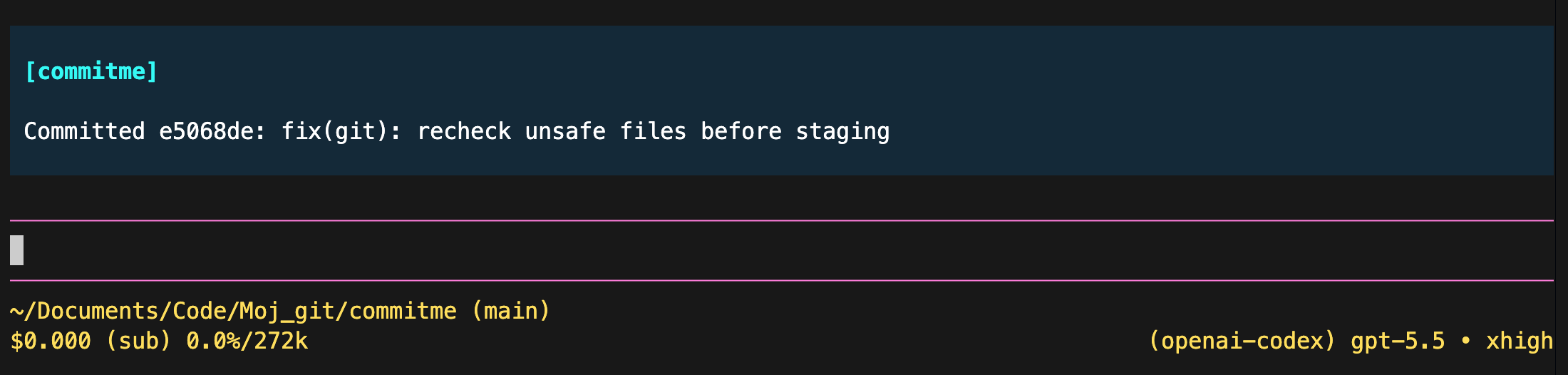
}
Security note
Pi packages can execute code and influence agent behavior. Review the source before installing third-party packages.
README
CommitMe is a pi extension for turning local git changes into clear one-line Lightweight Conventional Commit subjects. It gathers staged and unstaged git context, trims noisy diffs, redacts sensitive content, asks the active pi model for one subject line, then creates a local git commit.
- Local-git native: reads your current repository, stages the gathered changed paths, and commits with
git commit. - Local-model friendly: builds a compact, priority-ordered prompt, reserves output budget, normalizes drafts to one subject line, and retries/repairs weak-model drafts when safe.
- Safety-aware: omits secret-like content from model context and prompts in UI-capable sessions before committing flagged unsafe files.
- No push, no telemetry: CommitMe never runs
git pushand does not send usage telemetry. - Pi-native: use it as a slash command, agent tool, global package, project-local package, git install, or source checkout.
Security: pi packages run with your full system permissions. CommitMe reads git/project files, runs local
gitcommands, stages gathered changed paths, creates local commits, and sends bounded context to your active pi LLM provider. ReadSECURITY.md.
Table of Contents
- Quick Start
- Installation
- Daily Usage
- Shell Command and Local Models
- Commands
- Agent Tool
- Context and Commit Standard
- Safety Model
- Troubleshooting
- Update and Uninstall
- Development
- Publishing
- License
Quick Start
pi install npm:@senad-d/commitme
cd /path/to/your/git/repo
pi
Start with confirmation enabled:
/commitme --confirm --steering focus the message on the command steering support
When you are comfortable with the workflow, run the fast path:
/commitme focus the message on the command steering support
CommitMe will gather the current repository changes, ask your active pi model for a one-line Lightweight Conventional Commit subject, stage the gathered changed paths, and create a local commit. Optional steering text after the command guides the model when it matches the actual git changes.
Installation
| Scope | Command | Notes |
|---|---|---|
| Global | pi install npm:@senad-d/commitme |
Loads in every trusted pi project. |
| Project-local | pi install npm:@senad-d/commitme -l |
Writes to .pi/settings.json in the current project. |
| One run | pi -e npm:@senad-d/commitme |
Try without changing settings. |
| Git | pi install git:github.com/senad-d/commitme@<tag> |
Pin a tag or commit. |
| Local checkout | pi --no-extensions -e . |
Develop or test this repository. |
Source checkout:
git clone https://github.com/senad-d/commitme.git
cd commitme
npm ci
npm run validate
pi --no-extensions -e .
Use a checkout globally while developing:
pi install /absolute/path/to/commitme
Daily Usage
Inside a git repository, run one of these in pi:
/commitme --confirm focus on the bug fix
/commitme --steering add steering support for commit generation
/commitme -- --prefer feat if accurate
/commitme help
Recommended first run:
- Review your working tree with
git status. - Start pi in the repository.
- Run
/commitme --confirm, optionally followed by steering text. - Review the generated message in the confirmation dialog.
- Confirm to stage the gathered changed paths and create the commit.
Use /commitme only when you are comfortable with CommitMe creating the commit immediately after drafting the message. Add steering text when you know the intent and want the model to prefer your wording while still checking the git context.
Shell Command and Local Models
CommitMe works well as a shell command when paired with a local model. The example below uses the LM Studio lms CLI, loads essentialai/rnj-1, runs pi without a saved session, and triggers /commitme.
Add this to ~/.zshrc:
commit() {
  (
    trap 'lms daemon down >/dev/null 2>&1 || true' EXIT INT TERM

    lms load essentialai/rnj-1 \
      --context-length 10000 \
      --gpu max \
      --identifier essentialai/rnj-1 >/dev/null 2>&1

    pi --no-session \
      --model local-llm/essentialai/rnj-1 \
      -p "/commitme $*"
  )
}
Reload your shell and use it from any git repository:
source ~/.zshrc
commit
commit focus on the parser and prompt-builder changes
commit --steering focus on parser flag handling
commit -- --prefer feat when accurate
commit help
Notes:
- Install CommitMe globally first with
pi install npm:@senad-d/commitme, or add-e /absolute/path/to/commitmeto thepicommand while developing from source. - This helper uses
pi --no-session -p, so it is intended for the fast non-interactive path. Use the TUI with/commitme --confirmwhen you want an approval prompt. - Change
essentialai/rnj-1andlocal-llm/essentialai/rnj-1to match your local model provider and model id. - Increasing context length alone may not fix empty local-model drafts. Some reasoning models can spend their whole output budget on thinking/reasoning and return no final text.
- If your local provider exposes a thinking/reasoning setting, lower or disable it for CommitMe if drafts are empty or stop by length.
- Remove the
trapline if you do not want the function to shut down the LM Studio daemon after each run. - Rename the function to
commitme()if you do not want to shadow acommitalias or function.
Commands
| Command | Description |
|---|---|
/commitme [steering prompt] |
Generate a message, stage the gathered changed paths, and create a local commit. Optional steering guides wording, emphasis, type, and scope when supported by the git context. |
/commitme --confirm [steering prompt] |
Generate a message, ask for confirmation, then commit only if you approve. |
/commitme --steering <prompt> |
Pass explicit steering text (--steering=<prompt> also works). This is equivalent to positional steering and can be combined with --confirm. |
/commitme -- --prompt-that-starts-with-a-dash |
Use -- before positional steering text that begins with - or --. |
/commitme help |
Show in-session help. /commitme --help and /commitme -h also work. |
CommitMe waits for the current agent turn to finish before it gathers context. It aborts when there are no staged or unstaged changes.
Agent Tool
CommitMe also registers a commitme tool for agents.
| Tool action | Behavior |
|---|---|
action: "gather" |
Read-only. Returns compact git/project context and a subject-line prompt. Accepts optional steeringPrompt guidance. |
action: "commit", message: "..." |
Uses the provided final one-line subject, stages gathered changed paths, and creates a local commit. This path does not need an active model. |
action: "commit" without message |
One-shot /commitme parity path. Gathers context, drafts with the active pi model, validates the subject, optionally confirms when confirm: true, stages gathered changed paths, and creates a local commit. Accepts optional steeringPrompt. |
Use action: "gather" when you want pi to draft a message without immediately committing, or when another workflow needs bounded git context. Use action: "commit" only when you explicitly want a local git commit.
The commitme tool returns control to the agent after every outcome instead of terminating the agent loop. Multi-step requests such as “commit and push” can therefore continue with a dedicated push tool after CommitMe creates the local commit. CommitMe itself never pushes.
Context and Commit Standard
CommitMe gathers a compact bundle from the current repository and sends it in a local-model-friendly order:
- output contract and drafting process
- current branch and porcelain status
- staged and unstaged changed paths
- staged and unstaged diff stats
- safe snippets from changed text files
- bounded, redacted diff excerpts
- omitted-context notices and warnings
- lower-priority project metadata such as
package.json, README, changelog, and common build config files - truncation metadata and visible truncation notices
Contents from generated, binary-looking, unreadable, overly large, symlinked, symlink-aliased, and secret-like changed files are omitted from model context. Commit actions still locally scan changed files, including generated and binary-looking paths, for high-confidence secret tokens before staging; unreadable changed files and symlinks to sensitive repository paths are treated as unsafe.
CommitMe validates and normalizes the final subject to this one-line Lightweight Conventional Commit shape:
<type>(optional-scope): <summary>
Allowed types: feat, fix, refactor, docs, test, chore, build, ci, perf, style, and revert.
Summaries should be imperative, clear, specific, and must not end with a period.
For command drafting, gather-tool prompts, and message-less commitme action="commit" drafting, CommitMe uses separate system and repository-context prompts where supported by pi, sizes the prompt to the active model when available, keeps the prompt bounded even for very large context-window local models, and asks for only the final subject line. If a model returns a verbose message with a body, CommitMe automatically extracts the first valid Conventional Commit subject and commits only that line. If a model returns empty text, thinking-only content, a length-stopped response, or an invalid subject, CommitMe retries or repairs once where safe and still refuses to commit without a validated subject.
Safety Model
- CommitMe never runs
git push. - CommitMe does not send telemetry.
- CommitMe uses only local
gitcommands and the active pi LLM provider. /commitme --confirmandcommitme action="commit", confirm: truerequire a UI-capable pi mode.- If known secret paths, unreadable changed files, or high-confidence secret-like content are detected in a UI-capable session, CommitMe asks whether those flagged files are safe to commit; declining blocks the commit before staging.
- The
commitmetool mutates git history locally only foraction: "commit"; message-less commit mode drafts like/commitme, while explicit-message mode uses the provided final subject. - Commit actions abort before staging if known secret files, unreadable changed files, or high-confidence secret tokens would be committed in non-UI mode or if UI approval is denied.
.env.*files such as.env.example,.env.local, and.env.productionare allowed by path; their contents are still redacted for model context and scanned for high-confidence secret tokens before staging.- Large, generated, binary-looking, unreadable, symlinked, and symlink-aliased changed-file contents are omitted from model context, but CommitMe still scans regular changed files locally to detect high-confidence secret tokens before staging.
- Renames from sensitive paths and symlinks to sensitive repository paths stay omitted from model context and are checked or marked unsafe before staging.
- Commit actions recheck unsafe content immediately before staging.
- Commit actions stop if git status changes after context gathering.
- Commit actions validate and normalize the drafted message to one subject line before confirmation, staging, or committing.
- Diff collection disables Git external diff and textconv commands.
- Ordinary placeholder examples such as
TOKEN=not-realmay be redacted from model context but are not treated like real secrets.
See SECURITY.md for details.
Troubleshooting
| Problem | Try |
|---|---|
CommitMe must be run inside a git repository |
Start pi from a repository checkout. |
| No changes found | Check git status; CommitMe needs staged or unstaged changes. |
| No active model or API key | Select/configure a pi model, or use the local-model shell function above. |
--confirm requires a UI-capable Pi mode |
Run pi with the TUI, or use /commitme without confirmation in non-UI mode. |
| Commit flagged for secret files/tokens or unreadable files | In the TUI, approve only if you reviewed the files and they contain safe fixtures/placeholders. In non-UI mode, remove the file/token, make the changed file readable, or commit manually if intentional. |
| Git status changed while CommitMe was running | Rerun CommitMe so it can gather fresh context. |
| Local model is too slow | Use a smaller model or shorten the diff before running CommitMe. |
Empty local-model draft, thinking-only response, or stopReason=length |
CommitMe retries with a shorter final-answer prompt and larger output budget when possible. If it still fails, reduce the change size, lower/disable model thinking, try /commitme --confirm, or use the commitme gather tool and ask the agent to draft manually. |
| Verbose local-model draft with a body | CommitMe automatically extracts the first valid Conventional Commit subject and commits only that one line. |
| Invalid Conventional Commit draft | CommitMe attempts deterministic cleanup/repair but refuses to stage or commit unless the final subject validates. Add clearer steering text or gather context manually with the commitme tool. |
Update and Uninstall
pi update --extensions
pi update npm:@senad-d/commitme
pi remove npm:@senad-d/commitme
pi remove npm:@senad-d/commitme -l
Development
npm ci
npm run validate
Useful checks:
npm run typecheck
npm run lint
npm run format:check
npm run test
npm run check:pack
pi --no-extensions -e .
Publishing
CommitMe publishes to npm as @senad-d/commitme. Run from a clean working tree after updating CHANGELOG.md.
npm login
npm whoami
npm run validate
npm version <version>
npm publish --access public
Push the release commit and tag after the package is published.
License
MIT