@spences10/pi-factory
Reusable software-factory control plane for Pi workflows
Package details
Install @spences10/pi-factory from npm and Pi will load the resources declared by the package manifest.
$ pi install npm:@spences10/pi-factory- Package
@spences10/pi-factory- Version
0.0.7- Published
- Jul 20, 2026
- Downloads
- 588/mo · 588/wk
- Author
- spences10
- License
- MIT
- Types
- extension, skill
- Size
- 651.7 KB
- Dependencies
- 3 dependencies · 2 peers
Pi manifest JSON
{
  "extensions": [
    "./dist/index.js"
  ],
  "skills": [
    "./skills"
  ],
  "image": "https://raw.githubusercontent.com/spences10/my-pi/main/assets/pi-package-preview.png"
}Security note
Pi packages can execute code and influence agent behavior. Review the source before installing third-party packages.
README
@spences10/pi-factory




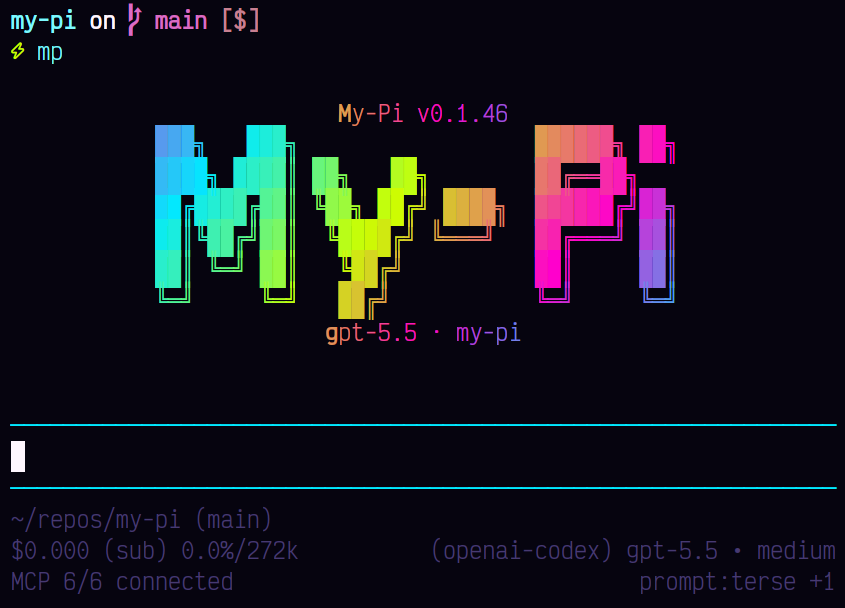
A governed workflow control plane for Pi. It routes complex software work through one task contract, one harness, deterministic validation, independent review, and explicit approval gates.
Use Factory for ambiguous or high-risk work, coordinated delivery, or changes that need review gates. Routine changes in one coding session do not need Factory solely because a commit or push was requested.
Installation
pi install npm:@spences10/pi-factory
Local development from this monorepo:
pnpm --filter @spences10/pi-factory run build
pi install ./packages/pi-factory
# or for one run only
pi -e ./packages/pi-factory
How it works
preview → contract → execute → validate → review → approve → outcome
- Preview a task to see the selected workflow, risk, compute policy, validation, review mode, and required approvals.
- Start the task to create its durable workflow state and one
authoritative
pi-harness. - Factory progresses eligible planning, execution, and validation through an owned adapter or an explicit peer handoff.
- Failed gates produce bounded feedback rather than redefining success.
- Required side effects stop for human approval before the workflow records its outcome.
Factory includes workflows for chores, features, ambiguous bugs, UI copy, database migrations, incidents, architecture, and safe releases. Routing can strengthen a requested workflow when the affected surface or safety signals require it.
Commands
/factory preview <task>
/factory start <task>
/factory status <workflow-id>
/factory resume <workflow-id>
/factory cancel <workflow-id>
/factory metrics
The bundled factory tool provides the full workflow API used by the
agent. Detailed operating instructions are supplied by the bundled
software-factory skill, so
they do not need to be repeated here.
What it provides
- explained, complexity-aware workflow routing
- a versioned task contract and one authoritative harness
- one mutating owner with explicit ownership transfer
- owned RPC execution or acknowledged peer handoff
- deterministic validation with bounded retries
- diff-bound independent review
- explicit approval gates for commit, push, deploy, release, destructive, and configured public-contract actions
- durable recovery, terminal outcomes, and correlated metrics
- optional repository policy, external intake, and calibration APIs
Workflow state is stored under Pi's agent directory, normally
~/.pi/agent/factory. Set MY_PI_FACTORY_DIR to use another
location.
Safety boundary
Factory supervises only processes started through an owned execution adapter. It does not spawn or control independently opened Pi sessions, and mailbox delivery is not evidence that a peer completed work.
Process settlement is not task success. Completion requires evidence bound to the current contract, validation, review, and approval state. Factory never infers human approval from validation, silence, delivery, or model output.
See the v1 architecture boundary for the detailed responsibility map, compatibility guarantees, and unsupported claims.
Using from a custom runtime
import factory from '@spences10/pi-factory';

// pass `factory` as an ExtensionFactory to your Pi runtime
The package also exports its dispatcher, state engine, execution adapters, policy, review, metrics, intake, and calibration APIs for programmatic integrations.
Development
pnpm --filter @spences10/pi-factory run check:self
pnpm --filter @spences10/pi-factory run test:self
pnpm --filter @spences10/pi-factory run build
License
MIT