@spences10/pi-footer
Configurable Pi footer/statusline that keeps model, project, Git, token, and runtime state visible
Package details
Install @spences10/pi-footer from npm and Pi will load the resources declared by the package manifest.
$ pi install npm:@spences10/pi-footer- Package
@spences10/pi-footer- Version
0.0.16- Published
- Jul 26, 2026
- Downloads
- 1,365/mo · 248/wk
- Author
- spences10
- License
- MIT
- Types
- extension
- Size
- 96.3 KB
- Dependencies
- 2 dependencies · 3 peers
Pi manifest JSON
{
  "extensions": [
    "./dist/index.js"
  ],
  "image": "https://raw.githubusercontent.com/spences10/my-pi/main/assets/pi-package-preview.png"
}Security note
Pi packages can execute code and influence agent behavior. Review the source before installing third-party packages.
README
@spences10/pi-footer




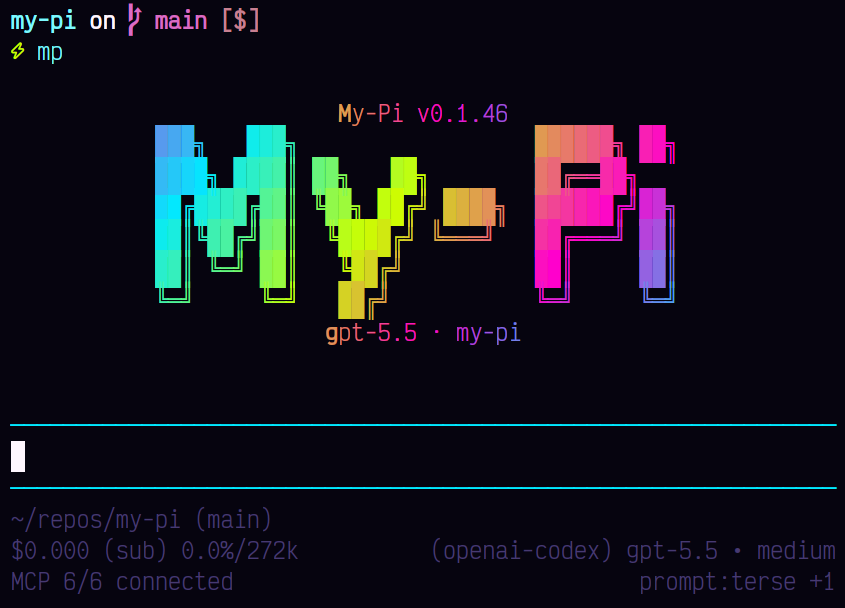
See the session state that matters without leaving Pi. pi-footer
adds a configurable statusline for model, project, Git, token, and
runtime signals so long agent sessions stay easy to orient and trust.
Upstream Pi boundary
Pi owns the footer lifecycle through ctx.ui.setFooter(...) and
status transport through ctx.ui.setStatus(...) plus the footer data
provider. This package directly calls setFooter and reads the data
provider; it does not call, wrap, or re-export setStatus. Other
extensions publish status values through setStatus, and Pi supplies
them to this renderer through the provider. Without the curated
layouts below, Pi's built-in footer already renders core session data
and extension statuses.
pi-footer adds the configurable part: presets, density and tone,
selectable widgets, multi-row status placement, persistent settings,
and the /footer live-preview workflow. Installing it replaces Pi's
built-in footer renderer with that curated UI while continuing to read
status values published through Pi's native API. Session names are
read from Pi on every render; Pi invalidates the footer when
session_info_changed fires, so this package does not poll session
metadata.
Token and cost widgets follow Pi's canonical session accounting: assistant responses, nested LLM usage returned by tools, compaction summaries, and branch summaries are each counted once. Context percentage remains Pi's active-model context usage and is separate from these cumulative billed totals.
Library API
@spences10/pi-footer is both a Pi extension and a supported library.
The package root is the only public import path; files under dist/
are implementation details.
import footer_extension, {
	FOOTER_PRESETS,
	get_current_thinking_level,
	render_footer_status_line,
} from '@spences10/pi-footer';
The root API includes:
- the default Pi extension;
get_current_thinking_levelandget_default_footer_thinking_levelfor model-thinking status;render_footer_lines,render_footer_status_line, andrender_footer_three_column_linefor footer rendering;FOOTER_PRESETS,FOOTER_DENSITIES,FOOTER_STATUS_ALIGNMENTS,FOOTER_TONES,FOOTER_WIDGETS, plusFooterPreset,FooterDensity,FooterStatusAlignment,FooterStatusLayout,FooterStatusPlacement,FooterTone, andFooterWidgetfor configuration-aware integrations;FOOTER_COLORSandFooterThemefor theme-compatible rendering;FOOTER_RESEARCH_REFERENCES, the reference metadata shown by the/footerpreset guidance.
These root exports are compatibility-supported. Additive changes can ship in minor or patch releases, while removing or changing an export requires a breaking release.
Commands
/footer— configure layout, density, appearance, visible content, and extension-status placement with a live preview.
Extension statuses published through ctx.ui.setStatus(...) can be
assigned independently to any numbered row, aligned left, center, or
right, or hidden. Populated rows render in order; empty rows collapse
automatically. Compact density renders the first populated status row.
The default layout keeps harness and prompt state on row 1, then
places MCP/service health on row 2 left and Codex usage on row 2
right. Footer choices persist under the packages.footer section in
~/.pi/agent/my-pi-settings.json.
Presets
default— current my-pi-style 2–3 line footer.minimal— compact cwd/model/context footer.power— fuller status-forward layout.git-heavy— emphasizes cwd/git/status widgets.
Development
Package scripts build transitive workspace dependencies first, then
run local tools through Vite+ with vp exec.
pnpm --filter @spences10/pi-footer run check
pnpm --filter @spences10/pi-footer run test
pnpm --filter @spences10/pi-footer run build