@tinysquid/pi-opencode-go-usage
OpenCode Go plan usage in pi: footer status line (5h/weekly/monthly) + /opencode-go usage table, via the opencode.ai console API
Package details
Install @tinysquid/pi-opencode-go-usage from npm and Pi will load the resources declared by the package manifest.
$ pi install npm:@tinysquid/pi-opencode-go-usage- Package
@tinysquid/pi-opencode-go-usage- Version
0.2.1- Published
- Sep 22, 2026
- Downloads
- 174/mo · 135/wk
- Author
- tinysquid
- License
- MIT
- Types
- extension
- Size
- 187.8 KB
- Dependencies
- 0 dependencies · 1 peer
Pi manifest JSON
{
  "extensions": [
    "./opencode-go-usage.ts"
  ]
}
Security note
Pi packages can execute code and influence agent behavior. Review the source before installing third-party packages.
README
@tinysquid/pi-opencode-go-usage
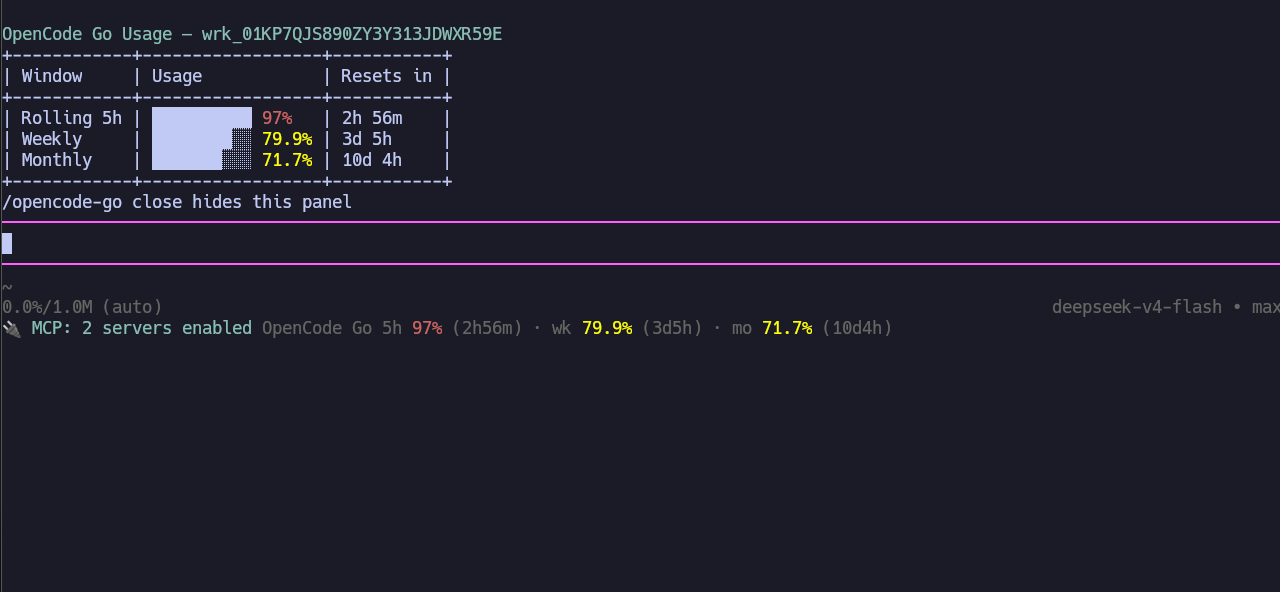
Shows OpenCode Go plan usage — rolling 5-hour, weekly, and monthly percentages and reset times — inside pi: a status line appended to the built-in footer (refreshed in the background) and a /opencode-go usage table. Usage data comes from opencode.ai's console API (GET /console/api/go/status), authenticated with your browser's __Host-console_session cookie and your workspace id.
0.2.0 — API migration. opencode.ai replaced the dashboard page with an API. The old
authcookie no longer works; re-authenticate with/opencode-go session-cookieusing the__Host-console_sessioncookie'sst_…value. The oldauth-cookiesubcommand name is kept as an alias.
Install
pi install npm:@tinysquid/pi-opencode-go-usage
For local development, symlink the extension directory (multi-file extensions must be loaded as a directory, not a single file):
ln -sfn $(pwd)/opencode-go-usage ~/.pi/agent/extensions/opencode-go-usage
Screenshots
What it does
- Footer status line (via
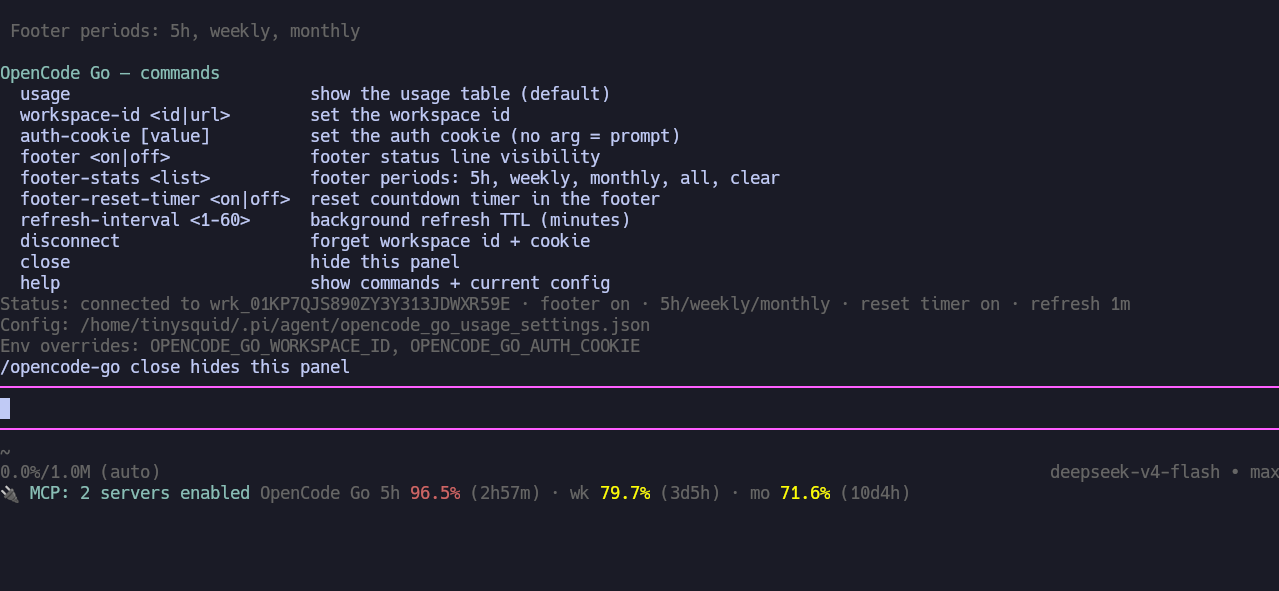
ctx.ui.setStatus, joined onto the built-in footer's extension-status line; the footer itself is never replaced):OpenCode Go 5h 62% · wk 31% · mo 44%, or with countdowns on:OpenCode Go 5h 62% (1h12m) · wk 31% (3d4h) · mo 44% (12d0h). Percentages are colored: dim below 70%, warning at 70%+, error at 90%+. /opencode-go(or/opencode-go usage) — force-fetches and shows a bordered ASCII table widget above the editor with a usage bar, percentage, and reset countdown per window./opencode-go closehides it./opencode-go workspace-id <id|url>— sets the workspace (org) id, sent as thex-org-idheader. Accepts a barewrk_…id or a full dashboard URL (https://opencode.ai/workspace/wrk_…/goorhttps://opencode.ai/console/wrk_…/go); the id is extracted and validated./opencode-go session-cookie [value]— sets the console session cookie. With no argument it prompts via an input dialog (recommended: inline slash-command text is persisted to session history, dialog input is not). The dialog is not masked. Accepts a barest_…value, a__Host-console_session=…pair, or a fullCookie:header line containing the pair; stored normalized to the barest_…id. The oldauth-cookiespelling still works as an alias./opencode-go footer <on|off>— toggles footer status visibility (no argument = toggle)./opencode-go footer-stats <list>— sets which periods the footer shows:5h,weekly,monthly, a comma list (5hr,mo),all, orclear/none. Aliases:5h/5hr/rolling,weekly/wk/week,monthly/mo/month. Stored in canonical order./opencode-go footer-reset-timer <on|off>— toggles reset countdown timers in the footer (no argument = toggle). Default off./opencode-go refresh-interval <1-60>— background refresh TTL in minutes. Default 3./opencode-go disconnect— forgets workspace id + cookie (display settings kept). Warns ifOPENCODE_GO_*env vars still supply credentials./opencode-go help— command list + current config state as a widget.- Subcommand and value autocomplete while typing the command. Typing just
/opencode-goimmediately offers the subcommand list (the extension wraps the autocomplete provider) — Tab or Enter picks a subcommand without needing a space first. - Background refresh: a 30s timer fetches only when the cached data is older than the TTL;
turn_endalways refreshes (usage just changed); theusagecommand always fetches. Concurrent triggers share one in-flight request. - On session start the extension loads the config, creates the default config file if missing, renders the footer immediately (last known state or a setup hint), and fetches without blocking startup.
Configuration
Config file: ~/.pi/agent/opencode_go_usage_settings.json (created with defaults, mode 0600, on first load; all writes are atomic tmp+rename at 0600):
{
  "workspaceId": "",
  "sessionCookie": "",
  "footerEnabled": true,
  "footerPeriods": ["5h", "weekly", "monthly"],
  "footerCountdowns": false,
  "refreshMinutes": 3
}
- Env vars override the file:
OPENCODE_GO_WORKSPACE_ID,OPENCODE_GO_SESSION_COOKIE. Commands that save a field warn when a matching env var takes precedence. - Manual edits are validated per field; invalid values fall back to that field's default (never crash).
footerPeriodsaccepts alias tokens; a non-array value falls back to all three. An empty array is valid and means "no periods in the footer".refreshMinutesis clamped to 1–60. - Every setting is also managed by the commands above; the file is the escape hatch, not the primary interface.
- The
__Host-console_sessioncookie is a browser session credential: the file is 0600, the recommended way to set it is the/opencode-go session-cookieprompt (keeps it out of session history files), and env vars are an alternative. Never commit it. Configs from pre-0.2.0 versions are migrated in place (authCookie→sessionCookie); the oldauthcookie value is dead and must be replaced with the new session value.
Behavior notes
- Unconfigured: the footer shows a dim hint
OpenCode Go: not configured · /opencode-go help(suppressed whenfooterEnabledis false);/opencode-go usageshows setup instructions. - Failure display: on fetch failure the footer keeps the last data with a
· stalemarker; if no data was ever fetched it shows the error (e.g.OpenCode Go: session expired — set a fresh one with /opencode-go session-cookie). The table showsStale — <error>under the data. - A 401/403 response, or a 200 whose JSON parses but carries no meters, is reported as an expired/invalid session cookie. A 200 with meters missing some window (e.g. no
month) simply omits that row. - The API reports usage in microcents; the extension converts to percentages and never displays dollar amounts. A schema change in the payload will surface as
no usage data in response — opencode.ai API may have changed. - Print mode (
pi -p):usageandhelpprint to stdout; UI-dependent features (footer, widgets, the cookie prompt) are inactive — pass the cookie as an argument instead. - Requests go to
https://opencode.ai/console/api/go/statuswith the session cookie, thex-org-idheader, and a 20s timeout.