@tranhoangnguyen0310/pi-flow-external
External Claude Code, Codex CLI, and Antigravity delegation for pi.
Package details
Install @tranhoangnguyen0310/pi-flow-external from npm and Pi will load the resources declared by the package manifest.
$ pi install npm:@tranhoangnguyen0310/pi-flow-external- Package
@tranhoangnguyen0310/pi-flow-external- Version
1.0.10-external.2- Published
- Jul 16, 2026
- Downloads
- 289/mo · 213/wk
- Author
- tranhoangnguyen0310
- License
- MIT
- Types
- extension
- Size
- 516.2 KB
- Dependencies
- 1 dependency · 5 peers
Pi manifest JSON
{
  "extensions": [
    "./index.ts"
  ],
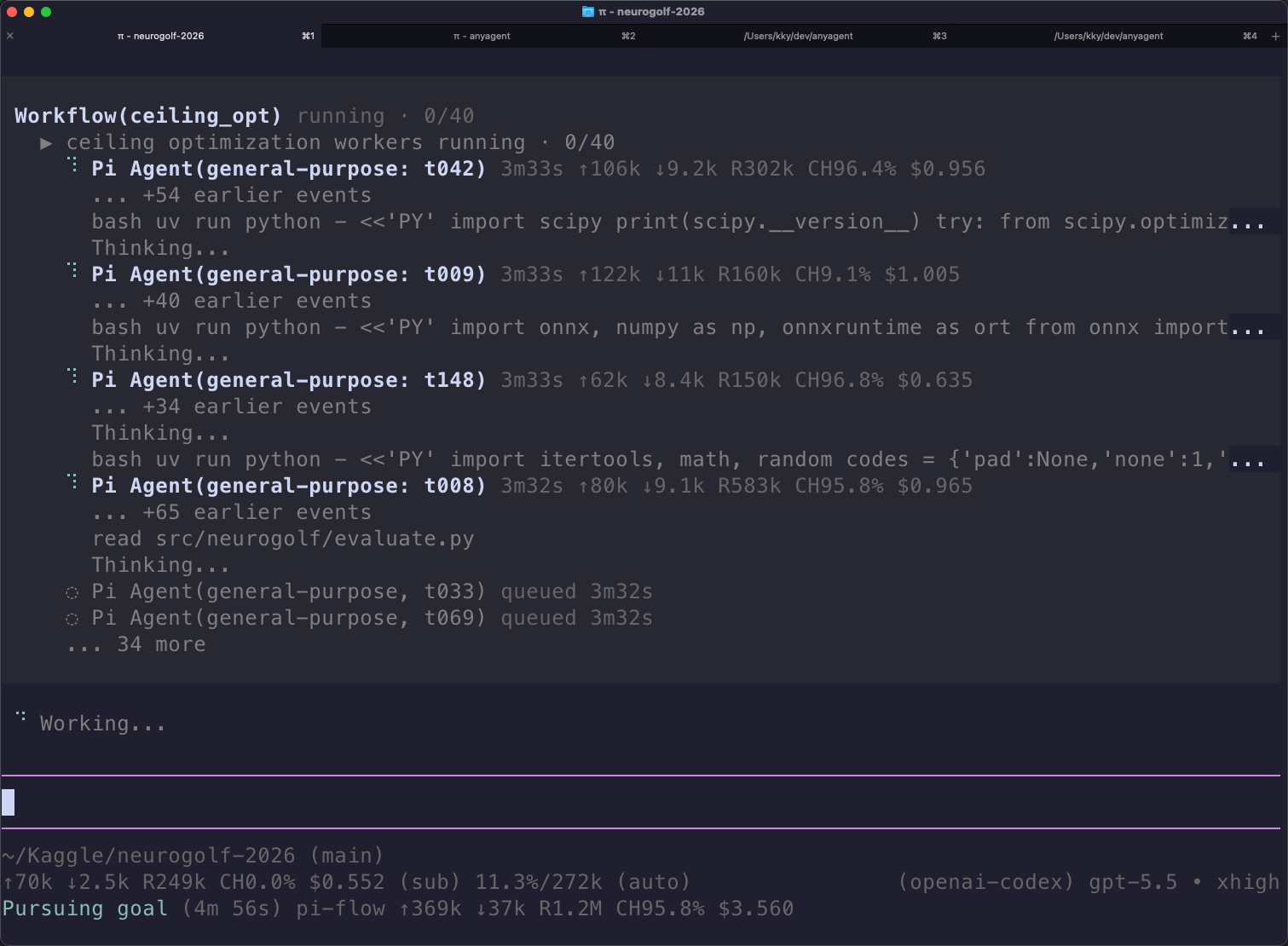
  "image": "https://raw.githubusercontent.com/tranhoangnguyen03/pi-flow-external/main/assets/pi-flow.png"
}
Security note
Pi packages can execute code and influence agent behavior. Review the source before installing third-party packages.
README
pi-flow external
External Claude Code, Codex CLI, and Antigravity delegation for pi.
This fork intentionally narrows pi-flow's Agent and workflow subagent lanes to external CLI backends only:
- Claude Code via profiles with
backend: claude - Codex CLI via profiles with
backend: codex - Antigravity via profiles with
backend: agy
Use pi's native subagent system for Pi-backed agents such as scout, reviewer, planner, worker, or oracle. Use this extension only when you explicitly want another agent harness.
Why this fork exists
The upstream pi-flow package can launch Pi, Codex, and Claude subagents through the same Agent tool. That is powerful, but it creates routing ambiguity when pi also exposes a native subagent system.
This fork enforces a global split:
Native Pi delegation      -> native subagent tool
External harnesses        -> Agent / workflow from this extension
That keeps prompts predictable across projects:
- "Use scout/reviewer/planner" means native Pi subagents.
- "Ask Claude Code" means an
Agentprofile named likeclaude-*. - "Ask Codex" means an
Agentprofile named likecodex-*. - "Ask Antigravity" means an
Agentprofile named likeagy-*.
Install
Global install from npm; the npm: prefix is required:
pi install npm:@tranhoangnguyen0310/pi-flow-external
pi list
Project-only install:
pi install -l npm:@tranhoangnguyen0310/pi-flow-external
Project packages load after project trust. In a fresh project, pi list --approve can display a project package before trust so you can approve it.
Local development examples:
cd /path/to/pi-flow-external
pi install "$(pwd)"
Run once from a checkout without installing:
cd /path/to/pi-flow-external
pi -e ./index.ts
Prerequisites and onboarding
This npm package installs the Pi extension only. It does not install or authenticate Claude Code (claude), Codex CLI (codex), or Antigravity (agy). At least one selected CLI must be installed, on PATH, and authenticated:
claude --version
codex --version
agy --version
External profiles run those CLIs in no-approval/dangerous modes (claude ... --dangerously-skip-permissions, codex exec ... --dangerously-bypass-approvals-and-sandbox, agy --dangerously-skip-permissions). Use them only in trusted repositories.
No usable external profiles are bundled. Create backend-qualified profiles in ~/.pi/agent/subagents/*.md before Agent or workflow can run. Project-only package installation still reads profiles from that global agent directory; project-local profiles are not currently supported.
Define external profiles
Custom profiles live in ~/.pi/agent/subagents/<name>.md. Valid profile names use lowercase letters, numbers, and hyphens. Only profiles whose frontmatter sets backend: claude, backend: codex, or backend: agy are shown to, and accepted by, Agent/workflow.
Claude profile, ~/.pi/agent/subagents/claude-explorer.md:
---
description: Repository exploration through Claude Code.
backend: claude
model: sonnet
thinking: high
---

Explore the repository read-only. Identify architecture, entry points, tests, configuration, risks, and recommended first-read files.
Codex profile, ~/.pi/agent/subagents/codex-explorer.md:
---
description: Broad code search through Codex CLI.
backend: codex
model: gpt-5.4-mini
thinking: high
---

Search broadly and summarize findings with file references. Do not edit files.
Antigravity profile, ~/.pi/agent/subagents/agy-reviewer.md:
---
description: Code review through Antigravity.
backend: agy
thinking: high
---

Review the requested change for correctness, regressions, and missing validation. Do not edit files.
Do not add tools: expecting it to control external CLI tools; external backends use their own tool surface. Profiles with backend: pi or missing backend are rejected by design. Use the native subagent system for those jobs.
Use from Pi
Natural request:
Ask Claude Code to explore this repository read-only and summarize the architecture.
Exact/manual profile selection is more deterministic:
Use the Agent tool with subagent_type "claude-explorer" to explore this repository read-only and summarize the architecture.
Parallel request using named profiles:
In parallel, use the Agent tool with subagent_type "claude-explorer" to map the architecture and subagent_type "codex-explorer" to search for tests and entry points. Synthesize their findings.
Workflow/fan-out request:
Use the workflow tool to fan out repository review with explicit external profiles "claude-explorer" and "codex-explorer", then synthesize the results.
Explicit profile naming is the most deterministic form. Every Agent call and every workflow agent() child requires subagent_type.
Advanced: tool-call shape
Agent({
  description: "Claude repo map",
  subagent_type: "claude-explorer",
  prompt: "Map this repository read-only and summarize important files.",
});
Subagents start fresh in the same working directory. Parent messages and tool results are not inherited, so prompts must be self-contained.
The workflow tool is trusted JavaScript orchestration. Its agent() calls use the same external-only profile roster, and each child needs an explicit backend-qualified subagent_type.
Runtime guardrails
Direct Agent calls and workflow agent() calls share one global concurrency cap and one wall-clock timeout guardrail. Defaults are 12 concurrent subagents and 2 hours per subagent.
pi --max-concurrent-subagents 4 --subagent-timeout-ms 600000
Set --subagent-timeout-ms to 0 to disable the timeout. Values are milliseconds.