@underactive/pi-topping-moa-fusion
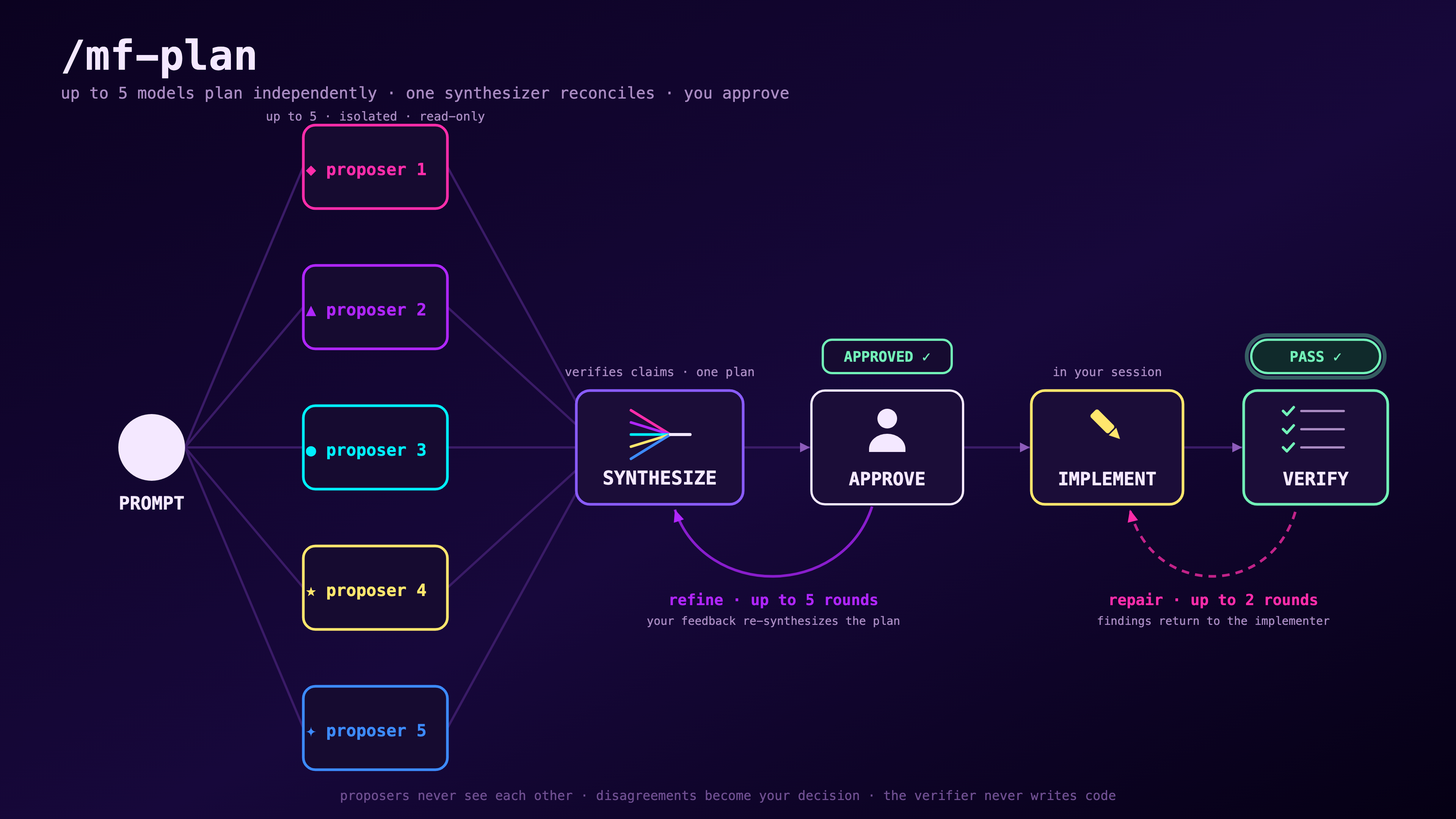
Pi extension implementing /mf-plan — Claude Code-style 5-phase plan mode with a Mixture-of-Agents proposer/synthesizer pipeline.
Package details
Install @underactive/pi-topping-moa-fusion from npm and Pi will load the resources declared by the package manifest.
$ pi install npm:@underactive/pi-topping-moa-fusion- Package
@underactive/pi-topping-moa-fusion- Version
0.4.1- Published
- Oct 1, 2026
- Downloads
- 341/mo · 35/wk
- Author
- underactive
- License
- MIT
- Types
- extension
- Size
- 735 KB
- Dependencies
- 0 dependencies · 5 peers
Pi manifest JSON
{
  "image": "https://raw.githubusercontent.com/underactive/pi-topping-moa-fusion/main/docs/images/mf-plan-workflow.png",
  "extensions": [
    "./index.ts"
  ]
}
Security note
Pi packages can execute code and influence agent behavior. Review the source before installing third-party packages.
README
pi-topping-moa-fusion
A Pi extension built around Mixture of Agents (MoA) planning: several models independently explore your repo, each writes a complete implementation plan, and a synthesizer reconciles them into one stronger plan — surfacing every disagreement as a decision you get to make.
Contents
- Quick Start
- Screenshots
- Mixture of Agents (MoA)
- Commands
- Plan Mode
- Custom Tools
- Subagents
- Plan File Location
- Non-Interactive Behavior
- How It Works (Architecture)
- Porting Notes
Quick Start
pi install npm:@underactive/pi-topping-moa-fusionRun /mf-plan, describe what you want planned, and pick Mixture of Agents when the model picker opens. Assign your models in the MoA Fusion Pre-flight overview, then choose Start fan-out. In the prompt editor, Tab completes file paths and @name fuzzy-searches the repo when fd is available (pi's bundled copy, or fd/fdfind on your PATH); completions insert references, not file contents.
Screenshots
MoA Fusion Pre-flight — assign proposer, synthesizer, implementer, and verifier slots, or load a saved roster before starting fan-out.

MoA Fusion table — watch proposers explore and plan in parallel while synthesis, implementation, and verification remain queued.

Synthesized plan review — inspect the reconciled plan's evaluation dimensions, proposer alignment, and synthesis decisions before approval.

Synthesized plan detail — review the concrete implementation steps produced from the merged proposals.

Mixture of Agents (MoA)
MoA is the reason this extension exists, and the mode it defaults to — the picker lists it first, and saving /mf-plan-settings sets it as your default. Up to 5 models each independently explore the repo and write their own complete implementation plan, then a synthesizer reconciles them into one.
It stays optional. Single-model planning is one keystroke away and runs the full 5-phase workflow on your active model. But MoA is worth preferring for anything non-trivial:
- Independent proposals surface options one model won't. Each proposer explores the repo on its own with no shared context, so they genuinely diverge on approach rather than converging on one model's first instinct.
- Claims get checked. The synthesizer has read-only repo access and verifies proposer claims about file paths, functions, and line numbers instead of trusting them — catching the confident-but-wrong details a single planner would carry straight into the plan.
- Disagreements become your decision. Where proposers took different approaches, you get an explicit conflict-review tab with the tradeoffs spelled out, instead of a silent choice buried in someone's plan.
The cost is real: an MoA run spends roughly N× the tokens of a single-model plan, takes as long as its slowest proposer, and wants several providers configured to be worth doing. For a one-line fix, use single model.
Why prose, not code
Fanning out a coding task and merging the resulting token streams does not work — different models produce wildly different code for the same problem, and any aggregator splicing them together introduces its own bias. MoA here never fuses code. Proposers write plans in prose, which is far easier to reconcile than syntax: a disagreement like "model A wants a migration, model B wants an in-place patch" is legible enough to evaluate on the merits. Code is written afterward, from the single merged plan, by one agent.
How a run works
- After you submit your plan prompt, a picker opens on a mode screen (Mixture of Agents or Single model). Single model — or Esc — runs the 5-phase workflow on the current model.
- MoA opens the MoA Fusion Pre-flight overview with all eight slots — five proposer slots plus a synthesizer, an implementer, and a verifier — starting empty at
(none), plus a Load Roster row above Start fan-out that applies a saved agent roster to every slot at once (see Agent rosters). Selecting any slot row opens a two-pane model/thinking picker for that one slot and returns to the overview; cancelling leaves the slot unchanged, and Backspace (or Delete) on a slot row clears it back to(none). Start fan-out stays disabled until you assign at least two proposer slots and all three required roles (the minimum roster; the same model may fill several slots, and the extra proposer slots are optional). Thinking levels come from the model's pi registry metadata, which is authoritative for every model the registry lists; the genericoff/low/medium/highlist applies only to models it doesn't. Your saved choices and active model only pre-highlight a slot's picker — they never count as assignments until you confirm them — and confirmed selections are remembered in~/.pi/agent/mf-plan/settings.json. - Proposers run in parallel as isolated
moa-proposersubprocesses. Each ends with an "Open Questions / Assumptions" section rather than pausing — proposers never block waiting on input. moa-synthesizerreads every successful proposal (at least 1 must succeed) plus the original request, and writes one merged plan.- If the proposers substantively disagreed, a conflict-review overlay opens first: one tab per conflict, plain-language options, the synthesized pick tagged (Recommended), and a Chat about this box for free-text feedback. Your resolutions are fed back for re-synthesis. Esc cancels the whole run.
- The plan opens in the same review overlay
exit_plan_modeuses, where you can inspect any proposer's original plan, edit the synthesized one, or send the synthesizer feedback for a revised version (up to five rounds). - On approval, the synthesizer makes one read-only pass to create a frozen observable checklist at
.pi/mf-plan/<slug>__criteria.md, then plan mode exits and implementation begins in the current session using the implementer you already picked — there is no second picker (the single-model flow picks its implementing model up front when you choose Single model, and neither flow shows a model picker after approval — one appears only via/mf-plan-implement, or when an MoA run is resumed without a saved roster). If implementation fails (for example, auth expiration or provider error), an automatic recovery dialog prompts to retry, switch to a different model, or continue manually. You can also run/mf-plan-implementanytime to resume the approved plan. - Once the implementation turn settles, the verification phase runs when a verifier is configured: the project's own
check/lint/testscripts run first, then a read-onlymoa-verifiersubprocess judges the working tree against the frozen approved plan and scores every frozen criterion pass/fail/cannot-verify. The overall verdict is derived from those scores. If criteria are unavailable, it falls back to judging plan steps directly. If it finds gaps (or a check fails), the repair prompt shows a short Simplified Technical English summary, then the verifier summary, unmet criteria or gaps, and failing project checks, followed in the TUI by three choices in order: View full findings, Send verifier findings to the implementer (a bounded repair round, up to the max verification repairs setting — two by default), and Accept implementation as-is. View full findings opens the complete verifier report in a read-only, scrollable popup and, when closed, returns to the same three choices, so viewing never consumes a repair round. A repair round sends the findings back to the implementer and re-verifies. The raw verdict is saved next to the plan as<slug>__verification.md. Once the repair budget is spent, a handoff file is written as<slug>__verification-handoff.mdand named in the exhaustion notification. A user-cancelled implementation is never verified.
Before building the full verification task, MoA Fusion runs a cheap verifier preflight that asks for a one-word response. Auth, quota, model, and liveness problems therefore surface quickly with an actionable child error instead of after the full audit attempt.
Verification troubleshooting. If criteria generation fails, implementation continues and verification falls back to plan-step mode. If verification cannot complete, the dialog shows the underlying child error (including provider or spawn details), and failed output is saved at .pi/mf-plan/<slug>__verification.md.
How the synthesizer works
The synthesizer's contract (agents/moa-synthesizer.md) is to produce a new plan — selecting one proposal, or lightly editing a favorite, is defined as failure.
Several safeguards target known LLM judging biases:
- Identity blinding — proposals arrive headed
### Proposal from Proposer N; real model names never appear in its input. This counters self-preference bias, where a model favors output it recognizes as its own. Enforcement runs both ways: proposers must not hint at their own model name, family, or provider, and the synthesizer must not infer or emit one — including in its own output, which keeps re-synthesis rounds blind too. - Separate evaluation dimensions — proposals are judged on correctness, completeness, feasibility, risk, and simplicity as distinct dimensions rather than one overall impression. The prompt states outright that confidence, detail, and length are not evidence of quality, guarding against verbosity bias.
- Agreement is signal, not proof — where proposers agree, the synthesizer still sanity-checks the shared assumption against the repo, since independent models can share the same error. A blinded
Panel dependence:note in the synthesizer input names how many distinct models contributed and which slots share one model, and the pre-flight picker warns when assigned slots repeat a model or provider. - Auditable reasoning — the plan opens with a Context section recording dimension reasoning, proposer alignment, and synthesis decisions, so recombination choices are inspectable.
### Proposer alignmentlabels support as evidence-backed or asserted, and conflict recommendation Details lines include distinct-model support counts. Reconciliation commentary is confined there; the rest reads as one coherent plan. The orchestrator verifies all three subsections are present and rejects a first plan that omits them (one corrective retry, then a warning), the same way it enforces## Proposer Verdicts. - Disagreements go to the user — every substantive disagreement must be emitted as a
## Conflictsblock, even when the synthesizer is confident, so its judgment is a default you can override rather than a decision made for you. Genuine ambiguity about your intent instead produces a single## Open Question, and the synthesizer is re-run with your answer.
Protocol-internal, always current at runtime. The proposer, synthesizer, and verifier prompts are tightly coupled to this extension's parsers and UI (e.g. the ## Conflicts markup, and the verifier's **Verdict:**/### Gaps markup). A hand-edited copy under ~/.pi/agent/agents/ is still written for inspection, but MoA runs always use the bundled definition from the installed extension, so a protocol update can never desync from what the subprocess runs. moa-explore and mf-plan remain fully user-customizable.
Implementation failures
If the picked implementing model fails immediately upon kickoff (such as an expired session, auth failure, or provider outage), an automatic recovery prompt appears offering:
- Retry with — retry kickoff with the same model.
- Choose a different model — pick a replacement model from the registry.
- Continue manually — keeps the plan safely saved on disk.
The approved plan is persisted across session restarts. You can run /mf-plan-implement at any time to re-send the approved plan and optionally pick a new implementing model.
The MoA Fusion table
When an MoA run starts, a MoA Fusion table pins itself above the editor and stays there for the whole run — proposer fan-out, synthesis, the in-session implementation turn, and verification. The plan's summarized name sits at the right of the title bar.
Under the title, a phase band traces the pipeline — Plan › Synthesize › Implement › Verify — with each phase's model beneath its name. The active phase shimmers. (The band's chevrons are Powerline glyphs; without a Nerd Font they render as boxes.)
Rows are grouped under ── Plan, ── Synthesize, ── Implement, and ── Verify headings, one row per model. Roles that have not started yet show as dim queued rows, so the table's shape is visible from the first second. Each row carries:
- MODEL — the provider/model reference.
- CTX — how much of that model's context window its latest turn is using.
- MONITOR — an activity meter of generated output rate, independent of CTX: an agent can be deep into its context window and idle, or near empty and generating hard. Uses provider-reported token counts when available, otherwise word counts of the streamed deltas. Each row's meter is tinted with the thinking level that row is running under, using that level's native theme colour (
offthroughmax), so you can read a row's effort at a glance; the hue is tracked per row, so the same model can show different colours in different slots and it follows retries, model swaps, verifier fallback, and resumed runs. A row whose level is unknown falls back to the neutral accent colour, and idle cells and settled traces keep their usual dimming under whichever hue applies. - ACTIVITY — what the agent is doing, with its current tool call beneath, its tool name and argument highlighted with pi's own bold
toolTitle/accenttheme colours. - TURNS / TOOLS / COST / TIME — assistant turns completed, tool calls started, registry-rate model cost, and elapsed time. All freeze when the agent settles.
While an agent is working, its row also shows a dim, guttered preview of the latest four wrapped lines from the same transcript used by Observe. The preview follows the newest output automatically; short terminals reduce or drop preview lines after preserving tool activity, and narrow terminals omit previews entirely.
Proposer and synthesizer rows are fed by the subagent processes. The Implement row is the model running in your own session: its turns, tool calls, output meter, and cost are collected live from pi's lifecycle events while the approved plan is being implemented. The Verify row is fed by the verifier subprocess; when you send verifier findings back to the implementer, the Implement row reactivates in the same table. The table closes when verification finishes, when an implementation is cancelled or paused with "Continue manually", or when the session shuts down.
Press F2 or run /mf-preview to toggle the inline/live preview of streamed agent output shown under each row, or F3 during a run to open a read-only observer of any agent's streamed output.
Opinions (/mf-opinion)
/mf-opinion asks up to five models the same repository question without entering plan mode or starting an implementation workflow:
- Enter a question directly (
/mf-opinion is this retry safe?) or use the prompt editor. Tab completes file paths and@namefuzzy-searches the repo whenfdis available (pi's bundled copy, orfd/fdfindon your PATH); completions insert references, not file contents. - Assign 1–5 slots in Select Opinion Models. Duplicate model choices are allowed.
- Independent
moa-opinionsubprocesses inspect the repository in parallel with strict read-only tooling. - After the last agent settles, every answer is appended verbatim to the transcript in slot order. Nothing synthesizes, judges, merges, or rewrites the opinions.
During the run, F3 opens the live observer and Esc or F4 opens cancellation controls. The prompt and combined result are saved under .pi/mf-opinion/ as <slug>__opinion-prompt.md and <slug>__opinions.md.
Debates (/mf-debate)
/mf-debate runs a multi-round debate between up to five models — no judge, no synthesis, no implementation:
- Enter a topic directly (
/mf-debate is this retry safe?) or use the prompt editor. Tab completes file paths and@namefuzzy-searches the repo whenfdis available (pi's bundled copy, orfd/fdfindon your PATH); completions insert references, not file contents. - Assign 2–5 slots in Select Debating Models and set the round ceiling (2–5, default 3) with
←/→on the Rounds row. Duplicate model choices are allowed. - Round 1: independent
moa-debatersubprocesses each form their own repo-grounded position with strict read-only tooling. - Every later round, each surviving debater receives every other debater's prior position under anonymous
Debater Nlabels and may rebut, concede, or change stance. - The debate stops early when nobody moved in a round (from round 2 on) or fewer than two debaters remain. The full transcript — every round plus final positions — is appended verbatim to the session. Nothing judges or merges.
During the run, F3 opens the live observer and Esc or F4 opens cancellation controls. The prompt and combined transcript are saved under .pi/mf-debate/ as <slug>__debate-prompt.md and <slug>__debate.md.
Specs (/mf-spec)
/mf-spec follows a separate requirements workflow: rough request → clarification → approved planning brief → a user-started /mf-plan.
- Enter a request directly (
/mf-spec add dark mode) or use the prompt editor. - It asks up to five adaptive clarifying questions, stopping early when it has enough context. Each question names the area it affects: scope, UX, architecture, acceptance criteria, or testing.
- Press Esc during clarification to choose whether to draft from the answers so far or cancel; cancelling saves nothing.
- Review the draft and approve and save it, edit it directly, or revise it with feedback. Nothing is written before approval.
- The approved brief is saved as
.pi/mf-plan/<slug>__spec.md./mf-plan-implementignores these files because they are specifications, not approved__plan.mdimplementation plans. - After saving, a ready-to-run
/mf-plan …handoff is placed in the input box when it is empty; review it and press Enter to start planning. Existing input is never overwritten, and/mf-specrefuses to run while plan mode is active.
Clarification and drafting run in-process on the active session model with no tools or repository access. Repo-grounded planning begins only when you run the prepared /mf-plan command.
Commands
| Command | Shortcut | Description |
|---|---|---|
/mf-plan |
— | Toggle plan mode on/off |
/mf-opinion |
— | Ask 1–5 models for independent read-only opinions about the repository |
/mf-debate |
— | Run a read-only multi-round debate between up to 5 models |
/mf-spec |
— | Clarify a rough request into an approved planning brief and prepare a /mf-plan handoff |
/mf-preview |
— | Toggle the inline/live preview of streamed agent output |
/mf-plan-settings |
— | Configure the explore and cheap/fast agents, named agent rosters for the MoA roles, plan options, and max concurrent agents |
/mf-plan-implement |
— | Retry implementation of the last approved MoA plan, optionally with a different model |
/mf-plan-clear |
— | Clear completed plan state so the next /mf-plan starts a fresh round; approved plans stay in .pi/mf-plan/ and remain re-implementable |
--mf-plan |
— | Start pi with plan mode enabled |
| — | F2 (during MoA runs) |
Toggle the inline/live preview of streamed agent output |
| — | F3 (during MoA runs) |
Open a read-only observer of streamed proposer/synthesizer output |
| — | Esc (during MoA runs) / F4 |
Open the cancel overlay: kill one stuck subagent or cancel all |
On Mac laptops the top row may send brightness/media keys by default. Enable the System Settings option to use the top row as standard function keys if the remaining function-key shortcuts do not work.
Cancelling running subagents
During an MoA fan-out or synthesis, Esc opens a cancel overlay. Enter cancels the selected agent — its siblings keep going, and once the fan-out settles you are asked, for each cancelled agent, to select a replacement model or continue without it; Cancel ALL (including during a replacement run) aborts the run and reopens the prompt editor prefilled with your original prompt. Each agent's live tool call is highlighted the same way as the Fusion table's ACTIVITY column.
During the single-model workflow's mf_plan_subagent runs, plain Esc keeps pi's default abort-the-turn behavior; use F4 to kill an individual agent instead. A cancelled agent reports "cancelled by user" back to the model, which continues with the other agents' results.
While an MoA run is active this extension consumes Esc via a terminal-input listener, which may shadow another extension's Esc handling for the duration of the run.
Plan Mode
Both modes share the same plan-mode container. While it is active:
Read-only enforcement — plan mode uses an explicit allowlist rather than disabling known mutators. Only read-only inspection tools and the custom plan-mode tools remain; generic subagent launchers and shell access are excluded.
5-phase workflow injected every turn:
- Phase 1: Initial Understanding — launch parallel
moa-exploresubagents to search the codebase - Phase 2: Design — launch
mf-plansubagent(s) to design the implementation - Phase 3: Review — read critical files, clarify requirements with the user
- Phase 4: Final Plan — write the finalized plan to disk
- Phase 5: Exit — call
exit_plan_modefor user approval
This is the single-model workflow: the model you pick drives all five phases. MoA replaces phases 1–2 with the proposer fan-out.
- Phase 1: Initial Understanding — launch parallel
Per-session plan file — one slug per session, persisted across
/resume. Submitting a prompt shows aNaming the plancard while the cheap/fast model summarizes it into that slug; press Esc to skip straight to a name derived from the prompt instead of waiting.User approval —
exit_plan_modeprompts to approve or keep planning. Approving restores full tool access and hands the plan back to the model.
- A
● MoA Fusion (plan mode)indicator sits in the footer while planning, and stays as● MoA Fusionthrough implementation and verification. Green: agents are working. Yellow: waiting for you (a prompt, an overlay, a questionnaire, or an idle plan-mode session). Red: a flow stopped with nothing left to try; it clears on your next turn or when you leave plan mode.
ask_user_question coordination
When an extension such as rpiv-ask-user-question registers the ask_user_question tool, MoA Fusion defers all in-plan clarification to it rather than drawing its own dialog. The plan-mode tools (enter_plan_mode, exit_plan_mode, mf_plan_subagent) run sequentially, so a same-message ask_user_question + exit_plan_mode resolves the questionnaire first — MoA Fusion's review overlay never opens on top of it. exit_plan_mode refuses with a pending-question error while a questionnaire is still waiting for answers. The slash commands, F3, and F4 warn instead of opening; Esc and F4 during a mf_plan_subagent run pass through to the questionnaire. MoA orchestration prompts (synthesizer open questions, conflict review, review-loop plan review/chat editor, verification) are deliberately unaffected because they run while the session model is idle. Without the tool registered, the model asks for clarification in plain text and the injected instructions never name ask_user_question.
Custom Tools (Available in Plan Mode)
| Tool | Description |
|---|---|
write_plan |
Write/update the plan file (the only writable file) |
mf_plan_subagent |
Launch moa-explore/mf-plan subagents (single or parallel mode) |
exit_plan_mode |
Present plan for user approval and exit plan mode |
ask_user_question |
Ask structured questions — active only when an extension (e.g. rpiv-ask-user-question) registers it; MoA Fusion's plan-mode tools run sequentially so its own overlays never cover the questionnaire, and without it the model asks in plain text |
Outside plan mode, one additional tool is exposed:
| Tool | Description |
|---|---|
enter_plan_mode |
Lets the agent enter plan mode itself when asked for a design or plan. Takes the single-model path on the current session model — no pickers, no MoA. Exit and approval work exactly as if the user had invoked /mf-plan. |
All four tools declare pi 0.99 annotations, and none claims to be read-only: write_plan is destructiveHint: true, idempotentHint: true, exit_plan_mode is destructiveHint: true, idempotentHint: false, mf_plan_subagent is idempotentHint: false, and enter_plan_mode sets only readOnlyHint: false. Under the example permission policy in pi's extension docs they are confirmed exactly as before. Each also declares an outputSchema and returns matching structuredContent for programmatic consumers (RPC/JSON tool_execution_end events, tool_result handlers, and codemode scripts); for mf_plan_subagent that is each agent's status, exit code, stop reason, usage, and output capped at 50 KB. The model-facing text is unchanged, and pi does not save structured values in the session.
Subagents
Seven agent definitions are auto-installed to ~/.pi/agent/agents/ on first run (won't overwrite existing files). Two belong to the single-model workflow, three to MoA planning, one to the independent opinion flow, and one to the debate flow:
| Agent | Workflow | Role | Model & thinking come from |
|---|---|---|---|
moa-proposer |
MoA fan-out | Explores the repo and writes a complete plan, one independent instance per slot | The per-slot picker at the start of each MoA run |
moa-synthesizer |
MoA synthesis | Reconciles every proposal into one plan | The synthesizer slot of the same picker |
moa-verifier |
MoA verification | Read-only; scores the frozen verification criteria against the implemented working tree, using the diff and check/lint/test results as evidence |
The verifier slot of the same picker |
moa-opinion |
Opinion fan-out | Produces one independent, repo-grounded answer; no synthesis or adjudication follows | The selected /mf-opinion slot |
moa-debater |
Debate | Argues one side of a multi-round debate, seeing peers' labeled prior positions each round; may keep or change stance; no judge follows | The selected /mf-debate slot |
moa-explore |
Single-model (Phase 1) | Fast codebase recon | Its own frontmatter, via /mf-plan-settings (haiku by default) |
mf-plan |
Single-model (Phase 2) | Turns exploration context into a detailed plan | The session's active model — whatever you picked in the "Single model" picker. No settings slot |
MoA never invokes moa-explore or mf-plan — each moa-proposer is a self-contained fusion of both roles, doing its own exploration so the proposals stay independent. The plan-only tools (write_plan, exit_plan_mode, and mf_plan_subagent) are active only while /mf-plan or single-model plan mode is on.
Every planning subprocess is forced through a runtime read,grep,find,ls allowlist, even when an installed agent definition is stale, customized, or omits its tools field.
Choosing their models
moa-explore is the only agent whose frontmatter model is authoritative. mf-plan also carries a model: in its frontmatter, but it is only a fallback — the session's active model (set via pi.setModel) overrides it. The MoA agents carry no model: field at all.
---
name: moa-explore
description: Fast codebase recon...
tools: read, grep, find, ls
model: anthropic/claude-haiku-4-5
thinking: off
---
/mf-plan-settings writes these two fields for you, but editing the file by hand works equally well — the overlay reads its current values back. An unrecognized thinking: value is ignored rather than passed to the subprocess.
Agent rosters
The MoA roles (proposers, synthesizer, implementer, verifier) are no longer assigned one-by-one in /mf-plan-settings. Instead the overlay's agent rosters row manages named rosters — reusable sets that assign a model + thinking level to every MoA role at once (2–5 proposers plus the three required roles; a roster must be complete to save). Each run, the picker's Load Roster row applies a roster to every slot wholesale — a 2-proposer roster also clears stale picks from slots 3–5 — and slots whose model is no longer callable are skipped with a warning while the rest load normally.
Rosters persist in ~/.pi/agent/mf-plan/settings.json:
{
  "rosters": [
    {
      "name": "team1",
      "proposers": [
        { "ref": { "provider": "anthropic", "id": "claude-opus-4-6" }, "thinking": "high" },
        { "ref": { "provider": "google", "id": "gemini-3-pro" }, "thinking": "medium" }
      ],
      "synthesizer": { "ref": { "provider": "anthropic", "id": "claude-opus-4-6" }, "thinking": "high" },
      "implementer": { "ref": { "provider": "anthropic", "id": "claude-opus-4-6" }, "thinking": "medium" },
      "verifier": { "ref": { "provider": "anthropic", "id": "claude-haiku-4-5" }, "thinking": "off" }
    }
  ]
}
Names are 1–24 alphanumeric characters, unique case-insensitively, up to 20 rosters. Slot edits remain drafts until Save roster is selected; that action persists the completed roster immediately, without requiring Save and Close in the parent settings overlay.
Max concurrent agents
The max concurrent agents row in /mf-plan-settings controls how many child-agent subprocesses may run at once during MoA proposer fan-out (including retries), opinion fan-out, debate rounds (including retries), and mf_plan_subagent parallel mode. Use ←/→ to pick a value from 1 to 8. The setting persists in ~/.pi/agent/mf-plan/settings.json:
{ "maxConcurrentAgents": 1 }The default is 1 — several local models running in parallel are usually unusably slow, so keep this at 1 for local agents and raise it for cloud models. Out-of-range values clamp to 1–8; malformed values fall back to 1. The limit is read once when a run starts, so edits apply to the next run rather than one already in flight.
Max verification repairs
The max verification repairs row in /mf-plan-settings controls how many automatic verifier-driven repair rounds a single implementation may consume after verification finds gaps. Use ←/→ to pick a value from 0 to 5. The setting persists in ~/.pi/agent/mf-plan/settings.json:
{ "maxVerificationRepairs": 2 }The default is 2. Set 0 to disable automatic repair offers — verification still runs, but gaps go straight to an exhaustion notification. When repairs are exhausted or disabled, MoA Fusion writes .pi/mf-plan/<slug>__verification-handoff.md with each criterion's pass/fail status, the full frozen criteria checklist, gaps, and failing project checks so you can continue the fix/verification loop manually (for example via /mf-plan-implement). The exhaustion notification includes the handoff file path.
First run. Until the setup overlay has been saved once, /mf-plan opens it — set up agents and rosters before planning — instead of the plan prompt. Only interactive TUI sessions are gated; headless plan mode is unaffected.
Agentic provider bridges. Some pi providers are not plain chat-completion APIs but bridges to full coding agents with their own local edit/shell tools (e.g. pi-cursor-bridge, whose models run Cursor agents in the repo cwd). Pi's tool allowlist cannot restrain those agent-side tools, so plan mode adds two more layers:
- Read-only env handshake — every planning subprocess is spawned with
PI_CURSOR_FORCE_MODE=plan, and the parent session sets it while plan mode is active. cursor-bridge maps this to Cursor's native read-only plan mode (SDKmode: "plan"; CLI--mode planwithout--force). - Mutation tripwire —
git status --porcelainis snapshotted before subagents launch and re-checked after every phase. If the working tree changed while planning agents ran, a warning lists the touched files so rogue edits are never silently absorbed.
Parallel execution
In the single-model flow, Phase 1 launches up to 3 moa-explore agents in parallel and Phase 2 up to 1 mf-plan agent. Child-agent concurrency is configurable from 1 to 8 in /mf-plan-settings (default 1); it applies to MoA proposer fan-out, opinion fan-out, debate rounds, and mf_plan_subagent parallel mode, including every retry batch. The separate 8-task submission cap per batch is unchanged. Per-task output is capped at 50KB.
Cache warming. pi 0.86.0 defaults cacheWarming to "streaming". On Anthropic models, long mf_plan_subagent or MoA tool executions can therefore trigger paid cache refreshes while an agent is working. Set cacheWarming to "off" in your pi config if you would rather not pay for those.
mf_plan_subagent({
  tasks: [
    { agent: "moa-explore", task: "Find authentication modules and patterns" },
    { agent: "moa-explore", task: "Explore middleware and hook patterns" }
  ]
})
Plan File Location
~/.pi/agent/mf-plan/plans/<word-slug>.mdThe slug is a generated adjective-adjective-noun triple (e.g. happy-mellifluous-iguana). One slug per session, persisted via appendEntry so /resume reuses the same file.
/mf-plan-clear rotates the session to a fresh empty slug so the next planning round starts without prefilling or re-entry instructions; old plan files under ~/.pi/agent/mf-plan/plans/ are kept, and the approved-plan handoff is preserved so /mf-plan-implement still works.
Non-Interactive Behavior
In non-interactive modes (pi -p, --mode json), exit_plan_mode is rejected unless MOA_PLAN_AUTO_APPROVE=1 is set. With that explicit opt-in, it exits plan mode and hands the plan back without prompting. The plan file is still written to disk. /mf-spec <request> likewise requires MOA_PLAN_AUTO_APPROVE=1; with it, the command skips questions and review, generates and saves the brief, and prints the /mf-plan handoff, while without it no model call or file write occurs.
How It Works (Architecture)
index.ts                     # Package entry point (re-exports src/index.ts)
src/
├── index.ts                 # Thin composition entry
├── activityMeter.ts         # Dependency-free output-rate meter
├── shared/
│   ├── modelRefs.ts         # Model refs, thinking levels, display labels
│   └── functionKeys.ts      # F-key press matching (incl. Kitty encoding)
├── config/
│   ├── settings.ts          # Persistent MoA settings
│   ├── rosters.ts           # Agent-roster types, limits, and validation
│   ├── modelCatalogue.ts    # Registry-backed selectable model cache
│   └── planName.ts          # LLM-summarized plan names
├── agents/
│   ├── discovery.ts         # User/project agent discovery and parsing
│   ├── authoritative.ts     # Bundled-agent resolution and installation
│   └── defaults.ts          # Installed agent frontmatter defaults
├── runtime/
│   ├── runner.ts            # Isolated pi subprocess entry points
│   ├── processPool.ts       # Process tracking, concurrency, kill escalation
│   ├── wire.ts              # JSONL and usage-beacon parsing
│   ├── activityTracking.ts  # Streaming output/activity assembly
│   ├── results.ts           # Runner result classification/output helpers
│   ├── cancelRun.ts         # Per-agent cancellation bookkeeping
│   └── mutationTripwire.ts  # Working-tree mutation detection
├── opinion/
│   ├── runOpinion.ts        # Interactive opinion command orchestration
│   ├── opinionFanout.ts     # Parallel read-only opinion agents and retry
│   ├── opinionContract.ts   # Task/retry contract and output detection
│   ├── opinionResults.ts    # Outcome collection and transcript markdown
│   └── opinionFile.ts       # Repo-local opinion artifacts
├── debate/
│   ├── runDebate.ts         # Interactive debate command orchestration
│   ├── debateFanout.ts      # Round loop over parallel read-only debater agents
│   ├── debateContract.ts    # Opening/round task builders, stance parsing, retry
│   ├── debateRounds.ts      # Survivor/early-stop/next-round bookkeeping
│   ├── debateResults.ts     # Outcome collection and debate transcript markdown
│   └── debateFile.ts        # Repo-local debate artifacts
├── spec/
│   ├── specContract.ts      # Clarification/brief contracts, parsing, and handoff helpers
│   └── runSpec.ts           # Interactive/headless /mf-spec state machine
├── planning/
│   ├── planMode.ts          # Plan-mode state transitions and lifecycle handlers
│   ├── modeState.ts         # Persisted state shape, byte cap, append deduplication
│   ├── planFile.ts          # Slugs, plan files, proposal staging
│   ├── instructions.ts      # Injected 5-phase plan-mode instructions
│   ├── askUserQuestion.ts   # rpiv questionnaire detection and blocked-state tracking
│   └── tools/
│       ├── shared.ts
│       ├── enterPlanMode.ts # Interactive entry flow, ESC listener, agent tool
│       ├── writePlan.ts
│       ├── exitPlanMode.ts
│       └── mfPlanSubagent.ts
├── moa/
│   ├── orchestration.ts     # Outer phase sequencer and run cleanup
│   ├── fanout.ts            # Proposer fan-out and planless retry
│   ├── fanoutWiring.ts      # Widget-backed parallel fan-out wiring
│   ├── synthesis.ts         # Synthesis rounds, recovery, verdicts/conflicts
│   ├── reviewLoop.ts        # Review/edit/chat/approve flow
│   ├── verification.ts      # Post-implementation verify + bounded repair phase
│   ├── verificationCriteria.ts # Frozen criteria contract and generation
│   ├── verifyGate.ts        # check/lint/test script gate + git-diff capture
│   ├── implementationRetry.ts # Implementation handoff, kickoff, retry flow
│   ├── runContext.ts        # Explicit run-scoped mutable context and host API
│   ├── modelRuntime.ts      # Provider/model resolution
│   ├── conflicts.ts         # Conflict protocol parser
│   ├── conflictContract.ts  # Conflict-surfacing task-text contract
│   ├── contextContract.ts   # Context-subsection (auditable reasoning) contract
│   ├── planInfo.ts          # Persisted MoA metadata validation
│   ├── verdicts.ts
│   └── planlessRetry.ts
└── ui/
    ├── chrome.ts            # Shared overlay frame/render primitives
    ├── menu.ts
    ├── agentStatus.ts
    ├── twoPaneModelThinking.ts
    ├── modelLabel.ts
    ├── moaModelPicker.ts
    ├── rosterEditor.ts       # Staged agent-roster manager for /mf-plan-settings
    ├── opinionModelPicker.ts
    ├── debateModelPicker.ts
    ├── moaSetupOverlay.ts
    ├── moaProgressWidget.ts
    ├── agentTranscript.ts      # Shared Observe/inline-preview transcript formatting
    ├── planReviewOverlay.ts
    ├── conflictOverlay.ts
    ├── observeOverlay.ts
    ├── cancelOverlay.ts
    ├── promptEditor.ts         # File-path/@name completion editor
    ├── shimmer.ts
    ├── toolActivity.ts
    ├── verificationFindingsOverlay.ts
    └── workingOverlay.ts      # Blocking-work overlay (plan/opinion/debate naming)

agents/                      # Shipped agent definitions
├── moa-explore.md
├── mf-plan.md
├── moa-opinion.md
├── moa-debater.md
├── moa-proposer.md
├── moa-synthesizer.md
└── moa-verifier.md
Key design decisions:
- Custom
write_plantool instead of path-guardededit/write— guarantees the single-writable-file invariant. - Subprocess subagents (not in-process) — each agent runs in an isolated
pi --mode json -p --no-sessionsubprocess with an enforced read-only tool allowlist. - State via
appendEntry— plan mode state (enabled, slug, tools snapshot) persists in the session for/resumeand/reload. - Context injection and lifecycle cleanup via
before_agent_start+context— the 5-phase instructions are injected as a user message every turn while plan mode is active, and thecontexthook strips stale plan-mode messages once it is off. On pi 0.87+, the settle boundary also persists null context edits for reusable plan-instruction entries once plan mode is off, so later compaction cannot carry those instructions forward. When an approved implementation is expected to enter verification, the same boundary persists a hiddenmf-plan-verification-pendingmarker so a resumed session can warn that verification is still outstanding. - MoA proposers never pause mid-run — subprocess subagents are one-shot, so a proposer that hits an ambiguity records it as an assumption and keeps going. Only the synthesizer, which sees every proposal, asks the user anything — keeping fan-out fully parallel.
Porting Notes
Ported from Claude Code's plan mode, adapted to pi's extension primitives:
| Claude Code | MoA Fusion | Notes |
|---|---|---|
getPlanModeV2Instructions (messages.ts) |
src/planning/instructions.ts |
Adapted tool names, hardcoded agent counts |
ExitPlanModeV2Tool |
exit_plan_mode tool |
Simplified: no teammate/mailbox approval routing |
plans.ts (slug, file management) |
src/planning/planFile.ts |
Simplified: no CCR snapshot recovery |
| In-process Explore/Plan agents | Subprocess subagents | pi's subprocess pattern (isolated context) |
FileEditTool/FileWriteTool guarded |
Custom write_plan tool |
Safer single-writable-file invariant |
| Subscription-tier agent counts | Hardcoded constants (3/1) | Bumpable via code change |
| Plan-length A/B experiment | Standard Phase 4 | Experiment noise skipped |
| Spec Kit / brainstorming | /mf-spec |
Requirements clarification only |
| Interview phase variant | Standard 5-phase workflow | Variant skipped |
License
MIT