@vanillagreen/pi-agents-tmux
Pi extension for delegating work to project or user agents, including persistent tmux agent panes.
Package details
Install @vanillagreen/pi-agents-tmux from npm and Pi will load the resources declared by the package manifest.
$ pi install npm:@vanillagreen/pi-agents-tmux- Package
@vanillagreen/pi-agents-tmux- Version
3.5.0- Published
- Oct 23, 2026
- Downloads
- 1,426/mo · 102/wk
- Author
- vanillagreencom
- License
- MIT
- Types
- extension
- Size
- 815.4 KB
- Dependencies
- 0 dependencies · 4 peers
Pi manifest JSON
{
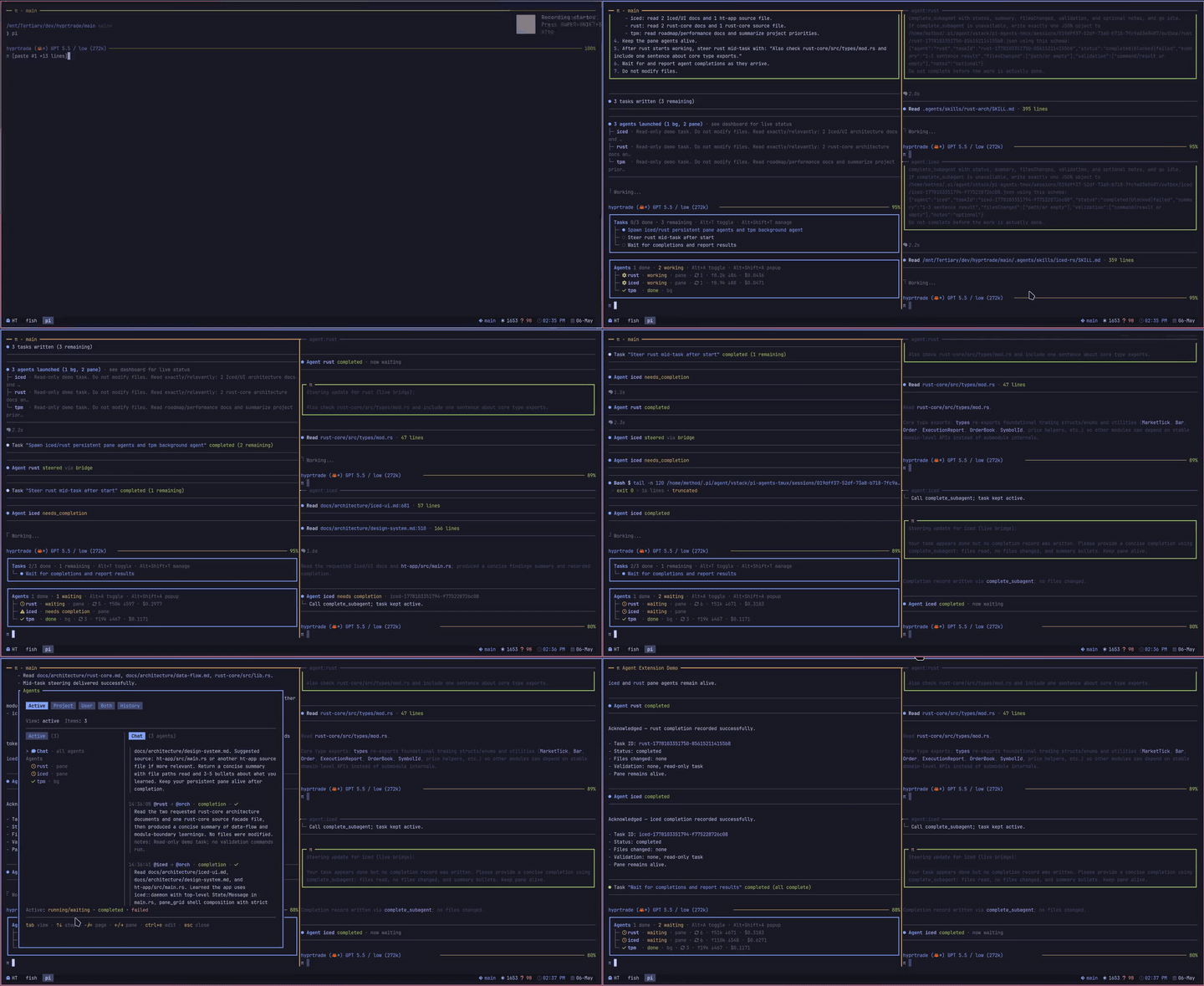
  "image": "https://raw.githubusercontent.com/vanillagreencom/kendex/main/pi-extensions/pi-agents-tmux/assets/agents-tmux-demo.gif",
  "video": "https://raw.githubusercontent.com/vanillagreencom/kendex/main/pi-extensions/pi-agents-tmux/assets/agents-tmux-demo.mp4",
  "extensions": [
    "./extensions/subagent/index.ts"
  ],
  "appendSystem": "./instructions.md"
}
Security note
Pi packages can execute code and influence agent behavior. Review the source before installing third-party packages.
README
@vanillagreen/pi-agents-tmux
A Pi extension for assigning work to other agents. You can follow each agent in a tmux pane or let it run in the background.
Features
- Assign a task, parallel tasks or a sequence of tasks.
- Select agents from project or user agent files.
- Send corrections, read results and stop running agents.
- Follow status and transcripts in the agents dashboard.
- Reuse background memory below its context threshold. Above it, a fresh agent receives the new task and prior final result.
- Resolve child model classes through kendex against the locally refreshed Pi model registry before either launch form starts.
Install
- npm:
pi install npm:@vanillagreen/pi-agents-tmux. - kendex: add the declaration below to the project's
kendex.toml, or to~/.config/kendex/kendex.tomlfor user scope. Runkendex update-pi.
[pi-extensions."@vanillagreen/pi-agents-tmux"]
source = "kendex"
Restart Pi after installation. Use kendex update-pi --check to preview the installation. Persistent agent panes require tmux; where no tmux server answers, a pane agent runs in the background instead.
How it works
The parent Pi session selects an agent file and sends it a task. The extension starts a separate Pi process with that agent's instructions. Agents configured for panes appear in tmux; other agents run in the background. The child returns its result to the parent. The dashboard shows the task state and saved transcript.
Streamed tool rows keep only the static call preview in the transcript. Follow live progress in the existing Agents panel, which shows each working child's operation and last recorded progress time in UTC. The time changes only when a child writes another transcript record, not when the panel refreshes. After completion, press Ctrl+O to expand the row and read its final result. A restored session shows saved final results.
Memory and disk use
All dispatch modes share
maxConcurrency. At most 256 tasks wait for a slot. Cancellation removes queued work before it launches. Session shutdown cancels and drains queued or active dispatch actions and owned commands, and it stops the persistent pane inbox poller before any drain waits. Persistent pane agents can continue after their dispatch action returns. Command capture keeps the last 1,048,576 UTF-16 code units per output stream, with additional failure and signal diagnostics in stderr. Pane title updates keep one active command and the latest pending title.The Agents popup keeps the current prompt layout and current trace layout. Scrolling reuses them until text, width or theme changes. It retains the 16 most recently viewed task traces and clears them when the popup closes. Managed-agent saves wait for an asynchronous refresh with a 120-second deadline, so Pi can process other events during the wait.
Agent discovery keeps at most 8 working-directory and user-source combinations across Pi sessions in one process. It reuses parsed agent files until their metadata changes. File and directory checks run outside rendering every 250 ms. A listed-file change reloads only that file; a directory change rebuilds the inventory. After a check detects a change, the next tool-call preview uses the updated agents. Removing a cache entry stops its file checks.
Completion polling, task updates and the dashboard share the most recent runtime's task registry and JSON text in memory. An unchanged registry needs only a file metadata check, not a content read. Local task writes update this cache, so sequential child usage writes need no registry content reads. An external registry change is read on the next poll or update. Reading or writing another runtime replaces the cached registry, and session shutdown clears it.
A one-shot result keeps its last 20 assistant messages, and the newest earlier one with text when those 20 carry only tool calls, so the final answer is kept. Each keeps only its text and tool-call parts. Tool-call arguments are cut to the tool-details bound: 8,192 characters per string, 50 array items, 80 object fields and a nesting depth of 4. The expanded view says how many earlier messages it does not show. The result also keeps the last 65,536 characters of the child's stderr.
Context handoff and background status reads inspect at most the last 2 MiB of the saved session for the prior final result. A normal or compact dashboard shows at most 512 characters of an unsuccessful task's reason.
The transcript keeps every event except the per-token
message_updateevents;PI_AGENTS_TMUX_TRANSCRIPT_FULL=1keeps those too. Each record holds its event once. When more than 8 MiB of transcript records wait to be written, the extension stops reading the child's stdout and stderr until the writer catches up.The dashboard caches one activity line of at most 180 characters per retained transcript, including its last-progress time. It reads appended records outside rendering and keeps no argument history.
Transcripts live in
~/.pi/agent/kendex/sessions/<session>/pi-agents-tmux/transcripts/, and full outputs too long for a tool result in.../pi-agents-tmux/outputs/. Each directory is deleted once the session's working directory is gone (a merged worktree), and any file in it older than 5 days is deleted. Pi applies both rules when a session starts. Pi applies them only to a directory that holds the ownership record this package writes from 3.2.0 on. A transcript directory an earlier version wrote gets that record when its session next starts; until then Pi deletes nothing in it.
Agent files
The model field accepts a class, inherit, a provider-qualified family such as anthropic/sonnet, or an exact Pi model id. An exact id can contain / after the provider, as in openrouter/anthropic/claude-sonnet-4. Unknown model access or capacity keeps the native parent or child default and prints one warning per extension session. kendex must be on Pi's PATH for class and family resolution. With kendex absent, only inherit and one uniquely authenticated exact registry match can start. Other requests refuse before child startup.
The subagent tool accepts an optional model on a single call. It replaces the agent file's model for that call and uses the same grammar, including light:medium. An unresolvable call model falls back to the agent file's model and prints one warning per extension session. subagentModelSource set to parent keeps parent precedence. A reused live pane keeps its current model. Stop the pane, then use forceSpawn to start fresh with the call model. Omitting model keeps the agent file and settings behavior.
An absent agent model or subagentModelSource set to parent requests inheritance. The parent model remains in runtime context. /agents:start and /agents:send use the same authenticated registry as tool dispatch.
An agent is a markdown file whose YAML frontmatter holds name and description, and optionally model (with an optional :effort suffix), effort (minimal, low, medium, high, xhigh, max; passed to the child as --thinking when the selected raw model carries no suffix; off passes nothing, so the child runs at Pi's default level), deny-tools, pane, color and allowed-subagents. Core-selected model ids have no effort suffix. The child receives their effort through --thinking. Everything after the frontmatter is the agent's system prompt. When the same name exists in several sources, project Pi wins over project Claude over user Pi over user Claude.
kendex resolves delegation targets from the catalog's role policy. Without a policy declaration or per-agent replacement, engineers get allowed-subagents: scout only when scout is enabled for Pi in the same scope. Otherwise engineers get no delegation targets. Other roles get no default delegation targets. Set per-agent overrides under [agent-frontmatter.pi.<agent>] in kendex.toml. An explicit allowed-subagents = [] turns delegation off. role-deny-tools replaces role tool restrictions, including with an empty list; deny-tools adds restrictions. Forks and source detachment carry declared policy into these manifest settings. Pi reads the resulting deny-tools and allowed-subagents in the installed agent file. The kendex repository's docs/authoring/README.md § Agent permissions documents these overrides and transfers.
Setup
The settings editor writes project values to .pi/settings.json. The default user file is ~/.pi/agent/settings.json. PI_CODING_AGENT_DIR changes the user directory. Package values are stored under kendex.extensionManager.config["@vanillagreen/pi-agents-tmux"].
Open /extensions:settings; settings appear under the Agents (tmux) tab. Project settings in .pi/settings.json apply only after Pi marks the workspace trusted.
enabled: package toggle.maxConcurrency,bgTaskTimeoutMs,subagentModelSource,subagentThinkingSource: how background children run and which model and thinking level they take.bgTaskTimeoutMsdefaults to 7200000 (2 hours) and also applies to headless pane agents. Nonpositive values use the default deadline instead of disabling it.reusedSessionBudgetThreshold,reusedSessionContextLimitTokens: the context estimate that starts a fresh background agent instead of reusing a saved session. These budget settings use the child working directory. The formerreusedSessionBudgetPolicysetting is read with a migration warning; remove it.dashboard,quietInlineWhenDashboard,dashboardMaxItems,dashboardCollapsed,animateSpinners,collapsedItemCount,glyphStyle,treeStyle: the dashboard card and inline rendering.truncateResults,resultMaxBytes,resultMaxLines,preserveFullOutput: how much agent output returns inline and whether the full output is kept as an artifact.completionPollMs,childInboxPollMs,forceSessionBridgeForPanes: pane polling and bridge loading.dashboardShortcut,popupShortcut: the keyboard shortcuts.
Maintainer notes are in DEVELOPMENT.md.