@vanillagreen/pi-agents-tmux
Pi extension for delegating work to project or user agents, including persistent tmux agent panes.
Package details
Install @vanillagreen/pi-agents-tmux from npm and Pi will load the resources declared by the package manifest.
$ pi install npm:@vanillagreen/pi-agents-tmux- Package
@vanillagreen/pi-agents-tmux- Version
2.6.1- Published
- Jun 14, 2026
- Downloads
- 1,542/mo · 215/wk
- Author
- vanillagreencom
- License
- MIT
- Types
- extension
- Size
- 655 KB
- Dependencies
- 0 dependencies · 4 peers
Pi manifest JSON
{
  "extensions": [
    "./extensions/subagent/index.ts"
  ],
  "image": "https://raw.githubusercontent.com/vanillagreencom/vstack/main/pi-extensions/pi-agents-tmux/assets/agents-tmux-demo.gif",
  "video": "https://raw.githubusercontent.com/vanillagreencom/vstack/main/pi-extensions/pi-agents-tmux/assets/agents-tmux-demo.mp4",
  "appendSystem": "./instructions.md"
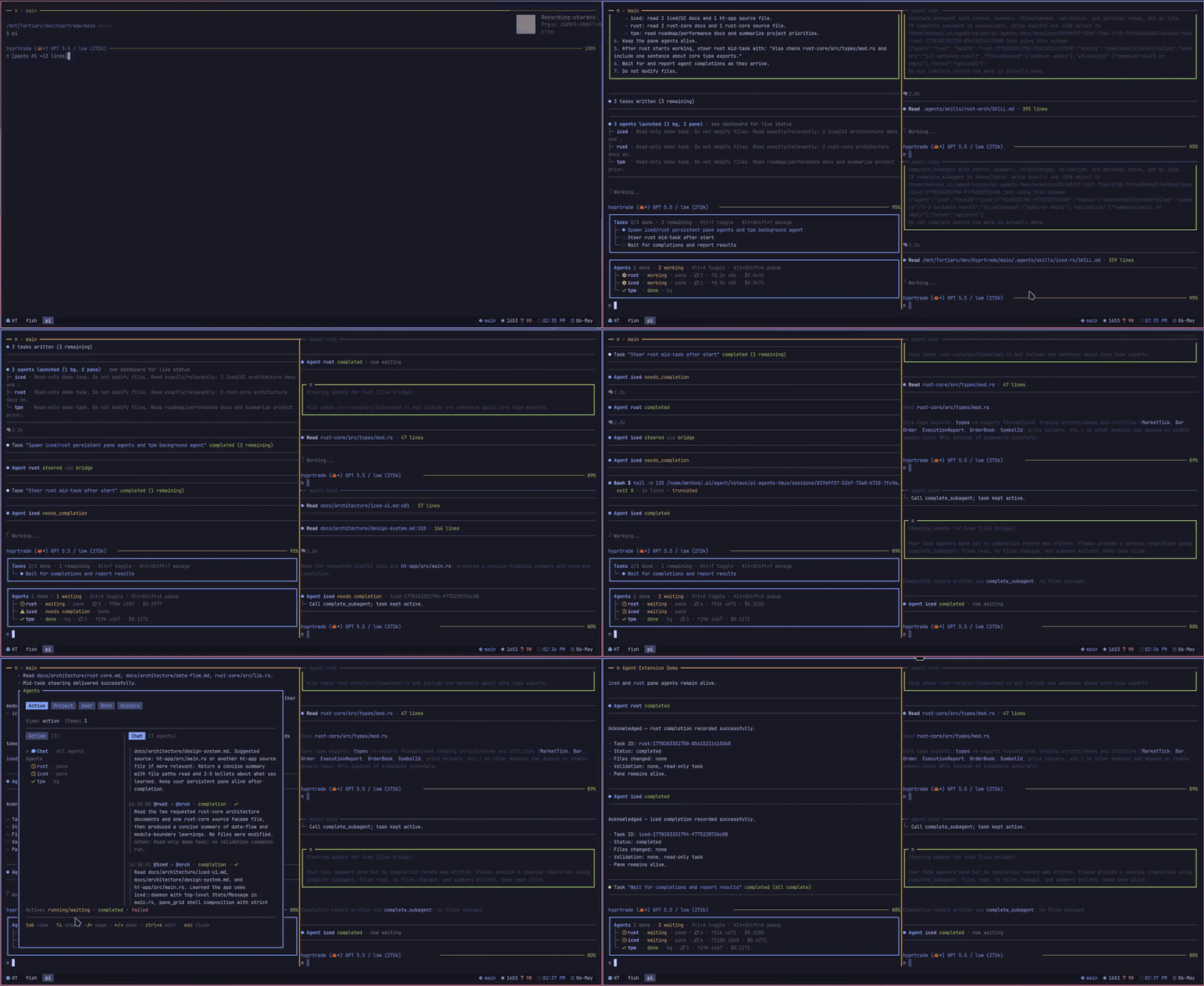
}
Security note
Pi packages can execute code and influence agent behavior. Review the source before installing third-party packages.
README
pi-agents-tmux
https://github.com/user-attachments/assets/36192e57-a6e4-47f9-b47c-dd26920906ae
Delegate work to specialized agents from a running Pi session. Agents run either as visible persistent tmux panes or resumable background (bg) sessions.
Highlights
subagenttool delegates one task, parallel tasks, or sequential chains.delegate_subagentis a restricted, single-mode variant child agents can call without gaining full orchestration controls. Engineer agents installed by vstack default toallowed-subagents: scoutso they can dispatch read-only reconnaissance into a fresh bg lane.- Agents with
pane: trueopen a visible tmux pane that persists across turns. Other agents run in the background. Spawned Pi sessions use the agent name as the Pi session display name. /agentsbrowser lists agents for the selected scope with static detail, Monitor task traces, and one-key launch.- Monitor groups tasks by session (pane, bg lane, bg one-shot) under expandable Active and Completed sections, with active sessions first and newest invocations first inside each section; repeated same-agent launches get session numbers and task numbers reset per session. Steering/follow-up delivery mode is shown in expanded rows and trace metadata.
- Chat completion rows show actual results, never a repeat of the original request.
- Task detail shows Summary and Completion tabs; Summary contains task metadata, artifacts, and task text, while Completion contains result summary, files changed, and validation.
- Bg one-shot transcripts keep start/end/tool audit events but omit successful streaming
message_updatesnapshots by default to avoid large duplicate JSONL files. Failed runs preserve the latest unfinalized update asbuffered: true; setPI_AGENTS_TMUX_TRANSCRIPT_FULL=1before launching Pi to retain every stream snapshot for debugging. needs_completiondiagnostics try to attach a best-effort workercwdSnapshotfor Git worktree cwds, soget_subagent_resultcan show HEAD, dirty status, and last commit without manual shell inspection when the snapshot is available. Dirty scans avoid content filters, reject unsafe tracked paths, enforce the lstat deadline across parent/final probes, and skip tracked paths under symlinked parent directories.- Dashboard widget shows live state, turns, tokens, and cost for every spawned agent; working agents stay above attention/completed agents, newest invocations lead each bucket, and activity updates do not reshuffle rows. Once you hide it, lifecycle updates do not reopen it until you toggle it back in.
- Grouped completion notifications batch multiple agents finishing together.
- When
pi-session-bridgeis loaded, spawn/queue/start/steer/completion lifecycle points publish structuredagent.*activity broker events without adding chat messages (agent.spawned,agent.task_queued,agent.task_started,agent.steered,agent.task_completed,agent.task_blocked,agent.task_failed,agent.needs_completion,agent.empty_after_compact,agent.pane_cwd_stale). taskIdretrieval, mid-run steering, and pane stop without losing memory. Whenpi-session-bridgeprovides compact input events, trace views humanizesteervsfollowUpinput records instead of showing raw JSON only.- Stop kills the tmux process but preserves the session — next launch resumes it.
- Bg agents get fresh sessions per call by default; opt into shared memory with an explicit
sessionKey. Bg completions are captured from the child process's final assistant output;complete_subagentis reserved for persistent pane/follow-up tasks and is withheld from bg children. - Bg one-shot children have a process-level deadline (
bgTaskTimeoutMs, default 30 minutes). A child that never exits is marked failed withreason: "unresponsive_timeout", its process group is terminated, and the parent parallel queue keeps draining instead of waiting forever. - Inventory-aware launch guard rejects unknown agent names with the available list.
- Large parallel calls run through a flat worker pool capped at
maxConcurrency; callers do not need to split requests. Pane idle waits usewait_for_subagent_idle. - Persistent panes auto-resume after detected provider rate limits. Scheduling prefers validated structured quota snapshots (Claude usage endpoints, Codex/OpenAI
wham/usagefixtures/seams, SDK reset/retry fields) and recordsresetSource; malformed quota data falls back with sanitized diagnostics, and localizedresets <time>prose is only a degraded fallback before plain backoff. - Periodic pane idle-stall probes cache
pi-bridgeresolution at extension load. A structuredspawn/ENOENTfor the expectedpi-bridgebinary is treated as genuinely missing and skips silently; other ENOENT/spawn failures are written tosubagent-diagnostics.jsonl. If initial resolver setup fails, onepi-bridge resolver failed: ...diagnostic is written.
Install
Via npm:
pi install npm:@vanillagreen/pi-agents-tmux
Via vstack:
cargo install --git https://github.com/vanillagreencom/vstack.git vstack
vstack add vanillagreencom/vstack --pi-extension pi-agents-tmux --harness pi -y
Restart Pi after installation.
Persistent panes require running Pi inside tmux.
Commands
| Command | Action |
|---|---|
/agents |
Open the agent browser for both project and user scopes. |
/agents project|user|both |
Open the browser with an explicit scope. |
/agents show <name> [scope] |
Inspect an agent. |
/agents:start <name> |
Start or resume a pane. |
/agents:new <name> |
Archive the saved session and start fresh. |
/agents:resume <name> [latest|archive-file] |
Restore an archived pane session. |
/agents:send <name> <task> |
Queue a task for a persistent pane. |
/agents:attach <name> |
Focus an existing pane. |
/agents:stop <name> |
Stop a persistent pane. |
/agents status |
Show pane status. |
/agents collect |
Collect completed pane results. |
/agents:trace <ref> |
Open or show one trace by task id or short id. |
/agents:toggle |
Toggle the persistent dashboard. |
Arguments support autocomplete, including known agent names.
Agent Sources
agentScope controls which directories are considered:
| Scope | Directories |
|---|---|
user |
~/.claude/agents, ~/.pi/agent/agents |
project |
Nearest <project>/.claude/agents, nearest <project>/.pi/agents |
both |
User sources, then project sources |
When Pi starts from a directory under $HOME, home-level harness directories such as ~/.claude/agents are still user scope, not project scope. Duplicate names resolve in this order: user Claude, user Pi, project Claude, project Pi.
Keyboard shortcuts inside the browser/dashboard popup are documented in the popup's own footer.
Persistent pane agents
Agents with pane: true use a visible tmux pane:
---
name: iced
description: Iced UI specialist
deny-tools: bash
model: openai-codex/gpt-5.5:xhigh
color: cyan
pane: true
---
Frontmatter fields:
| Field | Required | Values |
|---|---|---|
name |
yes | Unique agent name. |
description |
yes | Short description shown in /agents and completions. |
deny-tools |
no | Comma-separated Pi tools to deny. Future parent tools are inherited unless explicitly denied. |
allowed-subagents |
no | Comma-separated or array of agent names this agent may call via delegate_subagent. Engineer agents installed by vstack default to scout. Set [] to disable delegation. Aliases: allowedSubagents, subagent-agents, subagent_agents. |
model |
no | Pi model id; shorthands: sonnet, opus*, haiku. Other ids pass through. |
pane |
no | true for a visible persistent pane; omit for bg. |
color |
no | Pane badge color: red, green, yellow, blue, magenta, cyan. Aliases: orange, purple/violet, teal. |
Everything after the frontmatter is the agent's system prompt.
Pane tasks move through queued → running → completed | blocked | failed. On Linux, before reusing a live pane, subagent verifies the pane process cwd is still present and matches the requested task cwd; stale or mismatched panes return a structured pane-cwd-stale error, publish agent.pane_cwd_stale, and should be recovered with stop_subagent plus a retry using forceSpawn: true. Stop kills the tmux process; the session file is preserved so the next launch resumes memory.
Persistent pane children own their tmux pane and set the pane title to agent:<name>. Background one-shot children keep the same agent identity for authorization but do not update the inherited parent pane title or poll pane inbox files.
See DEVELOPMENT.md for the underlying tool surface (subagent, delegate_subagent, get_subagent_result, steer_subagent, stop_subagent, wait_for_subagent_idle) and activity broker mapping.
Restricted delegation (delegate_subagent)
vstack-installed engineer agents default to denying subagent so they cannot orchestrate fleets, but they still need to spend a fresh context window on reconnaissance work. delegate_subagent is the bridge:
- Only visible to child Pi processes whose
PI_SUBAGENT_CHILD_AGENTis set (panes and bg one-shot children both export this for issue #228). Visible pane ownership is separate: only pane launchers exportPI_SUBAGENT_CHILD_PANE=1. - Only the targets listed in the caller agent's
allowed-subagents:frontmatter are accepted; missing or unlisted targets fail with an inventory error. - Single-dispatch only — no
tasks,chain,agentScope,sessionKey,forceSpawn, orresumeSessionexposure. - Targets with
pane: trueare rejected — restricted delegation is bg-only. - The child receives its own append-system prompt, skills, and a fresh one-shot session; parent conversation is not shared.
vstack defaults for allowed-subagents:
| Role | Default |
|---|---|
engineer |
scout |
analyst / reviewer / manager |
empty (delegation denied) |
Customize per agent in vstack.toml:
[agent-frontmatter.pi]
rust = { allowed-subagents = ["scout"] }
iced = { allowed-subagents = ["scout", "researcher"] }
generalist = { allowed-subagents = [] }   # disable delegation entirely
An explicit empty list overrides the engineer default; the matching agent file is regenerated without allowed-subagents: and gains delegate_subagent back in deny-tools so the child never sees the tool.
Settings
Open /extensions:settings; settings appear under the Agents (tmux) tab.
Project settings in .pi/settings.json apply only after Pi marks the workspace trusted; before trust, vstack Pi extensions read user/global settings only.
Glyph style: each package exposes glyphStyle (unicode default, ascii for terminal-safe chrome). @vanillagreen/pi-tool-renderer.globalGlyphStyleOverride=ascii forces ASCII chrome across vstack Pi extensions while leaving tool/model/user content unchanged.
Execution
There is one execution-concurrency knob — maxConcurrency — and it caps concurrent one-shot/background agent execution in the parallel dispatch queue. Persistent pane agents occupy the queue only until they are launched/enqueued; after that they are not long-running bg workers for this limit. Earlier versions exposed maxParallelTasks as an internal chunk size; that key is now a no-op kept only for settings-file compatibility and safe to delete.
| Setting | What it does |
|---|---|
| Enable agents | Master toggle for the subagent tools, dashboard, and pane helpers. |
| Max concurrency | Cap on concurrent one-shot/background agent executions in the parallel dispatch queue; persistent pane agents only occupy the queue until launch/enqueue. |
| Background task timeout | Deadline in milliseconds for bg one-shot child processes. On timeout the child is marked failed with reason: "unresponsive_timeout" and its process group is terminated. Set 0 to disable. |
| Subagent model source | Use the agent's model: or inherit the parent session model. |
| Subagent thinking source | Use the model :effort suffix or inherit the parent thinking level. |
| Reused session budget threshold | Fraction of model context allowed before an explicit sessionKey lane is considered too full. |
| Reused session budget policy | refuse-and-warn (default) blocks near-limit reused lanes with a warning; warn logs and continues; compact-then-resume archives/truncates the lane before launch. |
| Reused session context limit tokens | Context limit used by the session-file-size heuristic. |
Rendering
| Setting | What it does |
|---|---|
| Show agent dashboard | Render the activity card above the editor. The first agent activity may show it each session; user-hidden state blocks automatic re-open until an explicit toggle/show. |
| Quiet inline output with dashboard | Keep inline tool output to short crumbs; single bg launches skip the initial task preview. |
| Dashboard max items | Maximum agent rows shown. |
| Dashboard collapsed by default | Start collapsed. |
| Animate spinners | Animate running-agent spinner frames; disable for a static gear icon to reduce terminal flickering. |
| Tree connector style | unicode or ascii. |
| Collapsed item count | Items shown in collapsed agent results. |
Output
| Setting | What it does |
|---|---|
| Truncate agent results | Apply Pi-sized inline caps to tool output. |
| Result max bytes | Inline byte cap per agent result. |
| Result max lines | Inline line cap per agent result. |
| Preserve full agent output | Save oversized output to the session runtime and include the artifact path. |
Persistent panes
| Setting | What it does |
|---|---|
| Completion poll interval | Parent poll rate for pane completion files. |
| Child inbox poll interval | Child pane poll rate for incoming tasks. |
| Force session bridge for panes | Load pi-session-bridge in pane launchers so steering keeps working. |
Keyboard
| Setting | What it does |
|---|---|
| Dashboard display shortcut | Cycles widget visibility and restores the last visible mode when toggled back in. |
| Agents popup shortcut | Opens the full /agents browser. |