@vanillagreen/pi-claude-bridge
Pi provider bridge that runs Claude Code through the Claude Agent SDK, with opt-in forwarding for Pi prompt context.
Package details
Install @vanillagreen/pi-claude-bridge from npm and Pi will load the resources declared by the package manifest.
$ pi install npm:@vanillagreen/pi-claude-bridge- Package
@vanillagreen/pi-claude-bridge- Version
1.4.1- Published
- Jun 5, 2026
- Downloads
- 1,949/mo · 216/wk
- Author
- vanillagreencom
- License
- MIT
- Types
- extension
- Size
- 2.1 MB
- Dependencies
- 4 dependencies · 2 peers
Pi manifest JSON
{
  "extensions": [
    "./bundle/index.js"
  ],
  "image": "https://raw.githubusercontent.com/vanillagreencom/vstack/main/pi-extensions/pi-claude-bridge/assets/claude-bridge1.png"
}
Security note
Pi packages can execute code and influence agent behavior. Review the source before installing third-party packages.
README
pi-claude-bridge
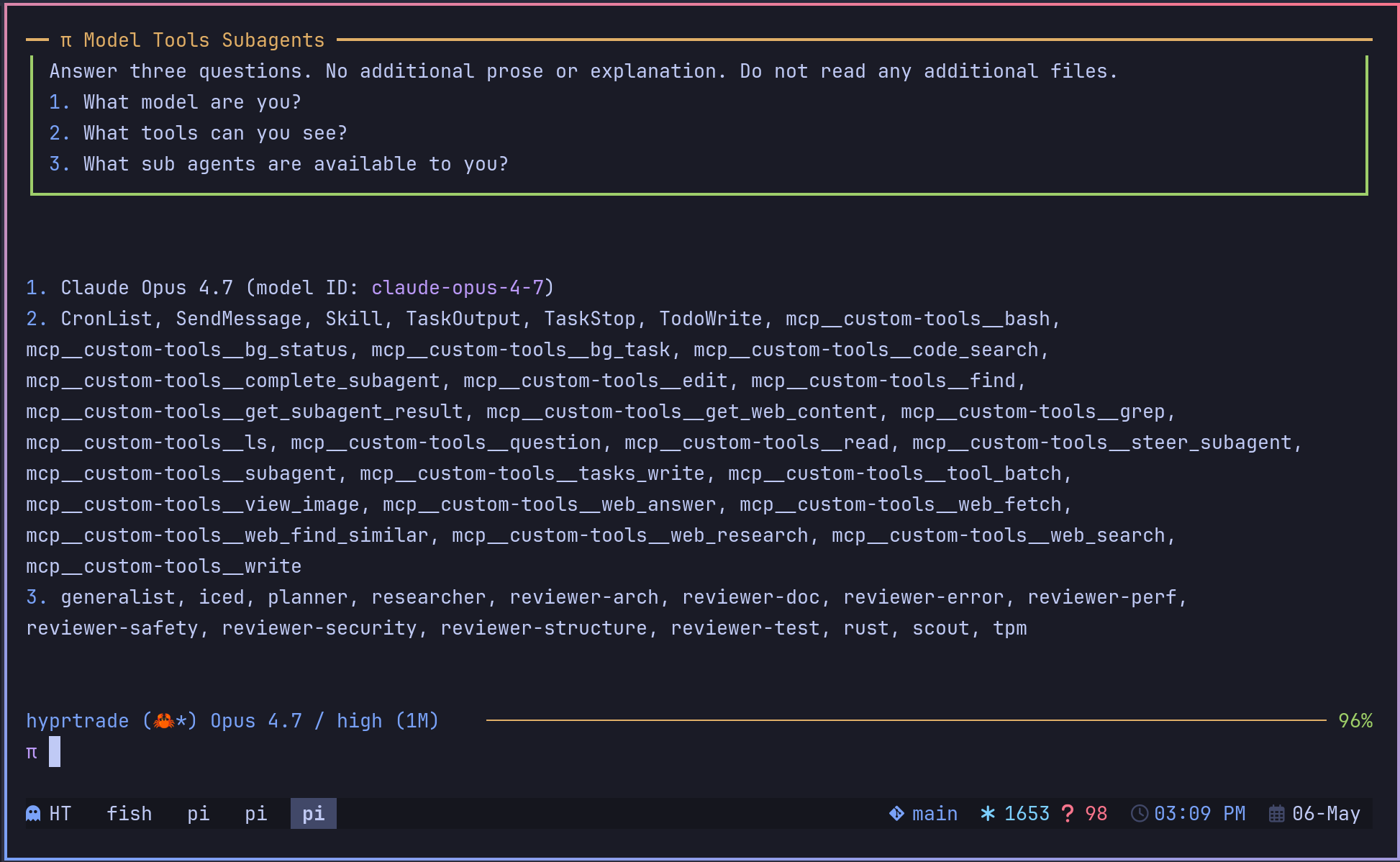
Run Claude Code as a Pi provider. Adds claude-bridge/* models to /model and routes Pi turns through the Claude Agent SDK while keeping Pi's tools and TUI.
Forked from elidickinson/pi-claude-bridge. The provider, MCP bridge, session sync, and SDK plumbing come from upstream; this fork removes the AskClaude tool and adds opt-in forwarding for Pi prompt context.
Highlights
claude-bridge/claude-opus-4-8, Opus 4-7, Sonnet, and Haiku in/model.- Pi tool calls run on Pi; Claude Code handles reasoning.
- Tool-use turns block until Pi-delivered tool results reach Claude Code, including persistent subagent panes.
- Session continuity across normal turns,
/compact, tree navigation, and abort recovery. - Thinking-level forwarding with summarized Opus thinking display.
- Optional Claude effort overrides (
xhigh→maxfor Opus 4.8). - MCP isolation and Claude cloud-MCP suppression to keep tokens lean.
- Opt-in forwarding of
APPEND_SYSTEM.mdand recognized Pi prompt hooks.
Install
Via npm:
pi install npm:@vanillagreen/pi-claude-bridge
Via vstack:
cargo install --git https://github.com/vanillagreencom/vstack.git vstack
vstack add vanillagreencom/vstack --pi-extension pi-claude-bridge --harness pi -y
Restart Pi after installation.
Prompt context
Default behavior matches upstream: append AGENTS.md plus Pi's skills block to Claude Code's claude_code preset prompt.
Extra Pi context is off by default. Enable per item in the extension manager when you want Claude Code to see prompt blocks that other Pi extensions add to your session. Forwarded blocks are wrapped in explicit XML tags so Pi 0.75+ project-context boundaries do not bleed into adjacent sections.
Settings
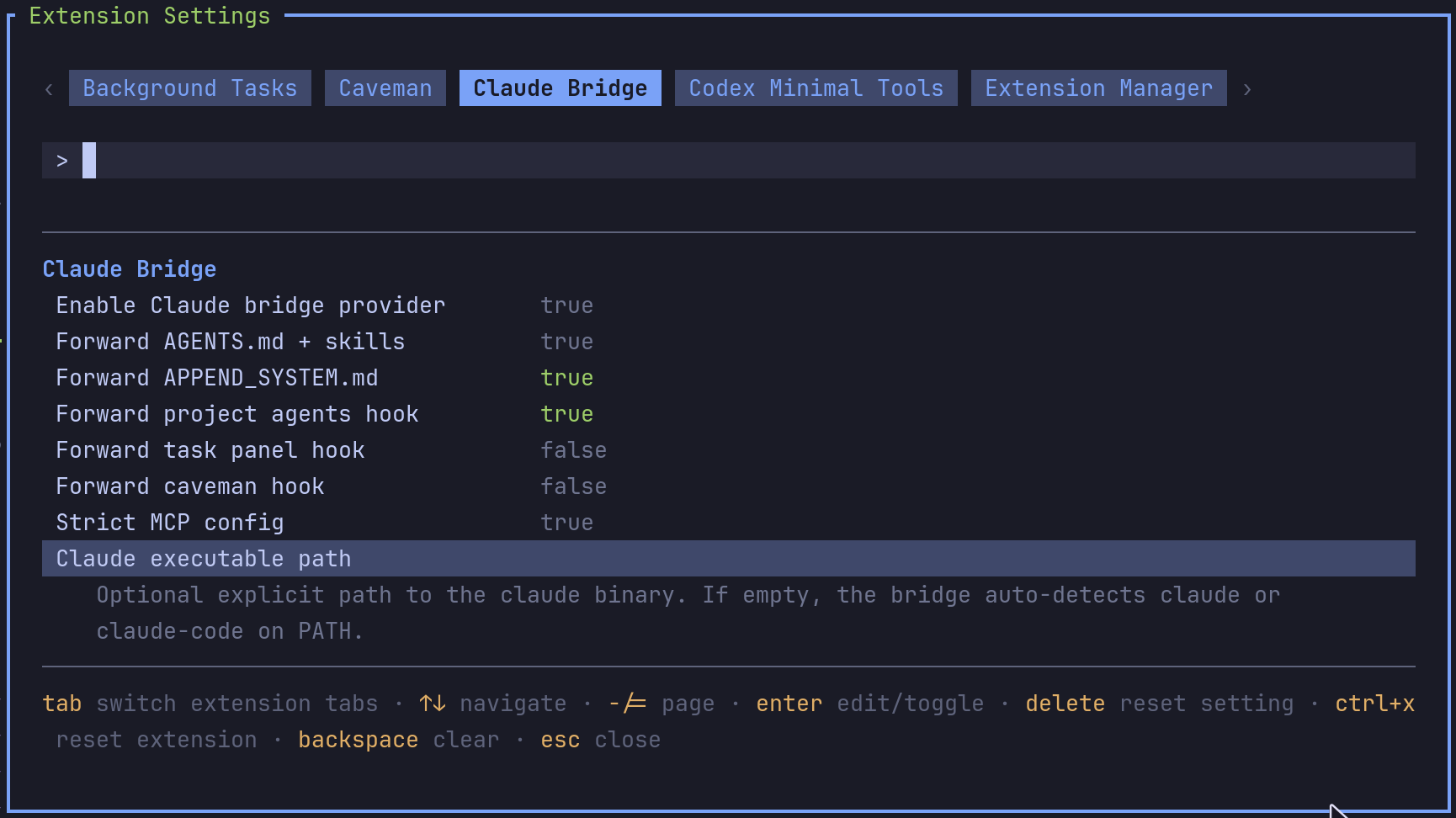
Open /extensions:settings; settings appear under the Claude Bridge tab.
General
| Setting | What it does |
|---|---|
| Enable Claude bridge provider | Register claude-bridge/* models. Reload required. |
Base prompt
| Setting | What it does |
|---|---|
| Forward AGENTS.md + skills | Append AGENTS.md and Pi's skills block. |
Pi prompt context
| Setting | What it does |
|---|---|
| Forward APPEND_SYSTEM.md | Forward project/global APPEND_SYSTEM.md content. |
Pi prompt hooks
| Setting | What it does |
|---|---|
| Forward project agents hook | Forward pi-agents-tmux Project Agents/Subagents list. |
| Forward task panel hook | Forward pi-task-panel workflow reminders. |
| Forward caveman hook | Forward pi-caveman response-style directives. |
Claude Code
| Setting | What it does |
|---|---|
| Strict MCP config | Block filesystem MCP auto-loads; Pi owns tools. |
| Allow extra usage helper | Let the bridge launch Claude Code's /extra-usage flow when extra usage is required. Billing/admin approval still happens in Claude's browser page. |
| Fast mode | Enable Claude Code fast mode for bridge requests when the selected model supports it. |
| Force Claude effort | Override Pi's thinking-level mapping for every claude-bridge request. none keeps Pi's selected level; max sends Claude Code --effort max. |
| Model effort overrides | JSON object mapping model IDs to Claude Code efforts, e.g. {"claude-opus-4-8":"max"}. Per-model entries beat the global force setting. |
| Claude executable path | Explicit claude binary path; empty auto-detects. |
Pi does not have a native max thinking level; it exposes up to xhigh, and each provider's model metadata maps Pi levels to provider values. To use Claude Code max effort only for Opus 4.8 through the bridge, set Model effort overrides to:
{"claude-opus-4-8":"max"}
Keys may be bare model IDs (claude-opus-4-8), claude-bridge/<id>, or * for all bridge models. Values are low, medium, high, xhigh, or max.
Extra usage and rate limits
Claude Code's /extra-usage local command works through the Claude Agent SDK. In Pi, use /claude-bridge:extra to run that flow from claude-bridge. Persist automatic launch on extra-usage errors with Allow extra usage helper in /extensions:settings.
When Claude Code emits rate-limit reset metadata, the bridge shows one red ASCII [rate-limit] Pi warning with the reset timestamp including timezone context, deduplicates repeated Claude Code error lines, and suppresses the SDK's follow-up Claude Code returned an error result: ... wrapper when the bridge already emitted the terminal error. The bridge also emits vstack:rate-limit on Pi's extension event bus so pi-qol can opt into reset-time auto-resume.
Allowed-warning rate-limit events are filtered before user notification. The bridge normalizes unambiguous numeric utilization (0 < value < 1 as fractional, 1 < value <= 100 as percent), suppresses low or unit-ambiguous values such as exact 1, and only shows a neutral warning at 80%+ instead of claiming an unverified % used value. Check Claude Code /usage for exact allowed-warning utilization.
If Claude Code accepts a turn but produces no assistant/tool output, the bridge treats that stream-idle stall as a retryable overload/rate-limit failure: it closes the stalled Claude Code subprocess, emits a normal assistant error with a backoff hint, and lets Flightdeck or pi-agents-tmux reuse their existing rate-limit retry ladder. Tune the first-output timeout with CLAUDE_BRIDGE_STREAM_IDLE_TIMEOUT (bare numbers are seconds; suffixes ms, s, and m are accepted). Default: 90s; set 0 to disable.
Debugging
Set CLAUDE_BRIDGE_DEBUG=1 to write bridge logs to ~/.pi/agent/claude-bridge.log and per-query Claude Code CLI logs under ~/.pi/agent/cc-cli-logs/.
If a Claude Code SDK stream yields a completed assistant tool-use message before a message_stop stream event, the bridge treats that assistant message as the tool-turn boundary. Pi executes the tool calls immediately and Claude Code's MCP handlers stay blocked until the matching Pi tool results are delivered, preventing empty inline tool results or one-render-cycle-late result batches in subagent panes.
Tool-result integrity failures are surfaced even when debug logging is off. If the bridge has to repair missing Claude Code tool_use / Pi toolResult pairs with [no tool result recorded], Pi shows an error notification and writes a JSON diagnostic to ~/.pi/agent/claude-bridge-diag.log with counts, affected tool names, and sampled tool-call IDs so the lost output is visible. Tool results whose IDs were never registered in the active assistant tool-use turn are refused instead of being queued against another pending call, and any remaining MCP handlers receive an internal-error result so the turn cannot report false success. If a query tears down while parallel tool results are still queued or unresolved, the bridge writes the same kind of diagnostic, marks the Claude session for rebuild, and re-imports delivered results from Pi history on the next turn instead of silently resuming a corrupted session.
Before starting Claude Code, the bridge preflights the resolved executable and working directory. Failures include the underlying code, errno, syscall, path, cwd, and detected executable file type so spawn issues point at the real failing path instead of the Claude Agent SDK's generic native-binary message. If Node still emits a spawn error after preflight, the bridge wraps that error with the same context before handing it back to the SDK.