@vanillagreen/pi-session-bridge
Pi extension and CLI for controlling visible interactive Pi sessions over a structured Unix-socket side channel.
Package details
Install @vanillagreen/pi-session-bridge from npm and Pi will load the resources declared by the package manifest.
$ pi install npm:@vanillagreen/pi-session-bridge- Package
@vanillagreen/pi-session-bridge- Version
1.3.0- Published
- Jun 12, 2026
- Downloads
- 765/mo · 242/wk
- Author
- vanillagreencom
- License
- MIT
- Types
- extension
- Size
- 223 KB
- Dependencies
- 0 dependencies · 1 peer
Pi manifest JSON
{
  "extensions": [
    "./extensions/session-bridge.ts"
  ],
  "appendSystem": "./instructions.md",
  "image": "https://raw.githubusercontent.com/vanillagreencom/vstack/main/pi-extensions/pi-session-bridge/assets/session-bridge-cli.png"
}Security note
Pi packages can execute code and influence agent behavior. Review the source before installing third-party packages.
README
pi-session-bridge
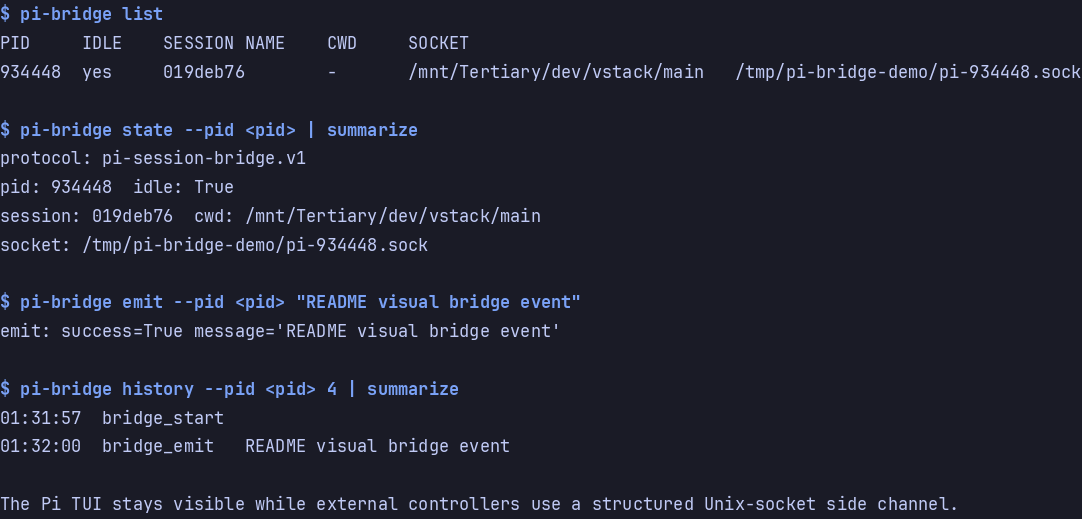
Control a running Pi session from outside the TUI. The interactive Pi terminal stays visible; a Unix-domain socket exposes a structured JSONL side channel for external clients.
Highlights
- External clients send prompts, steering, follow-ups, and aborts over a structured socket; plain text and expanded skills avoid tmux key injection, while extension/TUI slash commands use a guarded own-pane tmux route.
- Subscribe to live Pi events (messages, tool calls, agent end) without scraping panes.
- Activity broker at
Symbol.for("vstack.pi.activity")lets local extensions publish structuredvstack_activityevents to the bridge stream without chat noise. - Discover active Pi sessions through registry files; target by pid, cwd, session, or name.
pi-bridgeCLI handles common operations; raw JSONL protocol is documented for any language.- When
pi-questionsis loaded, external clients can list, answer, and reject pending questions.
Install
Via npm:
pi install npm:@vanillagreen/pi-session-bridge
Via vstack:
cargo install --git https://github.com/vanillagreencom/vstack.git vstack
vstack add vanillagreencom/vstack --pi-extension pi-session-bridge --harness pi -y
Restart Pi after installation.
pi-bridge is symlinked into the install scope's bin/ (.pi/bin/pi-bridge project, ~/.pi/agent/bin/pi-bridge global). Add the directory to PATH or run by path.
Commands
| Command | Action |
|---|---|
/bridge:status |
Show socket and registry paths. |
/bridge:ping [text] |
Emit a bridge_pong event without calling a model. |
pi-bridge CLI
pi-bridge list
pi-bridge state --pid <pid>
pi-bridge commands --pid <pid>
pi-bridge stream --pid <pid>
pi-bridge history --pid <pid> 20
pi-bridge history --pid <pid> 20 --event message_update --since 2026-05-21T00:00:00Z
pi-bridge history --pid <pid> 20 --raw
pi-bridge send --pid <pid> "message for the agent"
pi-bridge steer --pid <pid> "steer current work"
pi-bridge follow-up --pid <pid> "after you finish, do this"
pi-bridge questions --pid <pid>
pi-bridge answer --pid <pid> --request-id que_... --answers '[["Stop here"]]'
pi-bridge reject --pid <pid> --request-id que_...
pi-bridge emit --pid <pid> "hello"
If exactly one active bridge exists, target flags are optional. Filters: --pid, --socket, --session, --name, --cwd.
Compact vs raw history
pi-bridge history and the stream channel both default to compact event envelopes:
input→{ source, streamingBehavior, imagesCount, textBytes, textLength, textPreview, textTruncated }; idle prompts omitstreamingBehavior, mid-stream interrupts usesteer, and queued prompts usefollowUp.message_update→{ role, type, contentIndex, deltaLength, deltaBytes, deltaPreview }.tool_execution_*→{ toolName, toolUseId, status, isError, *Bytes, *Preview, artifactPath, logPath, detailPath }.agent_end→{ status, stopReason, usage, messagesCount, finalTextBytes, finalTextLength, finalTextPreview }.
When a payload had to be shrunk the envelope adds sibling metadata: truncated: true, originalBytes, rawEventPath (per-session JSONL under <bridgeDir>/raw/<pid>.jsonl), rawEventRef (line ref). The sidecar's on-disk size is bounded by maxRawSpillBytes: each spill compares against statSync of the file, runs a lazy compaction that rewrites the JSONL with only the slots whose envelopes are still in history, and refuses the spill if the file would still overflow. Sidecars are cleaned up on session_shutdown and process exit, and stale files belonging to dead pids are removed on bridge start. When a spill is disabled or refused the envelope carries a rawError string instead of rawEventPath/rawEventRef.
Pass --raw (or --verbose) to pi-bridge history to rehydrate compact envelopes from the sidecar:
--event NAME— only return events with that name (e.g.tool_execution_end).--since TS— only return events withtimestamp >= TS(ISO 8601, ms precision).--max-bytes N— cap response payload (default ~1 MiB; older events trimmed first, the most recent envelope is always included).
The history response also includes totalEvents, responseTruncated, rawSpillPath, and (when raw recovery fails) rawErrors so callers can decide whether to page further or read the JSONL directly.
Raw protocol
Connect to the advertised Unix socket and exchange one JSON object per LF-delimited record. Requests may include id; responses use type:"response" with the same id.
Example requests:
{"id":"1","type":"get_state"}
{"id":"2","type":"prompt","message":"Run tests","deliverAs":"auto"}
{"id":"3","type":"steer","message":"Focus on errors"}
{"id":"4","type":"follow_up","message":"Summarize when done"}
{"id":"5","type":"abort"}
Example response and event:
{"type":"response","id":"1","command":"get_state","success":true,"data":{}}
{"type":"event","event":"input","timestamp":"...","data":{"source":"extension","streamingBehavior":"followUp","textBytes":42,"textLength":42,"textPreview":"summarize when done"},"truncated":true,"originalBytes":96,"rawEventPath":"/tmp/pi-session-bridge-1000/raw/12345.jsonl","rawEventRef":"6"}
{"type":"event","event":"message_update","timestamp":"...","data":{"role":"assistant","contentIndex":0,"deltaLength":50000,"deltaBytes":50000,"deltaPreview":"Hello..."},"truncated":true,"originalBytes":50012,"rawEventPath":"/tmp/pi-session-bridge-1000/raw/12345.jsonl","rawEventRef":"7"}
{"type":"event","event":"vstack_activity","timestamp":"...","data":{"type":"agent.task_completed","source":"pi-agents","severity":"success","importance":"normal","summary":"agent done"}}
Clients receive events by default. Send {"type":"subscribe","enabled":false} to mute them. vstack_activity rows are bridge events, not sendMessage() chat entries, so they do not render in the conversation.
Compact event envelopes always include enough fields to reason about the original payload (preview, byte count, truncation flag). To replay raw deltas/results call history with {"raw":true} or read the per-session JSONL referenced by rawEventPath directly.
Activity broker
pi-session-bridge exposes an in-process broker at globalThis[Symbol.for("vstack.pi.activity")] for local Pi extensions:
interface PiActivityBroker {
  publish(event: PiActivityEvent): void;
  subscribe(listener: (event: PiActivityEvent) => void): () => void;
  recent(limit?: number): PiActivityEvent[];
}
publish() is best-effort and fail-open. The broker keeps a 100-event ring buffer; recent(limit) returns newest-first validated events for in-process replay. pi-bridge stream emits live broker publications as event:"vstack_activity" only while the bridge is connected; external clients that need earlier rows must use an in-process consumer before they leave the ring.
Slash command notes
pi-bridge send uses a hybrid slash dispatch path:
- Plain text keeps the normal
sendUserMessagepath. /skill:<name> ...expands client-side from the loaded skill'ssourceInfo.path, inlining the same<skill ...>block Pi's editor would produce the first time a skill is loaded in a Pi session.- Repeated
/skill:<name> ...sends in the same Pi session skip theSKILL.mdbody and sendSkill <name> (previously loaded). Invocation: ...instead. Changing theSKILL.mdfile content changes its hash and forces a fresh full expansion; session shutdown evicts that session, bridge restart loses the in-memory cache, and the bridge keeps only the 100 most recent sessions. - Prompt templates (
/<name> ...from loaded prompt paths) expand client-side with Pi-compatible$1,$@,$ARGUMENTS,${@:N[:L]}, and${N:-default}substitution; unquoted spaces, tabs, and newlines split arguments, while quoted newlines stay inside the argument. - Extension/TUI commands (for example
/bridge:pingand/tasks:add) are pasted into Pi's own tmux pane withsend-keys -l+ enter after resolving the pane by walking parent processes fromprocess.pid. This briefly shows text in the editor and always delivers immediately (deliverAsdoes not apply to this route). - If tmux pane resolution or paste fails, the bridge falls back to the old raw
sendUserMessagebehavior instead of failing the request.
Settings
Open /extensions:settings; settings appear under the Session Bridge tab.
Project settings in .pi/settings.json apply only after Pi marks the workspace trusted; before trust, vstack Pi extensions read user/global settings only.
| Setting | What it does |
|---|---|
| Enable session bridge | Master toggle for bridge socket registration, CLI access, and status reporting. |
| Bridge directory | Override the sockets/registry directory. PI_BRIDGE_DIR env var still wins. |
| Event history limit | Events retained for history clients. |
| Max bytes per event | Maximum bytes per compact event envelope before payload is collapsed to a descriptor. |
| Max history bytes | Total bytes retained across the in-memory event history before older envelopes are evicted. |
| Max history response bytes | Maximum bytes returned in a single history response; older envelopes drop first. |
| Event preview bytes | Bytes of delta/result/output retained as *Preview strings inside compact events. |
| Spill raw events | When true, oversized payloads spill to the per-session JSONL so history --raw can rehydrate them. |
| Max raw spill bytes | Cap on the on-disk size of the per-session raw JSONL. New spills check statSync of the file; if appending would exceed the cap, the sidecar is rewritten with only live slots, and the spill is refused (with rawError) when even the compacted file plus the new line would not fit. |
| Max request line bytes | Maximum JSONL request size accepted. |
| Registry heartbeat | Ms between registry file updates. |
| Notify on start | In-TUI notification when the bridge starts. |
| Show status badge | Show bridge:<pid> in the Pi footer. |
Security
The socket can trigger real agent work in the owning Pi process. Keep PI_BRIDGE_DIR private. Don't expose the socket to other users or untrusted containers.