@vshulcz/pi-deja
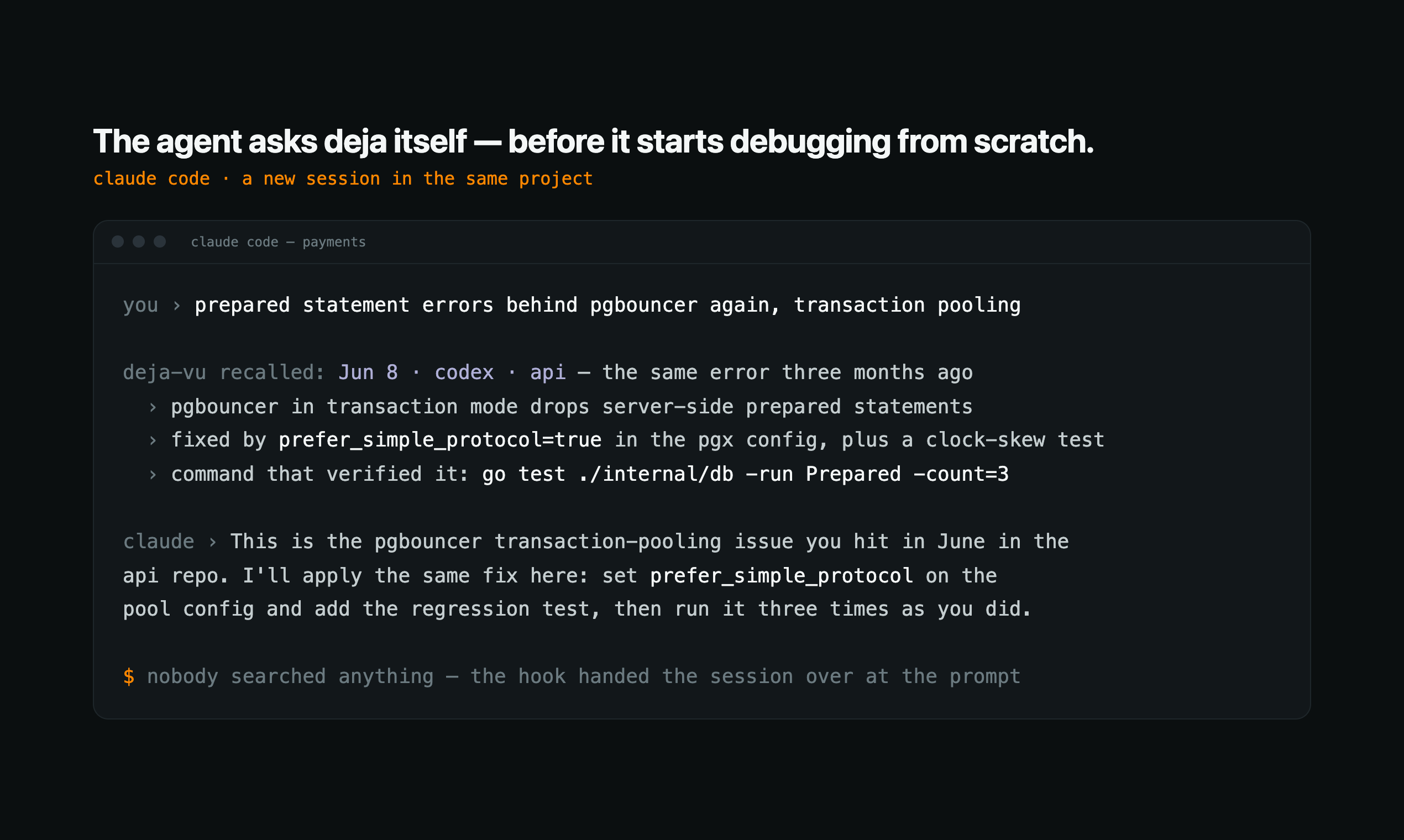
deja-vu memory for pi: the coding sessions already on this machine — pi, Claude Code, Codex, Cursor and 21 more — recalled at session start and on every prompt, searchable with /deja. A local index, no LLM.
Package details
Install @vshulcz/pi-deja from npm and Pi will load the resources declared by the package manifest.
$ pi install npm:@vshulcz/pi-deja- Package
@vshulcz/pi-deja- Version
0.20.0- Published
- Sep 12, 2026
- Downloads
- 164/mo · 164/wk
- Author
- vshulcz
- License
- MIT
- Types
- extension
- Size
- 16.6 KB
- Dependencies
- 1 dependency · 0 peers
Pi manifest JSON
{
  "image": "https://raw.githubusercontent.com/vshulcz/deja-vu/assets/listings/recall-card.png",
  "extensions": [
    "./index.ts"
  ]
}
Security note
Pi packages can execute code and influence agent behavior. Review the source before installing third-party packages.
README
@vshulcz/pi-deja
pi remembers its own sessions. This extension answers the other question: what was done in the twenty-four other coding agents on this machine — Claude Code, Codex, Cursor, Gemini, OpenClaw and Hermes among them — including the months before pi was installed.
It runs deja, a local Go binary that indexes the transcripts those agents already wrote to disk. No LLM, no embeddings, nothing leaves the machine.
Install
pi install npm:@vshulcz/pi-deja
The deja binary comes with the package; a deja you installed yourself
(brew install deja-vu) always wins — see Which binary.
deja install pi-auto wires pi too, and is the shorter path if you have the
CLI: it adds deja's MCP server and writes an extension of its own. When that
extension is present this package stands down, so having both never injects
twice — and the same for omp, whose extension the installer writes elsewhere.
omp loads pi.extensions manifests and emits the same before_agent_start
event, so pi install's omp counterpart picks this package up as well.
What it does
- Session start: a digest of what earlier sessions in this project decided goes to the model before your first prompt; the receipt shows in the footer.
- Every prompt (
before_agent_start): the prompt is matched against the index and, when a past session answers it, that session goes to the model with the prompt. Silence is the common case. - After a failed command (
tool_result): the repair this machine used the last time that error came up goes in beside the error, in the same turn. - Before an edit (
tool_resulton a read): what earlier sessions decided about the file the agent just opened. - After a compaction (
session_compact): the list of what this session was already shown is cleared, so the recall it lost can come back. /deja <query>: search the history by hand.
Which binary
In order: DEJA_BIN, deja on PATH, the usual install locations, and last
the copy bundled through @vshulcz/deja-vu.
Privacy
deja reads session files where the agents wrote them and builds a local index
under ~/.cache/deja (or DEJA_INDEX_DIR). Keys and tokens are stripped as
the index is built. Nothing is uploaded.
Part of deja-vu. MIT.