@xian0x5a/pi-durable-subagents
Durable Pi agents that collaborate asynchronously under explicit Owner and Spawner supervision.
Package details
Install @xian0x5a/pi-durable-subagents from npm and Pi will load the resources declared by the package manifest.
$ pi install npm:@xian0x5a/pi-durable-subagents- Package
@xian0x5a/pi-durable-subagents- Version
0.4.2- Published
- Oct 15, 2026
- Downloads
- 928/mo · 928/wk
- Author
- xian0x5a
- License
- MIT
- Types
- extension
- Size
- 1.8 MB
- Dependencies
- 4 dependencies · 5 peers
Pi manifest JSON
{
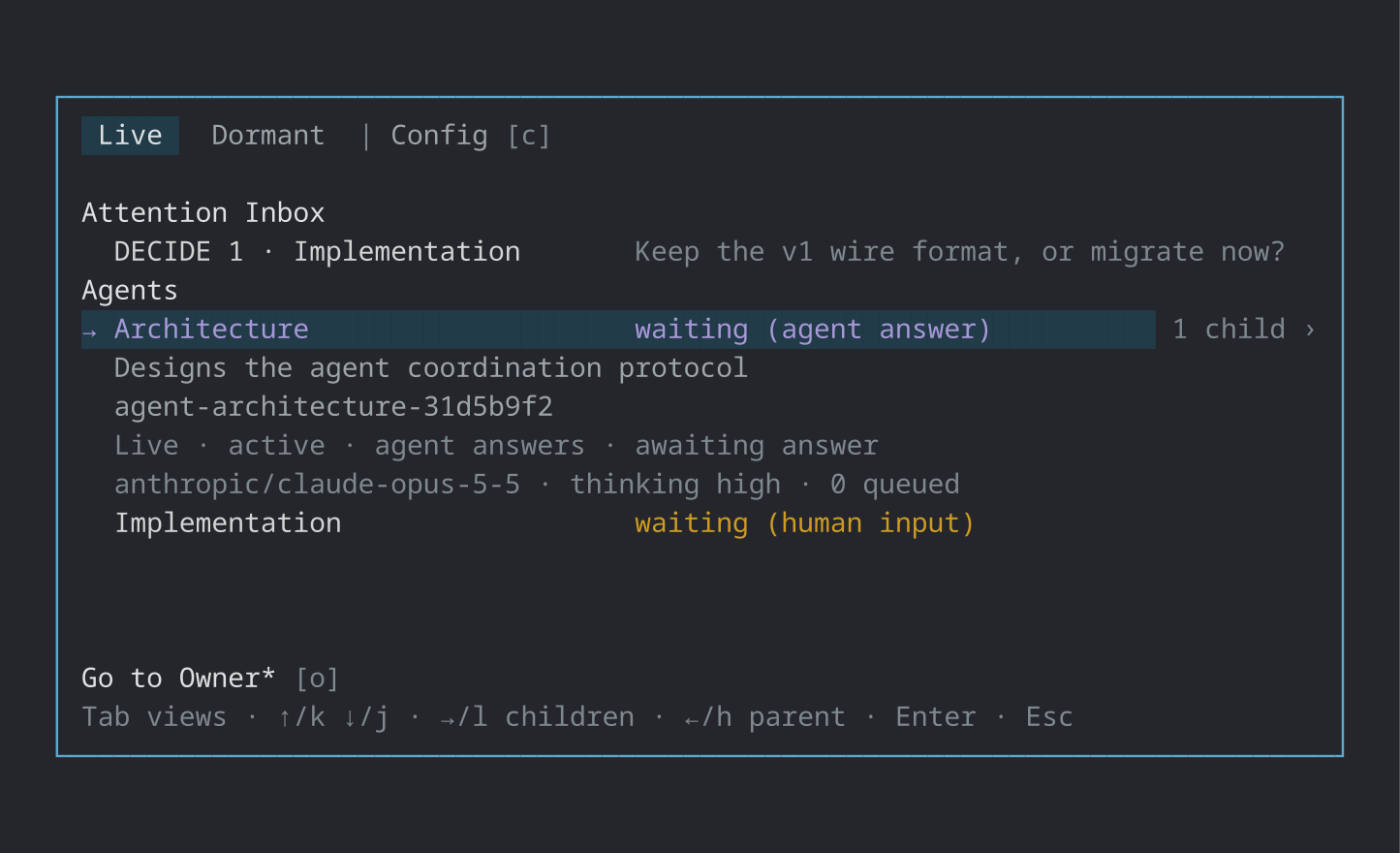
  "image": "https://raw.githubusercontent.com/xian0x5a/pi-durable-subagents/main/docs/images/agent-switcher.png",
  "extensions": [
    "./src/index.ts"
  ]
}
Security note
Pi packages can execute code and influence agent behavior. Review the source before installing third-party packages.
README
pi-durable-subagents
Durable Pi agents that collaborate asynchronously under explicit Owner and Spawner supervision.
Features
Interactive Agent switching
Run /agents from the Owner or any Agent to open the Agent switcher. Use /agents owner to return directly to the exact mounted Workflow Owner presentation without opening the switcher:
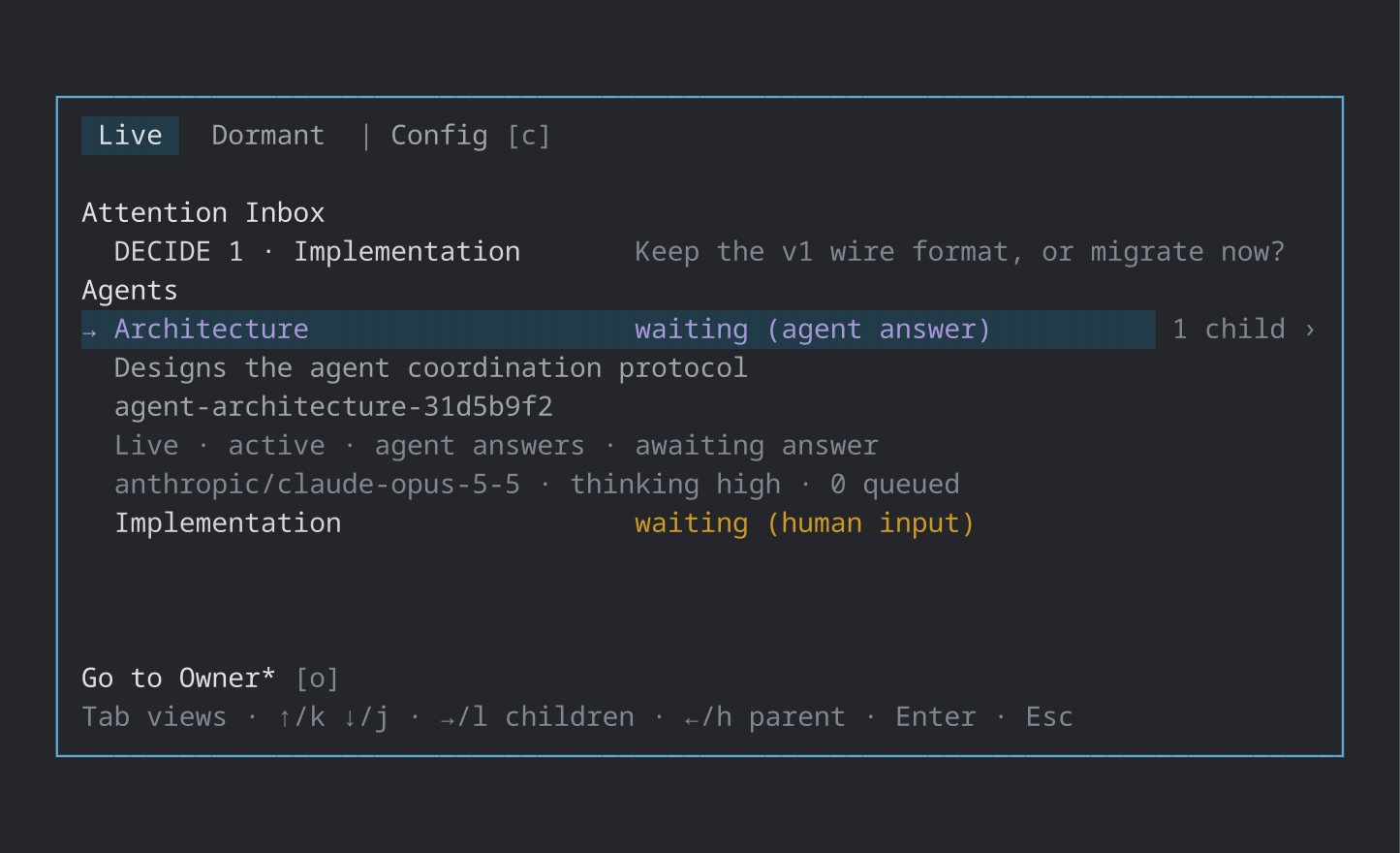
Select a subagent to enter its complete Pi session and interact with it directly—read its transcript, type into its editor, or use its commands and tools. In fullscreen mode, a primary click on the activity dock above the editor opens the same switcher.
Coordination and supervision
- Owner-directed Workflows: the current Pi session, in the TUI or a headless mode, becomes the durable Workflow Owner. Fork or clone it into a fresh, independent Workflow. See Owner Workflow.
- Durable child Agents: Agents create configurable, context-isolated children with
agent_spawn. See Agent spawning. - Messaging and Requests:
agent_messagesends Messages and titled Requests;agent_waitjoins their Answers. See Agent messaging. - Visible obligations:
agent_observelists and retrieves your outstanding Requests. - Human decisions: in the TUI, a spawned Agent can block on one free-form Human Answer with
ask_user. See Human Requests. - Run supervision: Owners and Direct Spawners inspect, interrupt, resume, or abort exact Runs with
agent_observeandagent_control. See Run supervision. - Incident handling: a runtime reminder recovers forgotten Answers; isolated Moderators handle persistent stalls, deadlocks, and failures under policy bounds. See Operational Incident moderation.
- Durable recovery: a fresh host rebuilds authority and pending Requests from Pi transcripts. See Cold host recovery.
- Model policy:
/agents modelsmaintains a durable deny list of models children may not use. See Workflow Policy. - Virtual models: name an ordered fallback list of models once and use
virtual/<name>in Templates and spawns; fixing the list updates every Agent. Edit them in the/agentsConfig tab (c). See Virtual Models.
Coordination does not override Pi's compaction, retry, or transport settings.
Durable obligations

A Request creates an Answer obligation that the responder owes until it commits an Answer or receives the requester's Cancellation. Stopping, resuming, or failing the Run, or a human typing into the child, leaves it open, and a plain Message creates none. When an obligated Agent stalls, the host sends one reminder (plus a free one if it stalled while a human was typing into it), then starts a Moderator that can intervene or escalate to the Workflow Owner. See Agent messaging and Operational Incident moderation.
Installation
Install from npm:
pi install npm:@xian0x5a/pi-durable-subagentsOr track the Git repository directly:
pi install git:github.com/xian0x5a/pi-durable-subagentsAttached-terminal support uses the node-pty native addon. It ships prebuilt binaries for Linux, macOS, and Windows on x64 and arm64, so those platforms need no install-time build. Other platforms compile it from source, which needs a C++ toolchain and npm permission to run its install scripts.
Usage
Start an interactive Pi TUI:
piThe package adopts the current session as the Workflow Owner; no separate activation command is required.
Headless modes host the Owner too, with no human in the loop:
pi -p "Delegate the review to two agents and summarize their answers"
pi --mode json "..."
pi --mode rpc
In a headless Workflow, Agents cannot use ask_user; they escalate through their supervisor instead. When a child's Run suspends, its supervisor is notified. The Agents selector, Agent views, and activity dock need the TUI. Reports are stored in the session, so reopen it interactively (pi --session <file>) to read them. See Headless Workflows.
Suggested agent templates
Templates are creation presets: edits apply to future spawns only. See Agent Templates for configuration details.
Both templates below use one Virtual Model, so a retired or banned model is fixed in one place. thinking: preset runs each entry on its own level. Add it in the /agents Config tab (c), or in ~/.pi/agent/config/pi-durable-subagents.json:
{
  "virtualModels": {
    "cheap": [
      { "id": "openai-codex/gpt-6-luna", "thinking": "high" },
      { "id": "deepseek/deepseek-v4-flash", "thinking": "high" }
    ]
  }
}
cheap-delegate
A cost-efficient default for bounded implementation, routine execution, and targeted fact-finding.
Save as ~/.agents/agents/cheap-delegate.md:
---
name: cheap-delegate
useWhen: >-
  Use as a cost-efficient default delegate for tasks with clear goals and
  verifiable outcomes, such as implementation with explicit requirements or
  instructions and bounded scope, routine execution, or targeted fact-finding.
  Do not use for thorough review, open-ended investigation, high-stakes security
  or architecture work, or tasks requiring substantial ambiguity resolution.
  If its results remain inadequate after several iterations and show no obvious
  improvement, stop assigning that task to this template.
models:
  - id: virtual/cheap
    thinking: preset
---
moderator
Used automatically for incident handling; point it at a cheaper model.
Save as ~/.agents/agents/moderator.md:
---
name: moderator
useWhen: Use for moderation and incident response.
models:
  - id: virtual/cheap
    thinking: preset
---
Compatibility
Pi supplies the package's Pi peer modules; compatibility is checked structurally against the running host. Pi 0.99.0 or newer is required, the first release with native virtual models. See Development for the conformance gate and supervised test runs.
Trust and persistence
Coordination is a trust-based protocol, not a security boundary. Owners, Spawners, ordinary Agents, and Moderators are trusted participants acting through role-scoped tools.
Pi transcripts are the durable authority for identity, Messages, Requests, Deliveries, and committed results. Scheduling queues, Holds, live Run state, UI attention, and open Agent-view attachment are volatile: orderly shutdown closes them, while abrupt process loss can discard them without claiming durable completion.
Documentation
- Owner Workflow — activation, headless Workflows, and compatibility behavior
- Owner blockage diagnostics — persistent admission failure status and
/agents diagnostics - Transcript repair design — proposed Workflow-owned repair Moderator and validated replacement; not implemented
- Operational Incident moderation — trigger detection, bounded handling, Moderator authority, Resolution, and recovery
- Cold host recovery — transcript discovery, quarantine, dormant rosters, and residual Requests
- Workflow Policy — reloadable execution, delivery, review limits, the
/agents modelsexclusion list, and Virtual Models - Agent spawning — child creation and receipt semantics
- Agent messaging — delivery modes and Agent Requests
- Human Requests — transcript-native questions, Answer mode, and commitment
- Agent selector — Live hierarchy, Dormant recency, attention, and keyboard navigation
- Interactive Agent view acceptance — complete-mode rendering, input, transitions, isolation, and lifecycle evidence
- Run supervision — observation, interruption, resumption, abort, and Agent-view retention
- Development — compatibility gate, supervised test runs, and deadlines