@yorch/pi-claude-delegate
[DEPRECATED] Delegate work to Claude Code — use pi-harness-delegate (pi install npm:pi-harness-delegate) — shim re-exporting claude harness.
Package details
Install @yorch/pi-claude-delegate from npm and Pi will load the resources declared by the package manifest.
$ pi install npm:@yorch/pi-claude-delegate- Package
@yorch/pi-claude-delegate- Version
0.6.1- Published
- Aug 26, 2026
- Downloads
- 2,596/mo · 68/wk
- Author
- yorch
- License
- MIT
- Types
- extension
- Size
- 13.9 KB
- Dependencies
- 1 dependency · 4 peers
Pi manifest JSON
{
  "extensions": [
    "./extensions/index.ts"
  ],
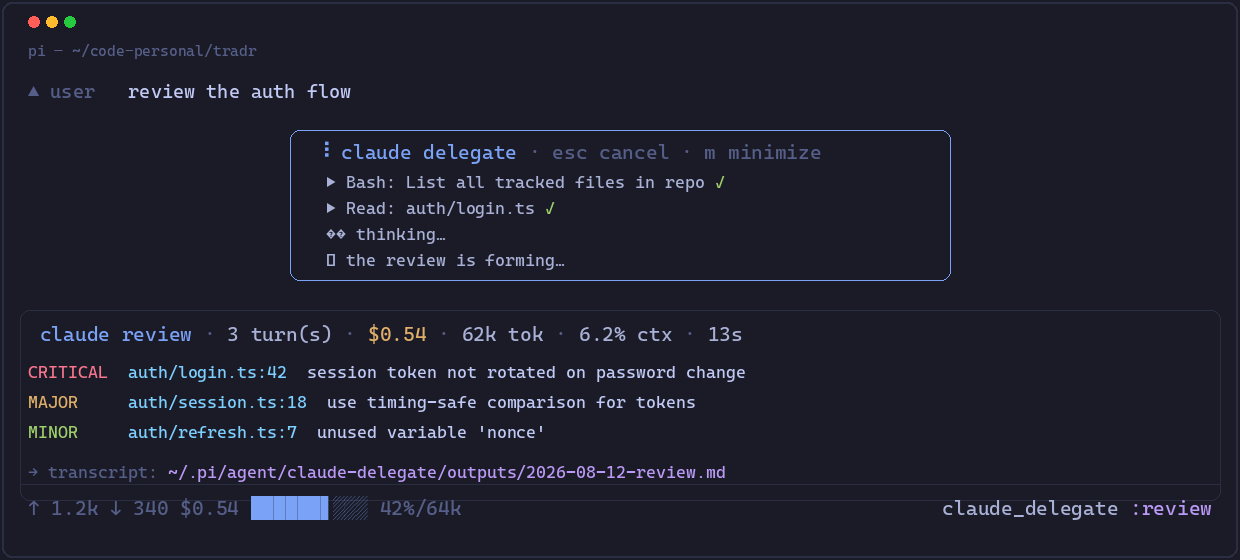
  "image": "https://raw.githubusercontent.com/yorch/pi-claude-delegate/main/docs/assets/claude-delegate-preview.png"
}
Security note
Pi packages can execute code and influence agent behavior. Review the source before installing third-party packages.
README
[!WARNING] Deprecated — use
pi-harness-delegateinstead.pi-claude-delegateis now a thin wrapper aroundpi-harness-delegate'sclaudeharness. Install the new package for multi-harness support (Claude, Codex, OpenCode, Amp):pi install npm:pi-harness-delegate— see Migration.
pi-claude-delegate


Delegate work to Claude Code from the pi coding agent: code reviews, detailed plans, implementation, security audits, docs — or your own custom templates.
Claude Code runs headless in your repo with a permission mode chosen per task. Results stream back live, and Claude's token/cost usage feeds into pi's footer stats.
Install
pi install npm:@yorch/pi-claude-delegate
# or from git
pi install git:github.com/yorch/pi-claude-delegate
Requires the claude CLI on your PATH (claude --version). Restart pi (or /reload) to activate.
Usage
The pi agent uses the claude_delegate tool automatically when you ask for e.g. "review this diff", "make a plan for …", or "audit the auth code".
Manual delegation:
/claude review the new auth flow                     # mode from first word
/claude --mode=security-audit --scope=auth/ …       # or explicit --mode=
/claude --mode=implement implement caching …        # implement with edits
/claude plan the cache migration
Only the prompt is required. A mode name as the first word selects the
mode; every --flag is optional (mode defaults to defaultMode, model to
the template/config, scope to the whole repo).
Some modes have default tasks when the prompt is omitted:
/claude review reviews the current git diff (scope: diff),
/claude security-audit audits the repository. Modes without a default
(plan, implement, docs, general) print a hint asking for a prompt.
The claude_delegate tool takes: task, mode, scope ("diff" = current git diff, a path list, or omit for the whole repo), model, maxBudgetUsd, allowDangerous.
Modes (templates)
| Mode | Permission | Model | Purpose |
|---|---|---|---|
review |
plan (read-only) |
sonnet | Code review, cites file:line, prioritized findings |
plan |
plan (read-only) |
sonnet | Detailed implementation plan with steps + risks |
implement |
acceptEdits |
sonnet | Implements a task, runs checks, reports changes |
security-audit |
plan (read-only) |
sonnet | Injection, auth, secrets, deserialization, supply chain |
docs |
acceptEdits |
sonnet | Generate/update docs matching repo style |
general |
acceptEdits |
config default | Any task |
Each mode is a markdown template. Built-ins ship in the package's templates/ (read them, copy them). Custom templates are just files with frontmatter + instructions, dropped in:
~/.pi/agent/claude-delegate/templates/<name>.md(global).pi/claude-delegate/templates/<name>.md(project — loaded when the project is trusted)
---
name: test-writer
description: Write unit tests for a scope. Writes files.
permissionMode: acceptEdits
model: sonnet
maxBudgetUsd: 3
---
You are a test engineer. Write focused unit tests matching the repo's
test framework and conventions. Run the suite and fix failures.
Any registered template name becomes a valid mode for the tool and /claude --mode=<name>.
Skills: delegated Claude runs with cwd = your repo, so .claude/skills/ in the repo are automatically available. Pin one with skill: <name> in a template's frontmatter.
How the main session consumes the output
- Agent-driven (
claude_delegatetool) — the report is the tool result, so it flows straight into the agent's context. The agent summarizes it, answers follow-ups, and keeps working from it automatically. - Manual (
/claudecommand) — after the run, the report is appended to the session as a custom message: it appears in the conversation (themed) and participates in LLM context, so your next prompt is answered with the report already in hand. The full text is also in the transcript file. Nothing is consumed automatically only in non-interactive modes (print/rpc), where the report goes to stdout.
So the natural loop is: /claude --mode=review <task> → the report lands in the
chat → you ask "what should we fix first?" and the main agent answers from it.
Inspecting what Claude is doing
Live activity feed — while a delegation runs, the tool box streams what Claude is doing:
▶ Bash: List all tracked files in repo ✓,💭 thinking…, and a tail of the answer as it forms. The/claudecommand opens a framed progress window with the same feed — a bordered modal showing⠋ claude <mode> · <model> · ⏱ elapsed, per-kind styling (accent tool calls with ✓/✗, dim thinking, streaming text), a red⚠ bypassPermissionsbanner when a mode runs unrestricted, and a hint row;esctwice cancels — first press arms, second confirms within 1.5s, so a stray tap never kills the run;mminimizes — the window hides while the run continues in the background, footer chip keeps updating; re-open with/claude watch) and mirrors it into the footer status chip.Formatted results — completed delegations render with a custom tool box: a colored head line (mode · turns · cost), the report as syntax-highlighted markdown (theme-aware), and a transcript/resume footer.
Full transcript every run — the complete output plus a tool-activity log and metadata is written to
~/.pi/agent/claude-delegate/outputs/(never in your repo). The tool result always ends with the transcript path.Resume a session — every run records a session id. Continue headlessly:
/claude --resume=<session-id> follow up on the reviewor interactively with
claude --resume <session-id>in your terminal.Reveal Claude's thinking live with
"inspectThinking": truein theclaudeDelegateconfig (off by default).
Config
All optional — in ~/.pi/agent/settings.json:
{
  "claudeDelegate": {
    "model": "sonnet",
    "timeoutMs": 600000,
    "defaultMode": "general",
    "allowDangerous": false,
    "inspectThinking": false,
    "maxBudgetUsd": 3,
    "autoDelegateHints": false,
    "modelAliases": { "economy": "haiku", "balanced": "sonnet", "max": "opus" },
    "maxConcurrent": 1,
    "maxTranscripts": 100
  }
}
maxBudgetUsd is a global default spend cap — per-call (maxBudgetUsd /
--budget=), per-template (frontmatter), then config, in that order.
modelAliases— templates may usemodel: economy|balanced|max(or any alias you define) instead of a literal; resolution: call → template → config, each alias-resolved.maxConcurrent— cap on overlapping delegated runs (default 1; each run costs money).maxTranscripts— oldest transcripts pruned beyond this count (default 100;0disables).
autoDelegateHints — inert by default
The extension never nudges the agent toward this tool unless you opt in. The tool exists in the agent's tool list with a neutral description (it may still be chosen on its own judgment), but:
autoDelegateHints: false(default) — user input is never touched. No system-prompt bias, no hint injection. Delegation happens via the/claudecommand or when the agent chooses the tool itself.autoDelegateHints: true— the input hook recognizes delegation intent and appends a hint for the agent: explicit markers ("…with claude", "delegate … to claude", "via claude") and imperative review/plan/audit/docs phrasing. Already-explicit references toclaude_delegateor/claudeare never re-hinted.Marker caveat: don't start a prompt with
@claude— pi parses a leading@as a file attachment. Use the phrase forms above, or/claude.
Metrics recorded
Every run records, in the tool result details and the transcript:
| Metric | Source |
|---|---|
| Cost | total_cost_usd |
| Tokens: input / output / cache write / cache read | usage |
| Context consumed (% of window) | prompt tokens ÷ modelUsage.contextWindow |
| Actual model | modelUsage key (canonical id, alias resolved) |
| Context window / max output | modelUsage |
| Turns, duration, TTFT, stop reason, session id | result |
Token + cost also feed pi's usage on the tool result, so they show up in the
pi footer stats. maxBudgetUsd hard-caps spend at the CLI level.
Security model
review/plan/security-auditrun with--permission-mode plan— read-only, can never edit.implement/docs/generalrun withacceptEdits— file edits auto-accepted, everything else still prompts.bypassPermissionsis only reachable viaallowDangerous: trueon a call (never a default).- Long outputs are truncated inline and saved to
~/.pi/agent/claude-delegate/outputs/(never in your repo).
Review what the claude CLI is asked to do before granting it broad permissions — like any powerful tool, delegate only in directories you trust.
Development
bun install
bun run typecheck
bun test
See CONTRIBUTING.md for the release dev-loop. Agents working in this repo should read AGENTS.md.
Credits
Built on pi's extension API and Claude Code's headless mode (claude -p --output-format stream-json --verbose).
License
MIT