@zhcsyncer/pi-meter
Local usage ledger plus subscription remaining for the Pi coding agent.
Package details
Install @zhcsyncer/pi-meter from npm and Pi will load the resources declared by the package manifest.
$ pi install npm:@zhcsyncer/pi-meter- Package
@zhcsyncer/pi-meter- Version
0.4.2- Published
- Sep 10, 2026
- Downloads
- 875/mo · 23/wk
- Author
- zhcsyncer
- License
- MIT
- Types
- extension
- Size
- 269 KB
- Dependencies
- 0 dependencies · 2 peers
Pi manifest JSON
{
  "image": "https://raw.githubusercontent.com/zhcsyncer/pi-extensions/main/packages/pi-meter/assets/demo-meter-status.png",
  "extensions": [
    "./extensions/meter.ts"
  ]
}
Security note
Pi packages can execute code and influence agent behavior. Review the source before installing third-party packages.
README
@zhcsyncer/pi-meter
Usage meter for the Pi coding agent. One /usage command answers two questions: how much of a subscription window is left, and where local tokens and cost went.
This package is also included in @zhcsyncer/pi-extensions.
Sources
This package combines two existing Pi extensions:
| Source | What you already know | What this package changes |
|---|---|---|
pi-tracker |
Local token/cost ledger, dashboard, budgets, session import | Those live under /usage, not /analytics. Counts use 34k / 4.3M / 5.35B. |
@pi-plugins/usage |
Claude and Codex subscription windows | Those live under /usage quota. SuperGrok and Ollama Cloud are included. |
Do not load @pi-plugins/usage at the same time. Both register /usage. If both are present, this package warns once and continues.
pi-tracker can stay loaded for comparison, but this package owns /usage.
Features
Footer line for the last 24 hours of local spend next to the current model's subscription window:
· 24h 12.4k $0.18 · xai week left ███░░ 49% (1d 23h)
Local dashboard by model, project, or session, including cache write. Usage-bearing tool results are counted too; Consult fanout is attributed to each advisor model instead of the main model.
Claude, Codex, SuperGrok, and Ollama Cloud remaining after
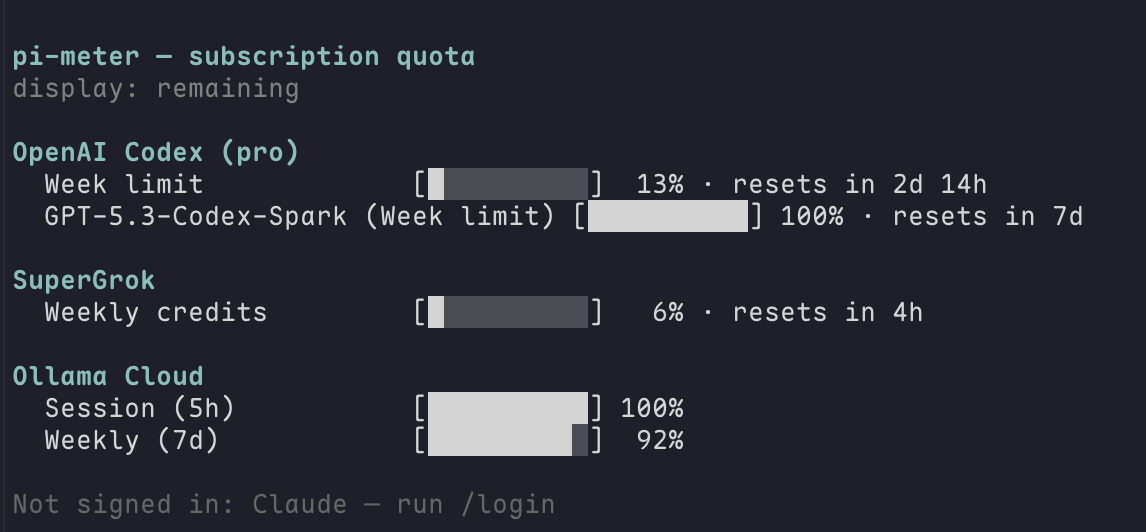
/loginfor that provider. Codex also shows banked weekly resets when you have any; the footer addsN resets …only while the current model is Codex./usage quotaopens a temporary dashboard. Unsigned-in providers stay as a muted summary at the bottom. If the current model has no window, or that provider is unsigned / unavailable, the footer shows a short hint instead of another vendor's bar. Snapshot titles show their age (12m ago) instead of the word stale.Other extensions can register a quota source. The footer still follows the current model only.
Optional local budgets. They warn; they never block requests.
Optional import from older session files. Safe to re-run: already-captured turns are not counted twice, and every run reports files scanned, records parsed, additions, known duplicates, skips, and whether the ledger changed.
--no-session still records local usage. Sub-agent usage is counted from each child's messages, not parent Agent results or marked get_subagent_result rollups; Pi's native session totals are unchanged. For reliable real-time coverage, including isolated children, add "pinnedExtensions": ["pi-meter"] to the user-level $PI_CODING_AGENT_DIR/extension-data/pi-subagents/config.json. Without pi-meter loaded in the child, use /usage import for saved child sessions.
Install
Standalone:
pi install npm:@zhcsyncer/pi-meter
Or install the whole extension bundle:
pi install npm:@zhcsyncer/pi-extensions
Try without installing:
pi -e npm:@zhcsyncer/pi-meter
Then restart Pi or run /reload. If @pi-plugins/usage is already in settings.json, remove it.
Commands
| Command | What you see |
|---|---|
/usage |
Menu: dashboard, quota, footer, budgets, import |
/usage quota |
Open the remaining/reset-time dashboard for Claude, Codex, SuperGrok, and Ollama Cloud |
/usage quota refresh |
Refresh subscription windows and open the dashboard |
/usage footer |
Configure the local summary, rolling/calendar window, quota visibility, and used/remaining display |
/usage import |
Back-fill from session files with an explicit added/duplicate/skipped/unchanged summary |
/usage budget |
View or add a local budget |
License
MIT
Local-ledger ideas come from MIT-licensed pi-tracker. Subscription-window ideas come from MIT-licensed @pi-plugins/usage.