avtc-pi-subagent
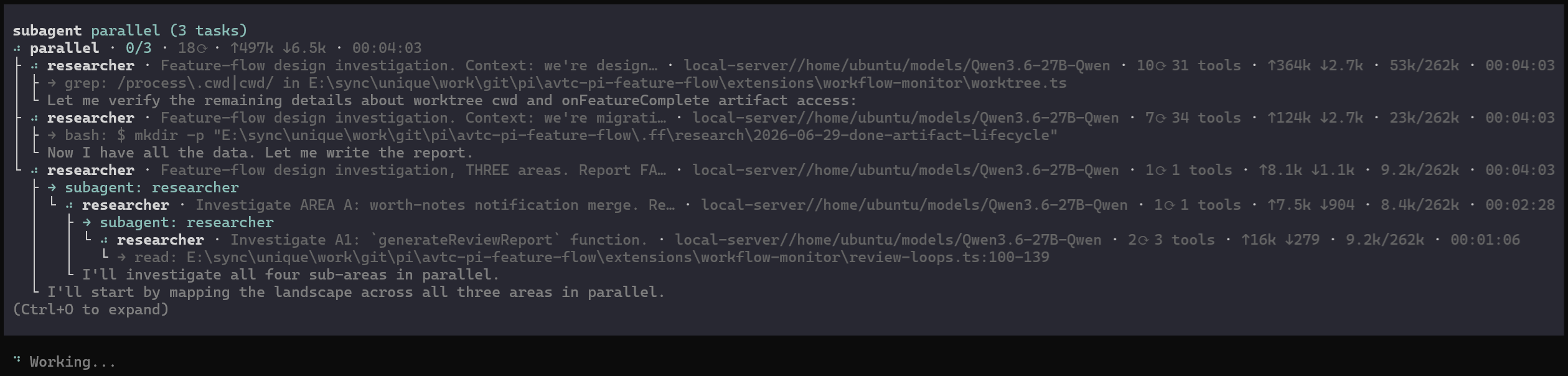
A subagent tool supporting context compaction and nested subagents — user-customizable models (with round-robin) and tool policies, extensible via hooks.
Package details
Install avtc-pi-subagent from npm and Pi will load the resources declared by the package manifest.
$ pi install npm:avtc-pi-subagent- Package
avtc-pi-subagent- Version
1.0.5- Published
- Jul 17, 2026
- Downloads
- 940/mo · 940/wk
- Author
- avtc
- License
- MIT
- Types
- extension
- Size
- 453.2 KB
- Dependencies
- 3 dependencies · 0 peers
Pi manifest JSON
{
  "extensions": [
    "./index.ts",
    "../avtc-pi-subagent-ui-bridge/index.ts"
  ],
  "allowedCodeDeps": [
    "avtc-pi-logger",
    "avtc-pi-settings-ui"
  ]
}
Security note
Pi packages can execute code and influence agent behavior. Review the source before installing third-party packages.
README
avtc-pi-subagent
A subagent tool supporting context compaction and nested subagents — user-customizable models (with round-robin) and tool policies, extensible via hooks.
Features
- Isolated context — each subagent runs in its own session with its own tools, system prompt, model, and skills.
- Three dispatch modes — single, parallel (concurrent), chain (sequential with
{previous}hand-off). - Overridable
cwd— dispatch a subagent into a specific directory (e.g. a feature worktree) instead of the main repo. - Fork mode — fork a subagent from the parent's session to reuse its prompt cache (see Fork mode).
- Model routing — per-call override, per-agent config by name or glob with round-robin rotation, and pluggable resolvers (see CONFIGURATION.md).
- Skills — agents declare
skills:in frontmatter; resolved and injected at dispatch; extra skill paths registerable. - Tool policy — control which tools each subagent can use, per agent or by glob: add, block, or whitelist tools, with reusable named tool sets and
$all(see CONFIGURATION.md). - Agent visibility — hide agents from announcements or disable them entirely via config globs (
hidden-agents,disabled-agents). - Concurrency & timeouts — parallel limit, subagent timeout, inactivity timeout, and a nesting-depth cap to bound recursion.
- Orphan-safe — subagents self-terminate if the parent process dies.
- Extensible — other extensions integrate via the
pi-subagent:readyevent (model resolvers, prompt transformers, agent/skill paths).
Defining agents
Agents are markdown files (YAML frontmatter + system prompt body) in ~/.pi/agent/agents/. Frontmatter fields: name, description, tools, model, skills, extensions, hide-from-agents-list.
hide-from-agents-list: true omits the agent from the subagent tool's "Available agents" list. The agent stays fully usable when called by name (by a user, skill, or other agent).
Fork mode
A -fork suffix marks a subagent as forked: it copies the parent's session system prompt and conversation history, so the prefill cache works. Set via the PI_SUBAGENT_FORK_MODE env var:
fork— every subagent runs forked.new+fork— each subagent runs twice in parallel: a fresh copy and a forked copy.- (unset) — every subagent runs as a fresh session (default).
Spawn mode
Controls how subagent child processes run. Set via the /subagent:settings Spawn mode dropdown:
- JSON — each subagent runs as a single-shot process: it receives the task, runs to completion, and exits.
- RPC — each subagent runs as a long-lived process that the parent talks to over a request/response protocol. A long-running subagent that compacts its own context keeps going on its own (and the parent can recover it if compaction is cancelled), so long tasks run without stalling or aborting as the conversation grows. This is the default.
Configuration
- Operational settings (timeout, concurrency, depth, spawn mode) — edit via
/subagent:settings. - Model overrides (which model each subagent uses) — see CONFIGURATION.md.
- Tool policy (which tools each subagent can use: add / block / only, named sets, hide/disable agents) — see CONFIGURATION.md.
Extensibility
Building an extension that integrates with subagents (model resolvers, prompt transformers, agent/skill paths, env hooks)? See EXTENSIBILITY.md.
Tools
| Tool | Description |
|---|---|
subagent |
Delegate a task to a specialized agent (single / parallel / chain modes) |
Commands
| Command | Description |
|---|---|
/subagent:settings |
Open the settings UI (concurrency, timeouts, max depth, spawn mode) |
Installation
pi install npm:avtc-pi-subagent
Full suite
Check out the full suite of related extensions, avtc-pi — deterministic feature development, subagent delegation, working-memory, behavioral learning, parallel-work guardrails, durable decisions, notifications, and more.
Developed with Z.ai — get 10% off your subscription via this referral link.
License
MIT