azdospec
Remote-first spec-driven development for Azure DevOps. Proposals, requirements and tasks as work items, linked to branches, PRs and people.
Package details
Install azdospec from npm and Pi will load the resources declared by the package manifest.
$ pi install npm:azdospec- Package
azdospec- Version
0.3.0- Published
- Sep 17, 2026
- Downloads
- 253/mo · 253/wk
- Author
- gn0m0-dei
- License
- MIT
- Types
- extension, skill
- Size
- 46 KB
- Dependencies
- 0 dependencies · 1 peer
Pi manifest JSON
{
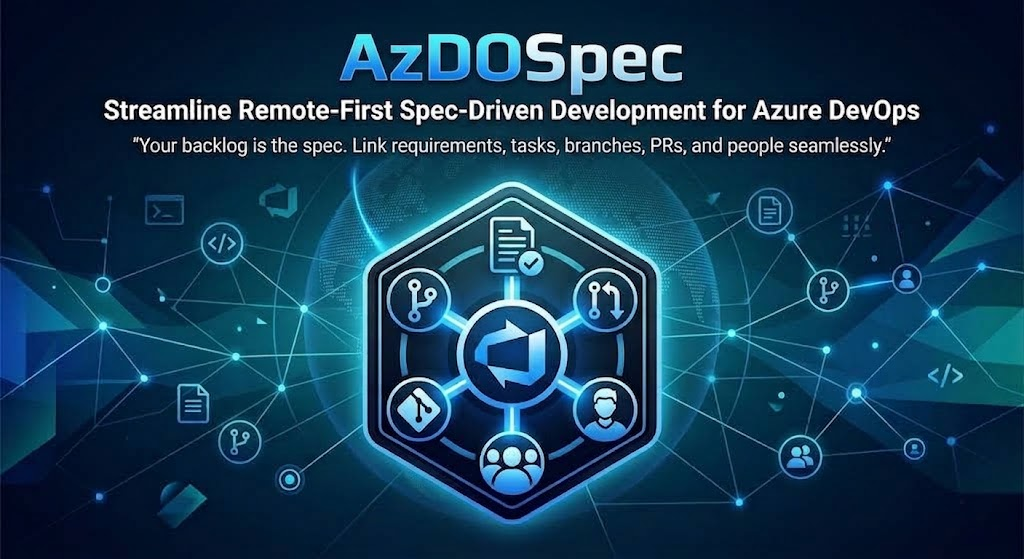
  "image": "https://raw.githubusercontent.com/Gn0m0-dei/azdospec/main/assets/banner.png",
  "skills": [
    "./skills"
  ],
  "extensions": [
    "./extensions"
  ]
}
Security note
Pi packages can execute code and influence agent behavior. Review the source before installing third-party packages.
README
Status: design phase. The model is settled and the commands are written. Not yet exercised against enough real projects to call it stable.
An agent skill that runs spec-driven development entirely inside Azure DevOps.
OpenSpec keeps proposals, specs and
tasks as Markdown in an openspec/ folder inside the repository. AzDOSpec keeps
the same model and drops the folder: every artifact is a native Azure Boards work
item, every relationship is a native link, and the agent reads the current state
from the board rather than the filesystem.
The result is one source of truth the whole team already looks at, where a requirement is connected to the branch that implements it, the pull request that merges it, the tests that verify it and the person who owns it.
Built on the open Agent Skills standard, so it works with any compatible agent — Claude Code, opencode, pi, and others.
How it maps
| OpenSpec | Azure DevOps |
|---|---|
| Capability | Area Path |
proposal.md |
Feature — a single backlog item when the change has one requirement, an Epic when it spans Features |
| Requirement + scenarios | Backlog item (User Story / Product Backlog Item / Requirement / Issue, per process) with Gherkin acceptance criteria and an ADDED / MODIFIED / REMOVED tag |
design.md |
Description of the Feature |
tasks.md |
Checklist while proposed; child Tasks once the item reaches a sprint |
| Dependencies | Predecessor / Successor and Related links |
specs/ |
Spec store — see below |
| Archive | Deltas applied to the spec store, items moved to Done |
Capabilities are Area Paths rather than long-lived work items on purpose: a backlog is a list of work, and an item that never closes distorts every board, rollup and forecast it appears on. The reasoning behind this and the other non-obvious choices is in how it maps.
Traceability is native throughout — parent/child hierarchy, AB#<id> in commits,
pull requests linked to the items they deliver, pull request completion
transitioning those items, and a branch policy that refuses a pull request with
no work item attached.
Commands
| Command | What it does |
|---|---|
/azdo:init |
Once per repository. Resolves organization and project from the git remote, detects the available spec store, configures the branch policy and writes .azdospec.json. |
/azdo:propose <idea> |
Reads the current spec, drafts the whole change — Feature, one requirement per delta, task checklist — shows it as a single draft, and creates and links everything once you approve. |
/azdo:apply |
Refuses unless a product owner approved the requirement and it has an iteration. Creates the tasks, derives parallel streams from the dependency links, pushes a branch named for the work item, opens the pull request and posts progress as comments. |
/azdo:archive |
Verifies the tasks are Done, folds the deltas into the spec store and closes the change. |
Full detail in commands.
Spec store
Where the merged, living specification of each capability lives. Chosen once by
/azdo:init, driven by what your organization actually licenses:
| Store | Requires | What it does |
|---|---|---|
testplans |
Basic + Test Plans | Each scenario becomes a Test Case — Design while proposed, Ready once archived, Closed when removed — in a suite per Area Path, linked Tests / Tested By to its requirement. Specification by example: the spec is executable. |
wiki |
Basic | Default when Test Plans is not licensed. One page per Area Path, rewritten on archive. |
epic |
Basic | Opt-in. One long-lived Epic per Area Path holding the spec in its description. Works anywhere, at the cost of a backlog item that never closes. |
none |
— | Opt-in. No merged spec; the agent reads the Done items of the Area Path. |
See spec stores for how to choose.
Requirements
An agent that supports Agent Skills or Claude Code plugins.
The Azure CLI with the
azure-devopsextension, signed in:az extension add --name azure-devops az loginThat sign-in is the identity for everything AzDOSpec does. There is no token to create or store, and no server to configure. Every artifact is a work item, so there is no offline mode.
A repository whose remote is an Azure DevOps repository.
Install
Claude Code — as a plugin
/plugin marketplace add Gn0m0-dei/azdospec
/plugin install azdo
This registers /azdo:init, /azdo:propose, /azdo:apply and /azdo:archive
as real commands.
pi
pi install npm:azdospec
git:github.com/Gn0m0-dei/azdospec works too, if you would rather track the
repository than the releases. It installs the skill and registers /azdo-init,
/azdo-propose, /azdo-apply and /azdo-archive.
opencode
Add the plugin to opencode.json and it registers the four commands and the
skill in one step — opencode installs it from npm itself:
{
  "$schema": "https://opencode.ai/config.json",
  "plugin": ["azdospec"]
}
The plugin never overwrites a command you configured yourself.
Any Agent Skills host
npx skills add Gn0m0-dei/azdospec
Or copy the skill folder (skills/azdospec/, the one containing SKILL.md)
into the skills directory your agent reads — ~/.claude/skills/azdospec/,
~/.config/opencode/skills/azdospec/, ~/.pi/agent/skills/azdospec/, or the
project-local equivalent.
Installed this way there are no slash commands: ask for what you want and the skill activates by description.
| Host | Install | Commands |
|---|---|---|
| Claude Code | /plugin install azdo |
/azdo:init, propose, apply, archive |
| pi | pi install npm:azdospec |
/azdo-init, azdo-propose, azdo-apply, azdo-archive |
| opencode | One line in opencode.json |
The same four |
| Any other Agent Skills host | npx skills add … |
None; activates by description |
Whatever the host, the Azure CLI is the connection: the same az login on every
one of them, and nothing per host to configure.
Documentation
→ Getting Started — install, set up a repository, first change → Commands — what each one does, and what it refuses to do → How It Maps — the reasoning behind the model → Spec Stores — where the living spec lives → FAQ
Layout
skills/azdospec/          # the skill itself — portable to any Agent Skills host
├── SKILL.md              # model, commands, hard rules
└── references/
    ├── work-items.md     # types, fields, links, delta tags, and the CLI commands for them
    ├── init.md · propose.md · apply.md · archive.md

.claude-plugin/           # Claude Code plugin manifest and marketplace entry
commands/                 # /azdo:init · propose · apply · archive — read by all three hosts
plugins/opencode.ts       # opencode plugin: registers them, plus the skill
extensions/               # pi extension: registers them
lib/                      # what the two of them share
test/                     # pnpm test
SKILL.md is loaded whenever the skill activates; references/ files are read
on demand, so only the detail a command actually needs enters the context.
The command files are deliberately thin — each one points at its procedure in
references/. The behaviour lives in the skill and nowhere else, and all three
hosts read the same four command files rather than each keeping a copy, so a
procedure is one edit and no host can drift away from another.
Nothing ships in a host's local configuration directory: .claude/, .opencode/
and .agents/ are where your machine keeps its agent settings, so they are
ignored here like in any other repository. Each host is pointed at the visible
directories above through its own manifest instead.
Credits
The artifact model comes from OpenSpec; the execution discipline — progress comments, dependency-driven parallel work, one branch per change — from CCPM. Both are local-first. AzDOSpec is the remote-first take on the same idea.
Contributing
See CONTRIBUTING.md. Open an issue before a pull request that changes behaviour — the mapping is deliberate, and a discussion is cheaper than a rewritten pull request.
License
MIT — see LICENSE.