design-playbook
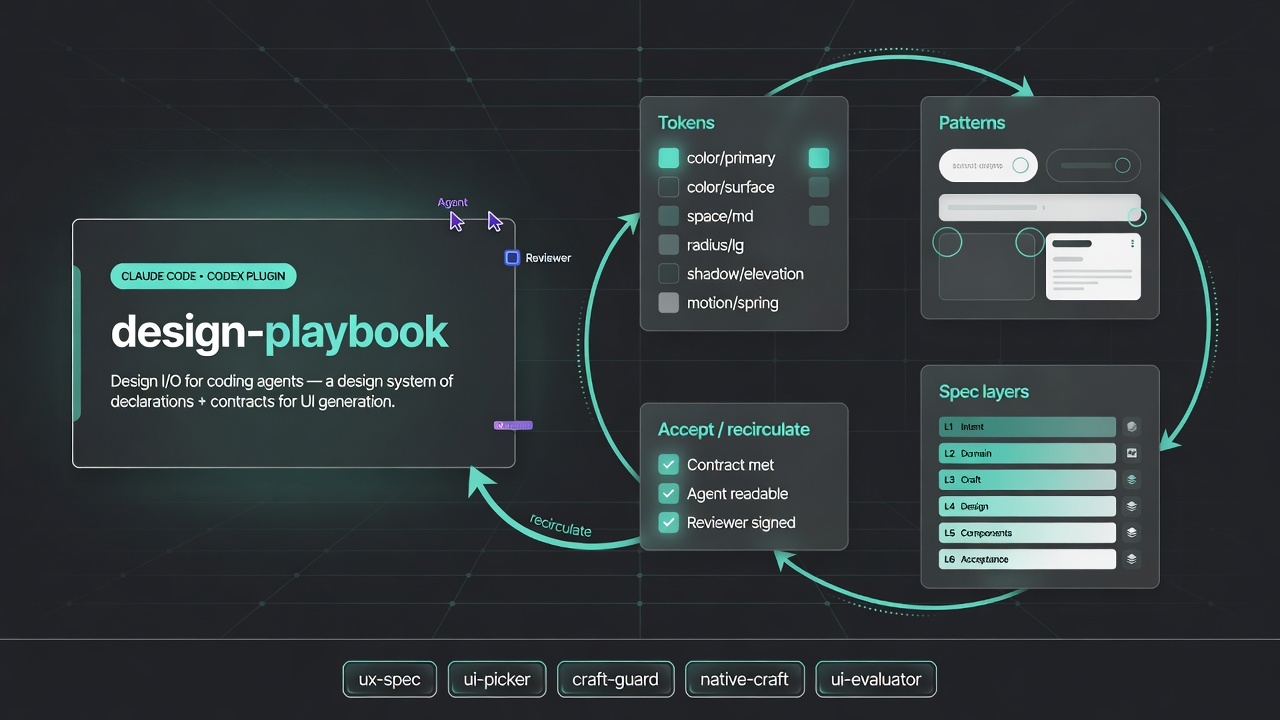
Design I/O for coding agents: controllable UI generation via declarations (spec/domain/craft/design/components/template) and contracts (skill/evaluator). Use for product UI—console, dashboard, agent-ops, CJK-first apps.
Package details
Install design-playbook from npm and Pi will load the resources declared by the package manifest.
$ pi install npm:design-playbook- Package
design-playbook- Version
0.10.0- Published
- Aug 4, 2026
- Downloads
- 430/mo · 430/wk
- Author
- amsterdam-littlehill
- License
- MIT
- Types
- skill, prompt
- Size
- 379.5 KB
- Dependencies
- 0 dependencies · 0 peers
Pi manifest JSON
{
  "skills": [
    "./skills"
  ],
  "prompts": [
    "./commands"
  ],
  "image": "https://raw.githubusercontent.com/Bandersnatch0x/design-playbook/main/packages/design-playbook/showcase/screenshots/hero.png"
}
Security note
Pi packages can execute code and influence agent behavior. Review the source before installing third-party packages.
README
design-playbook
Agent plugin: Design I/O for product UI (Claude Code / Codex).
Declarations + contracts — not a style CSV pack. Compose with ui-ux-pro-max and Anthropic frontend-design for aesthetics; this package owns pipeline and acceptance.
Install (Claude Code)
Path of record (published) - the marketplace catalog lives at the repo root, not in this package:
/plugin marketplace add https://github.com/Bandersnatch0x/design-playbook.git
/plugin install design-playbook@design-playbook
Local dev / self-test:
claude --plugin-dir <abs-path>/packages/design-playbook      # dev load, no install
# or local marketplace (point at the repo root, where the catalog lives)
/plugin marketplace add <abs-path-to-repo-root>
/plugin install design-playbook@design-playbook
Install (Codex)
Same GitHub repo / monorepo root catalog. Codex-native manifest lives at .codex-plugin/ (MCP uses relative paths).
codex plugin marketplace add Bandersnatch0x/design-playbook
codex plugin add design-playbook@design-playbook
Local monorepo:
codex plugin marketplace add <abs-path-to-repo-root>
codex plugin add design-playbook@design-playbook
Details + skills-only fallback: codex/AGENTS.md.
After install, skills and commands are namespaced by the plugin name:
| Invoke | Role |
|---|---|
/design-playbook:design-playbook |
Orchestrator skill (model-invoked) |
/design-playbook:design-baseline |
Discover/validate/draft the project DESIGN.md baseline |
/design-playbook:reference-intake |
Reference contract skill (screenshot/URL/analogy) |
/design-playbook:ux-spec |
Six-layer spec skill |
/design-playbook:ui-picker |
Shell + components skill |
/design-playbook:craft-guard |
Craft / anti-slop skill |
/design-playbook:native-craft |
Native-feel desktop declaration skill |
/design-playbook:ui-evaluator |
Point-back acceptance skill |
/design-playbook:design-io |
Full pipeline command |
/design-playbook:ux-spec |
Spec-only command |
/design-playbook:ui-review |
Review command |
/design-playbook:run-review |
Cross-run review command |
Bare /design-io is not the installed name — always use the design-playbook: prefix.
Install (pi)
Published to npm, listed in the pi package gallery.
pi install npm:design-playbook
pi has no plugin namespace — skills are /skill:<name>, commands are bare /<name>:
| Invoke | Role |
|---|---|
/skill:design-playbook |
Orchestrator skill (model-invoked) |
/skill:ux-spec … /skill:ui-evaluator |
Same eight skills as above |
/design-io · /ux-spec · /ui-review · /run-review |
Pipeline / spec-only / review / cross-run commands |
pi ships no built-in MCP, so preview* and observe* skip by default (ADR-0009 absent→skip; the pipeline still runs spec → picker → fill → craft → accept). To enable both gates, install an MCP adapter and register the bundled servers in your project .mcp.json:
pi install npm:pi-mcp-adapter
{
  "mcpServers": {
    "design-playbook-preview": {
      "command": "python",
      "args": ["<pkg>/mcp/preview/server.py"],
      "timeout": 3600000
    },
    "design-playbook-evidence": {
      "command": "python",
      "args": ["<pkg>/mcp/evidence/server.py"],
      "env": { "DESIGN_PLAYBOOK_RUN_ROOT": "." },
      "timeout": 3600000
    }
  }
}
<pkg> is the installed package root — ~/.pi/agent/npm/node_modules/design-playbook for a user install, .pi/npm/node_modules/design-playbook for a project install. Evidence also needs pip install playwright && playwright install chromium.
Stack with other skills
| Package | Use for |
|---|---|
| design-playbook | Baseline? → Reference? → Spec? → plan? → shell → optional preview* → fill → craft → optional observe* → evaluate / recirculate |
| ui-ux-pro-max | Style / palette / type search |
| frontend-design | Anti-template visual direction |
Layout
.claude-plugin/
  plugin.json          ← plugin manifest (the marketplace catalog lives at the repo root)
.mcp.json              ← bundled MCP servers, launched via ${CLAUDE_PLUGIN_ROOT} (ADR-0009)
mcp/{preview,evidence}/← MCP adapter runtimes (preview_prototype / execute_capture_plan)
skills/<name>/SKILL.md ← model-invoked skills
commands/<name>.md     ← slash commands (design-io, ux-spec, ui-review, run-review)
codex/AGENTS.md        ← Codex bridge notes
examples/              ← self-authored onboarding samples
LICENSE · NOTICE       ← authored-only scope
What ships
Only authored content in this package (skills, pipeline commands, metadata, self-written examples, self-authored bundled MCP adapters). See NOTICE and repo ADRs 0003–0006, 0009. Repo-maintainer polish commands live in the monorepo root .claude/commands/, not in this package.
Contract vs enforcement
Evidence exists only to satisfy a declared criterion — an observation without a binding to an L6 acceptance item is telemetry, not evidence. Runtime capture is done by external providers; design-playbook owns the binding (manifest) and the verdict (ledger), never the runtime.
The Design I/O run is a declared, host-neutral contract over plain-Markdown artifacts (DESIGN.md, spec, decision report, point-back ledger). Any coding agent that emits that shape can be checked; Claude Code and Codex are adapters over the same artifacts. Generators and bridges remain optional; existing-product UI work must bind a valid/accepted project baseline or record an explicit waiver.
Run artifacts land under .scratch/<run>/ (design-baseline/, plan.md, preview/, evidence/manifest.jsonl, point-back.md); see the orchestrator skill for what lands when. That is where to look — and manually intervene — when a run stalls.
Bundled MCP (v0.3+): Preview (mcp/preview/) and Evidence (mcp/evidence/) runtimes ship inside this package and are registered by .mcp.json (${CLAUDE_PLUGIN_ROOT}). Sibling monorepo dirs remain compatibility launchers/docs. The orchestrator still probes MCP tools/list and skips preview* / observe* when tools are absent. Evidence provider writes artifacts only — never the manifest. DESIGN_PLAYBOOK_RUN_ROOT: default "." in .mcp.json is the MCP process cwd, not the chat workspace — for a host-app dogfood, set an absolute path to .scratch/<run>/ (see mcp/evidence/README.md). Capture responses include written_path (absolute) so mis-rooted writes are visible without a filesystem search.
What is deterministically enforced today: plugin install/structure (scripts/validate.py) and the run-artifact shape (scripts/validate_run.py — L1–L6 present; every top-level L6 item ordered Given -> When -> Then; one non-empty four-field evidence ledger row per L6.<n> with allowed results; four non-empty finding fields with non-empty source; exactly one explicit ## Verdict of Pass or Recirculate; Pass requires every evidence result to be pass and exactly one issue-linked 0 blocking closure per blocking finding; exit 0/RUN OK, exit 1/RUN INVALID, exit 2/RUN ERROR; regression-tested by tests/test_validate_run.py, which also validates the showcase artifacts directly; G5 is a conditional preview-confirm gate — enforced only when preview artifacts exist / --preview-dir is used; G6 is a conditional evidence-binding gate — enforced only when a ledger observed references an evidence/ artifact / --evidence-dir is used; opt-in strict mode via --require-preview / --require-evidence / --strict). The observe* step probes MCP tool execute_capture_plan and is skipped when absent. Everything else in the pipeline is agent-executed craft judgment, not a machine gate.
Codex
See codex/AGENTS.md.