json-render-pi
A Pi TUI adapter for json-render Ink specs.
Package details
Install json-render-pi from npm and Pi will load the resources declared by the package manifest.
$ pi install npm:json-render-pi- Package
json-render-pi- Version
0.1.0- Published
- Jul 28, 2026
- Downloads
- 176/mo · 176/wk
- Author
- sharanry
- License
- MIT
- Types
- extension, skill
- Size
- 260.7 KB
- Dependencies
- 3 dependencies · 3 peers
Pi manifest JSON
{
  "extensions": [
    "./src/index.ts"
  ],
  "skills": [
    "./skills"
  ],
  "image": "https://raw.githubusercontent.com/sharanry/json-render-pi/main/docs/images/deployment-status.png"
}
Security note
Pi packages can execute code and influence agent behavior. Review the source before installing third-party packages.
README
json-render for Pi
A Pi extension that renders a constrained json-render Ink spec with Pi's
native @earendil-works/pi-tui component system.
Pi and Ink both control the terminal screen, so mounting @json-render/ink
inside Pi would conflict with Pi's TUI. This adapter pins the upstream Ink
catalog as its declarative contract, narrows it to reliable read-only
components, and translates the result into Pi TUI lines.
Start locally
Load the complete package—extension and skill—from this repository:
pi -e .
Or install it persistently:
pi install .
pi
Inline UI generation
The model-invocable json-ui skill teaches Pi when and how to call
render_json_ui: compact dashboards, status cards, progress, trends,
comparisons, tables, and checklists when visual structure is more scannable
than prose.
There is no /json-ui command and no dialog or overlay. Tool results render
inline in Pi's conversation transcript.
Render examples
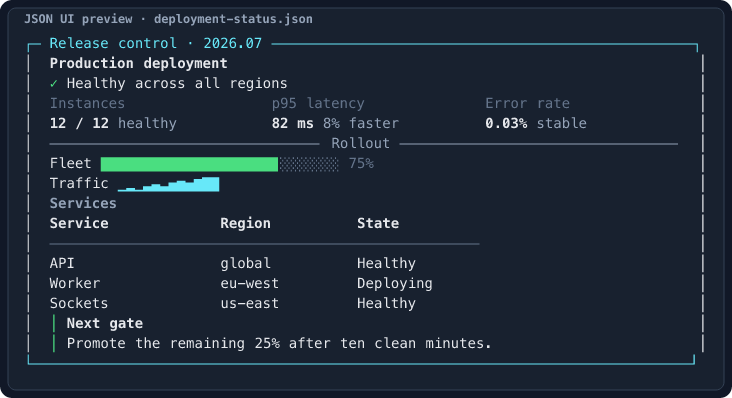
Each screenshot is generated by the standalone harness from the linked JSON spec and inspected at its target terminal width.
Deployment status · 80 columns
Compact agent plan · 80 columns
Detailed agent plan · 120 columns
Includes concrete file paths, an information-flow diagram, proposed database schemas, verification steps, and a stop condition.
Reliability constraints
The tool exposes its exact component schema to the model and validates it again at runtime. It rejects unknown components and props, invalid child placement, missing or unreachable elements, cycles, excessive nesting, and oversized specs. Current limits include 30 elements, six nesting levels, two cards, and bounded table/list/chart data.
Only Box and Card may contain children. Supported leaves are Text,
Heading, Divider, Badge, KeyValue, StatusLine, Metric,
ProgressBar, Sparkline, BarChart, Table, List, and Callout.
Interactive controls and action bindings are rejected rather than pretending
to work in a static transcript.
Rendering is parent-width-aware. Long text wraps with ANSI styling preserved,
table cells wrap within their columns, and row boxes retain multi-line child
alignment. The tool uses Pi's self-rendering shell so the UI stays on the normal
terminal background instead of inheriting the green toolSuccessBg surface.
Standalone visual development loop
Validate and render without invoking a model or starting Pi:
npm run ui:dev -- examples/deployment-status.json \
  --width 80 \
  --ascii .artifacts/deployment-status.txt \
  --png .artifacts/deployment-status.png \
  --report .artifacts/deployment-status.report.json \
  --strict
The harness uses the same validator and renderer as the extension, prints an
ANSI terminal preview, runs design heuristics, and can write ASCII, SVG, PNG,
and JSON reports. PNG screenshots open automatically in macOS Preview. Pass
--no-open only for CI or automated tests.
Use watch mode for a short edit–inspect–iterate loop:
npm run ui:dev -- examples/agent-plan.json \
  --watch \
  --width 80 \
  --png .artifacts/agent-plan.png \
  --strict
Run npm run ui:dev -- --help for every option. Curated examples include a
production deployment dashboard, a compact coding-task plan, and a detailed
120-column plan with file paths, information flow, and proposed database schemas.
Develop
npm test
npm run typecheck
The tests include regressions for malformed generated specs, schema exposure, complexity budgets, nested wrapping, row layout, snapshot generation, design auditing, the complete CLI workflow, and package skill discovery.
License
MIT © 2026 Sharan Yalburgi