no-more-agents-dot-md
No More Agents Dot MD: turn .pi/context/*.md files into declarative behavior rules (conditional context injection, tool guards, confirmations, input transforms, notifications) managed with the /nma command.
Package details
Install no-more-agents-dot-md from npm and Pi will load the resources declared by the package manifest.
$ pi install npm:no-more-agents-dot-md- Package
no-more-agents-dot-md- Version
1.2.0- Published
- Aug 17, 2026
- Downloads
- 1,195/mo · 637/wk
- Author
- theophile-baudouin
- License
- MIT
- Types
- extension, skill
- Size
- 298.8 KB
- Dependencies
- 0 dependencies · 1 peer
Pi manifest JSON
{
  "extensions": [
    ".pi/extensions/context-engine"
  ],
  "skills": [
    "skill/context-engine"
  ],
  "image": "https://raw.githubusercontent.com/TheophileBaudouin/No-More-Agents-Dot-MD/main/assets/image.png"
}
Security note
Pi packages can execute code and influence agent behavior. Review the source before installing third-party packages.
README

No More Agents Dot MD
Context at the right moment — not always.
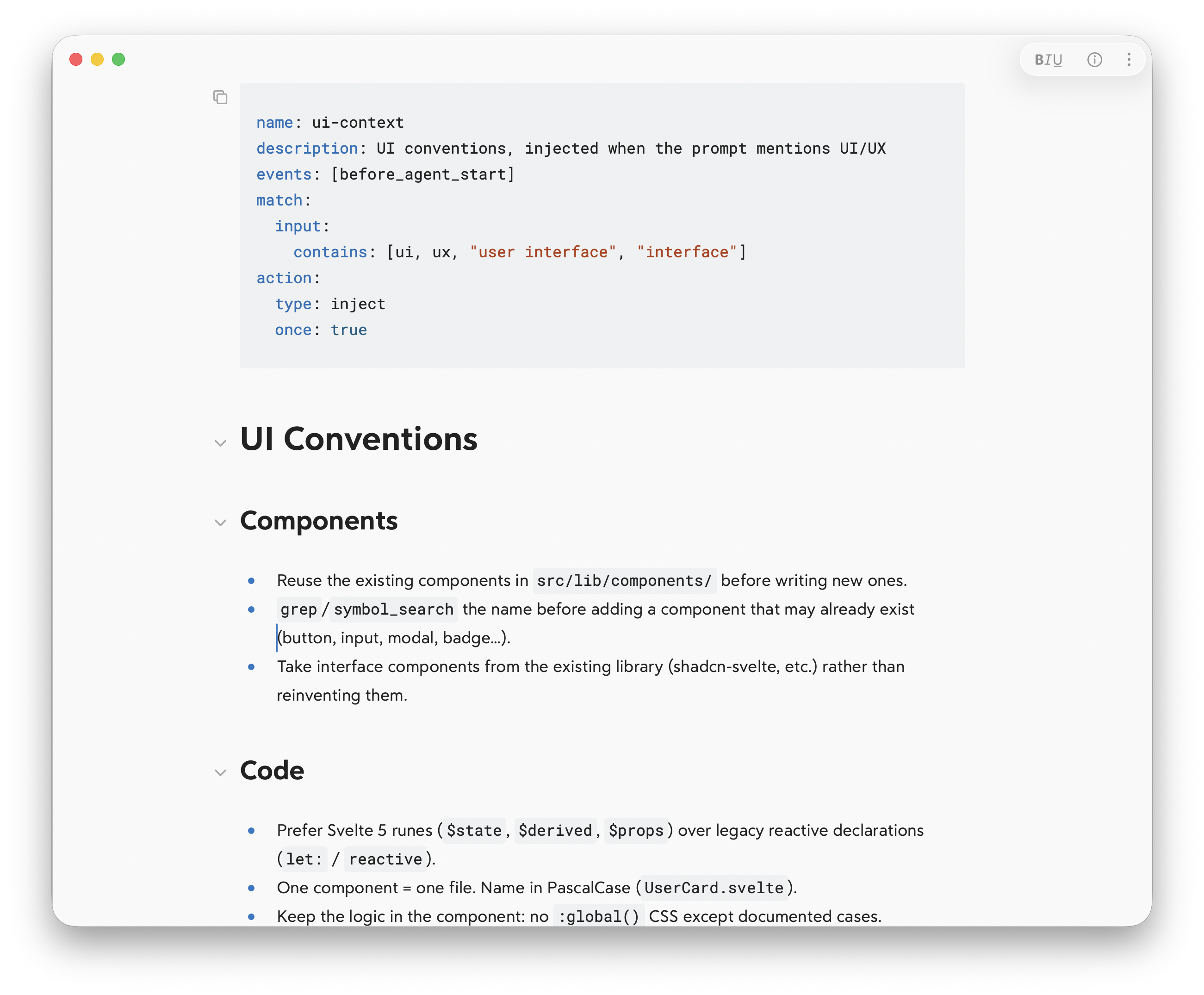
No More Agents Dot MD replaces the monolithic AGENTS.md with tiny, declarative context files (.pi/context/*.md), driven by a Pi extension. Each file is a micro-context: the YAML frontmatter describes when a rule applies and what it does; the Markdown body is the context the agent sees — injected only when it's relevant.
The idea
This extension was born from a video by Matt Pocock about the /init command. Its point: /init doesn't do magic — it just writes rules into an AGENTS.md file. Those rules then stay in the context constantly, even when they're useless for the task at hand.
The alternative in the video: Claude Code's hooks — instructions that fire at the right moment (before a tool call, after a result, when the user types…). Claude Code has them natively, and Pi extensions already exist to create hook-compatible files.
But stopping there felt like a shame: you'd only be able to produce files compatible with Claude Code — and never use the full power of the Pi SDK.
No More Agents Dot MD goes all the way. It is a native Pi extension built on 100% of the Pi SDK — itself far more permissive and granular than any hooks system — so your context is managed 100% by Pi, with a level of control that's impossible anywhere else:
- instructions arrive at the right moment, injected only when they apply;
- the agent sees cleaner context — no permanent noise in every prompt;
- rules can go further than injecting text: block an action, ask for a confirmation, transform an input, toggle tools;
- and you stay in control: write the rules by hand, or ask the agent — the built-in skill writes exactly the context file you need.
How it works
.pi/
├── context/                 # user-created — your behavior rules
└── extensions/
    └── context-engine/      # the extension (installed by pi)
        ├── index.ts         #   event wiring + /nma command
        ├── engine.ts        #   rule model + loader + validation
        ├── match.ts         #   declarative matcher
        ├── frontmatter.ts   #   YAML-subset parser
        └── security/        #   scan gate + action barrier + trust
            ├── scan.ts      #   scan pipeline (decode → rules → code)
            ├── rules.ts     #   prompt-injection signatures
            ├── commands.ts  #   shell pipeline analysis
            ├── encoding.ts  #   base64/hex/URL decoders
            ├── trust.ts     #   trust store (path + SHA-256)
            └── …            #   13 modules total
skill/context-engine/        # the skill (installed by pi)
.pi/context/ is yours — the repository ships no rules. Create it with mkdir -p .pi/context, or ask the agent: the skill creates it for you.
Security is built in. Every rule file is scanned before it loads (obfuscation, prompt-injection, external refs, frontmatter-as-code) and gated through a trust store: critical is blocked, medium/high confirm, trusted files load silently. While any loaded file is not yet trusted, tool commands are scanned too. At the action barrier, commands containing public http(s) URLs can optionally be checked against URLhaus (NMA_URLHAUS_KEY); a listed host is treated as critical and terminal. Network checks never run at load time, and NMA_NETWORK=0 disables them. See the Security model for the honest limits.
Install
pi install npm:no-more-agents-dot-md
Or from git:
pi install git:github.com/TheophileBaudouin/No-More-Agents-Dot-MD
Restart pi in a project. With no rules yet, the engine loads silently — it
only logs when rules exist (e.g. [No More Agents Dot MD] 2 rule(s) loaded from .pi/context/). That silence is normal: rules are user-created, the
repository ships none.
Write a rule
Ask the agent ("add a context rule for X"): the skill picks the closest template and writes the rule. Or write one by hand:
---
name: git-safety
description: Confirm before destructive git commands
events: [tool_call]
match:
  tool: bash
  command:
    regex: ["^git push", "^git reset --hard"]
action:
  type: confirm
  message: "Potentially destructive git command."
priority: high
---
Reload with /nma reload — no restart needed. Full schema in skill/context-engine/references/schema.md.
What a rule can do
| Event | Subject matched | Actions |
|---|---|---|
before_agent_start |
prompt text | inject, tools, notify |
tool_call |
tool name, input JSON, command | block, confirm, modify, inject, tools, notify |
tool_result |
tool name, output text (result) |
annotate, inject, notify |
input |
raw user input, source | transform, handled, tools, notify |
user_bash |
! / !! command |
block, confirm, modify, notify |
session_before_switch |
reason (new/resume) |
confirm, block, notify |
session_before_fork |
position (before/at) |
confirm, block, notify |
Match on: input, command, tool, any — plus model (active model), cwd (project path), sessionSize, contextFill (context usage %), result (tool output), source (input origin).
Actions: inject (once per session), confirm (fail-safe without UI), block, modify (command append/prepend), tools (enable/disable pi tools), notify (visual feedback), transform (rewrite input), handled (answer without the LLM), annotate (append to a tool result).
Manage rules with /nma
/nma— list the loaded rules (name, events, action, priority, file)./nma reload— reload.pi/context/without restarting pi./nma status— what fired this session (injections, blocks, journal)./nma security— per-file scan level, load state, trust state, command guard ON/OFF./nma trust <file> [--yes]— scan + approve a rule file;/nma untrust <file>— revoke./nma import <name|keywords> [--yes]— search the community registry by name or keywords (name, tags, category, author) and import a context file into.pi/context/. An exact name match imports directly; keyword matches with multiple results open a picker (or a bullet list without a UI). Imported files go through the same security scan and trust flow as local files;--yesanswers the high/critical and overwrite confirmations when there is no UI./nma share— open the community submission form.
Share your rules
Found a rule worth keeping? Share it. Awesome No-More-Agents-Dot-MD is the community registry of Pi context files — a website to browse, submit and share them in a few clicks:
- Site: https://theophilebaudouin.github.io/awesome-No-More-Agents-Dot-MD/
- Repository: https://github.com/TheophileBaudouin/awesome-No-More-Agents-Dot-MD
Documentation
- documentation/ — the human guide: installation, writing rules, examples, reference, architecture, security model.
- The skill in
skill/context-engine/is the documentation for the LLM.
Verify
With a few rules of your own (see the examples):
- "improve the ui" → the UI conventions appear in the system prompt.
git push→ pi asks for confirmation, and a warning notification appears.pytest -x→ testing conventions show up right after the result.!review→ the input is rewritten into a full code-review request.- A failing test run → the result carries the focused-test guidance.
/nma→ the loaded rules are listed.
Test
cd .pi/extensions/context-engine && node --test "*.test.ts" "security/*.test.ts"
Zero runtime npm dependencies (native fetch for the optional network
signals); runs on Node ≥ 22.6 (native TS type-stripping).