opencode-pi
Bridge OpenCode CLI free models into Pi without OpenCode login
Package details
Install opencode-pi from npm and Pi will load the resources declared by the package manifest.
$ pi install npm:opencode-pi- Package
opencode-pi- Version
1.1.3- Published
- Aug 12, 2026
- Downloads
- 649/mo · 225/wk
- Author
- luong.nguyen
- License
- MIT
- Types
- extension
- Size
- 83.8 KB
- Dependencies
- 0 dependencies · 2 peers
Pi manifest JSON
{
  "extensions": [
    "./src/index.ts"
  ],
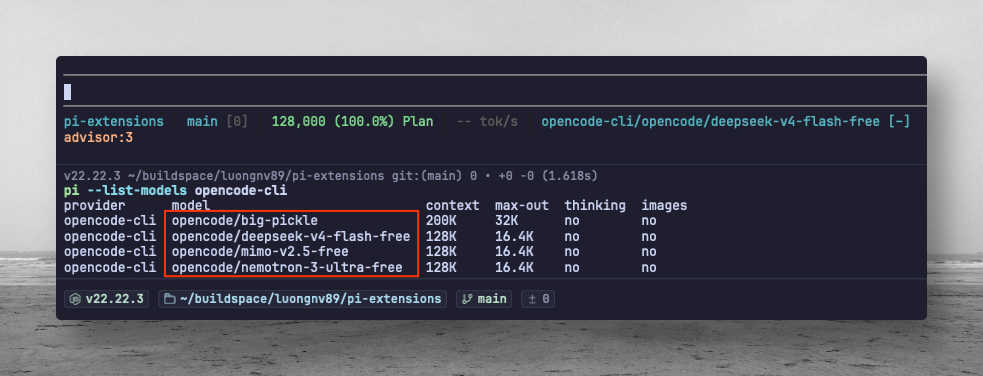
  "image": "https://raw.githubusercontent.com/luongnv89/pi-extensions/main/assets/pi-opencode-cli-model-list.png"
}
Security note
Pi packages can execute code and influence agent behavior. Review the source before installing third-party packages.
README
opencode-pi
opencode-pi registers an opencode-cli provider in Pi and delegates model calls to the local opencode CLI.


It is intended for the free OpenCode models that work without opencode auth login, such as:
opencode/deepseek-v4-flash-freeopencode/mimo-v2.5-freeopencode/nemotron-3-super-freeopencode/big-pickle
Requirements
- Pi Coding Agent
- OpenCode installed and available on the same machine:
opencode --version
opencode models opencode --verbose
No OpenCode login is required for the bundled free OpenCode models.
Install
Published on npm: opencode-pi. Use Pi's package manager (pi install), not npm install alone.
pi install npm:opencode-pi
pi install npm:opencode-pi@1.1.0   # pin version
pi install -l npm:opencode-pi      # project-local (.pi/settings.json)
pi -e npm:opencode-pi                # one session, no install
Then run /reload in Pi (or restart).
pi list
pi update npm:opencode-pi
pi remove npm:opencode-pi
From pi-extensions (git):
cp -r extensions/opencode-pi ~/.pi/agent/extensions/
# or from repo root: npm run install-extensions
Usage
Pick the provider from /model, or start Pi directly:
pi --provider opencode-cli --model opencode/deepseek-v4-flash-free
Print-mode smoke test:
pi -p --provider opencode-cli --model opencode/deepseek-v4-flash-free "Reply with exactly OK"
Commands:
/opencode-pi status
/opencode-pi models
/opencode-pi test
/opencode-pi update
/opencode-pi help
Refreshing the model list
OpenCode changes its free model roster frequently. Refresh the registered models at runtime:
/opencode-pi update
This queries opencode models opencode --verbose, parses each model's capabilities and limits, updates the provider's model list, and shows how many new models were added. Pi receives the discovered display name, reasoning and image capabilities, context window, and output limit. The status command also displays the timestamp of the last discovery.
Configuration
| Environment variable | Description |
|---|---|
OPENCODE_PI_BIN |
Override the OpenCode executable path. Defaults to opencode. |
OPENCODE_PI_MODELS |
Comma- or space-separated model list to register. Values without / are prefixed with opencode/. Registers immediately with conservative fallback metadata (skipping verbose discovery so startup never pays a discovery timeout); run /opencode-pi update to enrich these models with real capabilities from verbose discovery. |
Example:
OPENCODE_PI_MODELS="opencode/deepseek-v4-flash-free,opencode/mimo-v2.5-free" pi
How it works
For each Pi model call, the extension:
- Discovers model metadata from the ID/JSON pairs printed by
opencode models opencode --verbose. - Creates a temporary OpenCode project with a locked-down
pi-modelagent. - Denies OpenCode's own tools (
bash,edit,read, web tools, subagents, etc.). - Sends Pi's current prompt/context to
opencode run --format jsonover stdin. - Writes user and tool-result images to temporary files and adds one
--fileargument per image when the selected model advertises image input. - Enables
--thinkingfor reasoning models, maps supported Pi reasoning levels to discovered OpenCode variants, and converts reasoning JSON events into Pi thinking blocks. - Converts marker-only
<pi_tool_call>{...}</pi_tool_call>responses into real Pi tool calls, so Pi executes tools rather than OpenCode.
Tool markers are treated as control syntax only inside <pi_tool_call> blocks. The parser accepts markers surrounded by model prose, whole-response JSON-quoted markers, common unambiguous closing-tag variants, and a complete JSON payload whose closing tag was omitted. It also narrowly repairs unescaped quotes inside JSON string values—a compatibility case seen when reasoning models generate shell commands—then applies the normal payload validation and current-tool allowlist. Truncated or ambiguous markers, other malformed arguments, and unavailable tools are never executed. Rejected requests report whether the marker structure, payload, or allowlist caused the failure. Tool-call IDs are retained in the serialized transcript so later results can be matched correctly.
This keeps file access and edits under Pi's normal tool pipeline. Temporary image and agent files are removed after each turn.
Testing
Run the automated suite from this extension directory:
npm test
Notes and limitations
- This is a CLI bridge, not a native provider API. It is slower than direct HTTP providers because it starts
opencode runfor each model turn. - Tool calling is prompt-bridged. Marker payloads remain shape-validated and tool-allowlisted; the only leniency is prose extraction and narrow repair of unescaped quotes inside JSON strings. Native tool-call providers can still be more reliable.
- Image and reasoning support are advertised per model only when verbose discovery reports those capabilities. Models configured via
OPENCODE_PI_MODELSstart on conservative text-only, non-reasoning fallback metadata (no discovery call at startup) until/opencode-pi updateruns discovery to enrich them; default (unconfigured) IDs fall back the same way if discovery fails. - Reasoning levels are exposed only for variants reported by OpenCode; models without variants do not claim selectable thinking levels.
- If OpenCode ever attempts to use its own tools, the extension fails the turn instead of hiding it.