pi-agent-fleet
DAG-of-agents fleets for pi — parallel workers with contracts, reviewer-gated iteration loops, and live progress
Package details
Install pi-agent-fleet from npm and Pi will load the resources declared by the package manifest.
$ pi install npm:pi-agent-fleet- Package
pi-agent-fleet- Version
0.7.1- Published
- Aug 29, 2026
- Downloads
- 608/mo · 25/wk
- Author
- sagx
- License
- MIT
- Types
- extension
- Size
- 1.9 MB
- Dependencies
- 4 dependencies · 3 peers
Pi manifest JSON
{
  "extensions": [
    "./src/index.ts"
  ],
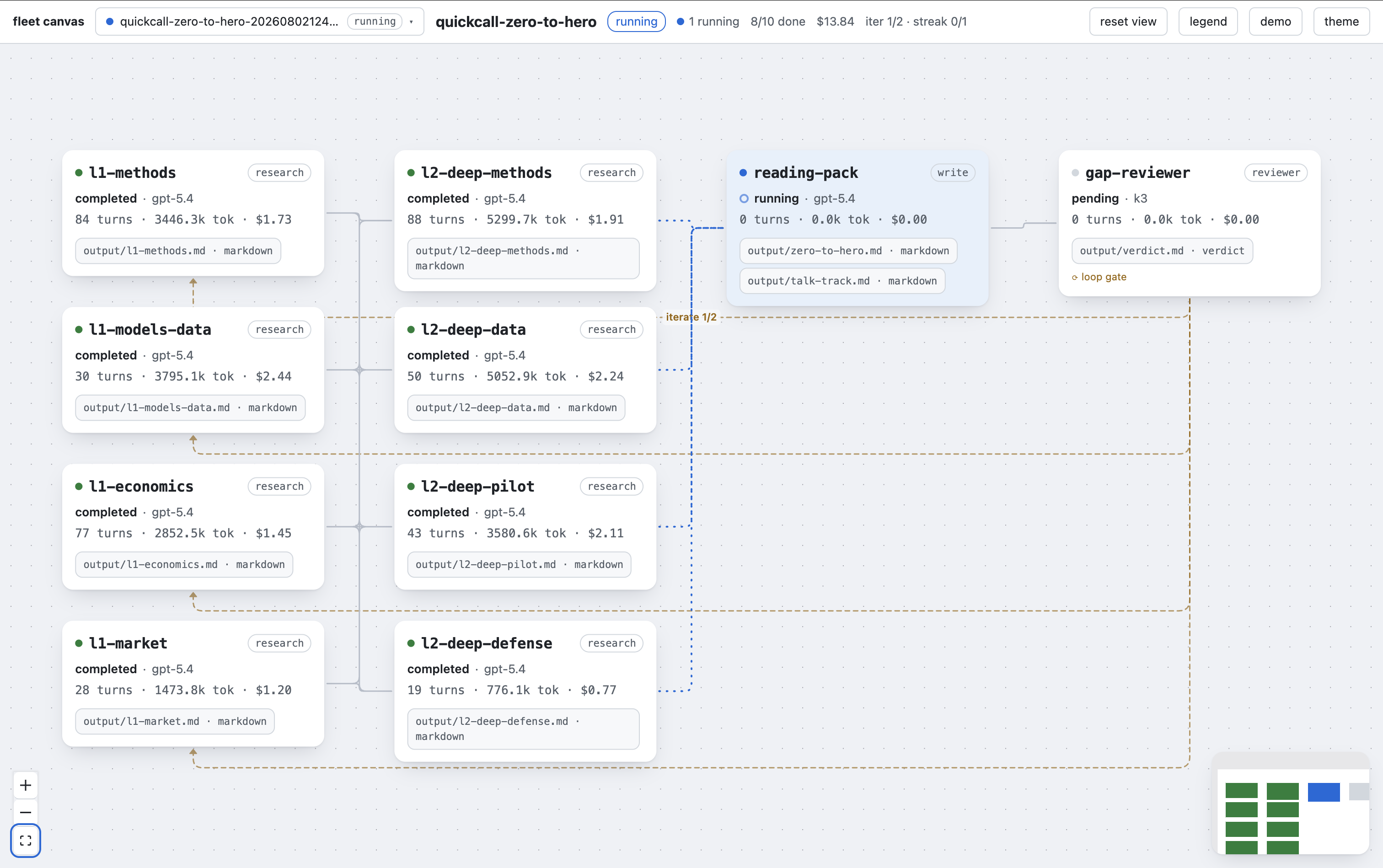
  "image": "https://raw.githubusercontent.com/sagarsrc/pi-agent-fleet/v0.5.0/assets/canvas.png"
}
Security note
Pi packages can execute code and influence agent behavior. Review the source before installing third-party packages.
README
pi-agent-fleet
DAG-of-agents fleets for pi. Define a fleet of worker agents as data, preview it, launch it, watch it run — with per-worker output contracts, reviewer-gated iteration loops, live cost tracking, and a machine-written report.
● fleet: cost-relaunch-build · iteration 1/3 · last verdict: iterate · streak 0/1 (2/3 done · $1.42)
├─ ✓ builder-pricing (kimi-for-coding) · 32 turns · 945k tok · $0.83
├─ ⠹ builder-relaunch (kimi-for-coding) · 12 turns · 401k tok · editing src/scheduler.ts…
└─ ○ reviewer (k3) · waiting on builder-relaunch
Demo
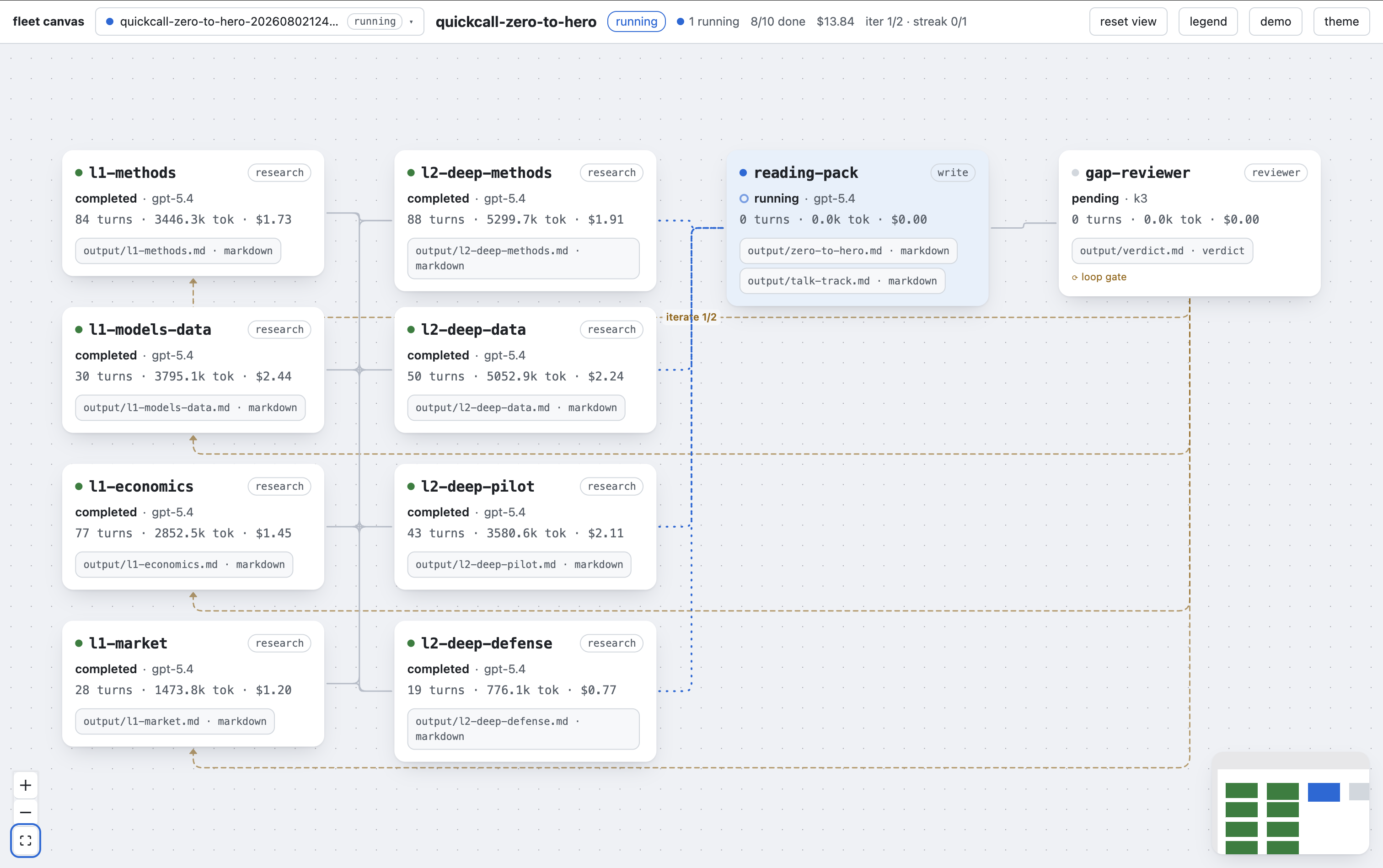
Live browser canvas — per-node status, turns, tokens, cost, and click-to-peek session tail:
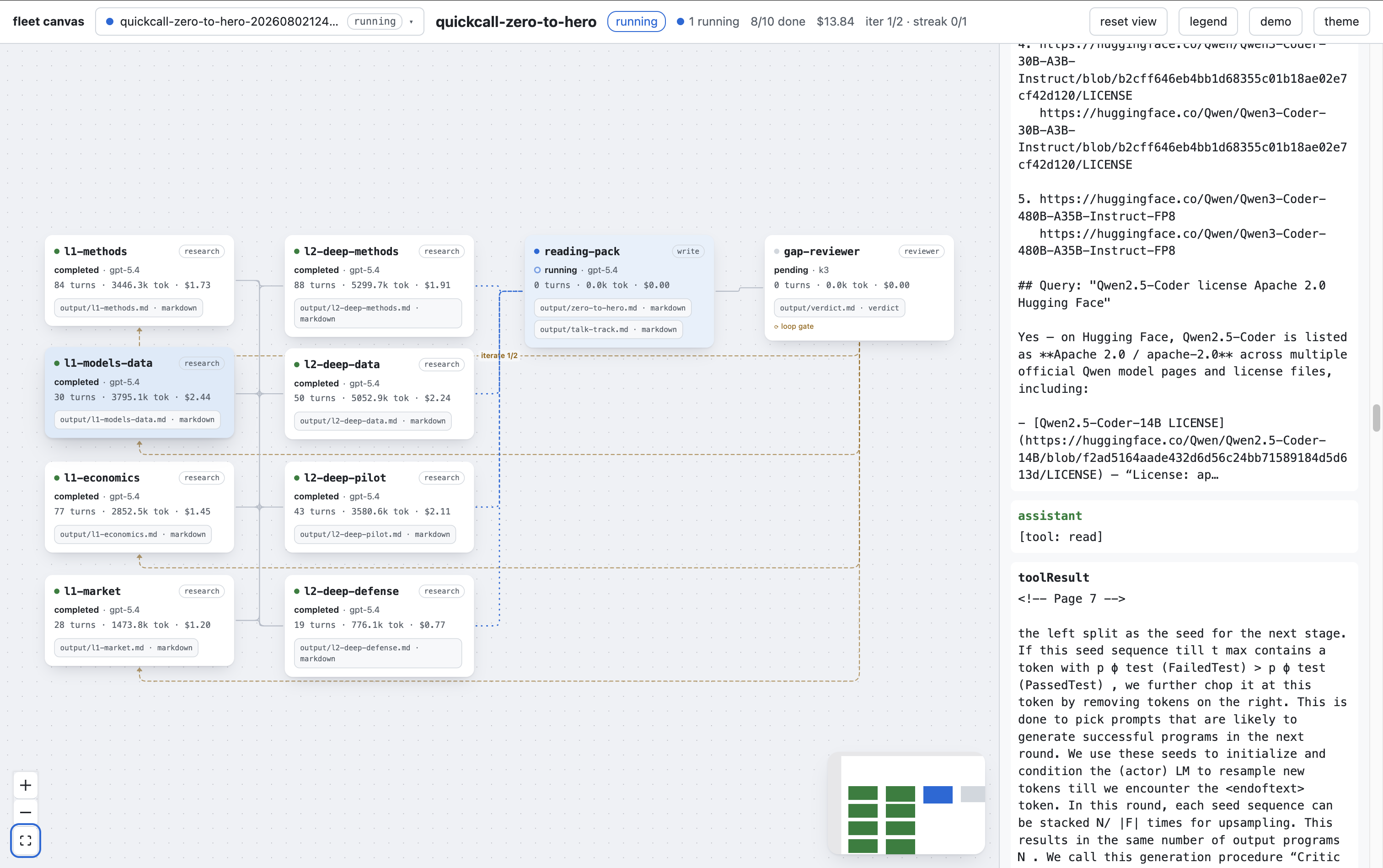
Node detail side panel — peek a running node's recent session without leaving the canvas:
Why
One agent is a tool. A fleet is a workflow: researchers feed builders, builders feed reviewers, reviewers gate quality — all visible, all recorded, all contract-checked. Fleets run in-process via pi's SDK: any provider pi is logged into (Claude, Codex, Kimi, …) works per-node.
Philosophy: no auto-restart, no auto-kill, no babysitting. Failures surface; the operator decides. Contracts are checked at worker exit. The reviewer is the quality gate; you are the kill switch.
Install
pi install npm:pi-agent-fleet                    # from npm
pi install git:github.com/sagarsrc/pi-agent-fleet # from git
pi install /path/to/pi-agent-fleet               # local
Quickstart
Ask your pi session (the LLM drives the tools):
Plan and launch a fleet: two parallel writers and a combiner, all gpt-5.4-mini. writer-a writes output/a.md containing "# 123", writer-b writes output/b.md containing "# 456", combiner (depends on both) writes output/sum.md with the total. Each declares its output as a markdown contract.
The agent calls fleet_design (if you describe it in prose) or fleet_plan (if you already have JSON), you confirm the preview, then fleet_launch runs it. Plan and launch responses include a fleet canvas link by default; the in-chat widget is hidden until you run /fleet viz. Read the report at .fleet/<name>-<ts>/report.md.
JSON pipeline variant — a numeric handoff chain where workers pass typed JSON, verified by schemas at contract check:
Plan and launch the fleet defined in
examples/json-number-pipeline.json.
One writer emits {"values":[3,5,8]}, two parallel consumers add and subtract, a synthesizer combines the results — each output declared as a json contract with a schema naming its required and numeric keys.
Writing a fleet
{
  "fleet_name": "auth-research",
  "type": "dag",
  "config": {
    "max_concurrent": 4,
    "model": "gpt-5.4-mini",
    "effort": "medium",
    "warn_cost_usd": 10
  },
  "workers": [
    {
      "id": "research",
      "type": "research",
      "task": "…",
      "outputs": [{ "path": "output/findings.md", "kind": "markdown", "required": true }]
    },
    {
      "id": "build",
      "type": "code-run",
      "task": "…",
      "depends_on": ["research"],
      "model": "kimi-coding/k3",
      "effort": "high",
      "outputs": [{ "path": "src/auth/login.ts", "kind": "file-exists", "required": true }]
    }
  ]
}
config.model/config.effort— fleet-wide defaults; per-workermodelandeffortoverride.effortmaps to pi thinking levels:off | minimal | low | medium | high | xhigh | max.config.warn_cost_usd— soft cost guardrail surfaced in the canvas and report.iterate: false— run the node once at iteration 1 and carry its outputs forward.worktree: true— run the node in a dedicated git worktree.- Worker types
research,code-run,reviewer,write,read-onlyeach get a tailored tool set.
Fleet modes
One-shot DAG — static dependency graph, parallel layers, contracts at exit.
Iterative fleet — reviewer-gated replay until quality passes:
{
  "config": {
    "loop": { "gate": "reviewer", "max_iterations": 5, "lgtm_count": 2 }
  }
}
A reviewer node writes a verdict contract (verdict: lgtm | iterate | escalate + actionable body). iterate → builders get the review injected as feedback next iteration. lgtm × lgtm_count consecutive → completed. escalate → fleet pauses and notifies you. gate: "none" → free-running loop (autoresearch pattern: eval instructions live in the worker's task text).
Worktree mode — worktree: true on a node: the worker runs in a dedicated git worktree on a deterministic branch (fleet/<fleet-name>/<node-id>). The extension creates the worktree, commits the worker's changes, and, when two or more worktree workers exist, auto-injects a fleet-integrator node that merges their branches in dependency order before the agent runs. Overlapping repo-relative output paths without an ordered handoff are rejected at plan time. Merge conflicts surface as a failed integrator with a status_note listing the files, so the operator can resolve and relaunch.
Run-once vs replay nodes — iterate: false: node runs at iteration 1 only, outputs carry over (e.g. research that doesn't change).
Contracts
Every worker declares outputs[] with kinds, verified in code at worker exit before dependents are released:
| kind | check |
|---|---|
markdown |
exists, non-empty, starts with # |
file-exists |
exists, non-empty (repo-relative paths = code edits) |
verdict |
verdict: lgtm|iterate|escalate line + non-empty body |
json |
parses as JSON; optional schema checks (below) |
yaml |
parses as YAML |
JSON outputs may declare a schema with required_keys (keys that must exist) and number_keys (keys that must be numbers or arrays of numbers). Schemas are only allowed on kind: "json" outputs, are injected into the worker's prompt, and are enforced at contract check. When a schema is present, the JSON must be a top-level object (arrays and scalars fail):
{ "path": "output/sum.json", "kind": "json", "required": true,
  "schema": { "required_keys": ["operation", "result"], "number_keys": ["result"] } }
Failed required contract → contract_failed, dependents blocked, orchestrator notified. No silent passes.
Tools & commands
| tool | purpose |
|---|---|
fleet_design |
draft a fleet DAG from plain-language requirements (planner agent → validated JSON + preview) |
fleet_plan |
validate + preview a fleet definition (no launch) |
fleet_models |
list available model refs (provider/id) from the live registry — call before fleet_plan if you don't know exact model IDs |
fleet_launch |
launch the planned fleet after user confirmation; skip_confirm for unattended runs |
fleet_status |
live DAG status and text summary |
fleet_continue |
resume a failed/killed fleet from current state without restarting completed nodes |
fleet_pause / fleet_resume |
pause/resume loop fleets at the next iteration boundary |
fleet_kill |
kill all, or kill a single node by worker id |
fleet_relaunch |
re-run a failed/killed node and its blocked downstream; optional model override |
fleet_add_node |
insert new workers into a running fleet mid-flight |
fleet_edit |
edit a pending node's model/effort/task, or fleet config mid-run |
fleet_report |
regenerate the fleet markdown report |
fleet_canvas |
open a browser canvas; ?demo=1 shows synthetic data for UI iteration |
/fleet viz | status | clear | pause | resume | continue | kill all|<node_id> | relaunch <id> [model] | add <json> | edit <node_id>|config ... | configure [show|set k v] | canvas [open|url|stop]
Runtime mutation
Fleets are not frozen after launch. You can kill a single stuck node, relaunch it with a stronger model, edit a pending node's task, or inject new workers with fleet_add_node. Inserted nodes validate against the existing DAG (unique ids, acyclic, loop-gate rules) and start dispatching as soon as their dependencies complete.
Preferences
Set fleet-wide defaults in ~/.pi/agent/fleet.json:
{
  "max_concurrent": 4,
  "model": "gpt-5.4-mini",
  "effort": "medium",
  "warn_cost_usd": 10
}
These are merged into fleet_plan results. Manage them with /fleet configure show | set <key> <value>.
Records
Everything lands in .fleet/<name>-<ts>/ (git-ignored): state.json (single source of truth, atomic writes), per-worker prompt.md + session.jsonl + outputs, per-iteration archives, and a machine-written report.md with per-worker turns/tokens/cost, contract results, verdict history, and git diff stats. Completed nodes keep their stats visible in the canvas and report after the fleet ends.
Model selection and effort
Fleet-wide default via config.model and config.effort; per-node override via worker.model and worker.effort. Any model pi can resolve works, including any provider pi is logged into. Cheap models for trivial writers, strong models for reviewers:
{ "id": "reviewer", "type": "reviewer", "model": "kimi-coding/k3", "effort": "high" }
Model refs are validated at plan and launch time so bad names fail fast. There is no baked-in default provider: the extension uses whatever pi has configured.
Development
npm install
npm test          # 274 tests, zero-API (fake session factory)
npm run typecheck
Design docs are archived locally under .archive/docs/superpowers/ (not tracked); experiment history in docs/experiments/.
License
MIT