pi-agent-stack
A chartered project-manager agent plus the specialist team it delegates to: kernel/charter pm, pack-based intake interview, researcher, oracle, worker, and the ship-gate reviewers. Bundles the subagent runtime and the execution pipeline.
Package details
Install pi-agent-stack from npm and Pi will load the resources declared by the package manifest.
$ pi install npm:pi-agent-stack- Package
pi-agent-stack- Version
1.1.0- Published
- Sep 15, 2026
- Downloads
- 130/mo · 130/wk
- Author
- krisgray
- License
- MIT
- Types
- extension, skill, prompt
- Size
- 220.9 KB
- Dependencies
- 4 dependencies · 0 peers
Pi manifest JSON
{
  "image": "https://raw.githubusercontent.com/KrisGray/pi-agent-stack/main/docs/assets/preview.png",
  "skills": [
    "./node_modules/@chankov/agent-skills/skills",
    "./node_modules/pi-subagents/skills",
    "./node_modules/pi-ask-user/skills",
    "./node_modules/pi-prompt-template-model/skills"
  ],
  "prompts": [
    "./.pi/prompts",
    "./node_modules/@chankov/agent-skills/.pi/prompts/*.md",
    "!./node_modules/@chankov/agent-skills/.pi/prompts/spec.md",
    "!./node_modules/@chankov/agent-skills/.pi/prompts/plan.md",
    "!./node_modules/@chankov/agent-skills/.pi/prompts/doctor-agent-skills.md",
    "!./node_modules/@chankov/agent-skills/.pi/prompts/setup-agent-skills.md"
  ],
  "extensions": [
    "./node_modules/pi-subagents/index.ts",
    "./node_modules/pi-prompt-template-model/index.ts",
    "./node_modules/pi-ask-user/index.ts"
  ]
}
Security note
Pi packages can execute code and influence agent behavior. Review the source before installing third-party packages.
README
pi-agent-stack


A chartered project-manager agent plus the specialist team it delegates to, packaged for pi.
The stack
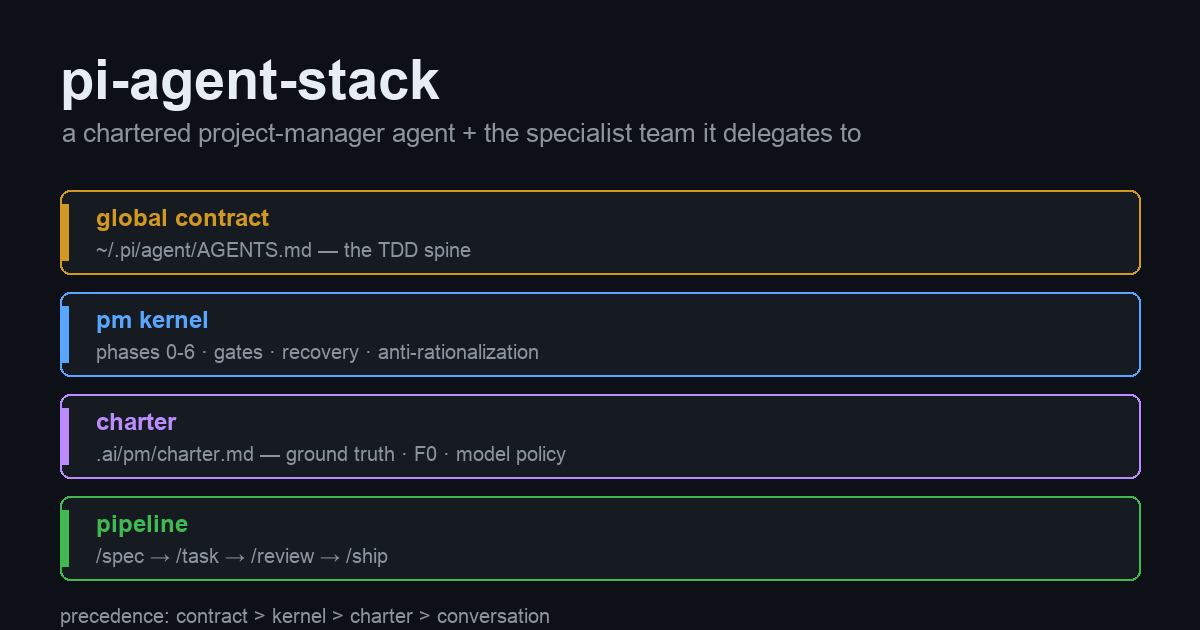
 ┌────────────────────────────────────────────────────────────────┐
 │  global contract      ~/.pi/agent/AGENTS.md — the TDD spine   │
 │      (shipped as templates/AGENTS.md; seeded by /hire-pm)     │
 ├────────────────────────────────────────────────────────────────┤
 │  pm kernel            agents/pm.md — phases 0–6, gates,       │
 │                       recovery, anti-rationalization          │
 │                       (identical in every project)            │
 ├────────────────────────────────────────────────────────────────┤
 │  charter              .ai/pm/charter.md — ground truth, F0,   │
 │                       domain rows, model policy               │
 │                       (binds tighter, never weaker)           │
 ├────────────────────────────────────────────────────────────────┤
 │  pipeline             /spec → /task → /review → /ship         │
 │                       (pi-subagents runtime + pipeline pkg)   │
 └────────────────────────────────────────────────────────────────┘
   precedence: contract > kernel > charter > conversation
The pm kernel (agents/pm.md) is the role contract — identical in every project. The charter (.ai/pm/charter.md, per project) binds it to a project: ground truth and how it is refreshed, the fixed foundation task F0, domain delegation rows, hard boundaries, and the model policy. Where they conflict, the kernel wins; the charter may bind tighter, never weaker.
Generality in the process, specificity in the charter. examples/nomgen/ is the worked extraction from the project this stack was born in.
The team
| Persona | Job | Invoked by |
|---|---|---|
pm |
Owns what gets built and in what order. Interviews, PRD, feature graph, gates. Never writes code. | you, via /pm |
researcher |
Evidence-backed external facts, version-pinned, citations required | pm |
scout |
Fast read-only recon of codebase and artefacts | pm (as ground-truth role when the charter says so) |
oracle |
Adversarial second opinion on expensive-to-reverse decisions | pm |
plan-reviewer |
Critiques the pm's own PRD and feature graphs | pm |
worker |
One spec task, strict TDD cycle, stops before committing | pm proposes, you run |
code-reviewer |
Ship gate: correctness | /review, /ship |
test-engineer |
Ship gate: tests and coverage | /review, /ship |
security-auditor |
Ship gate: security | /review, /ship |
builder, planner, documenter |
Execution-side utilities | you, ad hoc |
The pm sits above a /spec → /task → /review → /ship pipeline and never runs those commands itself — it decides what runs, reads the results, and gates. The pipeline is split across packages, deliberately:
/specand/taskship with pi-agent-stack — they are the kernel's contract surface./specwrites specs in planning mode from.ai/templates/spec.md(claim labels, runnable Verify lines,traces_torequirement IDs — exactly what the kernel's Phase 6 review checks);/taskruns one task through a strict TDD cycle and stops before committing. If you also run @chankov/agent-skills or agent-fleet, this package's/specshadows their generic one — that is the intent./build,/test,/review,/shipcome from the pipeline package — the kernel treats them as pluggable and only emits their command lines.- The global TDD contract (
~/.pi/agent/AGENTS.md) the kernel assumes is shipped as an installable default:templates/AGENTS.md./hire-pmchecks for it and offers to seed it.
Install
One command. The package carries its companions as npm dependencies — pi installs them and loads their resources through the package manifest:
pi install npm:pi-agent-stack
# or from git:
pi install git:github.com/KrisGray/pi-agent-stack
What arrives with it:
pi-subagents— the team runtime: thesubagenttool, persona loading, review fan-out (core pi has none of this)@chankov/agent-skills0.4.2 — the execution pipeline:/build,/test,/review,/ship,/code-simplifyand its skillspi-ask-user— structured interview questions for/hire-pmpi-prompt-template-model— deterministic pre-steps (the/hire-pmcatalog feed)
Then the personas (pi packages don't ship agents natively — copy step):
PKG=~/.pi/agent/npm/node_modules/pi-agent-stack   # global install
# (project install: ./.pi/npm/node_modules/pi-agent-stack; a git checkout of this repo works the same)
bash $PKG/bin/install.sh      # → ~/.pi/agent/agents/   (global)
bash $PKG/bin/install.sh -l   # → ./.pi/agents/         (this project only)
Already running any of these standalone? Remove them (
pi remove npm:pi-subagents,pi remove npm:@chankov/agent-skills@0.4.2,pi remove npm:pi-prompt-template-model,pi remove npm:pi-ask-user) — this package now carries them, and dual installs register duplicate resources.
Quick start
Your first hour in a project:
- Install (above), then in the project root run
/hire-pm. - The interview. You confirm-or-correct proposals — never author from a blank page: the project archetype (PostgreSQL schema-mapping library, Python data pipeline…), ground truth and its refresh, the fixed foundation task F0, domain boundaries, and a model slate drawn from your configured catalog. Nothing is written until you approve the full playback.
/hire-pmwrites.ai/pm/— the charter, the seeded interview system, the model pin map — and installs the personas with your approved pins./pmopens the working relationship. It reads the contract, charter and task state, restates its constraints in five lines or fewer, and states which phase it is entering. If work is in flight, it resumes — it never re-interviews.- The loop. The pm announces the next feature and emits
/spec "<feature>"; you run it in a fresh session; the pm reviews what came back (runnable Verify lines, labelled claims, requirement traces); it emits/tasklines; workers implement in strict TDD and stop before committing;/review+/shipgate the merge behind three isolated reviewers. The pm decides and gates; you execute.
Re-running /hire-pm on a chartered project is an audit: it verifies installed pins against the catalog and the charter's policy, flags drift, and re-pins with your approval.
The pm refuses to run unchartered — a project without bindings gets generic mush, which is worse than no pm.
Model policy
Which model each persona runs is a charter section, not a frozen frontmatter accident. The frontmatter model: line is the only mechanism pi reads, so the policy lives in reviewable files — the charter's table (the why) and .ai/pm/models.json (the pin map) — and bin/install.sh -m renders them into frontmatter. The pm verifies installed pins against the charter at session start and reports drift. Constraints encoded in the template: ship-gate reviewers never share the worker's model; plan-reviewer and oracle differ from pm's; recon runs cheap, reasoning runs strong. The shipped pins are bootstrap defaults matching the author's catalog — /hire-pm audits them against yours and proposes a slate from what you can actually run.
Security
The model catalog lives in ~/.pi/agent/models.json next to live API keys, and this package treats that file accordingly:
- The only sanctioned reader is
bin/catalog.py— a whitelisted field projection:apiKey,baseUrl,headersand any future auth-shaped field cannot appear in its output by construction. Leak checks are part of the test suite (tests/test_catalog.py). - Parse errors report position only — never file content.
/hire-pmconsumes only the redacted catalog output, never the file; credentials cannot appear in charters, prompts, or the pin map because nothing carries them.- Nothing in the package makes network calls on its own; no telemetry. The catalog extractor reads two local files and prints.
Working with the pm
| It does | It never does |
|---|---|
| Interviews you; writes the PRD and feature graph | Writes or patches code — "just a small fix" included |
| Emits the exact command line for you to run | Runs /spec, /task, /review, /ship itself |
| Reviews every spec: runnable Verify lines, claim labels, requirement traces | Marks a task done — you commit; /ship closes |
| Delegates recon and second opinions; gates behind three reviewers | Accepts secrets in prose, prompts or URLs |
| Stops at every gate: what completed, what's next, what could go wrong | Re-interviews a project mid-flight — it resumes instead |
The interview
Project intake is a pack system: a core bank of five questions plus archetype packs (orm-model, data-pipeline, web-app, cli-tool, …), routed from the first answer, at most two packs composing, five pack questions max. AI-INSTRUCTIONS.md owns the intake procedure and playback format; PACKS.md owns the boundary tests that separate close archetypes (does a user log in? does the model choose what to call next?). /hire-pm seeds the charter with a route hint — intake verifies it, never assumes it.
Risk intake is split by domain: the pm compiles the difficulty candidates from the Phase 0 inventory and the charter's oracle rows — difficulty is the expert's call, not the stakeholder's — and asks the user only for consequence and appetite: descope, spend, or delay.
Layout
agents/            personas: pm kernel + 8 specialists + researcher/oracle/worker
.pi/prompts/       pi prompt templates (shipped natively by the package)
bin/               installer (personas + pins) and the catalog extractor
templates/         charter; interview system (core bank, PACKS index, AI intake instructions, archetype packs); pm-reference; spec template; global AGENTS.md contract
examples/nomgen/   worked charter/interview/reference extraction
docs/design.md     kernel/charter rationale, coverage map, /hire-pm design
Troubleshooting
/pmrefuses to run — no.ai/pm/charter.md. By design. Run/hire-pm, or copytemplates/charter.mdthere and fill it in.- Prompt conflict notices at startup — pi's precedence is project > user > package. This package's
/specintentionally shadows the generic pipeline one. If you see duplicates ofbuild/test/review/ship, you have a standalone companion package installed — remove it (see Install). - Personas don't appear in
subagent list— the runtime isn't loaded.pi install npm:pi-agent-stackprovidespi-subagents; then run the persona copy step. - Pins reference models you can't run — the shipped defaults match the author's catalog. Run
/hire-pm(audit mode) to propose a slate from yours. CATALOG_SCRIPT_MISSING— the persona copy step hasn't run from an installed package (≥ 1.0.1). See Install.
Status
- Kernel/charter split, nomgen extraction, team personas,
/pmlauncher -
/hire-pminterview compiler (catalog extractor + pin rendering, tested) - Pack-based intake interview (core bank, PACKS index, AI intake instructions, 15 archetype packs)
- Package publication (npm + GitHub — listed on the pi.dev gallery)
- Installable generic global contract (
templates/AGENTS.md, seeded by/hire-pm)
Releasing
Automated by semantic-release: push
conventional commits to main and CI does the rest — feat bumps minor,
fix/perf bump patch, breaking changes bump major, and
docs/chore/refactor release nothing. On a release it runs the test
suite, bumps package.json, prepends CHANGELOG.md, commits the release
back to main, tags, opens the GitHub release, and publishes to npm with
provenance.
Publishing auth is OIDC trusted publishing — no npm tokens exist, ever.
Bootstrap once by hand (the trusted-publisher config needs the package to
exist): npm login locally, npm publish from the repo (public access is
set via publishConfig), then on npmjs.com → pi-agent-stack
→ Settings → Trusted Publisher → GitHub Actions
(KrisGray / pi-agent-stack / release.yml). From then on, every release
publishes by OIDC: GitHub proves the workflow's identity to npm, provenance
is automatic, and there is no credential anywhere to leak. (Requires
npm ≥ 11.5 in CI; the workflow pins latest.)
Provenance
Eight specialist personas are adapted from @chankov/agent-skills v0.4.2 (MIT), which is itself a fork of addyosmani/agent-skills by Addy Osmani (MIT) — imported from the live installed copies, with model:/thinking: pins added (planner verbatim). Upstream has since moved to agent-fleet. The pm kernel, charter format, researcher/oracle/worker personas, the interview pack system, and the scripts are original to this repo. License notices for derived material: THIRD-PARTY-NOTICES.md; this repo's license: MIT, see LICENSE.
Contributions: see CONTRIBUTING.md.