pi-asterisk-tui
Polished Pi coding agent TUI: transcript collapse modes (native / per-tool / grouped / run lines), claude-hud style dashboard, telemetry, and bilingual settings.
Package details
Install pi-asterisk-tui from npm and Pi will load the resources declared by the package manifest.
$ pi install npm:pi-asterisk-tui- Package
pi-asterisk-tui- Version
0.6.1- Published
- Sep 22, 2026
- Downloads
- 190/mo · 163/wk
- Author
- no_world
- License
- MIT
- Types
- extension
- Size
- 400.7 KB
- Dependencies
- 0 dependencies · 3 peers
Pi manifest JSON
{
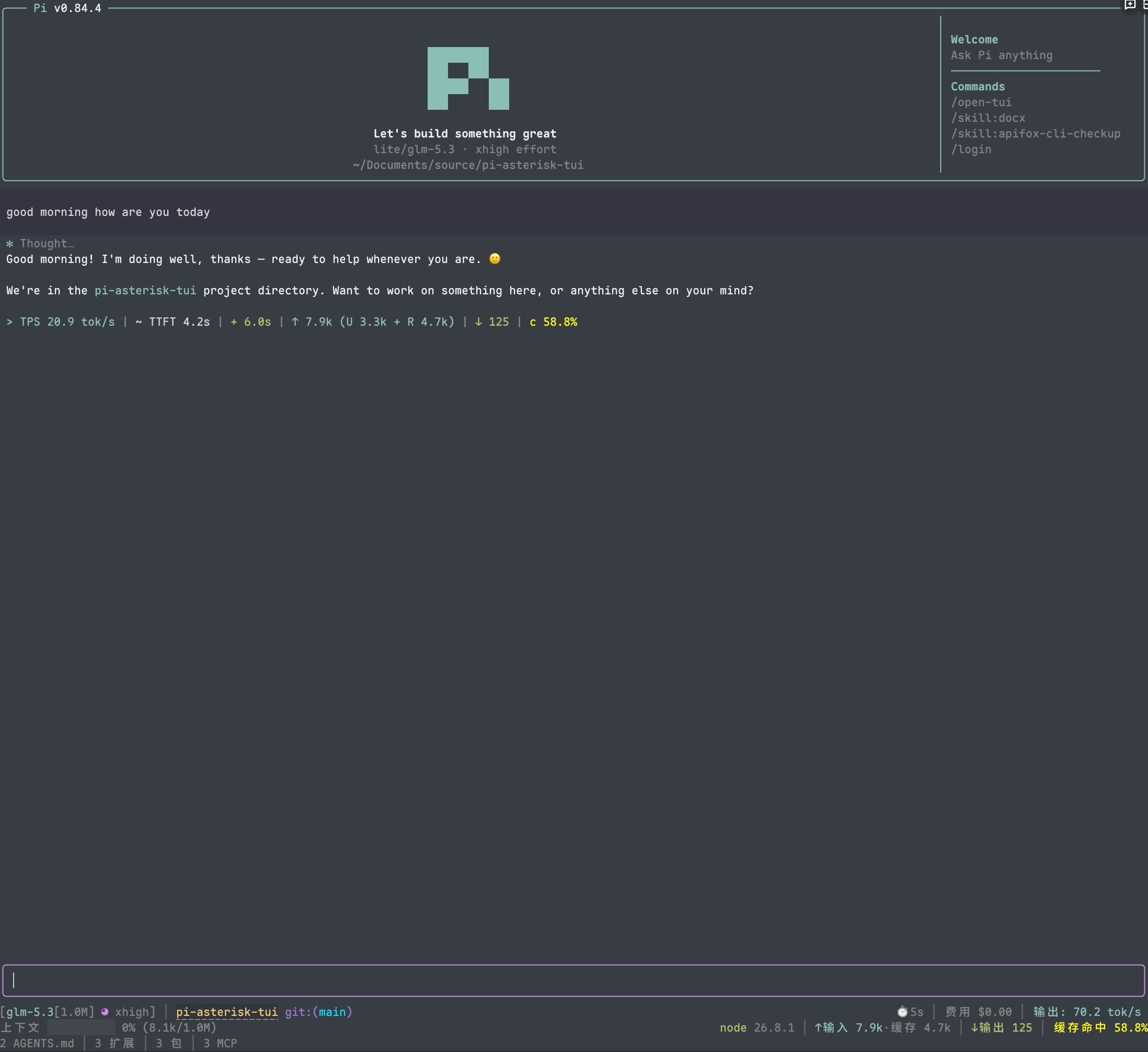
  "image": "https://raw.githubusercontent.com/No-World/pi-asterisk-tui/main/assets/preview_dashboard_1.png",
  "extensions": [
    "./extensions/open-tui/index.ts"
  ]
}
Security note
Pi packages can execute code and influence agent behavior. Review the source before installing third-party packages.
README
pi-asterisk-tui
English | 简体中文
A Pi terminal experience where everything the model does folds into tidy
✻ lines — Claude Code style — plus a claude-hud style status dashboard.
pi install npm:pi-asterisk-tui
Or from git (tracks main):
pi install git:github.com/No-World/pi-asterisk-tui
✻ Transcript
The transcript renders as answer text plus compressed activity lines. How much
compresses is the compression mode (/*tui → Collapse):
| Mode | Rendering |
|---|---|
native |
untouched pi rendering — no compression |
single |
one line per tool (▸ bash · $ npm test), nothing merged |
group-same |
consecutive same-type tools merge (✻ read 3 files); thinking merges its own ✻ Thought for 11s line — kinds never mix |
group-all |
Claude-Code style: consecutive thinking + tools merge into one line (default) |
✻ Thought for 19s, searched for 9 patterns, listed 1 directory, ran 1 shell command
- Run lines (group-all): verbs read like a sentence —
ran 3 shell commands,edited 2 files,read 5 files,listed 2 directories,searched for 9 patterns,called playwright ×2(leading verb capitalized when no thinking precedes). Thinking durations come from live telemetry; history turns read✻ Thought, ran 1 shell command. - Per-tool overrides: every tool can be set to
default(follow the mode),single(one line),group-same(same-type group line, never absorbed into run lines) orexpand(native box);*matches unnamed tools. Per-item states are absolute — group-same groups even in native mode. - Thinking blocks share the same lattice (
turnCollapse.thought):default(follow the mode) /single(one ✻ label per message) /group-same(grouped Thought line, never merged with tools) /expand(inline, pi native). Whole-run absorption exists only via group-all mode + default. pi's nativehideThinkingBlockis kept as a mirror (ctrl+t flips are adopted as explicit states). - Line spacing:
compact(flush) orclassic(blank line around compressed lines, adjacent compressed lines separated by a single blank; ✻ label lines count as compressed lines, keeping them apart from their text tails). - One-click expand/collapse: click a compressed line to open the full reasoning and every tool's bordered output at once — including the thinking of text-bearing messages, no second tap on labels. Click any member line to fold it all back. A click is an unmodified press that releases on the same cell — drag-selecting text never toggles a run (pi's fullscreen selection keeps working untouched).
- Per-message thinking labels:
✻ Thought…(history) /✻ Thinking…(streaming), individually clickable to expand just that message's reasoning, styled identically to run lines (same accent ✻, same muted upright text). - Running tools render as an animated one-liner (
⠋ bash · $ npm test) with live output streaming beneath — and never drag completed neighbors out of their folded lines (turnCollapse.liveTools: falsedrops the streaming box, spinner line only; native- override tools always keep their box) - Live thinking (
turnCollapse.liveThinking, default on): while a message streams thinking-only content it renders inline in real time; once text starts (or the message stops streaming) it folds back to the ✻ label / run line immediately — no need to wait for the run to settle (native mode keeps pure pi boxes). - Retry UX: the countdown carries the failure reason
(
Retrying (2/10) in 5s… · 429 rate_limit_error); intermediate errors are held back, a successful retry prints nothing, and only the last error shows if the run fails (togglable independently of the mode). - Regular-mode support: compressed lines work in the regular (non-fullscreen)
TUI too — every line ends with the effective expand-all shortcut hint (e.g.
(ctrl+\ to expand)); pressing it expands every run (reasoning + all tool output), pressing again collapses all. Fullscreen keeps per-run click-to-expand. - Compact spacing: pi's internal spacer padding and OSC shell-integration markers around ✻ lines are folded away.
Telemetry
- Working indicator:
Working… (34s · ↓ 1.2k tokens · 3 tools)— elapsed, run-cumulative output tokens (stream-estimated while streaming, exact on message completion, kept across tool calls), tool count as they start. - Turn telemetry after each run: TPS, TTFT, duration, stall count/time, input/output token breakdown with cache-read and cache-write, cache hit rate, and list-price $/M rate.
- Classic footer summary:
✓ done 12s · ✻ 8s · 2 shell commandsafter each run.
HUD footer
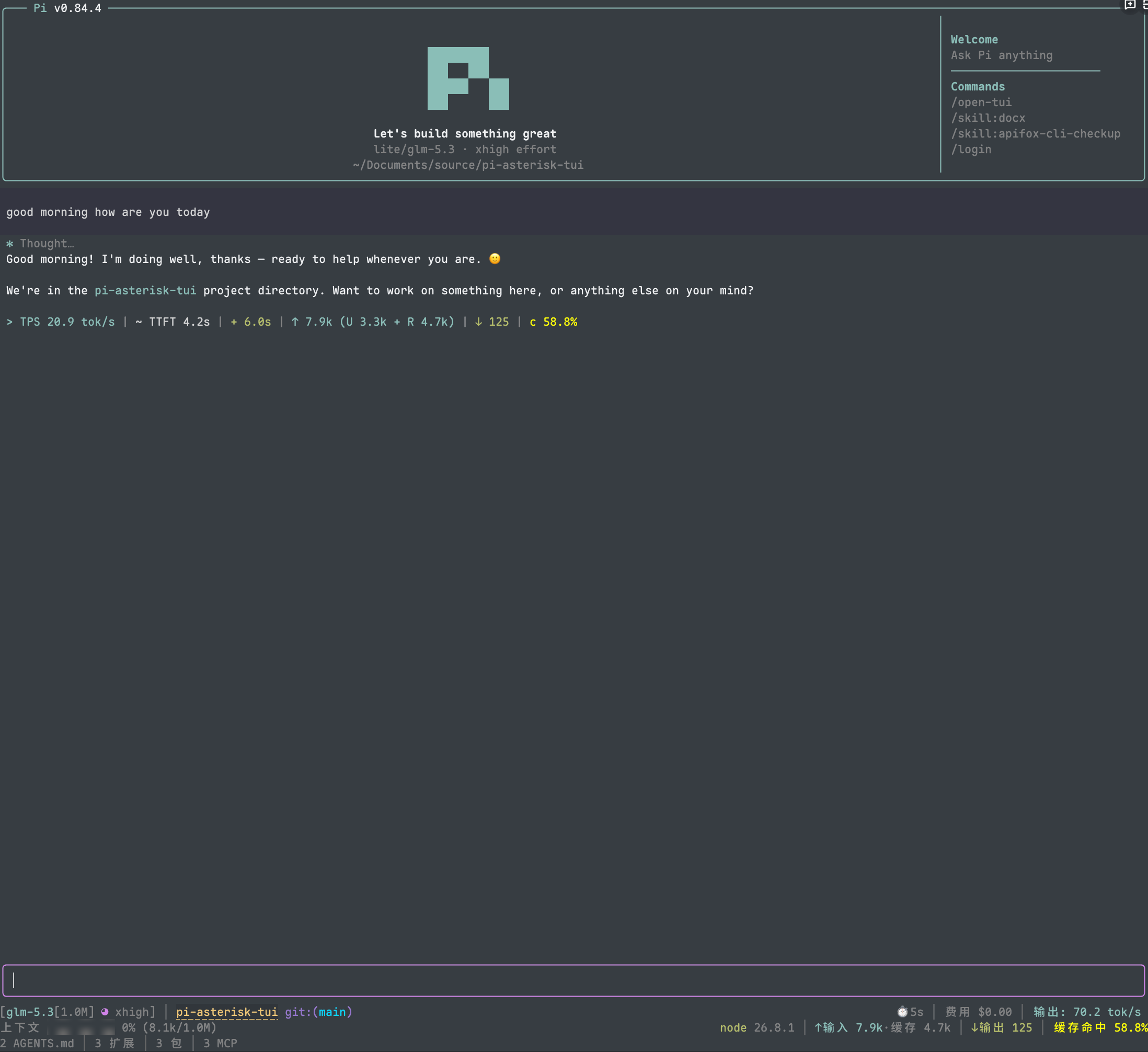
A claude-hud style four-line dashboard (a starship-style classic preset is also built in):
- Status line — model with context window, thinking level (moon-phase icons), git
branch with dirty marker, ahead/behind, per-file diff totals
[+71 -5], session name, cumulative working time, cost, today's cost, live output speed (tok/s; only updated when the message streamed for at least 1s — burst-flushed responses are not measurable and keep the last credible speed). - Context line — usage bar with percent and token counts, cache hit rate.
Token stats have three presentations (
hud.tokens): localizedverboselabels (↑in 77M ·cache 77M), language-independentcompactshorthand (↑ 77M (U 855k + R 77M) │ ↓ 266k │ C 98.9%), oroff. - Tools line — per-tool usage counts with ✓, running tool labels.
- Environment line — MCP server count (only when pi-mcp-adapter is actually installed), memory usage, compaction count, pi version.
Plus: OSC 8 hyperlinks on the working directory and changed files (click to open), powerline-styled git segment, ahead/behind indicators, and full subdirectory git detection (pi normally fails to show branch state when started inside a repository subdirectory).
Editor & settings
- Framed editor with block / bar / underline cursor styles.
- Bilingual
/*tuisettings panel (English / 简体中文) — the language choice also localizes HUD labels — covering footer segments, HUD toggles, telemetry fields, icon mode (nerd / ascii / auto), cursor style, fullscreen wheel-scroll speed, and a Collapse tab (compression mode, line spacing, retry-error folding, thinking visibility, per-tool overrides — extension/MCP tools appear there once seen) — with named style presets (hud / classic / custom). - Version-guarded compatibility shims: fullscreen wheel speed falls back to pi defaults if the runtime shape changes.
Fresh installs default pi's hideThinkingBlock to true (existing choices are never
overridden) so the ✻ experience works out of the box.
Requirements
- Pi 0.80+
- UTF-8 terminal; a Nerd Font for the full icon set (ASCII icons are built in)
- Both TUI modes work: in regular mode compressed lines expand/collapse via the
expand-all shortcut (default
ctrl+\, annotated at the end of each compressed line); **per-run click-to-expand** needs pi's fullscreen mouse capture (/settings→ TUI mode, or"tuiMode": "fullscreen"in~/.pi/agent/settings.json).
Configuration
Run /*tui, or edit ~/.pi/agent/asterisk-tui.json. Settings from a legacy
open-tui.json are adopted automatically on first run; the old file is kept.
Notable keys:
| Key | Default | Effect |
|---|---|---|
footerStyle |
"hud" |
hud / classic footer presets |
turnCollapse.mode |
"group-all" |
native / single / group-same / group-all compression |
turnCollapse.style |
"compact" |
compact / classic spacing around compressed lines |
turnCollapse.retryErrors |
true |
hold retry errors during a run; collapse repeated request errors into one ⚠ … ×N line (click to expand) |
turnCollapse.thought |
"default" |
thinking: default / single / group-same / expand |
turnCollapse.liveThinking |
true |
stream thinking inline while it arrives; fold back after |
turnCollapse.liveTools |
true |
render running tool output boxes below the spinner line |
turnCollapse.expandAllKey |
"ctrl+\\" |
expand-all shortcut in regular mode (pi KeyId; empty disables; applies after restart/reload) |
turnCollapse.tools |
{} |
per-tool default / single / group-same / expand; * wildcard |
icons.mode |
"auto" |
nerd / ascii / auto icon set |
cursorStyle |
"block" |
editor cursor style |
telemetry.* |
on | working-indicator and post-turn telemetry fields |
footerSegments.* |
mixed | classic footer segment toggles |
hud.* |
on | every HUD segment individually toggleable (hud.tokens: verbose / compact / off) |
fullscreen.wheelScrollLines |
4 |
mouse wheel lines per tick |
How it works
Everything is a runtime patch over pi's extension surface, version-guarded and inert on mismatch: the chat container's render is wrapped to re-chunk the transcript (containers, messages, and tools are classified by content, not appearance), the fullscreen viewport's mouse input is observed (never consumed) to route same-cell press→release clicks through per-render line segments, and pi-tui's loader messages carry retry reasons. No pi files are modified on disk.
Local development
npm install
npm test && npm run typecheck
pi -e .
Acknowledgements
- OldSuns/pi-open-tui — this project began as a fork of it; the original integration work and its credits carry over.
- claude-hud — the HUD footer layout.
- pi-haiku — footer structure and working timer.
License
MIT