pi-bar
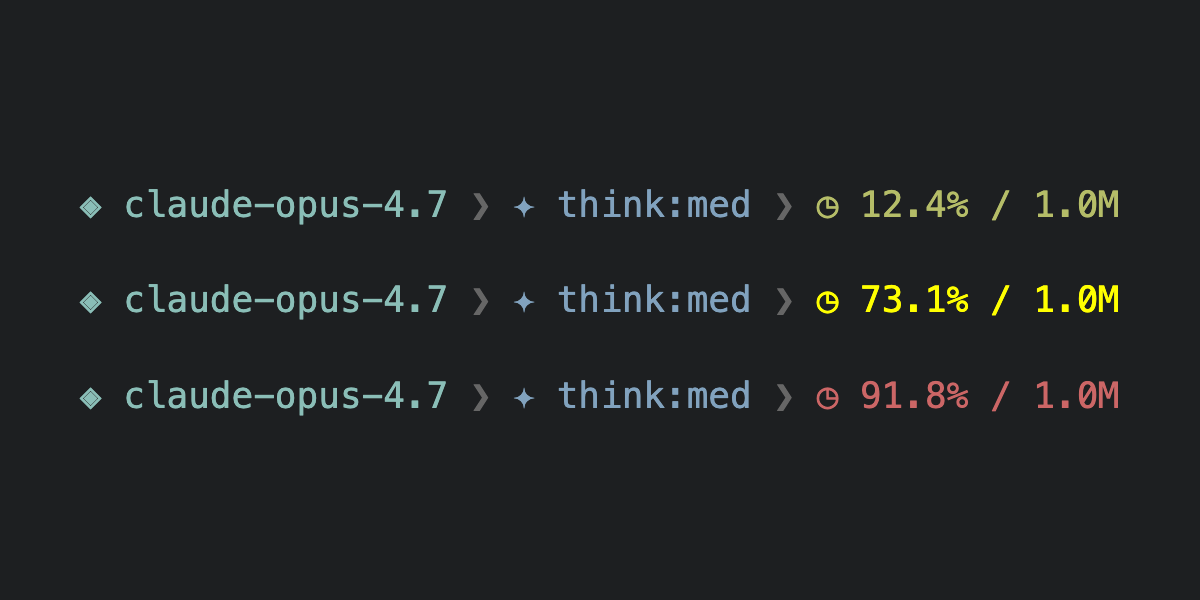
Pi footer/statusline showing active model, thinking level, context pressure, live TLDR, and extension statuses.
Package details
Install pi-bar from npm and Pi will load the resources declared by the package manifest.
$ pi install npm:pi-bar- Package
pi-bar- Version
0.3.22- Published
- May 15, 2026
- Downloads
- 126/mo · 126/wk
- Author
- tianrendong
- License
- MIT
- Types
- extension
- Size
- 89.4 KB
- Dependencies
- 0 dependencies · 3 peers
Pi manifest JSON
{
  "extensions": [
    "./extensions/status-footer.ts"
  ],
  "image": "https://cdn.jsdelivr.net/npm/pi-bar@0.3.22/assets/screenshot.png"
}Security note
Pi packages can execute code and influence agent behavior. Review the source before installing third-party packages.
README
pi-bar


Never accidentally run Opus on a typo again. pi-bar keeps your model, thinking level, context pressure, extension status, and a live one-line TLDR visible in pi's footer.
claude-opus-4.7 ❯ think:med ❯ 2.6% / 1.0M ❯ Inspecting package structure ❯ plan:active
Why use it?
- See the active model at a glance — catch accidental model switches before an expensive or sensitive task starts.
- Track thinking level in place — immediately notice when you are using the wrong reasoning setting.
- Watch context pressure early — context usage turns green, yellow, then red as you approach the limit.
- Follow what pi is doing — a live TLDR keeps the current task visible without scrolling.
- Keep extension statuses visible — statuses set with
ctx.ui.setStatus()still appear in the custom footer.
pi-bar is intentionally tiny: one small extension, no broad behavior changes, and no commands to learn. It replaces pi's built-in footer with a compact model / thinking / context / TLDR / extension-status line.
Install
pi install npm:pi-bar
If pi is already running after install, reload resources:
/reload
Customization
pi-bar works out of the box, but you can tune it with environment variables before launching pi.
Show or hide segments
PI_BAR_SHOW=model,thinking,context,tldr,extensions pi
PI_BAR_SHOW=model,context pi
Allowed segments are model, thinking, context, tldr, and extensions. The tldr segment is hidden until pi-bar generates a current TLDR. The extensions segment is hidden when no extension has set a status.
Configure live TLDR
pi-bar shows a concise live TLDR of the current task in the footer. It generates TLDRs from recent prompt, assistant, and deterministic code-compressed tool facts (for example bash ... ok, grep ... 4 matches, read file, or custom_tool key=value ok). It resets when you navigate the session tree so stale summaries do not follow you across branches. Set PI_BAR_SHOW without tldr to hide it.
Override the TLDR model with:
PI_BAR_TLDR_MODEL=anthropic/claude-haiku-4-5 pi
You can also set bar.tldrModel in pi settings.
Configure extension statuses
pi-bar shows statuses set by other extensions with ctx.ui.setStatus().
Use /bar inside pi to open an interactive status-visibility picker.
/bar
Toggle each status key between shown and hidden. The New statuses row controls whether status keys discovered later are shown or hidden by default.
Status filter choices persist globally across pi sessions. Set PI_BAR_CONFIG=/path/to/config.json before launching pi to override the default config path (~/.pi/agent/pi-bar.json). Advanced command forms like /bar status hide <key> still work for scripting.
Change context thresholds
PI_BAR_THRESHOLDS=60,85 pi
The first number is the warning/yellow threshold. The second number is the danger/red threshold. Defaults are 70,90.
Pairs well with
- pi-chrome — give your Pi agent your real, signed-in Chrome. Use pi-bar's red-context threshold as the signal to wrap up long browser scrapes before context overflows.
- pi-qq — ask side questions about what the agent just did without polluting the transcript.
Security note
Pi extensions run with your local user permissions. Review any pi package source before installing it.
Live TLDR generation sends short activity snippets to the selected TLDR model provider. Disable the tldr segment with PI_BAR_SHOW if that is unacceptable.