pi-better-subagents
Pi extension for detached, sandboxed subagent runs that keep the foreground session free.
Package details
Install pi-better-subagents from npm and Pi will load the resources declared by the package manifest.
$ pi install npm:pi-better-subagents- Package
pi-better-subagents- Version
0.17.0- Published
- Oct 7, 2026
- Downloads
- 5,831/mo · 2,705/wk
- Author
- exoulster
- License
- MIT
- Types
- extension
- Size
- 1.4 MB
- Dependencies
- 3 dependencies · 3 peers
Pi manifest JSON
{
  "image": "https://raw.githubusercontent.com/1aboveio/pi-better-harness/main/docs/images/package-gallery/pi-better-subagents.png",
  "extensions": [
    "./index.ts"
  ]
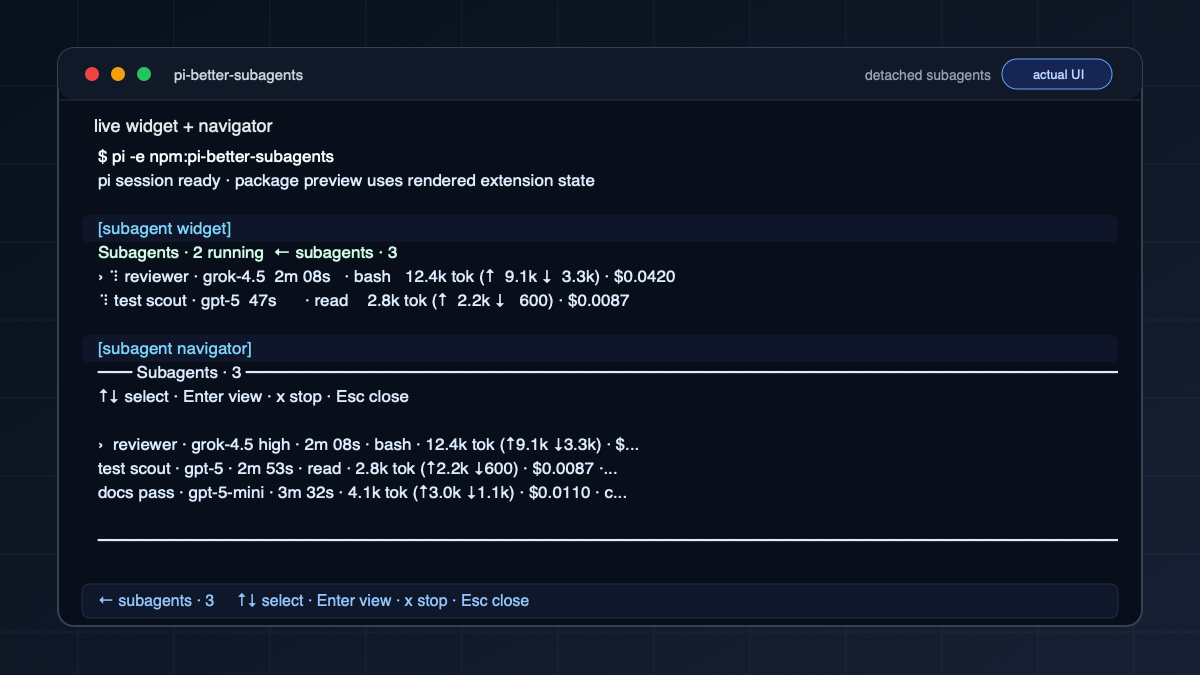
}
Security note
Pi packages can execute code and influence agent behavior. Review the source before installing third-party packages.
README
pi-better-subagents
pi-better-subagents is a Pi extension for detached, sandboxed subagent runs that keep the foreground Pi session free.
Quick Answer
Use pi-better-subagents when you want Pi to launch independent agent work without blocking the current conversation. Each subagent runs in its own pi -p child process, reports back when finished, and keeps durable logs for later inspection.
Screenshots
Core Features
- Non-blocking subagent launches, with an optional role and named-agent catalog (
docs/agent-catalog.md,docs/agent-catalog-lifecycle.md). - Typed foreground
subagent_spawn_batchlaunch receipts for native Pi codemode (Pi 0.99.1+), preserving direct tool calls, per-run callbacks, and batch capacity/catalog guarantees. See codemode batch launches. - Default OS write sandboxing on macOS and Linux.
- Explicit tool allowlists for child sessions.
- Durable logs, result retrieval, and failure observations independent of lifecycle status. A live child handles its own tool errors; the parent is woken only for actionable incidents, and children can classify handled failures with
failure_disposition. - Live background-work navigator for active runs.
- Harness-owned run timing: every run gets a no-progress wake (10 min), while wall-clock soft deadlines and hard ceilings are opt-in so productive agents are not stopped solely for taking a long time. Configure per spawn with
deadline_minutes,grace_minutes,max_minutes,stuck_minutes, or globally inconfig.json/PI_SUBAGENT_*_MINUTES. See usage notes.
Install
pi install npm:pi-better-subagentsTry it for one run:
pi -e npm:pi-better-subagentsLinux confinement requires a usable bubblewrap backend and Pi SDK 0.82.1 or newer. /sandbox controls the independent Subagents profile, which each launch freezes. Pi handles its own startup, authentication, and provider connection; task tools obey the selected file, command, and network permissions. Outside project defaults to Write: tasks write across home and temp but can remove files outside the workspace only in temp, hidden home directories, and worktree folders (Linux keeps ordinary home folders read-only instead). Confined children admit read, write, edit, and bash, the guarded apply_patch (Codex patches that follow the file rules), and the trusted tools ticked in /sandbox → Subagents · Tools (default web_fetch and web_search), which run outside the file rules. Other requested tools are reported as unavailable, with the reason. See usage notes for the runtime boundary and supported configurations.
Delegation Modes
The user config sets delegationMode to manual, adaptive (default), or
coordinator. /subagents settings (or /subagents) opens a settings page
for delegation mode and the concurrent-subagent cap (default 4). Edits apply to
this session and persist across reloads; Ctrl+S saves both as defaults, and
Reset to defaults clears
session overrides. /subagents mode manual|adaptive|coordinator and
/subagents cap <number> are command equivalents; /subagents save persists
both. Lowering the cap blocks new single and batch launches without stopping
running work. The navigator's main row retains its mode-only controls:
m cycles the session mode, ctrl+s saves that default, and x
does not stop it. Manual delegates only on explicit user or workflow request, even with a
plan. Adaptive delegates substantial independent work when useful. Coordinator
uses agents_catalog to discover current role descriptions and delegates every
nontrivial role-owned task, while the foreground coordinates, integrates, and
verifies. See usage notes.
Saved defaults live in global ~/.pi/agent/settings.json under
piBetterHarness.subagents (or under PI_CODING_AGENT_DIR) and survive package
reinstalls and upgrades. The old user config migrates on first use. Global values
override the package's config.json, which remains a compatibility fallback.
Save existing mode and cap choices with /subagents save or Ctrl+S. Put other
custom config keys in piBetterHarness.subagents as well; edits made only inside
the installed package can be lost on upgrade.
agents_catalog shows each role's and named agent's default model and effort,
such as role developer "Developer" … default openai/gpt-6.1-sol@high. Roles are
listed and passed by short name (role: "developer"); the stored id
role.developer also works, and named agents keep their full id
(agent: "agent.payments"). To launch on that default, omit
model and thinking on a role or agent spawn; name one only for a stated
reason. When a launch's model or effort differs from the default, its launch
line says so, for example
model openai/gpt-6-astra@high (role developer default openai/gpt-6.1-sol@high).
When To Use
Use this package for independent coding, review, research, or verification work that can finish later. Do not use it for steps that need immediate foreground interaction or user clarification.
Compatibility
| Requirement | Support |
|---|---|
| Pi | Required |
| Install method | pi install npm:pi-better-subagents |
| macOS sandboxing | Supported by default |
| Linux sandboxing | Uses bubblewrap when available |
| Development runtime | Node.js 22+ |
Update Or Remove
pi update npm:pi-better-subagents
pi remove npm:pi-better-subagents