pi-claude-marketplace
Access Claude plugin marketplaces from Pi Coding Agent. Supports Claude commands, skills, agents, hooks, MCP servers, and workflows.
Package details
Install pi-claude-marketplace from npm and Pi will load the resources declared by the package manifest.
$ pi install npm:pi-claude-marketplace- Package
pi-claude-marketplace- Version
0.22.0- Published
- Nov 3, 2026
- Downloads
- 11.3K/mo · 1,151/wk
- Author
- acolomba
- License
- MIT
- Types
- extension
- Size
- 5 MB
- Dependencies
- 6 dependencies · 6 peers
Pi manifest JSON
{
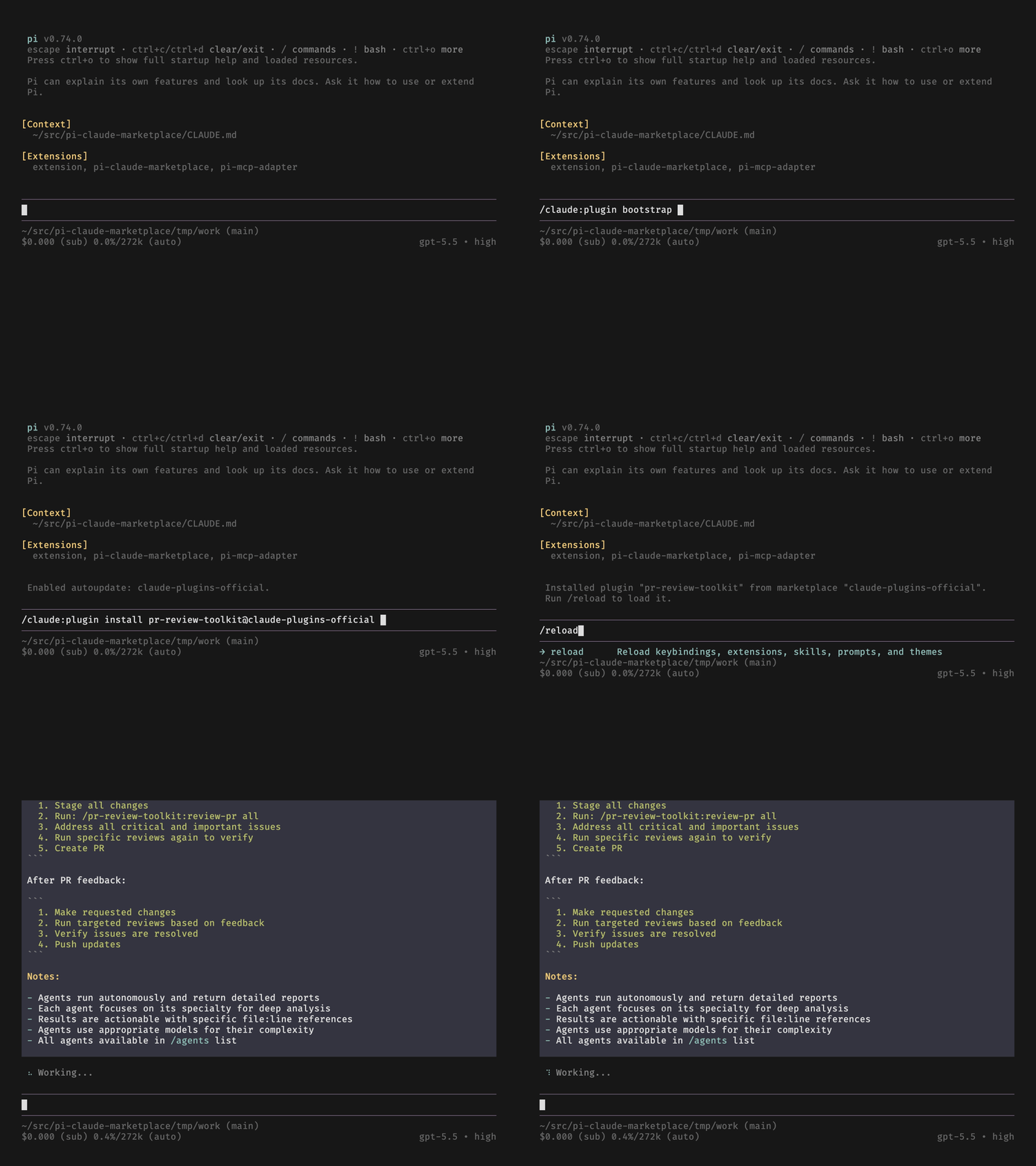
  "image": "https://media.githubusercontent.com/media/acolomba/pi-claude-marketplace/refs/heads/main/demos/bootstrap.gif",
  "extensions": [
    "./extensions/pi-claude-marketplace/index.ts"
  ]
}
Security note
Pi packages can execute code and influence agent behavior. Review the source before installing third-party packages.
README
Pi Claude Marketplace




Access Claude plugin marketplaces from Pi Coding Agent. Supports Claude commands, skills, agents, hooks, MCP servers and workflows.
Features
This extension installs plugins from Claude plugin marketplaces that contain these components:
- Commands.
- Skills.
- Agents. Requires pi-subagents. Agents in subfolders get their folder names, as in Claude Code, for example
demo:review:security. - Hooks. Partial support. For more information, see Hook compatibility.
- MCP servers. Requires pi-mcp-adapter. For more information, see MCP compatibility.
- Workflows. Requires @quintinshaw/pi-dynamic-workflows. For more information, see Workflow compatibility.
Plugins that contain unsupported components can be partially installed. A partially installed plugin may fail to work as intended.
The /claude:plugin command manages Claude marketplaces and plugins, like Claude Code's /plugin. Desired-state configs in [~/].pi/agent/claude-plugins[.local].json make plugin installations automatic and repeatable. You can share these configs across machines or team members.
Prerequisites
- Pi Coding Agent 1.4.0 or newer
- pi-subagents 0.84.0 or newer (optional but recommended,
pi install npm:pi-subagents) - pi-mcp-adapter 7.0.0 or a later 7.x release (optional but recommended,
pi install npm:pi-mcp-adapter). - @quintinshaw/pi-dynamic-workflows 3.15.0 or newer (optional but recommended,
pi install npm:@quintinshaw/pi-dynamic-workflows)
Usage
For scripts, see JSON output.
Install the Pi extension:
pi install npm:pi-claude-marketplaceBootstrap the official Claude plugin marketplace (anthropics/claude-plugins-official):
/claude:plugin bootstrapList plugins available for installation:
/claude:plugin list --availableInstall a plugin:
/claude:plugin install pr-review-toolkit@claude-plugins-officialAdd another marketplace:
/claude:plugin marketplace add upstash/context7List its plugins:
/claude:plugin list context7-marketplace --availableAdd another plugin:
/claude:plugin install context7-plugin@context7-marketplaceThen reload:
/reloadRun a plugin:
/pr-review-toolkit:review-prName mapping
This extension prefixes command and skill names with the plugin name. If the name already starts with the plugin name and -, this extension removes that common part.
Commands use a colon (:) on POSIX and a dot (.) on Windows:
| Plugin name | Command name | Pi name (POSIX) | Pi name (Windows) |
|---|---|---|---|
foo |
bar |
/foo:bar |
/foo.bar |
foo |
foo-bar |
/foo:bar |
/foo.bar |
foo |
foo |
/foo:foo |
/foo.foo |
A command also has aliases in interactive sessions and over RPC. If the command's frontmatter sets name, the command also answers to /<plugin>:<name>, and to /<name> when the name has no colon. For example, bar with frontmatter name: baz in plugin foo also answers to /foo:baz and /baz. If two commands set the same name, the first command gets the alias. A skill keeps an alias that it already has. Command aliases use a colon on every platform.
Skills use Pi's /skill: form and also have aliases in interactive sessions and over RPC:
| Plugin name | Skill name | Pi skill form | Aliases |
|---|---|---|---|
foo |
bar |
/skill:foo-bar |
/foo:bar |
foo |
foo-bar |
/skill:foo-bar |
/foo:foo-bar |
foo |
foo |
/skill:foo |
/foo:foo |
foo |
bar, with frontmatter name: baz |
/skill:foo-bar |
/foo:bar, /foo:baz, /baz |
The aliases are the names that Claude Code gives a skill. The skill name is the name of the skill's folder. If the skill's frontmatter sets name, the skill also answers to /<plugin>:<name>, and to /<name> when the name has no colon.
Plugin MCP servers get the names that Claude Code gives them. The model sees each tool as mcp__plugin_<plugin>_<server>__<tool>. pi-mcp-adapter stores each server under a key that ends with _. /claude:plugin info shows each server as plugin:<plugin>:<server>.
| Plugin name | mcpServers key |
Adapter server key | Tool names | Name shown by info |
|---|---|---|---|---|
foo |
api |
plugin_foo_api_ |
mcp__plugin_foo_api__<tool> |
plugin:foo:api |
foo |
my.db |
plugin_foo_my_db_ |
mcp__plugin_foo_my_db__<tool> |
plugin:foo:my.db |
bar |
api |
plugin_bar_api_ |
mcp__plugin_bar_api__<tool> |
plugin:bar:api |
Scoping
You can install marketplaces and plugins in the user scope or the project scope. The default is user scope.
The project scope inherits the user scope. So you can install a plugin from a user-scope marketplace into the project scope.
You can also install the same plugin in both the user and project scopes. Then the user-scope plugin takes precedence.
Partially available plugins
Some plugins contain unsupported components: an unmappable hook, an LSP server, a theme, an MCP server that uses a feature pi-mcp-adapter cannot run, or an MCP bundle. To install or update these plugins partially, pass the --partial option. This extension installs the supported components and ignores the unsupported ones.
List partially available plugins.
/claude:plugin list --partialInstall a partially available plugin. Put --partial first to enable argument completion for partially available plugins. Without that flag, completion excludes them.
/claude:plugin install --partial hookify@claude-plugins-officialConfiguration files
Each scope declares its marketplaces and plugins in two layers: the base layer and the local layer. The file of a layer is its config. The base config, claude-plugins.json, is under the scope root.
| Scope | File path |
|---|---|
user |
~/.pi/agent/claude-plugins.json |
project |
<cwd>/.pi/claude-plugins.json |
The configs of a scope are the desired state of its marketplaces and plugins. The catalog of a marketplace is the list of plugins and versions that it offers. A new session or /reload does not change your installed plugins, unless you turn on autoapply. It only lists the changes that your configs and the marketplace catalogs need.
To see those changes, run /claude:plugin pending. To make them, run /claude:plugin apply. Then run /reload so that Pi loads the result.
/claude:plugin pending
/claude:plugin apply
/reload
Whether Pi applies a declared plugin's components depends on the entry's optional enabled key and on the install-time default the plugin author declares. For more information, see Plugin enablement.
Autoapply
To make each new session and /reload apply your configs, turn on autoapply:
/claude:plugin autoapply onThis sets the top-level autoapply key of a config to true. Like enable, it writes the user base config unless you add --scope project or --local. /claude:plugin autoapply off sets the key to false. Run /claude:plugin autoapply with no value to see the value in effect, the config that sets it, and each config's own value. With --scope or --local, it lists only those configs. A set does not run apply: the next load reads the new value. You can also edit the key by hand:
{
  "autoapply": true,
  "plugins": { "context7-plugin@context7-marketplace": {} }
}
The default is false. When autoapply is on, the load runs /claude:plugin apply for both scopes before Pi looks for skills and prompts. So the plugins that it installs are ready in the same session. The load can clone repositories from the network, as apply does. A failed change shows as a failed row and stays in pending. The next load tries it again.
Any config can set autoapply. The most specific config that sets it wins, in this order: the project local config, the project base config, the user local config, and the user base config. If a config is not valid, for example because autoapply is not true or false, the load does not apply anything and reports the config.
A user config cannot turn off a project's autoapply, because the project configs are more specific. To stop it on your machine, set "autoapply": false in the project local config. A load never asks you to sign in. If a clone needs a credential that you have not stored, its row fails, and /claude:plugin apply can then ask you to sign in.
[!WARNING] A project's base config is usually in version control. If it sets
autoapplytotrue, startingpiin that project installs its plugins, hooks and MCP servers included, with no prompt. Read.pi/claude-plugins.jsonbefore you startpiin a project that you cloned. Claude Code has no such setting: it does not install a plugin that only a project's settings enable, and you install it with a command.
The local config
The local config, claude-plugins.local.json, is next to the base config.
| Scope | File path |
|---|---|
user |
~/.pi/agent/claude-plugins.local.json |
project |
<cwd>/.pi/claude-plugins.local.json |
The local config overrides entries from the base config. To write to the local config, add --local:
/claude:plugin marketplace add upstash/context7 --local
/claude:plugin install context7-plugin@context7-marketplace --local
Gitignore convention
In the project scope, commit the base config, claude-plugins.json. Then your collaborators install the same marketplaces and plugins. Keep the local config, claude-plugins.local.json, out of version control. Add this line to your project's .gitignore:
.pi/claude-plugins.local.jsonUser-scope configs live in your home directory. They are personal and never shared.
Command reference
This extension mirrors Claude Code's /plugin command. Use /claude:plugin in Pi for marketplace and plugin operations. After you install, uninstall, update, or reinstall plugins, run /reload. Then Pi discovers the changed resources. If you edit a config by hand, run /claude:plugin apply before /reload.
Marketplace
Add a marketplace from a GitHub repository owner/repo shorthand.
/claude:plugin marketplace add upstash/context7[!NOTE] If Git is not already authenticated, a private repository will trigger Device Flow authentication.
Add the same marketplace from a GitHub URL.
/claude:plugin marketplace add https://github.com/upstash/context7-marketplacePin a GitHub marketplace to a branch, tag, or commit with a #ref suffix.
/claude:plugin marketplace add https://github.com/upstash/context7-marketplace#v1.0.30Add a marketplace from another https:// git host, such as GitLab.
/claude:plugin marketplace add https://gitlab.com/my-group/my-marketplace[!NOTE] Device Flow authentication also covers
gitlab.com. Non-GitHub hosts need the fullhttps://URL; theowner/reposhorthand only resolves to GitHub.
Add a marketplace from the local filesystem. The path can be a directory with .claude-plugin/marketplace.json, or a direct path to a marketplace.json file.
/claude:plugin marketplace add ~/my-marketplace
/claude:plugin marketplace add ~/my-marketplace/.claude-plugin/marketplace.json
Add a marketplace local to the current project with --scope project. The default scope is user.
/claude:plugin marketplace add upstash/context7-marketplace --scope projectList configured marketplaces.
/claude:plugin marketplace list
/claude:plugin marketplace ls
Show details for one marketplace.
/claude:plugin marketplace info context7-marketplace
/claude:plugin marketplace info context7-marketplace --scope user
Update one marketplace. If you omit the name, the command updates all marketplaces.
/claude:plugin marketplace update context7-marketplace
/claude:plugin marketplace update
Remove a marketplace and uninstall its plugins. A dependency that another plugin still needs stays installed.
/claude:plugin marketplace remove context7-marketplace
/claude:plugin marketplace rm context7-marketplace
Autoupdate
Autoupdate is a setting for each marketplace. It controls what happens when the marketplace updates:
- If autoupdate is on, the extension updates the marketplace and its installed plugins in the background. The update starts after the first message of a
tuisession, with a random delay of up to ten minutes. A manualmarketplace updatealso updates the installed plugins of the marketplace. - The background update changes the marketplaces of the project scope only when Pi trusts the project.
- If autoupdate is off,
marketplace updaterefreshes only the list of plugins in the marketplace.
Turn autoupdate on or off for one marketplace.
/claude:plugin marketplace autoupdate context7-marketplace
/claude:plugin marketplace noautoupdate context7-marketplace
If a marketplace has no autoupdate setting, autoupdate is off. Official Claude marketplaces are the exception, as in Claude Code. An official marketplace is one with a name that Claude Code reserves for Anthropic, such as claude-plugins-official. Autoupdate is on by default for these marketplaces, except for knowledge-work-plugins and first-party-plugins.
Plugin
Browse plugins interactively across configured marketplaces. In interactive mode, running bare /claude:plugin also opens the browser.
/claude:plugin browse
/claude:plugin
List plugins available for installation. Omit the marketplace name to list across configured marketplaces.
/claude:plugin list context7-marketplace --available
/claude:plugin list --available
Filter the list by plugin status, installed, available for installation, partially available (not all features supported), remote (a plugin in a remote repository not yet fetched), or unavailable to install.
/claude:plugin list --installed
/claude:plugin list --available
/claude:plugin list --partial
/claude:plugin list --remote
/claude:plugin list --unavailable
Show details for one plugin.
/claude:plugin info context7-plugin@context7-marketplaceInstall a plugin with the <plugin>@<marketplace> format.
/claude:plugin install context7-plugin@context7-marketplaceInstall in the project scope instead of the user scope.
/claude:plugin install context7-plugin@context7-marketplace --scope projectA plugin can declare the other plugins it needs. The install adds them too, into the same scope. For more information, see Dependency resolution.
Update one installed plugin, every installed plugin from one marketplace, or all installed plugins.
/claude:plugin update context7-plugin@context7-marketplace
/claude:plugin update @context7-marketplace
/claude:plugin update
[!NOTE] Agent definitions in plugins can name a preferred model for the agent, for example "sonnet" or "opus". This extension discards these models by default. To map them to Pi models as a best effort, use the
--map-modeloption withinstallandupdate. It mapssonnet,opus,haiku,fable,best, andopusplan, with or without[1m], to the current Claude models, for exampleanthropic/claude-sonnet-5-5. It keeps fullclaude-model IDs.
Reinstall one installed plugin, every installed plugin from one marketplace, or all installed plugins.
/claude:plugin reinstall context7-plugin@context7-marketplace
/claude:plugin reinstall @context7-marketplace
/claude:plugin reinstall
Limit reinstall to one scope with --scope user or --scope project. The flag can appear before or after the target:
/claude:plugin reinstall --scope project
/claude:plugin reinstall @context7-marketplace --scope user
Uninstall a plugin.
/claude:plugin uninstall context7-plugin@context7-marketplaceKeep the plugin's data directory with --keep-data.
/claude:plugin uninstall context7-plugin@context7-marketplace --keep-dataAlso remove the dependencies that no remaining plugin needs with --prune.
/claude:plugin uninstall context7-plugin@context7-marketplace --pruneYou can uninstall a plugin that another installed plugin needs. Its row names the enabled dependents as {dependents unsatisfied}. The next /claude:plugin apply installs the plugin again as a dependency, because the dependents still declare it. If that install fails, apply disables those dependents. For more information, see Dependency resolution.
To remove orphaned dependency installs without naming a plugin to uninstall, run prune. It selects the user scope by default. Use --scope project to select the project scope.
/claude:plugin prune
/claude:plugin prune --scope project
Preview the same scope with --dry-run. The preview reads the current state and writes nothing. A later prune checks the state again, so its result can change.
/claude:plugin prune --dry-run
/claude:plugin prune --scope project --dry-run
Only dependency-installed plugins that no installed plugin in the same scope declares qualify. Even disabled plugins still hold their dependencies. Plugins you installed by name stay installed. The sweep repeats until no more plugins qualify. Actual rows read (uninstalled) {dependency pruned}; preview rows read (will uninstall) {dependency pruned}. If none qualify, both commands report Nothing to prune in user scope: no orphaned dependency installs were found. for the default scope.
Reload Pi after changes. Neither /reload nor /claude:plugin apply prunes orphaned dependencies. Run prune or uninstall <plugin> --prune to remove them.
/reloadRemote plugins
Marketplaces can declare remote plugins hosted in a different Git repository. You can list them with the --remote option.
/claude:plugin list --remoteThis extension fetches remote plugin repositories only when needed. So /claude:plugin info does not resolve their components. To fetch the repository of one plugin, pass the --fetch option.
/claude:plugin info 2crunch-api-security-testing@claude-plugins-official --fetchYou can also fetch repositories ahead of time. Fetch one remote plugin, all plugins in one marketplace, or all remote plugins across all marketplaces:
/claude:plugin fetch 2crunch-api-security-testing@claude-plugins-official
/claude:plugin fetch @claude-plugins-official
/claude:plugin fetch
After the fetch, each plugin is available, partially available, or unavailable to install.
The /claude:plugin install command automatically fetches a remote plugin.
/claude:plugin install 2crunch-api-security-testing@claude-plugins-officialBootstrap
Bootstrap is a one-step setup. It adds the official Anthropic marketplace, claude-plugins-official, in the user scope. Autoupdate is on by default for this marketplace. If the marketplace is already added, bootstrap does not change its autoupdate setting.
/claude:plugin bootstrapImport
The import command adds marketplaces and plugins already defined in Claude Code settings.
/claude:plugin importBy default, the import adds each marketplace and plugin to the same scope it has in Claude Code. You can also limit the import to a specific scope.
/claude:plugin import --scope user
/claude:plugin import --scope project
The import skips plugins that Pi cannot install because of unsupported components. It shows a warning for each one.
Contributing
Read CONTRIBUTING and CODE_OF_CONDUCT.
AI disclaimer
The author developed this project with AI agent engineering practices. It uses the Open GSD spec-driven development system.
The author vibe-coded a prototype until it was feature-complete for a first release, then extracted and reviewed a PRD from the implementation.
The PRD then guided GSD through the discussion, planning, and implementation phases of a new implementation.
License
The MIT License covers this project. For details, read the COPYING file.
Copyright 2026 Alessandro Colomba