pi-codemcp
Typed, sandboxed Code Mode access to configured MCP servers for Pi
Package details
Install pi-codemcp from npm and Pi will load the resources declared by the package manifest.
$ pi install npm:pi-codemcp- Package
pi-codemcp- Version
1.5.2- Published
- Sep 18, 2026
- Downloads
- 480/mo · 58/wk
- Author
- yolonir
- License
- MIT
- Types
- extension
- Size
- 649.1 KB
- Dependencies
- 2 dependencies · 3 peers
Pi manifest JSON
{
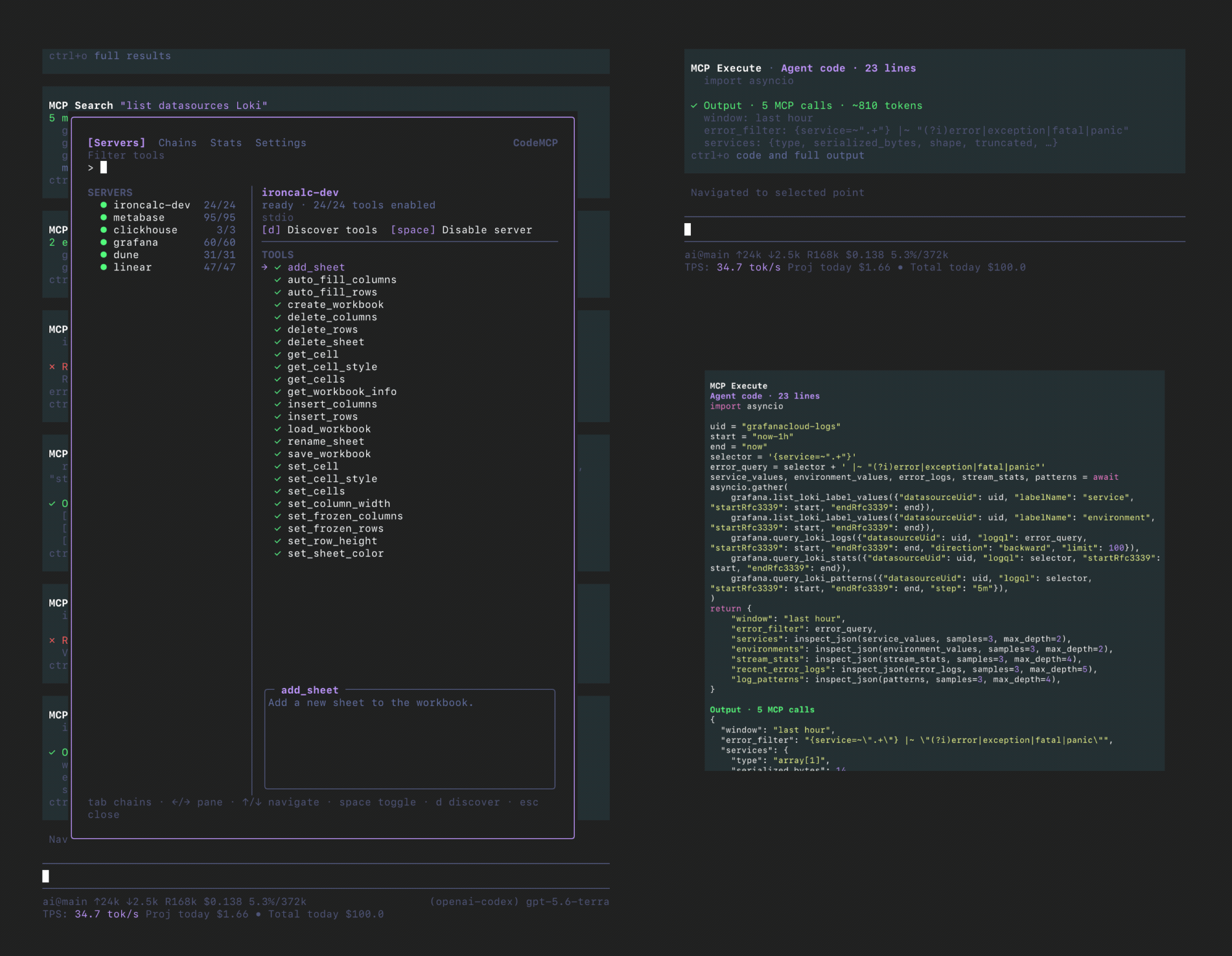
  "image": "https://raw.githubusercontent.com/yolonir/pi-codemcp/main/media/preview.png",
  "extensions": [
    "./extensions/index.ts"
  ]
}
Security note
Pi packages can execute code and influence agent behavior. Review the source before installing third-party packages.
README
pi-codemcp
[!IMPORTANT] Something failed? Please open an issue.
Please do not assume your failure is too specific or not worth reporting. Platform differences, strange schemas, slow startup, confusing rendering, OAuth problems, and rough edges are exactly the reports that make this project better.
Open an issue at https://github.com/yolonir/pi-codemcp/issues, or use Extension is broken! in
/codemcp→ Settings to ask the agent to investigate and prepare one.You can ask your coding agent to do the work:
Reproduce this pi-codemcp problem, redact all credentials and private data,
collect the pi-codemcp version, Pi version, OS/architecture, MCP transport,
minimal configuration shape, exact error, and relevant logs, then open a
GitHub issue at https://github.com/yolonir/pi-codemcp/issues.
If the agent cannot create the issue, ask it to prepare the title and body for you. I would much rather receive an incomplete report than have someone hit a problem, abandon the package, and never say anything. I will read the issues and work through them.
Typed, sandboxed Code Mode for your MCP servers in Pi.
The agent discovers the tools it needs, writes a Python program, and runs dependent or parallel calls across MCP servers. Intermediate data stays in the sandbox; only the program's compact return value goes back to the model.
Install
pi install npm:pi-codemcp
Reads <agent-dir>/mcp.json. Supports stdio, Streamable HTTP, SSE, bearer authentication, and FastMCP-managed OAuth.
Open /codemcp to manage servers, individual tools, saved chains, settings, and usage stats. Changes are saved immediately. Tool output expands with Pi's normal Ctrl+O.
No separate Python, uv, Bun, or just installation is needed. The package bootstraps a locked Python 3.13 runtime on first use; this needs network access unless already cached. Pi startup does not wait for MCP connections.
How it works
Discover tools → load selected contracts → execute a program → return compact data
| Tool | Purpose |
|---|---|
codemcp_search |
Search capabilities or browse the compact catalog. |
codemcp_route |
Optional Jev routing: select tools, roles, and composition guidance. |
codemcp_inspect |
Load exact typed SDK contracts for selected calls. |
codemcp_execute |
Type-check and run a sandboxed Python program. |
codemcp_edit |
Patch the previous program and rerun it. |
codemcp_save_chain |
Save a tested program as a reusable tool, with user approval. |
codemcp_manage_chains |
List chains; explicitly confirm enable, disable, revalidate, or delete. |
Independent calls can use asyncio.gather; dependent calls pass earlier outputs into later inputs. Filtering and aggregation happen inside the sandbox, without model round trips for every intermediate result.
Optional Jev routing
Provide TYPESAFE_API_KEY, then set Enable Jev → true in /codemcp → Settings. This replaces codemcp_search with codemcp_route as the agent's discovery tool.
- The agent calls
codemcp_routewith a shortintent, such as “read staging logs to diagnose the approval error.” The extension includes the original user request and up to three preceding user/assistant messages as context. A changed subtask can be routed again with a new intent. - Enabled tool names and descriptions go to Jev in parallel chunks of up to 40. Jev scores relevance to that subtask (including prerequisites), assigns workflow roles, and checks whether an intermediate model decision or user approval is needed.
- CodeMCP ranks and filters the answers, selects at most eight tools, derives composition guidance, and fetches their exact typed contracts.
- The agent writes the actual
codemcp_executeprogram, keeping a checkpoint between stages when needed.
Jev does not execute tools or block ordinary messages. Routing sends the intent, your request, recent context, and tool descriptions to TypeSafe, so it is opt-in. Without a key, local search stays active; a failed route enables search as a fallback. The SDK also honors TYPESAFE_BASE_URL and TYPESAFE_DEFAULT_MODEL.
MCP configuration
Use an mcpServers object or a root-level server map:
{
  "mcpServers": {
    "filesystem": {
      "command": "npx",
      "args": ["-y", "@modelcontextprotocol/server-filesystem", "/tmp"]
    },
    "linear": {
      "type": "http",
      "url": "https://mcp.linear.app/mcp",
      "auth": "oauth"
    }
  }
}
Set disabled: true or enabled: false to disable a server. For stdio, only a safe base environment, comma-separated variables in MY_PI_CHILD_ENV_ALLOWLIST / MY_PI_MCP_ENV_ALLOWLIST, and explicit server env values are passed through. Remote headers can reference allowed environment variables with ${NAME}.
Settings
Edit settings in /codemcp or <agent-dir>/pi-codemcp/settings.json. Defaults: 30-second execution and tool timeouts, 50 upstream calls, 16 KiB returned data, 50 KiB rendered output, and a 24-hour catalog cache.
{
  "version": 2,
  "jevEnabled": false,
  "backgroundWarmup": true,
  "cacheTtlHours": 24,
  "executionTimeoutSeconds": 30,
  "toolTimeoutSeconds": 30,
  "maxCalls": 50,
  "resultLimitKiB": 16,
  "outputLimitKiB": 50,
  "disabledTools": {
    "linear": ["delete_issue"]
  }
}
Older settings are migrated on load, including discoveryMode → jevEnabled.
Saved chains
With your approval, a successfully executed program can be saved with explicit input/output JSON Schemas. One manifest exposes both:
mcp_chain_weekly_digest(...)   # native Pi tool
chains.weekly_digest(...)     # typed call inside another CodeMCP program
Chains can call MCP tools or other chains. Nested calls share time and call budgets; inputs and outputs are validated. Changed dependency contracts mark chains stale for revalidation.
- Project:
<project>/.pi/pi-codemcp/chains(activated in trusted projects). - Global:
<agent-dir>/pi-codemcp/chains, when explicitly requested.
Project chains override same-named global chains, even when disabled. Manifests store code and schemas, not credentials or execution results. Manage them through /codemcp.
Execution and safety
FastMCP handles transports, validation, and OAuth. Pydantic Monty type-checks and executes Python without host filesystem, environment, network, or subprocess access. External access is only through the exposed MCP and saved-chain calls.
- Type errors stop execution before any upstream call. Time, memory, call count, and output size are bounded.
- Enabled tools retain their upstream permissions. Chains cannot bypass server or per-tool policy.
- No automatic call retries or cross-service rollback: a later failure does not undo earlier side effects.
codemcp_editreruns the whole program, including upstream calls; it is not a continuation.- Unscoped search returns available results plus explicit
discovery_failures; server-scoped search fails if that server is unavailable.
Incomplete schemas use recursive JsonValue, not Any. Use the prebound expect_object, expect_list, expect_string, and expect_integer helpers to narrow values. inspect_json(value, samples=2, max_depth=3) returns a bounded structural summary.
Oversized results fail explicitly. If the value fits the in-memory refinement cache, the error includes a result_ref. Pass it as inputRef in a follow-up codemcp_execute to filter the retained value as input without repeating upstream calls. References expire after five minutes and are valid only in the originating sidecar.
Failures distinguish preflight, runtime, timeout, cancelled, and oversized result stages. Rendered output has a separate outputLimitKiB cap.
Development
just init           # locked dependencies and hooks
just check          # locks, lint, types, and tests
just release-check  # also verify the packed clean-install path
pi -ne -e . --no-session
Uses Bun and uv with Python 3.13. For sidecar debugging:
uv run --project sidecar --frozen -m sidecar.cli doctor --agent-dir ~/.pi/agent
uv run --project sidecar --frozen -m sidecar.cli search "linear issues"
uv run --project sidecar --frozen -m sidecar.cli execute --code-file plan.py
Conventional Commit titles drive Release Please. Feature PRs do not publish; merging the release PR triggers the verified npm release.
Credits
Inspired by Cloudflare's Code Mode. Independent implementation for Pi using FastMCP and Pydantic Monty.
MIT