pi-contour
Evidence-first structural review of code changes, powered by Fovea's heat-diffusion substrate.
Package details
Install pi-contour from npm and Pi will load the resources declared by the package manifest.
$ pi install npm:pi-contour- Package
pi-contour- Version
0.4.2- Published
- Sep 18, 2026
- Downloads
- 666/mo · 666/wk
- Author
- monotykamary
- License
- MIT
- Types
- extension, skill
- Size
- 3.8 MB
- Dependencies
- 0 dependencies · 1 peer
Pi manifest JSON
{
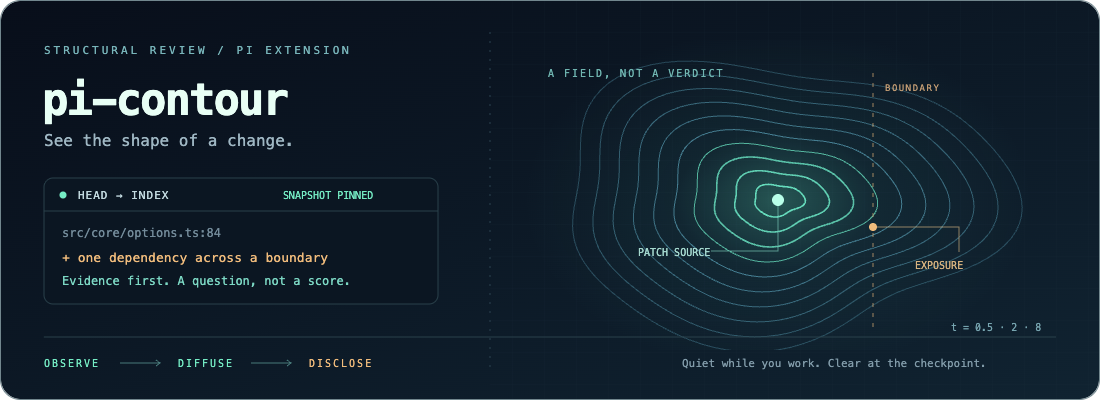
  "image": "https://raw.githubusercontent.com/monotykamary/pi-contour/main/media/preview.png",
  "skills": [
    "./skills"
  ],
  "extensions": [
    "./dist/index.mjs"
  ]
}
Security note
Pi packages can execute code and influence agent behavior. Review the source before installing third-party packages.
README
Fovea brings relevant code into focus. Contour reveals how that structure changes.
Not an AI detector. Not a quality score. Not a correctness stamp.
A patch can make individual functions shorter while moving decisions into helpers. It can remove a duplicate while creating a heavily coupled abstraction. Contour keeps those tradeoffs visible: before/after measurements, source witnesses, and a concrete review question, with heat diffusion showing where a finding's modeled exposure travels.
Install
For your Pi setup, choose one source:
pi install npm:pi-contour

# Or install directly from GitHub:
pi install git:github.com/monotykamary/pi-contour
Restart Pi, or /reload in a running session after installation. Requires Pi, Node 20+, and Git. You do not need to install Fovea separately. The compiler and versioned pi-fovea/substrate are bundled; Pi supplies typebox. Git and npm both ship the ready-to-load distribution—no sibling checkout, tsx, compilation, or postinstall script.
Want the standalone contour command on your PATH as well?
bun install -g pi-contour
# npm install -g pi-contour also works
contour review
Installing the CLI globally does not register a Pi extension; pi install does not promise a global CLI. No hooks, settings, network requests, or repository writes are performed by loading Contour.
The loop
       while you work                 when you ask / commit
   ┌────────────────────┐            ┌────────────────────────┐
   │ observe → cache    │ ─────────▶ │ pin → compare → reveal │
   │ silent, incremental│            │ witnesses + questions  │
   └────────────────────┘            └────────────────────────┘
Continuous discovery. Checkpoint disclosure. Successful native/Fabric pi.* path access selects a project—even when your Pi cwd is a parent folder or an unrelated launcher. A 32-root recency ring retires the least recently used project on overflow. Root-local Git comparisons never merge unrelated projects merely because they share a parent. Fovea and Contour exchange session-qualified target hints when both are loaded.
A quiet observer debounces successful activity (400ms), alternating recent projects with a round-robin backstop on a 5s scheduling tick. It scans one root per pass; 5s is not a per-project guarantee at 32 roots. Once enrolled, editor saves and opaque shell changes are still found by polling. Explicit checkpoints take priority and abort speculative work. Discovery never injects findings, shows notifications, or restarts an agent.
Startup registers the lightweight workspace interface and an unref'ed timer; an empty coordinator never scans cwd. The parser, numerical substrate, and engine load at the first enrolled-project scan or explicit review—not during extension loading or session_start. Branch-local root metadata survives compaction/reload/resume; old analysis does not. Reload/shutdown cancels obsolete work. For entirely on-demand analysis:
CONTOUR_BACKGROUND=0 pi
- Git blobs: batched, size-checked, object-ID cached.
- Working-tree reads: device/inode/size/mtime/ctime/mode manifests, not mtime guesses.
- Syntax facts: content + path + parser/semantic versions; bounded persistent reuse across Pi and CLI processes.
- Models: immutable content generations; staging already analyzed bytes reuses the graph.
- Reports: comparison/configuration identity; no-change passes do no parsing, graph assembly, or heat evaluation.
- Numerics: one Chebyshev recurrence per source/operator, reused across timescales.
- Scheduling: serialized, cancellable work; cooperative yields between files and findings.
Defaults: 2,000 source files, 512KiB per source, 32MiB per snapshot; 32 blobs per batch; 24 concurrent file operations. Facts are bounded at 4,000 entries / 48MiB. Graph assembly caps at 20,000 symbols / 80,000 import-and-call sites. Omissions remain visible.
Caches under $TMPDIR/pi-contour-<uid>/ contain local source-derived metadata, are never uploaded, and can be deleted safely. Root-local facts and advisory checkpoint markers share best-effort retention targets of 128MiB / 128 files / 7 days; regeneration changes speed or advisory repetition, not evidence or enforcement. Cleanup runs lazily on actual cache use, never at startup. See temporary-storage lifecycle and safe preview for ownership checks, atomic-temp grace periods, and safety exceptions. Polls still run bounded Git/stat discovery. One-file parsing and first-use module loading are synchronous and not free; see the performance contract, not a zero-overhead claim.
Set CONTOUR_MAX_ROOTS to lower the default/cap of 32. Reports label the canonical worktree; agentOrigin records the launcher separately. Symlink aliases unify, linked worktrees stay distinct. Native paths remain cwd-relative and no extension changes cwd. Use explicit roots for parallel work.
Enrollment follows successful structured/literal access, never blocked calls or guessed program output. It expands analysis to the containing project, not a per-file sandbox or a trust grant. Automatic discovery excludes broad/private/dependency paths. Analysis Git commands disable fsmonitor and remote/lazy fetching. Non-Git projects report review unavailable instead of silently reviewing the previous repository. Re-entry does not certify an inactive interval.
Review a patch
In Pi:
/contour review
/contour review working-tree
/contour review staged --root "/projects/service"
For the agent:
contour_review({ target: "staged" }) // the session cwd's own project
contour_review({ root: "/projects/service", target: "working-tree" })
contour_review({ target: "working-tree", maxTokens: 2500, maxFindings: 8 })
From the terminal:
contour review                      # HEAD → index (default)
contour review --working-tree       # includes nonignored untracked sources
contour review --json               # structured evidence + coverage
contour review --root /path/to/repo --max-tokens 1000
contour --version                   # version of the distribution on PATH
The index is the commit candidate—not the live worktree. Partially staged files and unchanged dependencies come from pinned Git blobs. Unborn HEAD uses an empty baseline; unmerged indexes are errors. Captures are checked for concurrent drift and reconciled again before returning a fresh report. A moving repository causes a retry error, not approval.
Review never checks out files, stages changes, executes repository code, commits, or runs tests. There is no atomic lock on an external editor or a later commit: every report identifies the snapshot it actually analyzed.
Reading a checkpoint
The contour-review message uses the same compact text renderer as the tool, CLI, and optional hook. It is still an explicit checkpoint, not an automatic edit-by-edit sync.
| Mark | Meaning |
|---|---|
Δ |
Structural finding, metric delta, or regional change |
▪ |
Source witness: file, line, and any recorded relationship |
↗ |
Modeled diffusion exposure—not severity or evidence of a defect |
? |
Review question, not a rewrite instruction |
⚠ |
Incomplete coverage; baseline/target gaps are labeled separately |
An abridged, illustrative report:
Contour · staged · <HEAD> → <snapshot>
Δ SLOC +18; decisions +4; erosion 0.120 → 0.180; verbosity 0.040 → 0.040

Δ [complexity; advisory] parse: decision load increased
  ▪ src/parser.ts:42
  8 → 12 decisions (CC = decisions + 1)
  ↗ Exposure (modeled): t=0.5: 2.0% outside source region; t=2: 8.0% outside source region
  ? Is this additional branching required, or can responsibilities be separated without merely distributing the same decisions?

⚠ Coverage incomplete; absence of findings is not approval.
⚠ Gap (target): worker/job.py — Unsupported language: .py
Full reports retain snapshot identities, policy/coverage counts, absolute totals, omitted-finding counts, and the reminder that heat is exposure—not defect probability. Symbols add hierarchy, not new scoring or automatic actions. --json remains structured data without presentation glyphs.
What a finding means
| Signal | Visible evidence | Question, not verdict |
|---|---|---|
| Complexity | Decisions, callable CC, SLOC, erosion, regional totals | Did we simplify the decisions—or redistribute them? |
| Duplication / verbosity | Exact-token clones and explicit syntax-rule witnesses | Is the repetition accidental, or useful independence? |
| Coupling | New direct cross-directory import and its source location | Is this the right boundary to cross? |
| Cycles | New/expanded strongly connected import regions | Does this coordination cost match the design? |
| Exposure | Source mass, conserved mass, neighbors at several scales | Where else should this change receive attention? |
Every finding retains its own category and units. Heat may prioritize review within a category; complexity, clone lines, and coupling are not summed into an invented quality number.
JS/TS/JSX/TSX, including .mjs, .cjs, .mts, and .cts:
- SLOC: lines containing syntax, excluding comments/blank lines.
- Decisions:
if, loops, conditional expressions, catches, non-default switch cases,&&,||,??. - Per-callable CC: decisions + 1, excluding nested callable decisions. Callable mass: CC × √SLOC.
- Erosion: callable mass in CC > 10 divided by total callable mass. A diagnostic convention, not a gate.
- Verbosity: union of flagged source lines and clone lines / SLOC, with absolute counts retained.
- Two syntax rules: catch-and-immediate-rethrow; Boolean-literal conditionals.
- Exact-token callable-body clones: at least 30 tokens / 4 source lines. Whitespace/comments ignored, identifiers/literals retained. No near-clone or semantic-equivalence claim.
- Regional function/decision totals expose redistribution that function-level ratios can conceal.
Inspired by Earendil's article and SlopCodeBench, not a reproduction of their full ruleset or cross-repository calibration. Test files are included. Generated/declaration files and unsupported languages are disclosed as omissions. Bare aliases and dynamic/runtime resolution remain limited; unresolved imports may simply be external dependencies.
Same heat. Different question.
Fovea owns graph assembly and the numerical solver. Contour feeds the shared pi-fovea/substrate API immutable syntax facts, not rendered navigation output or mutable session state.
Each selected finding seeds one unit of mass. Contour's conservative undirected conductance projection transports it through the forward, mass-conserving heat field:
$$ p(t)=D^{1/2}e^{-tL_{\mathrm{sym}}}D^{-1/2}q, \qquad \mathbf{1}^{\mathsf T}p(t)=\mathbf{1}^{\mathsf T}q. $$
At $t\in{0.5,2,8}$, the contours show local through wider exposure. Isolates keep their mass. Directory boundaries are proxies; legitimate integration can have high exposure. This is not defect probability, causal proof, or calibrated maintenance cost.
The full physics contract → · Fovea's substrate API →
Optional commit checkpoint
contour hook install
contour hook uninstall
Explicit installation only. Existing hooks and symlinks are never overwritten; Git's hooks path is honored. The hook invokes the built CLI via an absolute path, so keep that package location available. Uninstall removes only an unmodified, checksum-verified Contour-managed hook.
Already using a hook manager? Add contour review --staged --checkpoint yourself. Advisory checkpoints print actionable findings or incomplete-coverage warnings, suppress repeated advisories for the same comparison, and stay quiet otherwise. Operational failures are printed but do not block advisory commits. Explicit reviews are never suppressed.
No automatic project configuration loading. Opt in with a CLI path:
{
  "boundaries": [
    { "from": "src/core", "to": "src/ui", "reason": "Core must not depend on presentation." }
  ]
}
contour review --policy contour-policy.json
contour hook install --policy contour-policy.json
Policies match repository-relative path prefixes on new, directly resolved, unambiguous relative imports. Existing violations do not become new regressions. No code, commands, regular expressions, or complexity thresholds are evaluated from policy files.
Exit codes: 0 advisory · 2 explicit boundary violation · 1 operation/usage failure. Policy-enabled hooks propagate failures as well as violations. Display truncation/suppression never disables enforcement. Unsupported resolution is not certified compliant; inspect coverage.
Develop and verify
git clone https://github.com/monotykamary/pi-contour.git
cd pi-contour
bun install --frozen-lockfile
bun run check:fast        # typecheck + tests your working tree affects
bun run test:smoke        # curated entrypoint floor, seconds
bun run build             # bundle, license notices, static-startup gate
bun run smoke             # standalone bundles, real disposable commits
bun run verify:package    # production-only install + actual Pi loader
bun run bench             # incremental work-count assertions
bun run cover             # regenerate the standalone SVG
The substrate is a pinned registry dev dependency, not a sibling path or runtime extension dependency. dist/ is committed for script-free Git installation; prepack regenerates it for npm. Keep source and distribution together when releasing. Local extension testing: pi -e ./dist/index.mjs.
Acceptance ledger · Packaging and startup · Performance · MIT
More language adapters, declared feature boundaries, richer clones, co-change evidence, branch-base review, and maintenance-response experiments are future work—not silently promised by v0.1. Screened Green's functions and effective resistance remain research directions.