pi-dc-distill
Deterministic, local context compaction for the Pi coding agent. No LLM calls; includes tool-output previews and project-scoped recall.
Package details
Install pi-dc-distill from npm and Pi will load the resources declared by the package manifest.
$ pi install npm:pi-dc-distill- Package
pi-dc-distill- Version
0.1.8- Published
- Oct 6, 2026
- Downloads
- 724/mo · 724/wk
- Author
- dotcommander
- License
- MIT
- Types
- extension
- Size
- 903.1 KB
- Dependencies
- 0 dependencies · 5 peers
Pi manifest JSON
{
  "extensions": [
    "./index.ts"
  ]
}
Security note
Pi packages can execute code and influence agent behavior. Review the source before installing third-party packages.
README
pi-dc-distill
Deterministic context compaction. No LLM required.


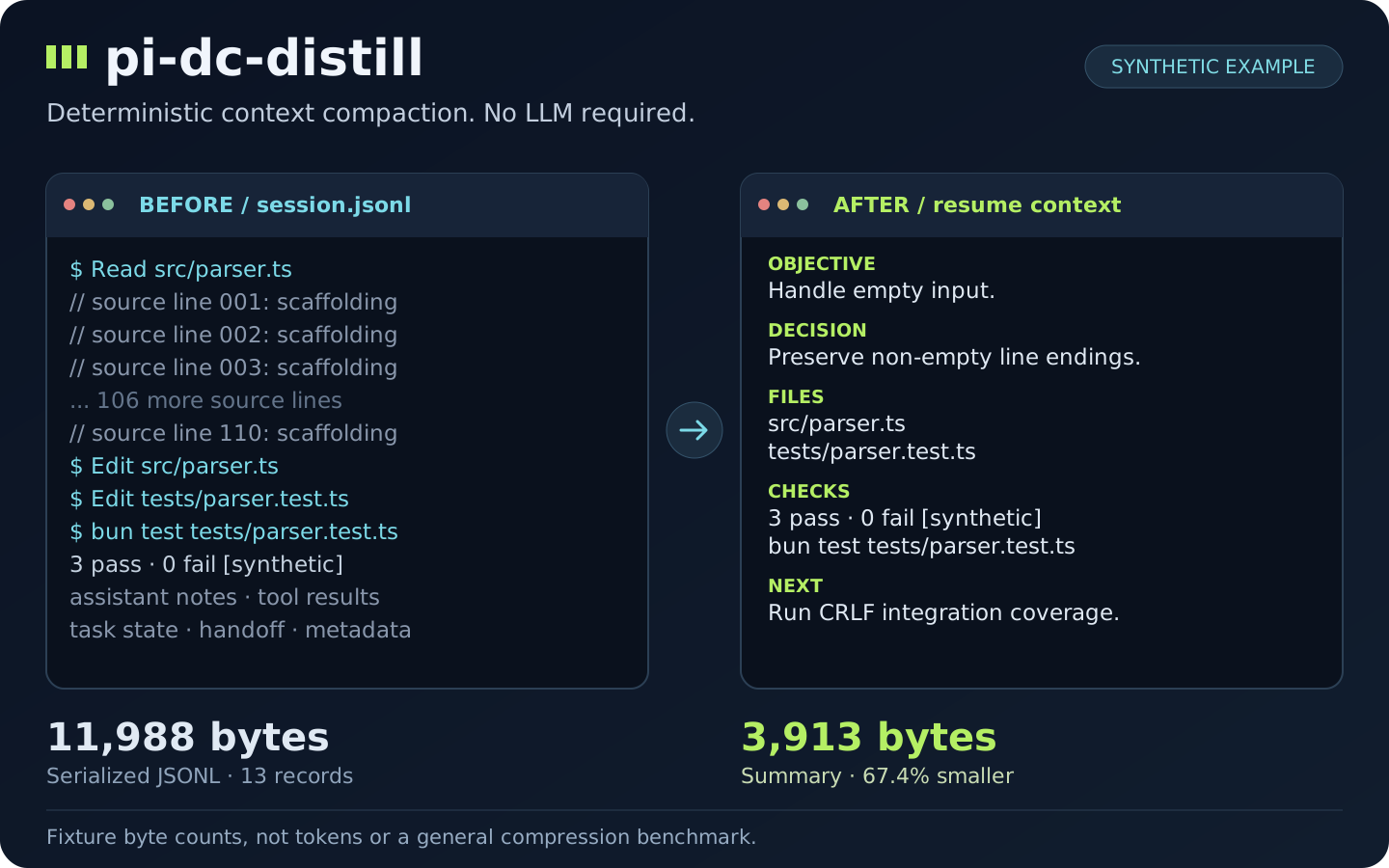
pi-dc-distill is a compaction extension for Pi. When a session grows long, it turns the old conversation into a summary you can resume work from: it extracts the objective, decisions, file observations, and verification receipts, and drops repetition and low-signal content to stay under a fixed budget. A local, rule-based compiler produces the summary — no LLM call is involved.
The priority is an accurate account of the previous session, useful continuity, and readable context, followed by compression. A smaller summary is useful only when it preserves the obligations, decisions, evidence, and context needed to resume. Fewer bytes or repetition markers do not prove summary quality.
The split of responsibility is simple: Pi owns /compact, decides which
entries to keep, and rebuilds the conversation. pi-dc-distill compiles only
the entries Pi discards, and its result replaces Pi's default LLM summary
for that attempt. This is lossy extraction; there is no guarantee that all
meaning survives. See
how the mechanism works
for the full sequence, the trigger/interception distinction, metric units,
and known verification-evidence risks.
Version 13 carries validated declarations, explicit user-source pins, evidence, and failure history in a durable checkpoint. Their retention is protected across compactions; terminal prose cannot clear unresolved work. Other context remains lossy. Checkpoint updates use exact sources and stale-base rejection; invalid expected state or protected overflow cancels compaction.
Summaries also carry a digest-authenticated <request-candidate-v1> marker:
the latest native user request restated as attributed context only — it never
becomes declared work, pins, or authorization. It is bounded with its optional
proposal inside a 4,096-code-point envelope and survives repeated compaction
through authenticated carry. See
summary organization for placement and
budget-eviction order.
Optional conversation previews shorten exact adjacent repetitions in eligible background prose before clipping, retaining one phrase and an explicit repetition count. This display cleanup preserves the original semantic preview used for selection and evidence handling, and leaves checkpoint state unchanged. It is mechanical and lossy; it makes no guarantee about subjective importance. See display cleanup for bounds and conservative bypasses.
Version 12 adds conservative unknown-tool fencing, structural parsing, locale-independent wire output, and rebuilt-context capacity acceptance. Version 11 preserves conservative shell/output evidence, adds transcript-derived rerun priorities and observed v3 handoff readiness, and improves summary ordering. Version 12 restores the baseline production selector after the coverage candidate failed its ordinary-workload performance gate. Coverage remains available in the offline evaluator. See the adoption decision for measurements and reproducible commands. Offline evidence does not establish installed Pi behavior, model resumption quality, attention gains or cache hits.
Two optional features — oversized tool-output previews and project-scoped recall — are independent of each other and off by default. Enable them only if you want the extra local storage and context behavior they add.
Install
Requirements:
- Node.js 22.19.0 or newer
- Pi 1.0.0 or newer (reviewed against 1.0.0 and 1.0.2)
- Bun 1.4.0, needed only for the packaged
dc-distill-sessionreplay CLI and the development commands below
Install from npm:
pi install npm:pi-dc-distillOr from GitHub:
pi install git:github.com/dotcommander/pi-dc-distillPi loads the TypeScript extension directly; no compiled build is required.
If you are upgrading from the previous pi-dc-shrink package, remove or
disable it before loading this one.
Start a new Pi session in your project. Once enough context has accumulated:
/compact preserve the parser repair, modified files, and remaining verificationExpand the compaction card to inspect the summary. A manual compaction
leaves choosing the next action to you. Automatic compaction runs on its
own: as context approaches Pi's limits, the monitor checks after each turn
settles (Pi's agent_settled boundary) and can queue a continuation
message once the summary commits. tool_call and completed turn_end callbacks
sample usage only. Every autonomous band waits for natural settlement, so
continuing tool loops can delay compaction. The extension never aborts a run for
compaction; native success cards and genuine errors/cancellations remain.
The observer and ctx.compact() are separate operations. A later user turn or manual/foreign compaction supersedes an older continuation.
Optional features
Both features are opt-in. Merge the block below into Pi's global or project
settings — keep any keys already present — then start a new session. The
example enables both; each enabled flag works independently:
{
  "extensionConfig": {
    "dc-distill": {
      "toolOutput": {"enabled": true},
      "recall": {"enabled": true}
    }
  }
}
With no opt-in (the default):
- Tool results are left untouched, and no tool-output artifacts or new recall summaries are written.
- No extra recall or focus echo is injected into context.
- The
recall_compactiontool still responds, but reports that recall is disabled without reading stored summaries. - Existing data is preserved. Core session compaction, handoffs, normal compaction metadata/logs, and continuation recovery all keep working.
After a validated v13 host commit, logs, dumps, recall and notifications run as independent best effort effects. Continuation recovery uses the active-branch journal and a process submission fence. Reloads and tree navigation preserve possible-submission fences; a true process restart recovers from the journal. Pi supplies no send acknowledgement, so uncertain submission does not promise exactly-once execution or zero lost turns.
See feature settings for storage paths, inheritance, migration deferral, and what enabling each feature changes.
Try a repeatable comparison
From a checkout with Bun installed:
bun install --frozen-lockfile
bun run distill:compare
The command replays a synthetic session, prints the retained summary, and checks that its objective, decisions, modified-file observations, verification status, and next action survive. It also checks that the output is byte-for-byte deterministic.
Current fixture result:
Before: 11988 UTF-8 bytes of serialized JSONL (13 records)
After:  3913 UTF-8 bytes of summary (67.4% smaller)
These numbers describe this fixture only — they are not model-token
estimates or a general compression benchmark. The fixture's test lines are
recorded data, not real executions: the comparison checks that the recorded
evidence is preserved, not that the sample parser's tests were run.
Artifacts are written to
~/.pi/agent/cache/dc-distill/compare/<unique-run>/.
Use
| Task | Interface |
|---|---|
| Compact now | /compact or /compact <focus> |
| Save explicit task state | Agent tool save_distill_handoff, with a non-empty handoff string and optional schema-v1 checkpoint operations. |
| Search retained summaries | Opt-in agent tool recall_compaction, with query, optional limit, and optional scope; reports disabled unless recall is enabled. |
| Recover full tool output | Read the artifact path in its preview notice. |
| Replay a session from a checkout | bun run distill:session -- <session.jsonl> |
The handoff and recall interfaces are agent tools. Pi's /compact is the
only slash command involved. See usage for arguments and
examples.
Policy and limits
Pi's own global and project compaction settings drive the autonomous
monitor. compaction.enabled: false turns it off; manual compaction
remains available. The extension adds no trigger settings of its own. Core
logs and optional recall/output artifacts live under
~/.pi/agent/data/dc-distill/. Raw input dumps are also off by default and
are enabled separately with DC_DISTILL_DUMPS=1. Diagnostics are written
to diag.log and diag.ndjson in that same directory; each rotates once
it exceeds 5 MiB, and rotated history is kept. See
architecture for
diagnostic path details and the removed legacy recall deep imports.
Trigger policy v3 lets the headroom floor and emergency bypass startup warmup,
cooldown, synchronization, and repeat-growth guards. Ownership, enabled valid Pi
settings, safe geometry, a finite count, and the concurrency latch still apply.
Ordinary checks retain warmup and require a current positive host usage sample.
A trustworthy nonempty restored branch with no compaction can skip the synthetic
120-second startup cooldown after warmup. A restored compaction uses its real
journal timestamp and a fresh host-count baseline; if still above auto, another
ordinary compaction needs 4,000 tokens of growth. Persisted details.tokensAfter
is a heuristic and never supplies that restart baseline. Missing or invalid
journal data keeps conservative guards. Model and branch changes require a fresh
sample, and duplicate commits do not reset admission guards. Manual, foreign,
and historical compaction commits update admission without extension success
artifacts. Diagnostics include session and process provenance. Details remain v13.
The compiler is rule-based and lossy. It can miss subjective context and low-signal details, so a handoff or focus hint helps mark what matters. File observations and test receipts are captured evidence — they do not prove current Git state or that a check is still fresh. If compilation fails, the compaction is cancelled; it never falls back to an LLM summary.
The summary targets 8,192 Unicode code points, with a hard wire limit of 65,536. Entries Pi retains stay in context untouched, and abandoned branches never enter the compiler. See policy and data for storage, retention, triggers, and migration from the previous name.
Development and documentation
Direct dependencies are pinned and resolved in bun.lock: the development
SDK baseline is Pi 0.99.2, while the reviewed installed runtime is Pi 1.0.0 and 1.0.2.
Checks run offline after installation:
bun test
bun run typecheck
bun run distill:architecture
git diff --check
bun run distill:quality /absolute/path/to/artifacts quality-v13 evaluates
checkpoint correctness and the separate optional selector.
bun run distill:performance /absolute/path/to/artifacts candidate-v13 /absolute/path/to/baseline.checkpoint.json
runs the sealed checkpoint benchmark and matched ordinary-workload gate; see
Compiler benchmarks for baseline preparation,
memory geometry, and the historical-comparison limits. Both write local receipts.
bun run distill:demo runs one manual lifecycle through installed Pi RPC
with a scripted provider. bun run distill:e2e also tests automatic
compaction and restart recovery; its automatic case includes the production
120-second cooldown. Both use isolated data directories and make no
provider/network requests. Select each reviewed host explicitly using the
RPC acceptance instructions.
- Usage: compaction, handoffs, recall, output previews, replay.
- Policy and data: settings, local storage, migration.
- Troubleshooting: diagnostics and compatibility.
- Architecture: ownership, lifecycle, isolation, metrics.
- Algorithm: scoring, repetition, evidence, eviction.
- Compiler benchmarks: offline compilation performance and memory efficiency.
- Architecture decisions: vendoring boundary and framework separation decisions.
- Releasing to npm: package checks, authentication, publication.
Checkpoint schema v1 protects validated declared tasks and explicit user-source pins, without inferring every implied obligation or authorization. Updates return canonical sources and a base identity for the next atomic update. Resolution cannot manufacture verification or waive authorization. Summaries contain no metric line; committed details and notifications report host-consistent token estimates. Historical v5–v12 entries remain readable. Rollback requires a v13-aware reader or refusal to discard checkpoint state.
Continuation intent, submission, and resulting work are distinct. Pi has no durable send acknowledgement, so a crash between acceptance and journal persistence leaves an uncertain interval; recovery cannot promise exactly-once work.