pi-dev-flow
Enforced feature workflow for Pi: plan → implement → pre-release → release, gated checkpoints, self-improvement reflections, one git worktree per feature, changelog + publish as part of the release
Package details
Install pi-dev-flow from npm and Pi will load the resources declared by the package manifest.
$ pi install npm:pi-dev-flow- Package
pi-dev-flow- Version
0.91.1- Published
- Nov 12, 2026
- Downloads
- 13.4K/mo · 3,431/wk
- Author
- dmitriy.marchevsky
- License
- MIT
- Types
- extension, skill
- Size
- 847.2 KB
- Dependencies
- 0 dependencies · 4 peers
Pi manifest JSON
{
  "image": "./banner.png",
  "skills": [
    "./skills"
  ],
  "extensions": [
    "./extensions/dev-flow.ts"
  ]
}
Security note
Pi packages can execute code and influence agent behavior. Review the source before installing third-party packages.
README
dev-flow
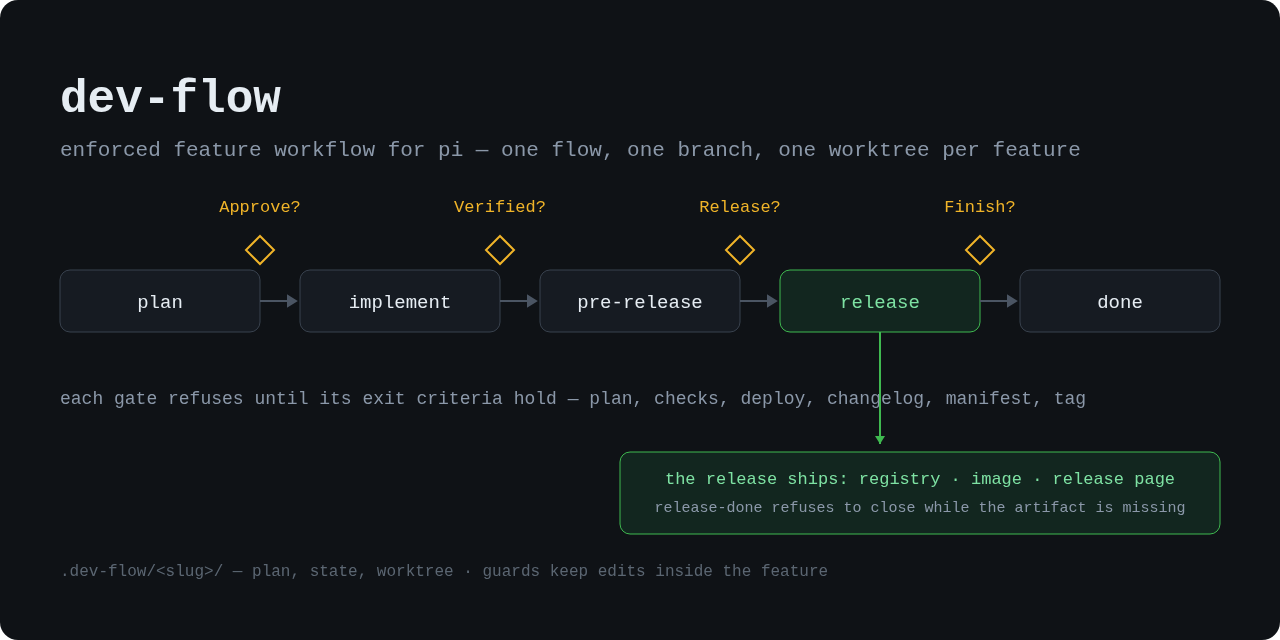
A feature workflow for Pi that the agent can't skip. You describe a feature, the
agent builds it, and the harness, not the agent, decides when a stage is done. Each feature goes
plan → implement → pre-release → release → done, and you answer one question at each checkpoint.
- Plan first. The agent writes a spec and can't touch code until you approve it.
- Real gates. Each stage ends in a check: tests pass, the app deploys and is healthy, the changelog and version agree, the tag is on the remote.
- Clean git. Each feature gets its own worktree and branch. Nothing lands on main until release.
- Parallel features. One Pi session per feature, as many at once as you like.
- It learns. When something gets in the agent's way, it leaves you a note so you can fix your setup.
Install
pi install npm:pi-dev-flow                        # from npm
pi install git:github.com/dmarchevsky/pi-dev-flow # or from git (pin with @vX.Y.Z)
Then run /flow init once in each project. It reads your repo (branch, forge, package manager,
test/build commands, version file, CI) and writes .dev-flow/project.md: your playbook. Each
question shows what it detected, so "keep these" usually answers it. It also installs a pre-commit
hook that blocks direct commits to main.
dev-flow does nothing in a repo until you run /flow init. Run it again later to check your
playbook for drift.
Updating: pi update --extensions, then /reload in running sessions. A running session keeps
the code it started with, and flow version tells you when it's behind.
How it works
Ask for a feature in plain words, for example "sessions expire silently, add sliding renewal and
a test". It becomes the feature session-renewal:
        you ask for a feature
                 │
        ┌────────▼────────┐
        │      plan       │  spec (+ mockups) in .dev-flow/<slug>/plan/
        └────────┬────────┘
         Approve?
        ┌────────▼────────┐
        │    implement    │  code + tests, in the feature's own worktree
        └────────┬────────┘
        Verified?  · checks green, app deployed and healthy
        ┌────────▼────────┐
        │   pre-release   │  review, docs, changelog, version bump
        └────────┬────────┘
          Release?  · usually answers itself when only release prep changed
        ┌────────▼────────┐
        │     release     │  PR → merge → tag → release notes
        └────────┬────────┘
           Finish?
        ┌────────▼────────┐
        │      done       │  worktree, branch and feature folder removed
└─────────────────┘| Stage | The agent | You answer |
|---|---|---|
| plan | reads the code, asks questions, writes plan/plan.md |
Approve? — build it |
| implement | works on feat/<slug>, commits in small steps, gets the checks green |
Verified? — you tried it; also pick patch / minor / major, or merge unreleased |
| pre-release | reviews, fixes, updates docs and changelog, bumps the version | Release? — only asked if something beyond release prep changed |
| release | opens the PR, merges, tags, publishes release notes | Finish? — clean up |
Your answers
- yes, or no with a reason. The agent fixes it and asks again.
- yolo: yes to this question and to all the remaining ones. Every check still runs. You can add wishes: "yolo, patch bump".
- merge unreleased: merge with a changelog entry, but no version bump or tag. The next release picks it up.
For small work the agent may suggest a lighter mode: --patch for a quick fix with no written
plan, or --docs for docs-only changes with no build checks.
You never need to type flow commands. /flow … is there as a manual override when a session gets
stuck. See the gate reference.
What is enforced
While a feature is in flight, every tool call goes through a guard:
- no commit, merge or push to main before the release stage (plus a git hook for work outside Pi);
- during plan, the agent can only write in its own feature folder; after that, only in its own worktree;
- outside a flow, the agent can't edit source at all;
- flow state and your playbook are off limits to the agent, so gates can't be faked;
- your own
deny/confirm/protect/forbidrules run on every command and path; - shell calls without a timeout get a sensible default, so nothing hangs forever.
More detail, and what this deliberately is not, is in Guardrails.
Also built in
- Reflections. When something costs the agent a step, it notes it in
.dev-flow/reflections.md. At finish, a separate reviewer reads the session and suggests what to keep. More /flow-reviewreviews a change against its plan./flow-auditaudits the whole repo./flow-simplifyremoves dead and duplicated code, one verified commit at a time.flow_stageworkers. The agent can hand big chunks of work, or a second-opinion review, to a fresh Pi session.- A roadmap.
.dev-flow/roadmap.mdis a backlog of future features.flow start <slug>can pick one up.
Where things live
.dev-flow/
  project.md            your playbook (the only committed file here)
  reflections.md        the agent's notes to you
  roadmap.md            your backlog of future features
  <slug>/
    plan/plan.md        the spec you approve
    plan/mockups/       mockups and screenshots (UI features)
    worktree/           the feature's git worktree
    state.json          stage, approvals, checks (the agent can't write it)
Docs
| Doc | What's in it |
|---|---|
| Playbook | writing project.md: checks, checklists, guard rules, flow init |
| Gates | every gate, its flags, and why it refuses |
| Guardrails | everything enforced, and the deliberate limits |
| Reflections | the agent's notes, the closing review, nudges |
| Concurrency | several sessions in one repo |
| Headless | driving dev-flow from a bot, web UI or queue |
| Development | working on dev-flow itself |
Credits
The review skills adapt ideas from ponytail, obra/superpowers and pi-development-system (MIT).
/flow-simplify adapts goal-sloc (MIT), addyosmani/agent-skills (MIT) and Anthropic's
code-simplifier plugin (Apache-2.0). Details are in each skill file. dev-flow itself is MIT.