pi-effect-harness
a harness specifically for writing Effect v4 code
Package details
Install pi-effect-harness from npm and Pi will load the resources declared by the package manifest.
$ pi install npm:pi-effect-harness- Package
pi-effect-harness- Version
0.1.0- Published
- May 1, 2026
- Downloads
- not available
- Author
- mpsuesser
- License
- MIT
- Types
- extension, skill
- Size
- 1,023.3 KB
- Dependencies
- 5 dependencies · 1 peer
Pi manifest JSON
{
  "extensions": [
    "./src/index.ts"
  ],
  "skills": [
    "./skills"
  ]
}Security note
Pi packages can execute code and influence agent behavior. Review the source before installing third-party packages.
README
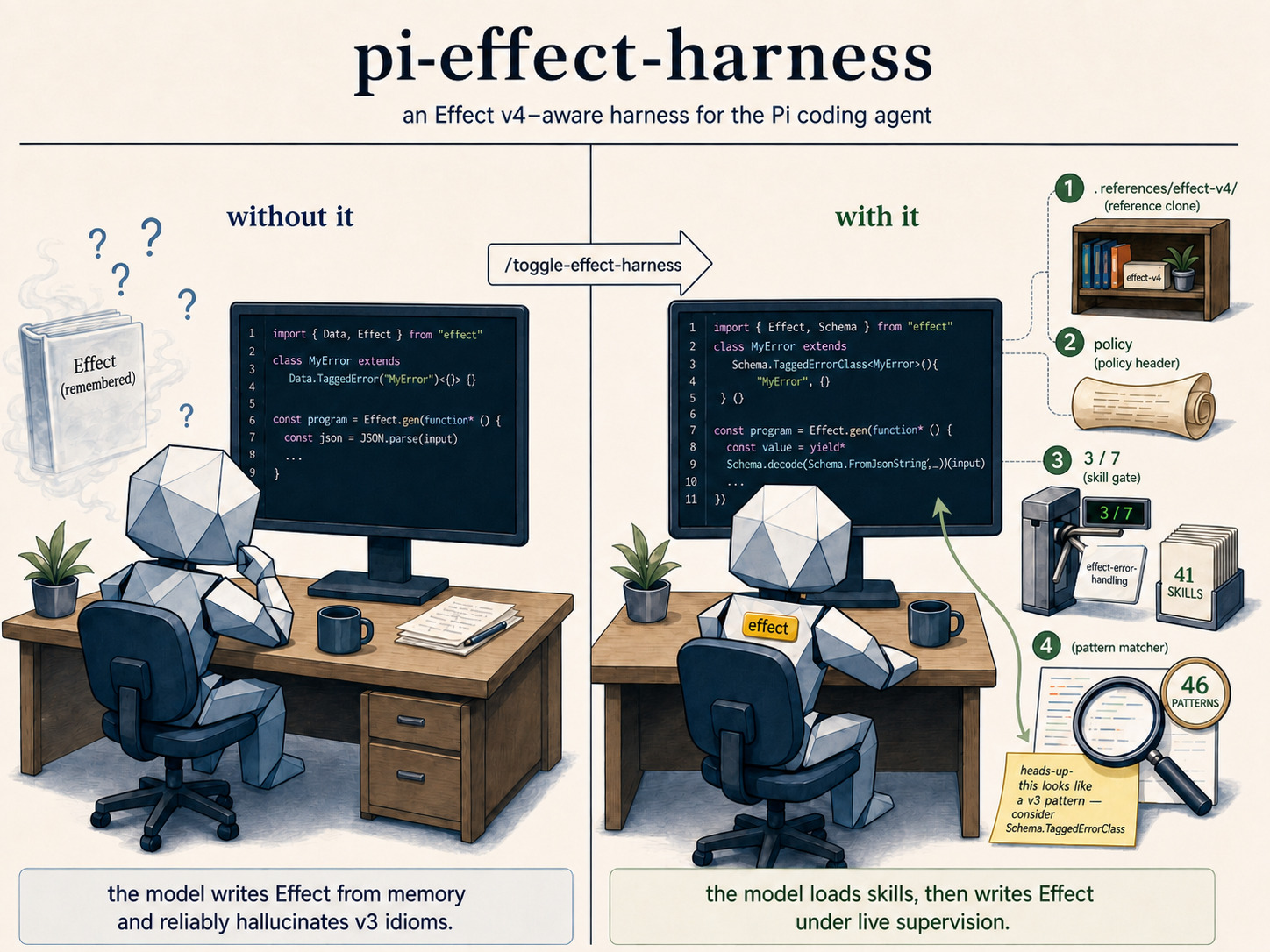
Table of contents
- What it does
- Install
- Usage
- How it works
- Skill catalog (41)
- Pattern catalog (46)
- Configuration
- Caveats
- Development
- License
What it does
When /toggle-effect-harness mode is enabled in the active Pi session:
- A gold
effectbadge appears in the Pi footer; mode state persists per-project. - The system prompt is augmented every turn with
effect-first-development.md(40+ rules covering errors, schemas, layers, services, retries, timeouts, structured concurrency, and observability), a progressive-disclosure agent rules doc, and a "loaded N/7 effect-* skills on this branch" preview. - Tool calls that would write Effect code are blocked until at least 7
effect-*skills have been read on the active branch. The check uses a prospective write projection: it looks at the resulting file, so deletion-only changes that leave no Effect code are not blocked. - After every successful write, the post-write file is matched against 46 pattern detectors. Matches are sorted by severity and replied back to the agent in-band as a single user message — including the pattern's transformation guidance and a hint to load any suggested skills.
- A shallow clone of
Effect-TS/effect-smolis maintained at.references/effect-v4/, pinned to the tag matching your project's installedeffectversion. The agent reads from it to verify v4 APIs instead of guessing.
Everything else about your Pi session is unchanged. Toggle /toggle-effect-harness off and the harness disengages cleanly — the system prompt reverts on the next turn, the gate stops firing, and the pattern loop stops emitting feedback.
Install
pi install npm:pi-effect-harness
This registers the extension and all 41 effect-* skills via the package's pi manifest. Pi auto-loads on the next session start.
The first time you enable /toggle-effect-harness in a project, the harness clones effect-smol at the tag matching your installed effect version into .references/effect-v4/ (≈30s, shallow, fail-silent). Add to your project's .gitignore:
.references/
Usage
| Toggle | /toggle-effect-harness (interactive), or via Pi's mode toggle UI |
| Status | Gold effect badge in the footer |
| Persistence | Project-scoped Pi session state; survives session restart |
| Activation cost | First time per project: shallow clone of effect-smol |
| Per-turn cost | ~3 KB of system-prompt headers + the merged guidance docs |
When mode is off, no policy header is injected and no write gate or pattern feedback fires. The harness may still rebuild its command/skill catalog and record successful effect-* skill reads as invisible branch metadata, so the loaded-skill count is ready if you re-enable the mode later.
How it works
The harness is a thin shell around an Effect ManagedRuntime. Pi events are forwarded to a HarnessController, which fans them out to a RuleSet and a HookSet. Rules return Decision values; a DecisionExecutor translates those decisions back into Pi ExtensionAPI calls.
Lifecycle
session_start ─► restore mode state · clear pending skill reads · rebuild SkillCatalog
              · refresh EffectVersion · ensure ReferenceClone if enabled

session_tree  ─► sync mode badge · clear pending skill reads · rebuild SkillCatalog

before_agent_start
  ├─► HookSet
  │     └─► EnsureReferenceClone (if enabled, using the latest refreshed EffectVersion)
  └─► RuleSet
        └─► InjectEffectPolicyHeader
              └─► Decision.InjectSystemPrompt

tool_call
  ├─► HookSet
  │     └─► TrackSkillRead (Read paths matching effect-* skills)
  │           └─► PendingSkillReads.remember(toolCallId, skillName)
  └─► RuleSet
        └─► RequireLoadedSkillsForEffectWrites
              ├─► WriteProjection.prospective(cwd, writeIntent)
              └─► Decision.BlockToolCall  (if Effect code present and skills < 7)

tool_result
  ├─► HookSet
  │     └─► EmitSkillLoadedEntry (successful tracked skill reads)
  │           └─► Decision.AppendCustomEntry
  │                 (customType: "pi-effect-harness:skill-loaded")
  └─► RuleSet
        └─► SendPatternFeedbackAfterWrite
              ├─► WriteProjection.actual(cwd, writeIntent)
              ├─► PatternMatcher × 46 patterns
              └─► Decision.InjectUserMessage

session_shutdown ─► unregister mode badge
Three rules plus session/tool hooks. Session hooks keep the skill catalog, version cache, and reference clone current; tool events record skill reads and run write checks. Everything that touches Pi runs through Decision — there is no direct mutation of session state from rule code, which keeps the rules trivially testable in isolation.
The skill gate
Effect v4 is wide. A model writing Effect cold — without any in-context skill — will reliably produce v3 patterns: Effect.catchAll, Schema.parseJson, Data.TaggedError, OptionFromSelf, compose(...) instead of decodeTo(...), untraced Effect.gen everywhere. The skill gate exists to make the agent stop and read before writing.
What counts as a skill. Each subdirectory under skills/ has a SKILL.md with frontmatter. Pi exposes these as /skill:effect-error-handling commands. The harness watches every Read tool call: when the read path resolves to a known effect-* skill (matched against the live skill catalog), it remembers the pending read keyed by toolCallId. On tool_result, if the read succeeded, it appends an invisible branch-metadata entry shaped like:
{
	customType: "pi-effect-harness:skill-loaded",
	data: {
		name: "effect-error-handling",
		path: "/absolute/path/to/effect-error-handling/SKILL.md"
	}
}
What "loaded" means. Loaded-skill state is derived, not stored. The activeBranchLoadedEffectSkills atom scans the current branch's entries for those custom entries and returns the resulting ReadonlySet<string>. This means:
/compact,/fork, and/clonereset the count by default — re-loading skills after a context reset is a feature, not a bug.- The count is monotonic within a branch.
- Counting pending reads in addition to confirmed loads avoids a race where the gate fires between the Read tool call and its result.
The threshold. MIN_EFFECT_SKILLS = 7. Schema, Error Handling, and Layers cover ~70% of any Effect codebase; the remaining four should be task-relevant (AI, SQL, HTTP, CLI, RPC, Workflow, Stream, Testing, Observability, etc.). Seven is calibrated, not arbitrary — fewer and the model still hallucinates; more and the activation friction outweighs the benefit.
Why prospective projection matters. The gate runs on WriteProjection.prospective(cwd, writeIntent), which reconstructs what the file will look like after the write/edit applies. A change whose resulting file no longer matches \bEffect\b|from\s+['"]effect.*['"] is allowed through. A change whose resulting file contains Effect code is gated. This means deletion-only Effect cleanup can proceed without artificially incrementing the skill counter.
The block message quotes the loaded count, the missing count, and a hint to read from .references/effect-v4/ if any API is unclear. The agent retries after loading more skills.
The policy header
Every turn while mode is enabled, InjectEffectPolicyHeader emits a Decision.InjectSystemPrompt whose content is the merged contents of harnesses/effect/guidance/:
| File | Contents |
|---|---|
effect-first-development.md |
The full Effect-first specification: 40+ numbered laws (EF-1 … EF-40) covering tagged errors, Option, schema, canonical imports, Match, services & layers, Clock, observability, Duration, JSON via Schema, scoped resources, retries, timeouts, structured concurrency, parallel concurrency, Config, Redacted, defects vs. failures, layer memoization isolation, schema-first domain modeling, schema defaults, branded guards, equivalence, transformations, native sort, dual APIs. Followed by copy-paste templates and a 45-item LLM review checklist. |
progressive-disclosure-guidance.md |
Short, imperative agent rules: "load AT LEAST 7 effect-* skills before any Effect work; if anything is unclear, read from .references/effect-v4/." |
post__effect-and-the-near-inexpressible-majesty-of-layers.md |
A long-form essay defending Effect's Layer type. Included for the same reason a system prompt cites a style guide: priors matter. |
Followed by a runtime line:
pi-effect-harness policy:
- Before planning or writing Effect code, read at least 7 relevant effect-* skills.
  Loaded on this branch: 3/7 (effect-error-handling, effect-layer-design, effect-schema-v4).
- If any Effect v4 API is unclear, read from the local Effect reference clone instead of guessing.
- Key reference paths: .references/effect-v4/LLMS.md, .references/effect-v4/MIGRATION.md,
  .references/effect-v4/packages/effect/SCHEMA.md, .references/effect-v4/packages/effect/HTTPAPI.md,
  .references/effect-v4/packages/effect/src/.
The skill preview is sorted, capped at 7 names, with (+N more) for overflow. The full guidance is loaded once at layer construction and re-emitted from memory each turn.
The pattern feedback loop
After a successful write, every pattern under patterns/ is matched against the actual post-write file via PatternMatcher. Each pattern is a markdown file with YAML frontmatter:
---
action: context
tool: (edit|write)
event: after
name: avoid-data-tagged-error
description: Use Schema.TaggedErrorClass instead of Data.TaggedError for serialization and RPC compatibility
glob: '**/*.{ts,tsx}'
detector: ast
pattern: Data.TaggedError($$$)
level: warning
suggestSkills:
    - effect-error-handling
---

# Use `Schema.TaggedErrorClass` Instead of `Data.TaggedError`
…
Detectors are either ast-grep rules (single pattern, list of patterns, or full rule object with inside / constraints) or regex with comment-skipping. Severity levels are critical, high, medium, warning, info. Matches are de-duplicated, sorted by severity, and emitted as a single Decision.InjectUserMessage:
pi-effect-harness review request:
File: `src/services/MyThing.ts`

I noticed potential Effect-pattern issues in the write you just completed.
Please inspect this change now.
If the warning is valid, revise the code before continuing.
If you believe it is a false positive or an intentional exception, briefly say so and continue.

Matched patterns:
- avoid-data-tagged-error [warning]: Use Schema.TaggedErrorClass instead of Data.TaggedError…

Relevant guidance:
## avoid-data-tagged-error
…(the full body of the pattern's markdown, plus suggested skills hints)…
The pattern bodies use a Haskell-style transformation diagram convention — type signatures for the bad and good forms, then a one-paragraph rationale. This is harness-internal style, not a requirement; you can fork the patterns and use whatever rationale format you prefer.
The suggestedSkills field is appended to the matched-pattern feedback as: "If you have not loaded the effect-error-handling skill, you should load it before continuing." This closes the feedback loop: a pattern miss surfaces both the rule and the skill that documents it.
The reference clone
Effect v4 is moving fast. Beta releases ship with API renames in nearly every minor (catchAll → catch, parseJson → fromJsonString, Either → Result, compose → decodeTo, the entire *FromSelf suffix removal, etc.). The most reliable way to keep an agent honest is to give it the source.
After /toggle-effect-harness is enabled, and again on enabled session starts / before agent turns, EnsureReferenceClone runs git clone --depth 1 --branch effect@<version> of Effect-TS/effect-smol into .references/effect-v4.cloning/, writes a .pi-effect-harness-version marker file, and atomically renames into place. The version is detected on session start and toggle-on by reading node_modules/effect/package.json (falling back to 4.0.0-beta.59 if absent).
Properties:
- Atomic: the clone happens in a temp directory and is
rename()-d into place. Either.references/effect-v4/is present and complete, or it is absent. - Idempotent: a marker file (
.pi-effect-harness-version) records the cloned tag. If the marker matches the installed version, the clone is skipped. If it mismatches, the stale clone is removed and re-cloned. - Single-flight: a module-level
clonePromisededuplicates concurrent invocations across hooks. - Fail-silent: a clone failure (no network, missing tag, git not on PATH) never blocks the agent. The harness continues without the reference; the policy header still tells the agent the paths to look for.
The agent doesn't have to know any of this. It sees .references/effect-v4/LLMS.md and .references/effect-v4/packages/effect/SCHEMA.md mentioned in the policy header, and reads them like any other file.
Skill catalog
41 skills, all loaded into Pi's /skill: namespace.
AI / LLM (6)
| Skill | Description |
|---|---|
effect-ai-chat |
Stateful AI chat sessions with the Effect Chat module — multi-turn conversations, agentic tool-calling loops, persistence, streaming, structured object generation. |
effect-ai-language-model |
The Effect AI LanguageModel service — text generation, structured output, streaming, tool calling, schema-validated responses. |
effect-ai-prompt |
The complete Prompt API for constructing, merging, and manipulating LLM conversations using messages, parts, and composition operators. |
effect-ai-provider |
@effect/ai provider layers (Anthropic, OpenAI, OpenAI-Compat, OpenRouter) with config management, model abstraction, ExecutionPlan fallback, runtime overrides. |
effect-ai-streaming |
Streaming response patterns: start/delta/end protocol, accumulation strategies, resource-safe consumption, history management with SubscriptionRef. |
effect-ai-tool |
Tool and Toolkit APIs — type-safe tool definitions, parameter validation, handler implementations, user- and provider-defined tools. |
Schema & domain modeling (8)
| Skill | Description |
|---|---|
effect-schema-v4 |
Authoritative reference for Effect Schema v4 API changes and v3 → v4 migration. Find-and-replace tables, breaking changes, idiom shifts. |
effect-schema-composition |
Schema.decodeTo, transformations, filters, multi-stage validation. |
effect-domain-modeling |
Production-ready domain models with Schema.TaggedStruct — ADTs, predicates, orders, guards, match functions. |
effect-domain-predicates |
Comprehensive predicates and orders for domain types using typeclass patterns. |
effect-typeclass-design |
Curried signatures and dual data-first / data-last APIs. |
effect-pattern-matching |
Data.TaggedEnum, $match, $is, Match.typeTags, Effect.match. Avoid manual _tag checks. |
effect-context-witness |
When to use Context.Service witness vs. capability patterns; coupling trade-offs. |
effect-optics |
Iso, Lens, Prism, Optional, Traversal — composable, type-safe access and immutable updates to nested data. |
Layers, services, runtime (5)
| Skill | Description |
|---|---|
effect-layer-design |
Designing and composing layers for clean dependency management. |
effect-service-implementation |
Fine-grained service capabilities; avoiding monolithic designs. |
effect-managed-runtime |
Bridging Effect into non-Effect frameworks (Hono, Express, Fastify, Lambda, Workers) via ManagedRuntime. |
effect-platform-abstraction |
Cross-platform file I/O, process spawning, HTTP clients, terminal — the abstraction itself. |
effect-platform-layers |
Structuring platform-layer provision for cross-platform applications. |
Errors, config, observability (4)
| Skill | Description |
|---|---|
effect-error-handling |
Schema.TaggedErrorClass, catchTag/catchTags, catchReason/catchReasons, Cause, ErrorReporter, recovery patterns. |
effect-config |
Config and ConfigProvider — env vars, structured config, test config, .env, JSON, custom sources. |
effect-observability |
Structured logging, distributed tracing, metrics; OTLP/Prometheus export. |
effect-wide-events |
Wide events (canonical log lines) for observability. Conceptual guide for instrumentation strategy. |
Data, IO, concurrency (7)
| Skill | Description |
|---|---|
effect-stream |
Pull-based streaming pipelines — creation, transformation, consumption, encoding (NDJSON/Msgpack), concurrency, resource safety. |
effect-batching |
Request, RequestResolver, SqlResolver — N+1 elimination, batched data-fetching layers, request caching. |
effect-pubsub-event-bus |
Typed event buses with PubSub and Stream. |
effect-filesystem |
Cross-platform file I/O across Node.js, Bun, browser. |
effect-path |
Cross-platform path operations — joining, resolving, URL conversion. |
effect-command-executor |
ChildProcess — shell commands, captured output, piping, streaming, scoped lifecycle. |
effect-concurrency-testing |
Testing PubSub, Deferred, Latch, Fiber, SubscriptionRef, Stream. |
Persistence & networking (4)
| Skill | Description |
|---|---|
effect-sql |
SqlClient, SqlSchema, SqlModel (CRUD repos), SqlResolver, Migrator. |
effect-http-api |
HttpApi, HttpApiClient, HttpApiBuilder — typed endpoints, security middleware, OpenAPI, derived clients. |
effect-rpc-cluster |
RPC endpoints, cluster routing, workflow patterns with Effect RPC and Cluster. |
effect-workflow |
Durable workflows with Workflow, Activity, DurableClock, DurableDeferred — execution that survives restarts, compensation (saga), distribution via Cluster. |
CLI & MCP (2)
| Skill | Description |
|---|---|
effect-cli |
Type-safe CLI applications — argument parsing, options, commands, dependency injection. |
effect-mcp-server |
MCP servers with McpServer, McpSchema, Tool, Toolkit; stdio and HTTP transports. |
Testing & migration (2)
| Skill | Description |
|---|---|
effect-testing |
@effect/vitest and it.effect(...) — services, layers, time-dependent effects, error handling, property-based testing. |
effect-incremental-migration |
Migrating async/Promise-based modules to Effect services while preserving backward compatibility. |
React (3)
| Skill | Description |
|---|---|
effect-atom-state |
Reactive state management with Effect Atom for React applications. |
effect-react-composition |
Composable React components using Effect Atom; avoiding boolean props; integrating with Effect's reactive state. |
effect-react-vm |
The VM (View Model) pattern for reactive, testable frontend state management. |
Pattern catalog
46 patterns run after successful edit/write tool calls when the written path matches the pattern's frontmatter glob. Most target TypeScript/TSX, but some use narrower or negated globs. Detectors are declared per pattern as either ast-grep rules or comment-skipping regex.
avoid-* (21)
| Pattern | Level | Description |
|---|---|---|
avoid-any |
warning | as any and as unknown type assertions. |
avoid-data-tagged-error |
warning | Data.TaggedError — use Schema.TaggedErrorClass for serialization and RPC compatibility. |
avoid-direct-json |
info | JSON.parse / JSON.stringify — use Schema.fromJsonString or Schema.UnknownFromJsonString. |
avoid-direct-tag-checks |
warning | Direct _tag property checks; use exported refinements/predicates. |
avoid-expect-in-if |
warning | expect() calls nested inside if blocks in tests. |
avoid-fs-promises |
warning | fs/promises direct usage — wrap with Effect. |
avoid-mutable-state |
info | let bindings inside Effect services; prefer Ref. |
avoid-native-fetch |
warning | Native fetch — use Effect HTTP modules. |
avoid-node-imports |
warning | node: imports — use @effect/platform abstractions. |
avoid-non-null-assertion |
warning | ! non-null assertion operator. |
avoid-object-type |
warning | Object and {} as types. |
avoid-option-getorthrow |
warning | Option.getOrThrow — use Option.match or Option.getOrElse. |
avoid-platform-coupling |
warning | Binding packages importing platform-specific packages like @effect/platform-bun. |
avoid-process-env |
warning | process.env — use Config.*. |
avoid-react-hooks |
high | useState/useEffect/useReducer etc. — use VMs with Effect Atom. |
avoid-schema-suffix |
info | Schema constants suffixed with Schema; name them after the domain type. |
avoid-sync-fs |
high | Synchronous filesystem operations. |
avoid-try-catch |
warning | try/catch in Effect code — use Effect.try or typed errors. |
avoid-ts-ignore |
warning | @ts-ignore and @ts-expect-error. |
avoid-untagged-errors |
warning | instanceof Error and new Error for recoverable failures — use Schema.TaggedErrorClass. |
avoid-yield-ref |
warning | Direct yield* Ref/Deferred/Fiber/Latch (removed in v4); use explicit method calls. |
prefer-* (7)
| Pattern | Level | Description |
|---|---|---|
prefer-arr-sort |
warning | Arr.sort with explicit Order over native Array.prototype.sort. |
prefer-duration-values |
warning | Duration helpers over numeric literals for time. |
prefer-effect-fn |
warning | Effect.fn for service methods (automatic tracing) over plain Effect.gen wrappers. |
prefer-match-over-switch |
warning | Match over native switch. |
prefer-option-over-null |
info | Option over T | null unions. |
prefer-redacted-config |
warning | Config.redacted / Schema.Redacted for secrets. |
prefer-schema-class |
warning | Schema.Class over Schema.Struct for object/domain schemas. |
use-* (7)
| Pattern | Level | Description |
|---|---|---|
use-clock-service |
warning | Clock / DateTime over new Date() and Date.now(). |
use-console-service |
warning | Console / Effect.log* over console.*. |
use-context-service |
warning | Context.Service over legacy ServiceMap.Service APIs. |
use-filesystem-service |
high | FileSystem service over direct node:fs imports. |
use-path-service |
warning | Path service over direct node:path imports. |
use-random-service |
warning | Random service over Math.random(). |
use-temp-file-scoped |
warning | makeTempFileScoped / makeTempDirectoryScoped over os.tmpdir() or non-scoped variants. |
Other (11)
| Pattern | Level | Description |
|---|---|---|
casting-awareness |
info | Type assertions in general — use type-safe alternatives. |
context-tag-extends |
warning | class *Tag extends Context.Tag naming — use Context.Service. |
effect-catchall-default |
warning | Broad Effect.catch defaults in domain logic — use catchTag unless it's an explicit boundary fallback. |
effect-promise-vs-trypromise |
warning | Effect.promise over Effect.tryPromise (loses error handling). |
effect-run-in-body |
warning | Effect.runSync / runPromise outside entry points. |
imperative-loops |
warning | for / for...of over functional transformations. |
require-effect-concurrency |
warning | Effect.forEach / all / validate without explicit concurrency on non-trivial fan-out. |
stream-large-files |
info | Whole-file reads when the path looks large or unbounded. |
throw-in-effect-gen |
critical | throw inside Effect.gen — use yield* Effect.fail(). |
vm-in-wrong-file |
critical | View Model definitions outside .vm.ts files. |
yield-in-for-loop |
warning | yield* in for loops — use Effect.forEach / STM.forEach. |
Each pattern's full markdown body — usually a Haskell-style transformation diagram, rationale, and a hint to load specific effect-* skills — is what gets sent back to the agent on a match.
Configuration
Effect version detection
EffectVersion.refresh(cwd) reads node_modules/effect/package.json and falls back to 4.0.0-beta.59. The detected version is used as the effect@<version> git tag for the reference clone. Refreshing the version happens on session_start and when /toggle-effect-harness is toggled on; the before-turn clone hook then uses the latest cached version. The clone hook compares the marker file to that version and only reclones on mismatch.
Reference clone location
Hardcoded to <cwd>/.references/effect-v4/. The <cwd>/.references/ parent is created if absent. The marker file is <cwd>/.references/effect-v4/.pi-effect-harness-version.
Skill threshold
MIN_EFFECT_SKILLS = 7, defined in harnesses/effect/src/constants.ts. Not currently configurable per-project; if you want a different threshold, fork.
Effect-code regex
\bEffect\b|from\s+['"]effect(?:\/[^'"]*)?['"]
Matches an Effect identifier or any from "effect..." import. The gate is intentionally permissive — false positives on the gate are safe (the agent reads more skills); false negatives are not.
What this extension never does
- Modifies application source files directly. It may create/update
.references/for the reference clone and Pi's project-scoped session-state file for mode persistence. - Blocks Read tool calls. The gate fires on writes only.
- Persists state across projects. Mode state is project-scoped.
- Calls the network outside the
git cloneof the reference repo. - Talks to Pi events outside the lifecycle listed above.
Caveats
- Beta on beta. Effect v4 is itself in beta (pinned to
4.0.0-beta.59), and so is this harness. Pin both deliberately. The reference clone tracks whichever Effect version your project installs, so v4 ABI churn won't break the agent's ability to read accurate sources. - The patterns are tripwires, not a linter. They catch the common v3 → v4 confusions and the most expensive-to-debug Effect-specific mistakes. They do not replace
bun run check && bun run test. Treat a clean pattern run as "the agent didn't trigger the obvious traps," not as "the code is correct." - The skill gate is branch-scoped, not session-scoped.
/compact,/fork, and/clonereset the loaded-skill set. This is deliberate: post-compaction, the agent has a smaller working memory, and re-establishing the relevant skill context is cheaper than letting it write Effect code from a partial summary. - First activation requires git on PATH and network access. If the clone fails, the harness continues without it; the agent will still be told the paths exist and will get a "file not found" if it tries to read them. Re-toggling
/toggle-effect-harnessretries. - The pattern-feedback loop runs after every successful write. On a large refactor the agent may receive several pattern-feedback messages in a row. This is by design — each one is severity-sorted and de-duplicated, but the rate is determined by the rate of writes.
Development
bun install
bun run check    # dprint format + oxlint + tsgo typecheck
bun run test     # vitest run (all tests)
See AGENTS.md and CONTRIBUTING.md for project structure, code style, and PR guidelines.
The harness is built on a small internal kernel (packages/harness-kit) that wraps Pi's ExtensionAPI in Effect — Decision, HarnessRule, HookSet, RuleEngine, WriteProjection, PatternCatalog, PatternMatcher. The kernel may eventually be lifted out as a standalone library for building other Pi harnesses; for now treat the Effect harness as the product and the kernel as an implementation detail.
License
MIT © Marc Suesser
- Pi — the coding agent this extension plugs into.
- Effect — what this extension is opinionated about.
Effect-TS/effect-smol— the source the reference clone tracks.- Kit Langton (@kitlangton) — primary source for the "near-inexpressible majesty of layers" guidance essay.
kriegcloud/beep-effect— the earliest version of theeffect-first-developmentguidance doc was sourced from here.