pi-experiences
Human-reviewed habits for Pi coding agents—a local-first behavioral learning layer alongside skills and memory.
Package details
Install pi-experiences from npm and Pi will load the resources declared by the package manifest.
$ pi install npm:pi-experiences- Package
pi-experiences- Version
0.1.49- Published
- Jul 21, 2026
- Downloads
- 4,809/mo · 1,694/wk
- Author
- misunders2d
- License
- MIT
- Types
- extension, skill
- Size
- 1.9 MB
- Dependencies
- 3 dependencies · 3 peers
Pi manifest JSON
{
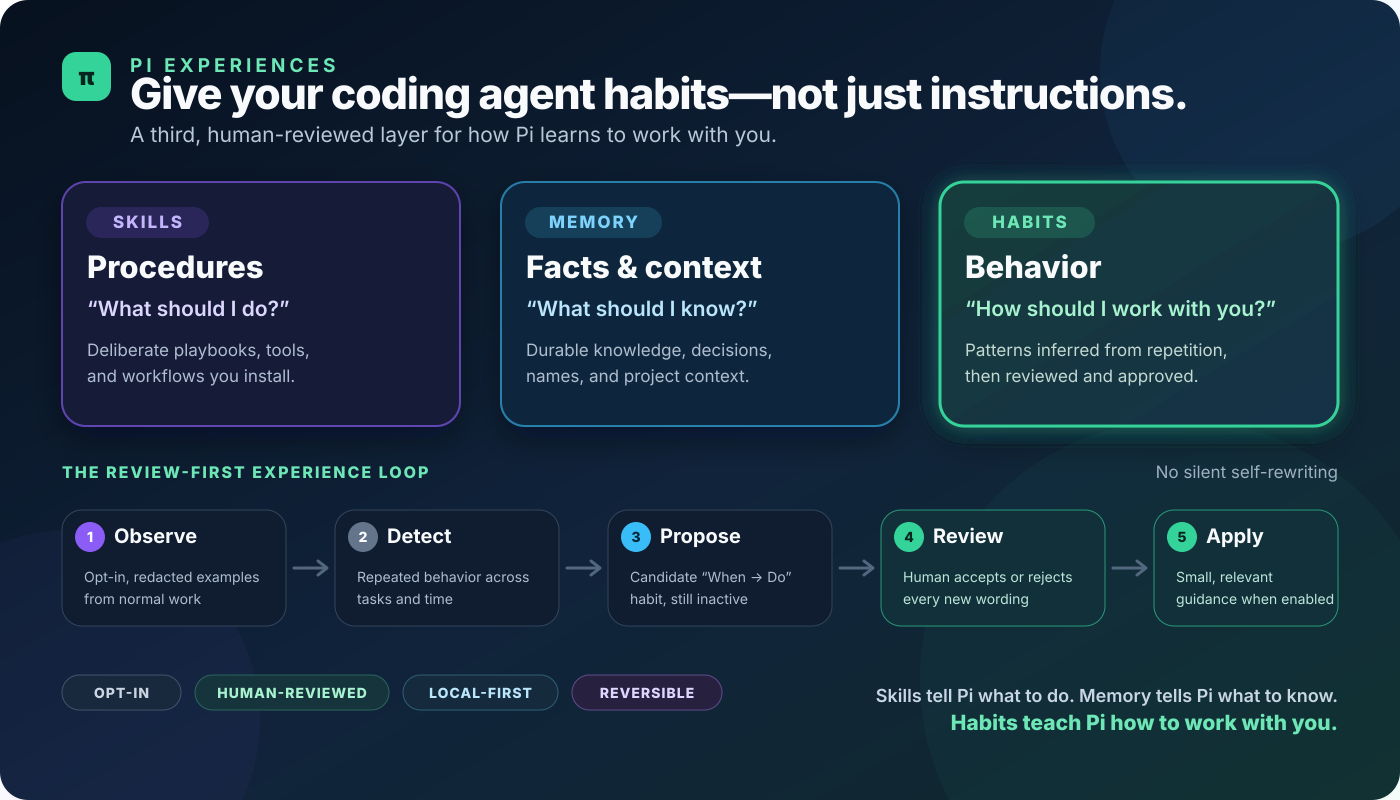
  "image": "https://raw.githubusercontent.com/misunders2d/pi-experiences/v0.1.49/docs/images/pi-experiences-habits.png",
  "skills": [
    "./skills"
  ],
  "extensions": [
    "./extensions"
  ]
}
Security note
Pi packages can execute code and influence agent behavior. Review the source before installing third-party packages.
README
Pi Experiences — habits for a coding agent that learns how you work
Give your Pi coding agent a third kind of long-term improvement: human-reviewed habits.
Agent skills teach procedures. Agent memory preserves facts and context. Experience helps Pi learn how you prefer to work—from direct conversation or repeated interaction, through explicit review, without silently rewriting itself.
pi-experiences is a local-first Pi extension and skill for persistent behavioral learning and coding-agent personalization. Tell Pi a habit directly and confirm its exact wording, or ask Analyze to turn repeated patterns into candidate habits. Nothing becomes active without your explicit approval.
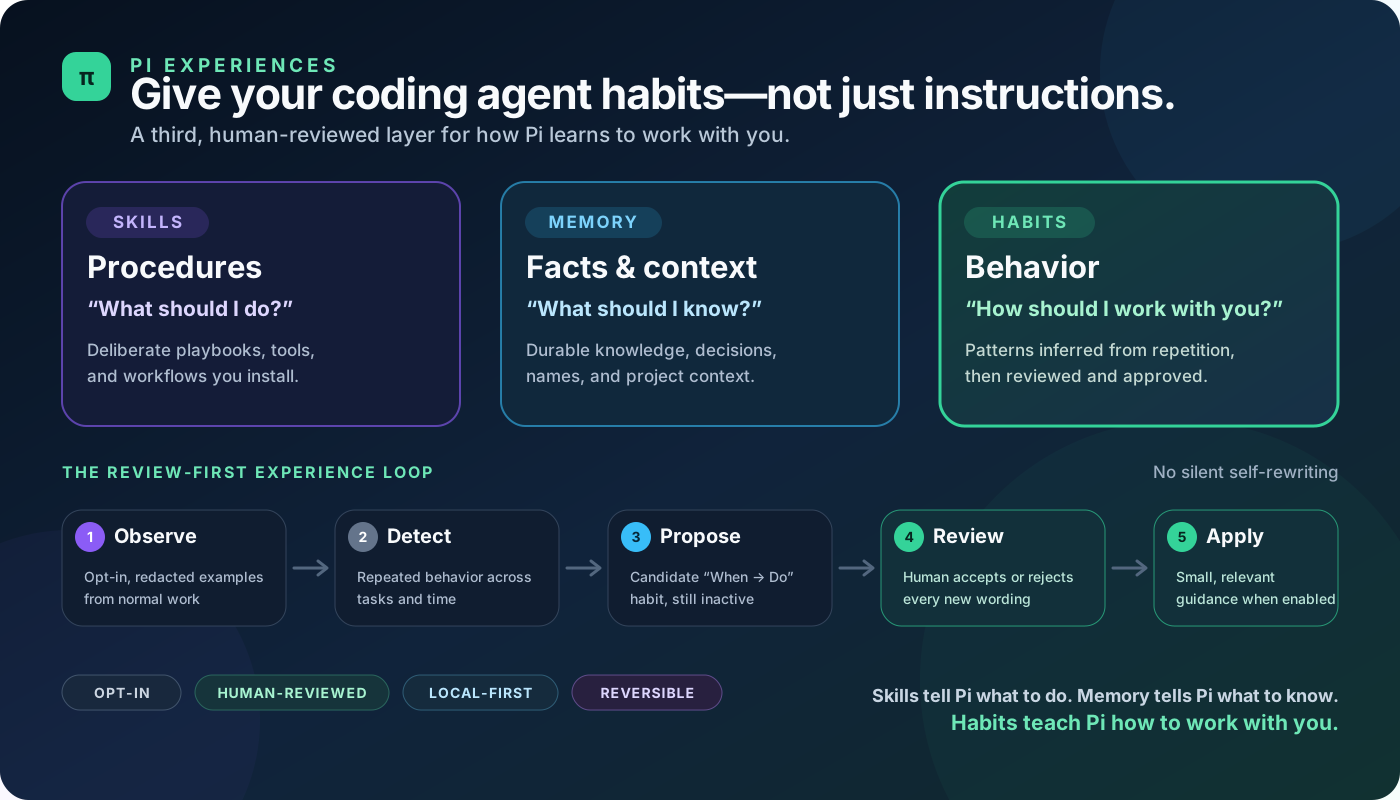
Skills tell Pi what to do. Memory tells Pi what to know. Habits teach Pi how to work with you.
The missing layer in AI agent improvement
Most AI agent improvement falls into two buckets:
- add more instructions;
- remember more context.
Both matter. Neither captures the small behavioral corrections that make collaboration improve over time: ask before guessing, show evidence before claiming success, lead with rollback for risky changes, or report status in the format a person actually uses.
Humans call those patterns habits. Pi Experiences gives them their own reviewed lifecycle instead of hiding them inside prompts or mixing them with facts.
| Layer | The question it answers | How it gets there | Example |
|---|---|---|---|
| Agent skill | “What procedure can I follow?” | Deliberately written or installed | “Use this release checklist.” |
| Agent memory | “What should I remember?” | Explicitly saved as durable knowledge | “This repository publishes from main.” |
| Experience habit | “How should I tend to behave?” | Declared directly or inferred from repetition, then reviewed by you | “Verify the packed artifact before calling a release ready.” |
This is the third layer: not more commands, not another fact store, but human-in-the-loop behavioral learning.
Why not put every preference in profile.md?
A profile file looks simple: keep appending facts, preferences, corrections, and behavioral rules, then load it for the agent. That works while the file is tiny. As an adaptive habit system, it breaks down.
For the model to react to a potentially relevant profile rule, the profile generally has to be placed in context before the model knows whether that rule matters. As the file grows, every turn pays for unrelated text—in tokens, attention, latency, and opportunities for stale instructions to collide.
A growing profile.md |
Pi Experiences |
|---|---|
| Mixes identity, facts, preferences, rules, and behavior in one document | Keeps habits as separate structured, reviewable records |
| Usually loads the whole profile so the model can discover what is relevant | Selects only a small set of relevant, approved habits when reminders are enabled |
| Accumulates permanent context and token cost | Keeps raw history out of the reply path and injects bounded guidance |
| Makes stale or contradictory lines hard to trace | Preserves evidence, freshness, state, and review audit per habit |
| Is awkward to disable one behavior without editing the document | Lets you disable, re-enable, archive, or recheck one habit |
| Depends on manual upkeep | Detects repeated patterns, then asks before activating anything |
Concrete example: suppose you correct Pi three times: “Do not call a release complete until you test the packed install.” In a growing profile, that sentence is carried into unrelated conversations about CSS, SQL, or documentation because the model must see it before deciding it is irrelevant. In Experience, it becomes one reviewed release habit. When reminders are enabled, the selector can surface that small habit for release work without loading the raw history or every other habit.
A short profile.md can still be useful for stable, deliberately declared identity or preferences. It is the wrong shape for an ever-growing behavioral learning system. Profiles describe the person; experience manages reviewed habits.
Real-life habits Pi can learn
A good habit generalizes across projects and tasks. It changes how the agent works, not what facts it knows.
| When this keeps happening… | Pi can suggest a habit like… |
|---|---|
| Release claims arrive too early | “Before calling a release ready, verify the actual packed and installed artifact.” |
| Ambiguous requests trigger guesses | “When missing input changes correctness, ask one crisp question before proceeding.” |
| Risky changes bury the escape route | “For migrations or destructive changes, explain rollback before implementation.” |
| Progress updates are vague | “Report status as done or blocked, include evidence, then state the next action.” |
| Logs contain more private data than needed | “When handling sensitive material, minimize raw detail and prefer a safe summary.” |
| Confident language outruns evidence | “Before making a technical claim, cite a file, test, command result, or explicit uncertainty.” |
These are not one-off macros. They are reusable behavioral tendencies that can make a coding agent feel less reset between sessions—while keeping the human in charge.
How the review-first learning loop works
Pi Experiences is a controlled answer to the self-improving-agent problem: let behavior improve, but make every change visible and reversible.
There are two reviewed entry paths:
- Declare a habit naturally: discuss a pattern with Pi, let Pi show the exact
When:/Do:wording, then say yes or correct it. Only a later, explicit confirmation saves that exact draft. A declared habit does not need repetition evidence, but current safety law, conflicts, local duplicate checks, stale-state protection, and audit still apply. - Learn from repetition: opt into local examples and manually run Analyze. The repeated-pattern loop remains:
- Observe — after you opt in, Pi stores bounded, heuristically redacted examples from normal work.
- Detect — when you manually start Analyze, Pi snapshots the examples waiting at that moment and your selected Pi model/provider examines them through sequential bounded batches for repeated behavior.
- Propose — possible habits appear as inactive “When → Do” suggestions.
- Review — you approve or reject every new or materially reworded habit.
- Apply — only approved, active habits can provide small relevant guidance, and only after you enable reminders.
- Control — inspect, disable, re-enable, archive, or recheck approved habits from the same setup panel.
Direct instructions and configured safety law always override habits. Duplicate detection, habit reminders, capture, and Analyze each have separate controls.
What belongs in experience—and what does not
Good experience habits are repeated behavioral preferences: caution, timing, tone, evidence standards, clarification style, review discipline, privacy posture, or tool-selection tendencies.
Keep these elsewhere:
- Skills: deliberate procedures, playbooks, scripts, and reusable domain workflows.
- Memory: facts, names, decisions, project context, and durable knowledge.
- Project instructions: explicit repository rules that should apply immediately.
- Never a habit: credentials, secrets, one-off commands, narrow task labels, or attempts to override safety policy.
Experience does not autonomously rewrite Pi, approve itself, or turn every correction into permanent behavior.
Safety model
Human review is the feature, not fine print.
- Everything starts off.
- Installation does not capture conversations, download a model, run Analyze, activate habits, install timers, or inject reminders.
- Every new or materially reworded habit requires explicit approval.
- Exact normalized evidence may strengthen an unchanged approved habit without changing its meaning.
- Strong exact contradictory evidence may make one uniquely matched old habit dormant, but replacement wording remains an inactive proposal.
- Direct instructions and configured law override habits.
- No automatic approval, semantic merge, replacement activation, law modification, or scheduling occurs.
- Missing, corrupt, stale, or incompatible state fails closed.
You can work naturally in chat—“Do you see this pattern?”, “Draft it as a habit,” then confirm the exact wording—or open the complete control panel:
/experience setup
The panel remains sufficient for every setting and review action. Conversational review uses numbered plain-language items. Normal users never need IDs, checksums, thresholds, endpoints, model servers, or advanced subcommands.
Natural-language setup and habit management
You can set up and manage Pi Experiences by talking to Pi in ordinary language. Ask Pi to explain the setup choices, draft a habit, show habits that need review, approve or reject a numbered suggestion, resolve a possible duplicate, or disable, re-enable, or remove an approved habit. Pi keeps internal identifiers hidden, asks for clarification or confirmation when the intended action matters, and preserves the same safety, stale-state, and audit checks used by the control panel.
Examples:
- “Help me set up Experience.”
- “Turn this pattern into a habit.”
- “Show me the habits waiting for review.”
- “Disable the habit about release status.”
- “Remove the cobalt habit.”
- “Turn approved-habit reminders off.”
If a conversational action is unavailable or ambiguous, Pi should open or direct you to /experience setup instead of guessing. The setup panel remains the complete fallback for every setting and management action.
Install
Stable npm installation:
pi install npm:pi-experiences
Update npm-installed Pi packages:
pi update --extensions
Pinned GitHub installation:
pi install git:github.com/misunders2d/pi-experiences@v0.1.31
Git refs remain pinned; they do not float to newer tags.
Requirements:
- Node.js
>=22.19.0 - a compatible Pi installation
Pi extensions execute with your user permissions. Review third-party package source before installation.
See CHANGELOG.md for verified user-facing release changes.
Normal workflow
Record a habit in conversation
- Tell Pi the pattern you want it to remember.
- Pi discusses it and shows exact
When:/Do:wording. - Say yes to that exact wording, or correct it and review the new draft.
- Pi saves only after a clear confirmation in a later message. It reports whether the habit is active or waiting on safety, conflict, or duplicate review.
You can also ask Pi to show habit suggestions or possible duplicates, discuss numbered items, then say things such as “approve 1,” “reject 2,” or “those are different—keep 3 separate.” Internal identifiers stay hidden.
Learn a habit from repetition
- Install the package and run
/experience setup. - Turn on Save chat examples locally.
- Use Pi normally until a behavioral pattern repeats.
- Select Choose model for habit learning.
- Choose Analyze all waiting examples now when you are ready, or run
/experience analyzedirectly. - Review suggestions conversationally or from Review suggested habits, then explicitly approve or reject each proposal.
- Use Review approved habits to inspect, disable, re-enable, archive, or recheck a waiting approval.
- Optionally prepare Prevent duplicate habits.
- Optionally select Choose model for habit assessment to choose which authenticated Pi model checks whether approved habits apply to a request.
- Optionally enable Use approved habits before replies.
The setup panel remains the complete fallback/control panel. It also contains duplicate resolution, 7/14/30-day source-example retention, current settings, plain-language help, all-off, and explicit local schedule management.
Analyze runs as a bounded nonblocking job. Suggestions remain inert until approval. On Linux with a systemd user manager, setup can optionally install a package-owned daily Analyze timer after showing the exact paths/model and receiving a separate confirmation. The default is still off.
Review and activation
An Analyze-generated suggestion currently needs repeated evidence: at least three cited observations across at least two days. A directly declared habit bypasses only that repetition threshold after you confirm its exact wording; it does not bypass safety law, conflicts, local duplicate checking, stale-state checks, or audit.
Approval and activation are separate when a requirement is temporarily unmet. An approved candidate can remain visibly waiting for enough evidence, current safety-law approval, conflict resolution, or local duplicate checking.
Analyze automatically rechecks approved waiting candidates after a validated commit. The same recheck is available under Review approved habits. Prior approval applies only while normalized condition, behavior, and polarity remain unchanged; material wording changes require approval again.
Potential duplicates are never silently merged. Resolve duplicate habits shows both complete wordings, states exactly which habit each outcome keeps or hides, and confirms merge, replacement, and archive choices before changing anything.
See when a habit steers an answer
Approved-habit reminders never steer invisibly. There is no daily quota: every genuinely matching eligible message may receive approved habit guidance. When one or more approved habits actually enter the model context for one specific answer, Pi places a muted marker between the triggering prompt and that answer. Every collapsed line identifies the exact selected condition instead of showing a generic enabled state or opaque count:
◇ Steered by habit · When I ask for cobalt status
If several habits genuinely apply, each selected condition gets its own line. Expand the marker to see every exact approved When: / Do: pair applied to that response. No marker means that response received no habit guidance.
The marker is a local Pi session entry, not an LLM message, so it does not itself influence the answer. The matching habit is delivered separately as a transient system-level instruction for that response—never as user-authored text and never as a saved conversation message. For traceability, the session entry retains only the selected approved wording, count, and time—never the raw prompt, IDs, checksums, confidence scores, provider/model details, source references, raw examples, private paths, or audit payloads. Approved-habit reminders are enabled only in the Pi TUI where this response-specific marker is guaranteed visible; other interfaces, unsupported provider APIs, and malformed provider payloads fail closed rather than steering without provenance.
Local duplicate prevention
Duplicate prevention is optional and off by default.
- Preparing it from
/experience setupdownloads about 150 MB once. - It compares each habit's situation and action separately on this computer and works offline after preparation.
- Both parts must align before a possible duplicate is shown, reducing topical false matches.
- Normal maintenance compares approved habits; suggestions are checked against approved habits when proposed or activated, not globally against one another.
- The managed semantic model supports 50+ languages, including comparisons between languages.
- It needs no account, API key, Python, external app, or model server.
- Setup can remove the downloaded files.
- A failed download, cancellation, corruption, or unavailable local check changes no habits.
The local duplicate model receives habit wording only—not raw chat examples, source references, evidence summaries, file paths, credentials, or tokens.
Privacy in plain language
Capture is opt-in. Captured conversation pairs are stored under your private local state root and heuristically redacted before storage. Redaction reduces exposure but cannot guarantee recognition of every sensitive value.
When you manually start Analyze from setup or /experience analyze, Pi snapshots the redacted examples waiting at that moment and processes the fixed queue through sequential bounded calls to the model/provider you selected for habit learning. Each call remains bounded; examples captured after the snapshot wait for the next run. That provider's data handling still applies. Analyze creates suggestions, never approvals.
When an approved habit later steers a TUI answer, its approved When: / Do: wording is retained in that local Pi session as the visible provenance marker. The marker contains no raw prompt or source example and never enters LLM context.
Fully analyzed source text expires after seven days by default; setup also offers 14 or 30 days. Minimized evidence and audit history remain so reviewed habits can still be explained. Backups exclude raw observation text and downloaded duplicate-model files.
Frequently asked questions
Is this another agent-memory extension?
No. Agent memory answers “what should the agent remember?” Pi Experiences answers “how should the agent tend to work with me?” Facts belong in memory; reviewed behavioral patterns belong in experience.
Is a habit the same as an agent skill?
No. A skill is an intentionally authored capability or procedure. A habit is directly declared or inferred from repeated interaction, requires explicit review, and captures a behavioral tendency rather than a full workflow.
Does Pi Experiences autonomously modify the agent?
No. It proposes habits. You approve or reject them. New wording cannot activate silently, and approved habits remain subordinate to direct instructions and configured law.
Is everything local?
Storage, review state, default reminder matching, and the optional multilingual duplicate check are local. Analyze uses the Pi model/provider you explicitly select, so bounded redacted examples may be processed by that provider when you start Analyze.
Can I undo a habit?
Yes. Approved habits can be inspected, disabled, re-enabled, or archive-hidden without deleting their audit history.
Give Pi experience
Install pi-experiences, then discuss and confirm a habit naturally—or open the complete control panel:
/experience setup
Teach procedures with skills. Preserve facts with memory. Let reviewed habits improve the way Pi works with you.
This section is intentionally collapsed. Preserve both this technical contract and the plain-language normal-user explanation above when editing the README.
Package contract
package.jsonincludes thepi-packagekeyword.pi.extensionspoints at./extensions;pi.skillspoints at./skills.pi.imagepoints at the maintained 1400×800 PNG gallery preview; both PNG and editable accessible SVG sources ship underdocs/images/.- Pi core packages remain wildcard peer dependencies and are not bundled as a second runtime.
- The package is TypeScript-source-first for Pi's extension loader; the public consolidation CLI is generated into
dist/. - Node engine:
>=22.19.0. - Installation has no
install,postinstall, orpreparehook and never downloads model assets.
Hard invariants
- Natural conversation and
/experience setupare complementary normal-user surfaces; setup remains the complete control panel/fallback. - Every new or materially reworded habit requires explicit human approval.
- Exact normalized evidence may update support for an unchanged approved identity without rewriting it.
- Strong exact contradictory evidence may suppress one uniquely matched old habit, but replacement wording remains a proposal.
- Never auto-approve, auto-merge, auto-activate replacement wording, modify law, or install/enable timers without the human selecting and confirming the exact setup action.
- Direct instructions and configured law override habits.
- Selector candidates are active, fresh, same-user approved habits only.
- Never inject from candidate, disabled, dormant, suppressed, archived, evidence, quarantine, report, or observation rows.
- Selector hit logs never persist raw prompts, sessions, or injected guidance;
prompt_hashremainsomitted. A separate TUI-only provenance entry retains selected approved wording solely so the user can trace a steered answer. - Missing, corrupt, stale, incompatible, or future-version state fails closed.
- The selector hot path must not initialize storage or run migrations.
Why profile.md is not the habit store
A profile document is appropriate for small, stable, deliberately declared identity/context. It is not the selector database.
- Habit state remains normalized and individually addressable in SQLite rather than appended to a monolithic prompt file.
- Evidence, approval identity, status, freshness, conflicts, provenance, and audit remain attached to each habit.
- The reply path considers only active, fresh, same-user approved habits and injects bounded relevant guidance when reminders are enabled.
- Candidate, disabled, dormant, suppressed, archived, evidence, quarantine, report, and raw observation rows never enter selector candidates.
- Raw history is not loaded merely so the model can decide whether one behavioral preference applies.
- Disabling or archiving one habit changes that record without rewriting an unrelated profile.
Implementation wins: bounded context instead of profile growth; per-habit approval and rollback; evidence/provenance; same-user and freshness gates; auditable conflict/duplicate handling; raw history excluded from normal reply selection.
Caveats: local vector similarity retrieves possibly relevant conditions but does not prove present applicability, so one bounded configured-model judge must independently accept each retrieved condition; no reminder is injected when vector readiness, judge confidence, freshness, status, law, or scope gates fail; disabled reminders mean no habit injection; structured lifecycle control adds SQLite and migration complexity, so unavailable or inconsistent state fails closed.
Do not market an ever-growing profile.md as equivalent to Experience. The architectural distinction is contextual selection and lifecycle control, not merely a different file format.
Conversational declaration and review contract
- Conversational tools keep one short-lived draft and one numbered review snapshot per user/session in bounded process memory. They store no raw conversation or confirmation utterance.
- Drafting changes no durable state. Saving requires
confirmed=trueafter a later user input turn; correcting wording replaces the prior draft. - Direct declaration bypasses only the repeated-observation threshold. Law, conflicts, local semantic duplicate checks, same-user scope, stale snapshots, audit, and fail-closed behavior remain mandatory.
- Semantic preparation occurs before the SQLite writer transaction. If it is unavailable, no candidate, relation, or approval row is created.
- A clean declaration creates the candidate and activates it inside one
BEGIN IMMEDIATEtransaction. A possible duplicate creates an inactive candidate and pending relation in that same transaction; it never merges automatically. - Review lists expose numbered
When:/Do:summaries and supported outcomes only. IDs, checksums, scores, thresholds, providers, source references, raw examples, paths, and audit payloads remain process-internal. - Review mutation resolves a number through the current hidden snapshot, revalidates relation/habit checksums inside product transactions, and invalidates stale snapshots. Merge, supersede, archive, approve, reject, and keep-separate remain explicit user decisions.
- Drafts and snapshots expire after 15 minutes and disappear on restart; the user then drafts or lists again.
Local embedding contract
- Model:
Xenova/paraphrase-multilingual-MiniLM-L12-v2at immutable revision2c4055b12046f11709e9df2c122e59ffbdc2f900, Apache-2.0. - Runtime: extension-managed INT8 ONNX inference through pinned
onnxruntime-weband tokenizer dependencies; no hosted provider or fallback. - Dimensions: 384. Effective similarity is the lower of separate condition and behavior cosine scores. Review threshold: 5,500 basis points. Strong threshold: 7,000 basis points. Matching is same-polarity only.
- Managed asset bytes: 148,618,669 before package/runtime overhead. User-facing copy rounds this to about 150 MB.
- Condition and behavior are normalized and embedded as two independent inputs. Raw examples, source references, summaries, residual JSON, paths, checksums, audit text, credentials, and tokens are excluded.
- Cache input versions and relation scoring methods are independent. Legacy whole-habit cache rows remain only to prove unchanged historical keep-separate decisions; missing or corrupt proof fails closed to re-review.
- Assets use private 0700 directories and 0600 files and are version, size, and SHA-256 checked before use.
- Complete interrupted generations may recover offline; corrupt, partial, symlinked, obsolete, or abandoned generations are rejected or removed only under the owned model lock.
- Inference runs in a bounded worker. Duplicate scans unload it after 30 seconds idle or explicit completion; reply-time selection may reuse it for up to 300 seconds and closes it on session shutdown or state-root replacement.
- Reply-time selector cache rows use a separate versioned condition-only input and stable normalized-condition identity. Prompt embeddings are ephemeral and are never written to SQLite, logs, markers, config, or session context.
- Explicit scans cap at 100 current habits / 4,950 pairs, embed each selected condition and behavior once, support cancellation, revalidate all habit/relation state they may change, and commit atomically.
- Normal scans compare active/disabled approved habits only. Candidate targets are checked against approved habits at proposal/activation; candidate-to-candidate semantic routing is excluded.
Duplicate-resolution contract
- Comparison and mutation share
planHabitDuplicateResolution; displayed survivor/archive roles must match committed roles. - Merge protects an active/disabled approved habit from being replaced by a candidate merely because the candidate is older.
- Supersede keeps the newer wording and synchronously rechecks current law and conflicts inside the writer transaction.
- Merge, supersede, and archive require a Back-first confirmation; keep-separate records a reason without archiving either habit.
- The pending relation checksum and both displayed habit checksums are revalidated inside
BEGIN IMMEDIATEbefore mutation. - A stale relation, changed habit, changed law, conflict, cancellation, or error rolls back without partial mutation.
- User-started scans dismiss and audit obsolete pending scoring-method relations. A hidden candidate returns to normal or approved-waiting review only after every pending relation involving it is resolved.
- Unchanged keep-separate decisions survive scoring/cache method upgrades; materially changed wording returns the pair to human review.
- Internal IDs, checksums, similarity scores, thresholds, model metadata, and backend details stay out of normal UI.
Bounded observations and privacy retention
Captured conversation pairs are heuristically redacted and bounded. Redaction reduces exposure; it is not a formal guarantee that every sensitive value can be recognized. Capture reads only assistant messages from each run's agent_end (the initial run also carries the triggering prompt; retry/continuation runs do not), so tool-heavy runs whose final message is tool-only are no longer dropped. Because Pi emits several agent_end events for one settled prompt across its retry boundary, persistence is deferred to the settle boundary and keeps the last non-empty run's answer. A run that terminates in error, aborted, or truncation is dropped in full (its earlier same-run text included), so partial, error, or truncated output is never saved, and an exhausted sequence of failed runs captures nothing; next-input and session-shutdown remain backstops. Oversized runs keep the tail (where corrections and conclusions live) with a truncation marker.
Observation storage uses:
- an append-only JSONL generation;
- a checksummed tail manifest;
- a fixed-width offset index;
- token-owned single-writer locking.
Append validates only bounded tail state rather than parsing all history. Manual Analyze snapshots the same-user unread queue waiting at action start, then seeks through that fixed queue using sequential calls bounded by default to at most 200 records and 80,000 bytes each. Examples appended afterward wait for the next run. Each batch advances the read watermark only in its successful reducer transaction, so earlier committed progress remains valid if a later batch fails. Compact structured habit/candidate context is rebuilt between committed batches, preserving cross-batch learning without resending committed raw observations. Scheduled Analyze remains one bounded batch per scheduled run. The Analyze model prompt performs friction-weighted causal extraction — locating friction across likely-related observation turns (adjacency is a bounded heuristic the model is instructed to corroborate before attributing pushback, not a pipeline-enforced guarantee, since concurrent sessions can interleave into one stream and pairs can be dropped), inferring the improvement direction, and formulating a generalized When/Do habit — rather than clustering superficially similar wording; friction-derived candidates outrank friction-free positive preferences.
After a generation is fully analyzed, source text rotates through a recovery journal. Rotated redacted source text expires after:
- 7 days by default (recommended/privacy-first);
- optionally 14 or 30 days from
/experience setup.
Deletion preserves minimized evidence, provenance, checksums, and review audit. Raw source text is never retained merely to compensate for missing incremental state.
Private state
Default root:
~/.agents/experience/
Representative contents:
agent-experience.toml       # private user controls
ledger.sqlite               # habits, evidence, review/audit, vectors, watermarks
observations.jsonl          # current bounded redacted source generation
observations.idx            # fixed-width end-offset index
observations-tail.json      # checksummed current-generation authority
archive/observations/       # journaled short-retention rotated generations
models/local-embedding/     # optional managed local duplicate-check assets
law.md                      # explicitly created/configured private safety law
habits-report.md            # report-only output; never selector input
One state root represents one human across local agents/harnesses. Shared multi-human roots are outside v1 scope.
SQLite safety, backup, and restore
Storage schema remains v6 for rollback compatibility with the corrective release.
- Existing databases read
PRAGMA user_versionbefore WAL or any writeful operation. - A future schema fails closed and is not downgraded or modified.
- Supported v5→v6 migration is transactional and idempotent.
- Current-schema opens verify required tables/indexes rather than silently reconstructing malformed state.
Backups use Node's SQLite online backup API to create a standalone consistent ledger.sqlite. New backups intentionally exclude WAL/SHM, raw observation text, archives, model assets, config, and law so backup cannot bypass source-retention policy.
Restore prevalidates allowlisted artifacts, paths, symlinks, sizes, hashes, schema, and PRAGMA integrity_check. A checksummed restore journal provides recoverable old-or-new transitions, removes stale sidecars, and starts a fresh observation generation after a storage-v2 restore.
Locks and concurrency
Maintenance, observation, model-installation, Analyze, and consolidation operations use token-owned locks with PID, hostname, and creation time.
- acquisition is atomic;
- live owners block concurrent writers;
- expired, dead-owner, and aged malformed locks can be reclaimed safely;
- foreign-host ownership fails closed;
- release removes only the caller's token;
- ownership mismatch preserves the replacement lock.
Habit declaration, approval, re-enable, and promotion prepare local vectors outside the SQLite writer transaction, then use one BEGIN IMMEDIATE transaction to revalidate target/comparator/relation/law state and either block or activate. Concurrent duplicate activations therefore cannot both succeed.
Approved-habit reminders
Reminder injection is off by default. Choose model for habit assessment in /experience setup selects the authenticated Pi model used for the bounded applicability check; changing that model does not turn reminders on or off. Enabling reminders separately first discloses and verifies two mandatory stages: private local multilingual vector retrieval and one bounded configured-model applicability call per eligible request. Setup prepares pinned local assets and the approved-condition vectors used for retrieval before writing the ON setting: the current-law reply-time top 100 is guaranteed, plus a best-effort law-agnostic fill up to 500 as a buffer for law changes. A future law can still expose eligible habits beyond that buffer; the runtime then fails closed (no injection) for the uncovered request until setup or maintenance re-prepares vectors — safe degradation, not silent wrongness. Package installation and updates never download those assets or enable reminders.
Every enabled selection embeds the current request locally and ephemerally, validates the cached condition vectors for the eligible candidates it considers, and retrieves a bounded condition-only candidate set by cosine similarity. Reply-time retrieval considers the deterministic top 100 eligible same-user law-valid habits (confidence descending, then id); habits beyond that cap are excluded deterministically rather than failing closed, so a growing habit collection no longer permanently disables steering. For follow-ups such as “yes, do that,” it may also use at most four prior visible user/assistant messages (300 redacted characters each, 1,200 total) from the current active branch. Contextual retrieval uses a separate compact current-first, newest-context-first query within a 120-byte local embedding budget; the full bounded context still reaches the judge. Current-only and compact-context queries normally share one local batch, current-only candidates keep priority, and context can only add candidates. If the optional contextual embedding fails, the selector retries the strict current-only embedding exactly once unless canceled; the judge remains mandatory after recovery. Behavior text cannot make a habit applicable.
The schema-v3 judge receives a bounded redacted current-request summary, the bounded role-tagged context, and retrieved condition text labeled with deterministic short process-local aliases—never behavior, original habit IDs, similarity, habit confidence/staleness, rationale, unretrieved habits, source evidence, paths, or audit data. The judge must copy every supplied alias exactly and cover every candidate once; accepted aliases are mapped back to original IDs before revalidation, guidance, results, or audit handling. Unknown, missing, duplicate, rewritten, or original-ID output fails closed. Judgments are isolated per candidate: a structurally valid judgment whose confidence is below the configured threshold is simply not selected (or accepted as a valid rejection) rather than discarding the whole batch, so one ambiguous candidate can no longer veto confident matches; only structural problems—bad ids/keys/reason, applicable/reason inconsistency, non-integer or out-of-range confidence, incomplete coverage, or too many selections—still fail closed. The current user message remains the sole causal trigger: prior user or assistant text may resolve an explicit reference, confirmation, continuation, modification, or rejection, but cannot independently activate a habit. The judge must reject context-only applicability, mere mentions, quotations, negation, generic shared wording, and conditions mentioned only as possible later triggers. A request made now about a future-dated subject remains current applicability when its request type matches the condition; for example, planning next summer is current planning, while discussing whether one might ask for planning later is hypothetical/future intent. It also rejects low confidence and ambiguity. There is no lexical-only or vector-only guidance path. Missing/corrupt vectors or assets, auth failure, timeout, cancellation, malformed/partial output, state drift, or uncertainty produces no guidance.
Extracted context, process-local candidate aliases and their original-ID map, vectors, hashes, similarities, rationale, and transient guidance are never persisted. Redaction is heuristic: strict message/character caps minimize exposure, but ordinary personal prose not matching a recognized secret/PII pattern may still reach the configured assessment provider. Invalid or sensitive context is dropped and the current-only path remains available. This is a code-only protocol change with no persisted schema-v3 state; rollback is a normal code revert.
After judgment, selected habit rows are re-read in one query and must retain the same user, active approval state, checksum, law hash, confidence/freshness eligibility, and condition identity. Post-activation maintenance prepares new condition vectors when possible without rolling back an approved habit; failure leaves habit state valid while reply-time steering fails closed until setup repair. Pending, disabled, dormant, suppressed, archived, evidence, quarantine, report, and raw observation rows are excluded.
before_agent_start only synchronously arms response-specific transient state, allowing Pi to persist and render the triggering user message immediately. Local embedding and bounded applicability assessment run once at the first provider-context boundary, after that user message is visible. Selection changes no conversation messages. Immediately before the response provider request, the extension strictly validates the current known Pi provider payload and prepares an immutable copy with the habit guidance in that provider's system-instruction field. Only after preparation succeeds does it append one durable agent_experience.habit_steering entry; only a successful append authorizes returning the modified provider payload. Tool-loop calls and retries reuse the same result without another assessment or marker, while an idempotent sentinel prevents duplicate system blocks; a new user message cannot inherit it. Collapsed rendering identifies every selected condition; expanded rendering shows exact selected condition/behavior wording. The durable marker does not participate in LLM context. The transient guidance is a provider system instruction for this response and is never saved as an LLM conversation message. Entry construction/renderer/append failure, malformed or sensitive wording, non-TUI modes, unknown provider APIs, and known-provider shape drift suppress guidance with a static sanitized diagnostic.
Selector hit logs never persist prompt/context text, prompt hashes/derivatives, vectors, similarities, judge confidence/reasons, sessions, raw errors, or injected guidance; prompt_hash is deliberately the fixed sentinel omitted. Logs retain only bounded selected/skipped metadata plus static sanitized failure reason, stage, mode, model, and retrieval-mode diagnostics. The response-adjacent durable marker is authoritative proof that guidance reached that response and stores selected approved wording only.
Optional local scheduled Analyze
The package never installs a timer during npm/Pi installation. From /experience setup, a human may explicitly install and enable a local systemd user timer with these fixed semantics:
- daily at 03:30 in the computer's system-local timezone;
Persistent=true, so a sleeping/offline laptop catches up once after returning;- the unit pins the exact host Pi runtime path needed by the standalone process; moving/updating Pi makes setup show repair before re-enabling;
- no host-runtime import, model authentication, or model call when no unread saved examples exist;
- the same bounded observation validation, Analyze lock, consolidation lock, watermark, suggestion, duplicate, and law gates as manual Analyze;
- suggestions only—never automatic approval, merge, activation, law mutation, or conversation interruption;
- a bounded private sanitized receipt queue, summarized once as a durable TUI-only transcript entry in an open private Pi session or the next eligible TUI session; the entry never enters model context;
- no Hub, remote scheduler, desktop notification, postinstall hook, or package-update activation.
Setup can inspect, repair/rewrite, disable, or remove the package-owned user units. Because the rendered service pins absolute Node and package CLI paths, rerun setup after a Node/package-path change if status reports that the schedule needs repair. For local diagnostics, use journalctl --user -u pi-experiences-agent-experience-analyze.service; journal output contains only sanitized status codes.
Optional break-in review prompts
/experience setup can explicitly enable private TUI break-in prompts. Default is off. After a manual Analyze action creates new suggestions, the prompt waits until Pi is idle; scheduled results are detected during an open private TUI session or at the next eligible private TUI start. Each manual Analyze action or scheduled batch prompts at most once with exactly Review now, Later, or Turn break-in off.
Break-in is review-only. It makes no extra model call and never approves, rejects, merges, activates, or applies a habit. Review now only opens the existing review UI, where every decision still requires human action. Later ends that action/result reminder while leaving suggestions in Review. Missing session scope, UI, idle state, readable review state, or safe lifecycle suppresses/defer the prompt. Tool execution, compaction, streaming, queued messages, headless modes, and session shutdown cannot open it. Only bounded sanitized metadata is retained; no suggestion text, source references, prompts, model output, credentials, or private paths enter the break-in queue.
Law-check caveat
The current law checker is deterministic v1: it verifies configured-law freshness/integrity and blocks a small denylist of dangerous habit text patterns. It does not semantically compare every habit against the full law text. Future semantic contradiction checks must route to pending human review, not direct activation.
Configuration
Normal configuration belongs in /experience setup. A minimal technical example:
enabled = true
capture_enabled = true
consolidation_enabled = true
embedding_enabled = false
selector_enabled = false
selector_model = "openai-codex/gpt-5.4-mini"
selector_timeout_ms = 20000
selector_min_confidence_bp = 7500
selector_max_habits = 3
selector_staleness_max = 0.8
observation_retention_days = 7
analyze_batch_max_records = 200
analyze_batch_max_bytes = 80000
law_path = "law.md"
timer_enabled = false
break_in_enabled = false
Legacy hosted-embedding fields are ignored and removed on the next config write. Legacy selector_mode and selector_min_overlap_score remain readable for compatibility but are ignored and omitted on rewrite; all enabled steering uses vectors plus the bounded judge. No hosted embedding environment variables are supported.
Override the private root when isolating a test:
AX_STATE_ROOT=/path/to/private/state pi
Development and validation
From the package root:
npm run check
npm audit --omit=dev
npm pack --dry-run
npm run check covers prior behavior plus:
- future-schema and v5 migration regressions;
- online backup/journaled restore adversarial tests;
- bounded observation append/Analyze/rotation/retention;
- real optional local-model integration when fixture paths are supplied;
- semantic two-connection barriers and atomic scan failure/cancellation;
- separate-field multilingual precision fixtures, approved-only scans, obsolete-method reconciliation, multi-relation candidate restoration, and keep-separate continuity;
- stale lock recovery;
- source/import bundling;
- mandatory vector retrieval plus strict judge schema, confirmed false-positive, true-positive, multilingual, missing/corrupt-cache, cancellation, timeout, drift, and prompt-non-persistence regressions;
- prompt/protocol-layer judge missteering regressions (faithful-judge simulation): the automated suite drives the real retrieval/prompt/parser pipeline but does not assert model-level judge precision, which is kept outside release claims and validated out-of-band with a real configured model;
- deferred-settle capture lifecycle across Pi's automatic retry boundary (initial-run shape with the triggering prompt, retryable-error continuation, clean single run, and shutdown-before-settled);
- CLI generation drift.
The real local-model integration command used by maintainers is documented in extensions/agent-experience/VALIDATION.md and requires already downloaded pinned fixtures; it makes inference offline.
Before release, validate the exact npm pack tarball in a fresh --ignore-scripts installation and run an isolated real Pi TUI with a temporary AX_STATE_ROOT. Source-path smoke alone is insufficient.
Release discipline
For a release:
- update
CHANGELOG.mdfirst with verified user-facing changes; - update source, tests, docs, and generated CLI together;
- run complete automated and packed-installed validation;
- obtain independent code/privacy/constitution review for significant changes;
- bump version and move the verified changelog entry from Unreleased to that version;
- commit and push
main; - create and push the matching immutable tag;
- stage npm through the GitHub OIDC workflow; a human approves publication with passkey/2FA.
GitHub is the source of truth. npm publication is not performed automatically by this repository.
Status
Agent Experience is a research package. Treat approved-habit injection as a carefully reviewed personalization layer, not a solved alignment system.