pi-extended-teams
Control-first, session-connected subagents for Pi with live navigation and intent-tier routing
Package details
Install pi-extended-teams from npm and Pi will load the resources declared by the package manifest.
$ pi install npm:pi-extended-teams- Package
pi-extended-teams- Version
2.6.0- Published
- Oct 28, 2026
- Downloads
- 609/mo · 51/wk
- Author
- dantetekanem
- License
- MIT
- Types
- extension, skill
- Size
- 3.7 MB
- Dependencies
- 1 dependency · 3 peers
Pi manifest JSON
{
  "image": "https://raw.githubusercontent.com/dantetekanem/pi-extended-teams/main/assets/pi-extended-teams-in-action.png",
  "skills": [
    "skills"
  ],
  "extensions": [
    "extensions/index.ts"
  ]
}
Security note
Pi packages can execute code and influence agent behavior. Review the source before installing third-party packages.
README
pi-extended-teams
pi-extended-teams runs read and write agents inside Pi, with eight configurable tiers and a live view of their work. Optional external harnesses run in Herdr panes. Agents have separate conversations and return their results to the session that spawned them.

Features
Run readers and writers in parallel. One agent can trace a failure while another checks tests or works on a separate change. File claims help writers coordinate their edits.
Choose models by the work they will do. Eight tiers cover collection, review, analysis, critical reasoning, patches, features, system changes, and critical implementation. Each tier has its own model and thinking setting, with the lead's settings as the fallback.
Run Claude Code, OpenCode, Amp, or Codex through optional global profiles. Bind a profile to a tier; the CLI controls its own model, effort, and permissions.
Let a native Pi writer call in specialists. A
write-featureorwrite-criticalagent can spawn read helpers when explicitly enabled. Helpers can use Pi or an external harness, report to that writer, and cannot delegate further.Direct agent-to-agent messaging lets readers send findings straight to writers, without making the lead relay them.
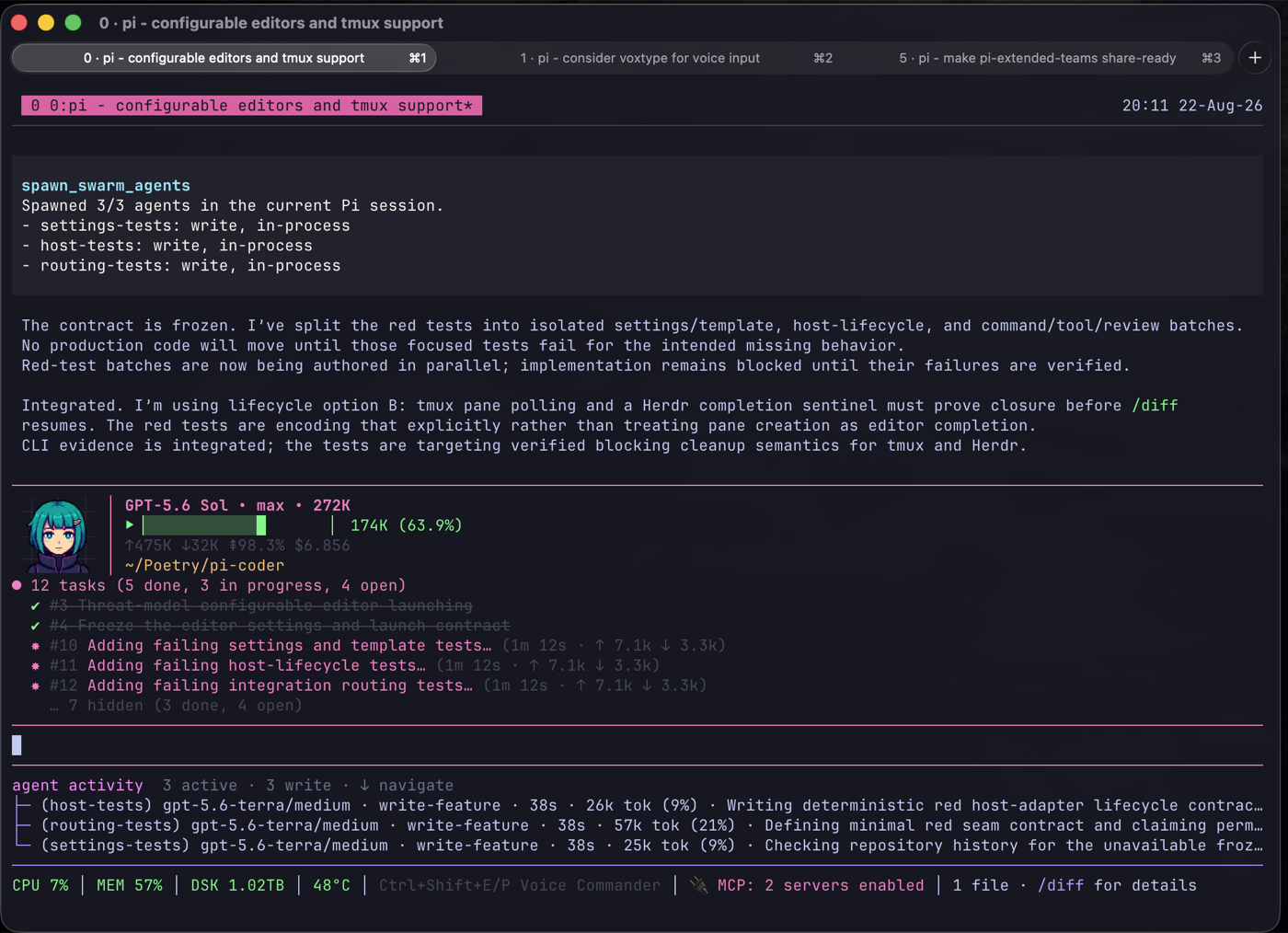
Follow native Pi agents from the editor. The activity card shows progress, tier, model, elapsed time, and context usage. Down opens the transcript, with theme-aware panels, configurable colors, and expandable tool results. External agents appear in the activity view;
hfocuses their Herdr pane.Mouse-wheel and Page Up/Page Down scrolling works inside Herdr, too. Press End to follow live output again.
Move an agent into its own Herdr pane with
h. Eligible direct agents resume their saved conversation in a focused sibling pane and keep communicating with the team.Correct an agent while it works. Press
mto message it,ito interrupt its current command while keeping its context, orxto stop it.Keep running agents through same-process
/reload. Their controls and reports reconnect after the reload; process restarts are not supported.Choose which of your loaded Pi extensions agents can use. Onboarding recommends models and extension settings for approval.
Check native Pi agents' work before accepting it. Assign verification commands, record which source they checked, and optionally allow a limited number of repair attempts. Reports distinguish the agent's claimed outcome from check results.
Keep the findings after agents exit. Reports arrive automatically, can be grouped into a batch summary, and remain recoverable. Save specialist findings for a fresh follow-up; compatible footers can show combined recorded session costs.
Get started
Try it for one Pi session:
pi -e npm:pi-extended-teamsOr install it:
pi install npm:pi-extended-teamsGitHub installation is also supported: pi install git:github.com/dantetekanem/pi-extended-teams.
Run /pi-extended-teams-onboard for setup recommendations, then ask for what you need:
Use separate agents to investigate the failure and check the test coverage. Bring their findings back together.
External harnesses
External runs require Herdr and an installed CLI. Ask your model to read the external harness setup guide to configure profiles in ~/.pi/agent/pi-extended-teams/settings.json.
Set favoriteModels.<tier>.harness to a profile name for automatic selection. Spawn calls select only model_slot; harness overrides are rejected. The existing picker displays the harness and its arguments. Unbound tiers stay native; missing external prerequisites fail without falling back to Pi.
External agents write private temporary report artifacts. Pi validates and saves the report before notifying the spawning owner; Herdr idle/done alone does not count as completion. Pi does not mirror external transcripts, tool activity, tokens, or cost. Assigned checks, automatic repair, checkpoints, and batch-report grouping remain native-only.
Documentation
Agent reference covers tiers, keyboard controls, Herdr eligibility, configuration, checks, repair, checkpoints, and extension integration. External harnesses covers CLI profiles, tier bindings, permissions, and limits. The teams skill has orchestration and handoff examples. See the changelog for release history.
Agents run with your system permissions. Read-only roles and file claims are coordination contracts, not sandboxes. See access disclosures and security reporting.
Development
pnpm typecheck
pnpm test:focused
Credits and license
Based on pi-teams, with coordination lineage from claude-code-teams-mcp.
MIT.