pi-fabric
A programmable tool and agent runtime for Pi
Package details
Install pi-fabric from npm and Pi will load the resources declared by the package manifest.
$ pi install npm:pi-fabric- Package
pi-fabric- Version
0.22.2- Published
- Jul 21, 2026
- Downloads
- 11.4K/mo · 10.6K/wk
- Author
- monotykamary
- License
- MIT
- Types
- extension, skill
- Size
- 3.3 MB
- Dependencies
- 9 dependencies · 2 peers
Pi manifest JSON
{
  "extensions": [
    "./dist/index.js"
  ],
  "skills": [
    "./skills"
  ],
  "image": "https://raw.githubusercontent.com/monotykamary/pi-fabric/main/media/cover.jpg"
}
Security note
Pi packages can execute code and influence agent behavior. Review the source before installing third-party packages.
README
🧵 pi-fabric
A programmable tool and agent runtime for Pi
One type-checked program for tools, MCP, agents, workflows, actors, mesh, councils, and recursion.




You keep talking to Pi the way you always do. Fabric gives the model one programmable tool — fabric_exec — that it uses to compose Pi's core tools, MCP servers, captured extension tools, child agents, persistent actors, and durable coordination into a single type-checked TypeScript program. The program runs in a QuickJS sandbox by default; an explicit unsafe Node-process executor is available for trusted workloads that exceed WASM32 memory. Only the final result comes back to the conversation. Branching, loops, fan-out, and data flow become code the model writes and type-checks — not a stack of separate tool calls you have to orchestrate.
Why Fabric?
| Capability | What it unlocks | |
|---|---|---|
| ⚡ | Code mode | One flat tool schema; branching, loops, fan-out, and data flow live in checked TypeScript. |
| 🧰 | Capability routing | Call Pi core tools, MCP servers, captured extension tools, or Fabric providers through one runtime. |
| 🧑🤝🧑 | Agent runtime | One-shot workers, persistent event-driven actors, councils, and bounded recursive queries. |
| 🕸️ | Workflows + mesh | Phased progress plus durable topics, shared tasks, and compare-and-swap state. |
| 🛡️ | Guardrails | Approvals, isolation, timeouts, concurrency, recursion depth, and shared cost budgets. |
| 🎛️ | Native TUI | Live activity, an interactive dashboard, and settings without leaving Pi. |
How it works
- You ask in plain language, as usual.
- Pi writes one program that calls the tools, agents, and MCP servers it needs. The program is type-checked before it runs.
- Only the result returns to your conversation. Intermediate work stays in the sandbox and surfaces in the activity panel and dashboard.
Under the hood, the model writes something like this — you don't:
const [manifest, sources] = await Promise.all([
  pi.read({ path: "package.json" }),
  pi.find({ pattern: "**/*.ts", path: "src" }),
]);
return {
  package: JSON.parse(manifest).name,
  sourceCount: sources.split("\n").filter(Boolean).length,
};
Independent calls run in parallel; only the returned object enters the model context. Known providers use concise direct calls such as mcp.fal_ai.get_model_schema(...), memory.recall(...), state.get(), schema.status(), and compact.status(); tools.call({ ref, args }) remains the fallback for refs discovered or computed at runtime.
Install
Requires Node.js 24+ and Pi 0.80.6+. Fabric also checks a detectable Pi host version at startup and warns when an older host may ignore continuation APIs such as actor triggerTurn.
pi install npm:pi-fabric
From GitHub:
pi install git:github.com/monotykamary/pi-fabric
From a local checkout:
pnpm install
pnpm build
pi install /absolute/path/to/pi-fabric
For one development run:
pi -e /absolute/path/to/pi-fabric
What you can ask for
Every pattern below is a skill Pi loads on demand. Invoke it with /skill:<name>, or just describe the task and let Pi pick it up.
| You want | Ask for | Skill |
|---|---|---|
| Parallel audits, migrations, or research with phased progress and a final synthesis | “Audit every auth file in parallel and synthesize findings.” | /skill:fabric-workflow |
| Work too big for one context window, decomposed recursively | “Produce a compact architecture map of this repo.” | /skill:fabric-rlm |
| A persistent watcher that steers only when you drift | “Watch this migration until it's complete and tested.” | /skill:fabric-supervisor |
| A quiet decision-point reviewer | “Review my decisions at idle and tool-error points.” | /skill:fabric-advisor |
| Several reviewers reconciled into one verdict | “Run correctness, security, and test reviewers, then merge.” | /skill:fabric-council |
| Multi-model deliberation with a compare-not-merge judge | “Deliberate this design across models.” | /skill:fabric-fusion |
| A durable team coordinating through shared tasks | “Stand up a team that claims tasks atomically and reports progress.” | /skill:fabric-swarm |
| Edits gated behind typed evidence and postconditions | “Make this parser change only if focused tests stay green.” | /skill:fabric-schema |
The foundation is the fabric-exec reference skill: the model loads it before its first fabric_exec call and again when a call errors on argument shape.
The dashboard
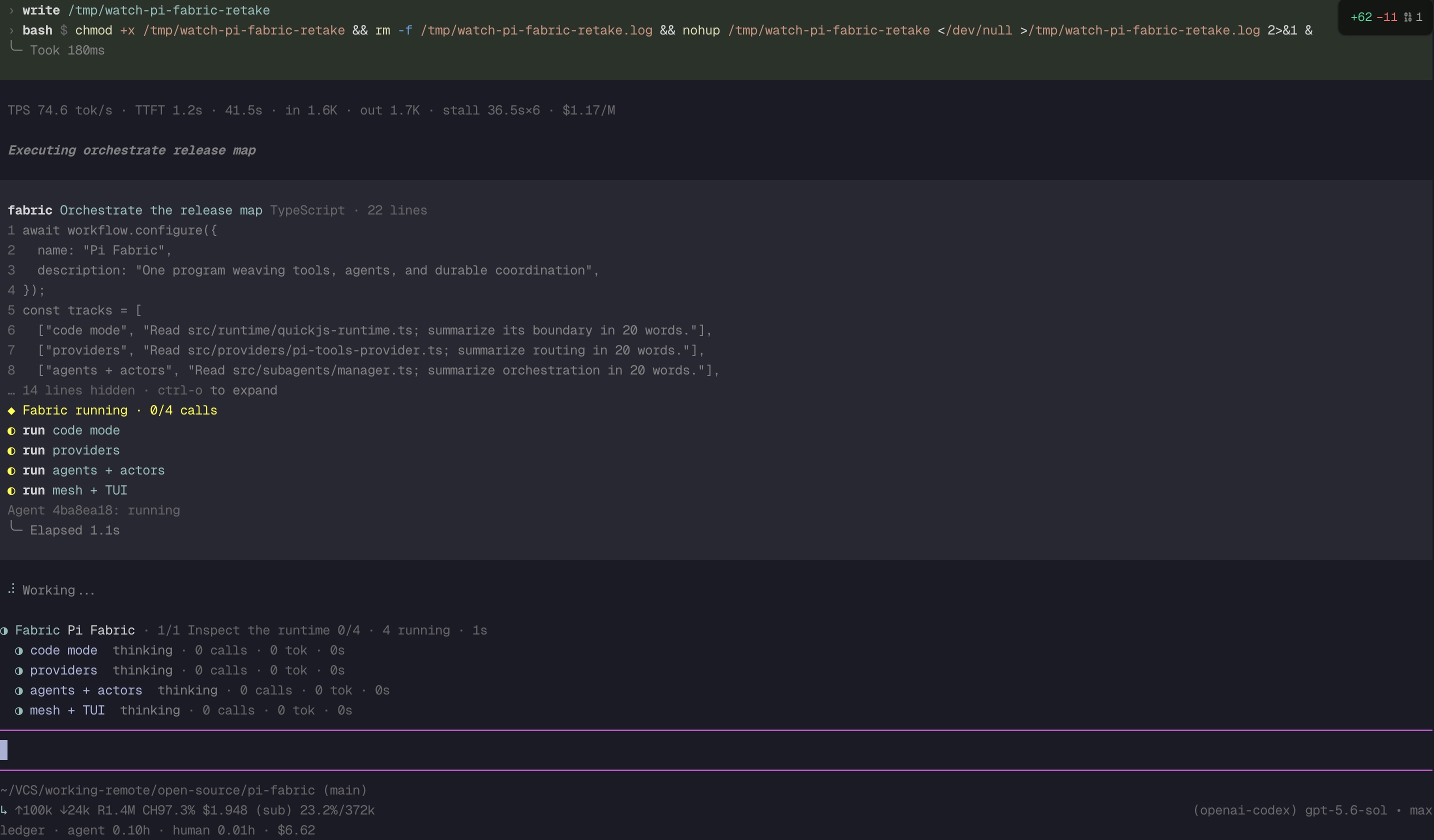
Fabric adds a live activity surface to Pi, no extra extension required:
- A compact widget above the chat (like
pi-supervisor) whose header follows the current phase while its rows show active/completed agents, active actors, and their recent nested tool or code-change activity. /fabric(or/fabric dashboard) — Activity and Topology views where the user-facing Pi session is always present as Main. Queue/steer Main, active children, actors, and observed mesh agents; inspect bounded Run/Project-mesh topologies, paged full agent/actor transcripts, topics, state, and routes./fabric settings— mirrors Pi's/settingsand writes changes tofabric.json.
See the interface & commands reference for every view, keybinding, and slash command.
Reference
- Configuration —
fabric.json, code modes, tool capture, approvals, and budgets. - Interface & commands — dashboard, settings, keybindings, slash commands, and headless runs.
- Agents, actors & mesh — subagents, the Claude runner, transports, steering, persistent actors, global templates, councils, recursive queries, and durable coordination.
- External providers — the versioned provider protocol for extensions.
- Architecture & security — the host bridge, sandboxing, tool-call robustness, and limitations.
- Skills — the model-invoked patterns and the full
fabric_execAPI reference.
Development
pnpm install
pnpm typecheck
pnpm test
pnpm build
The test suite covers configuration, schema validation, provider dispatch, registered-tool interception and execution, QuickJS isolation, Pi built-in invocation, subagents, fake Claude stream-JSON and model discovery, workflows, durable mesh state, actor mailboxes and subscriptions, and Pi/Claude actor restoration. Claude fixtures never make a billable request.
License
MIT