pi-hashline-context-edit
Hashline read/edit tool override for pi-coding-agent
Package details
Install pi-hashline-context-edit from npm and Pi will load the resources declared by the package manifest.
$ pi install npm:pi-hashline-context-edit- Package
pi-hashline-context-edit- Version
0.11.0- Published
- Jun 24, 2026
- Downloads
- 183/mo · 24/wk
- Author
- obalado
- License
- MIT
- Types
- extension
- Size
- 1.5 MB
- Dependencies
- 2 dependencies · 4 peers
Pi manifest JSON
{
  "extensions": [
    "./index.ts"
  ],
  "image": "./assets/banner.png"
}
Security note
Pi packages can execute code and influence agent behavior. Review the source before installing third-party packages.
README
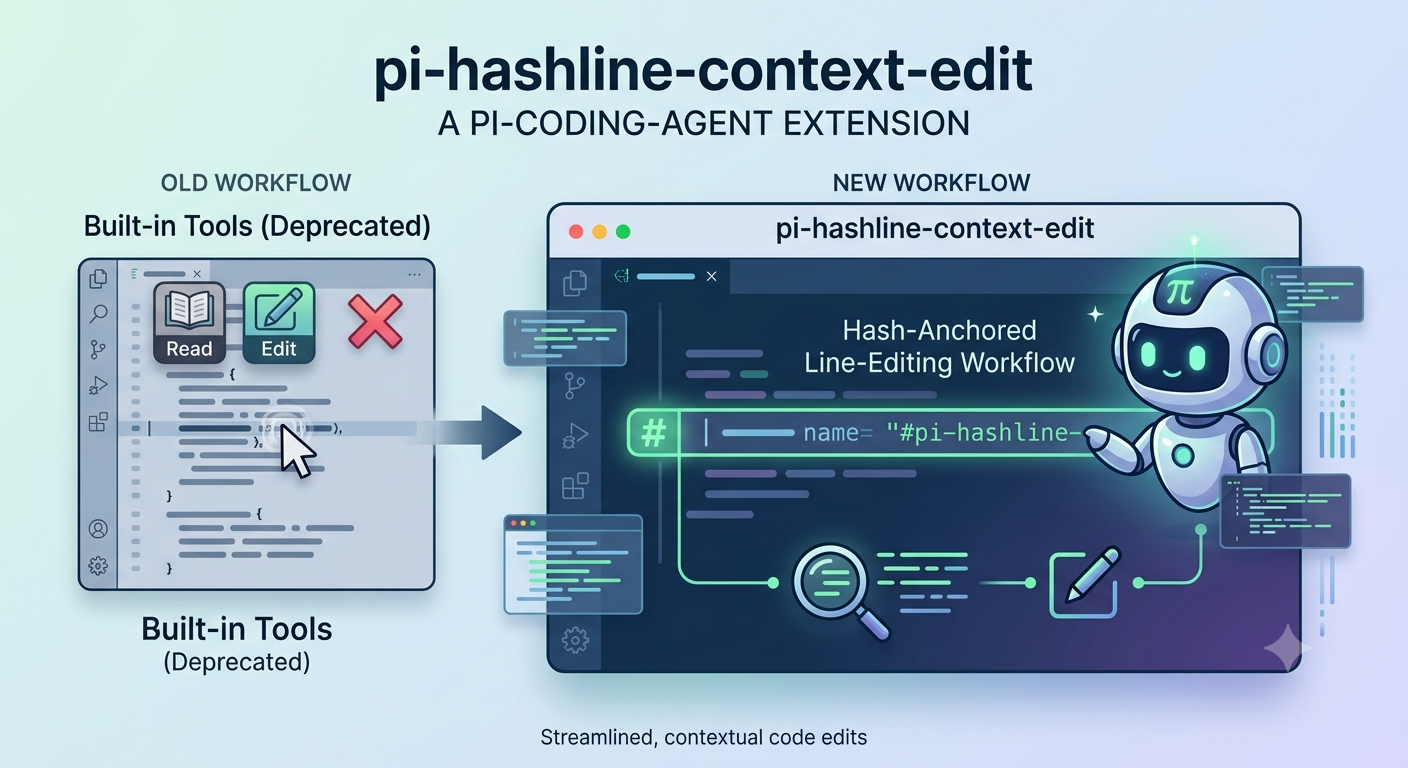
pi-hashline-context-edit
A pi-coding-agent extension that replaces the built-in read and edit tools with a hash-anchored line-editing workflow.
Fork notice
pi-hashline-context-edit is a fork of pi-hashline-edit, itself inspired by oh-my-pi. This fork keeps the strict hashline editing contract and adds v0.8 changes focused on safer stale-context detection, optional raw reads, and deterministic stale-anchor recovery.
Notable fork changes:
- Contextual FNV-1a hashes: anchors now include line number plus previous/current/next visible line context, so changing one line invalidates nearby stale anchors.
- Removed
xxhashjs; hashing is inline and dependency-free. - Added
read({ raw: true })for unanchored inspection/token-saving output. - Added normal-read snapshot cache and safe 3-way stale-anchor merge recovery for non-overlapping external file changes.
- Updated diff previews and edit success anchors to compute hashes against the full post-edit file context.
- Updated docs, prompts, ADRs, tests, and package metadata for v0.8.
Every line returned by normal read carries a short contextual hash. Edits reference these hashes instead of raw text, so the tool can detect stale context and reject outdated changes before they reach the file.
Installation
# From GitHub
pi install git:github.com/obalado/pi-hashline-context-edit

# From a local checkout
pi install /path/to/pi-hashline-context-edit
How It Works
read — tagged line output
Text files are returned with a LINE#HASH: prefix on every line. Line numbers may be left-padded within each returned block so the #HASH: columns align:
 8#VR:function hello() {
 9#KT:  console.log("world");
10#BH:}
LINE— 1-indexed line number.HASH— 2-character contextual hash from the alphabetZPMQVRWSNKTXJBYH.
Optional parameters:
offset— start reading from this line number (1-indexed).limit— maximum number of lines to return.raw— return raw file lines withoutLINE#HASH:prefixes. Use this for inspection/token saving only; use normalreadbefore anchor edits.
Images (JPEG, PNG, GIF, WebP) are passed through as attachments and do not participate in the hashline protocol. Binary and directory paths are rejected with a descriptive error. Empty files return an advisory suggesting prepend/append instead of a synthetic anchor.
edit — hash-anchored modifications
Edits use the LINE#HASH anchors from read output to target lines precisely:
{
  "path": "src/main.ts",
  "edits": [
    { "op": "replace", "pos": "11#KT", "lines": ["  console.log('hashline');"] }
  ]
}
| Op | Purpose | Fields |
|---|---|---|
replace |
Replace one line (pos) or an inclusive range (pos + end). |
pos required, end optional, lines |
append |
Insert lines after pos. Omit pos to append at EOF. |
pos optional, lines |
prepend |
Insert lines before pos. Omit pos to prepend at BOF. |
pos optional, lines |
replace_text |
Replace an exact unique substring anywhere in the file. Fails if the text is not found or matches more than once. | oldText, newText |
All edits in a single call validate against the same pre-edit snapshot and apply bottom-up, so line numbers stay consistent across operations.
Chained edits
After a successful edit in the default changed return mode, the result text includes an --- Anchors A-B --- block with fresh LINE#HASH references for the changed region. These can be used directly in the next edit call on the same file without a full re-read, provided the next edit targets the same or nearby lines. For distant changes, use read first.
Diff preview
The full diff is stored in details.diff for the host UI. The model-visible text stays compact and focuses on fresh anchors, warnings, and retry guidance.
Design Decisions
- Stale anchors fail or merge safely. A hash mismatch means the file has changed since the last
read. If the last normalreadsnapshot is available and the requested edit does not overlap current file changes, the edit may be merged with warning[W_MERGED_STALE_ANCHORS]. Otherwise the error includes freshLINE#HASHretry snippets. - No fallback relocation. Mismatched anchors are never silently relocated to a "close enough" line. Merge recovery composes non-overlapping changes only; conflicts still fail.
- Strict patch content. If
linescontainsLINE#HASH:display prefixes or diff+/-markers, the edit is rejected with[E_INVALID_PATCH]. The model must send literal file content; the runtime does not silently strip accidental prefixes. - Native edit normalization. When a caller sends a top-level
oldText/newTextpayload (the built-in edit format), the request is normalized intoop: "replace_text"and uses the same strict exact-unique-match semantics as any otherreplace_textedit. Inexact or non-unique matches are rejected; there is no fuzzy legacy fallback or separate compatibility notifier. - Atomic writes. Files are written via temp-file-then-rename to avoid corruption from interrupted writes. Symlink chains are resolved so the target file is updated without replacing the symlink. Hard-linked files are updated in place to preserve the shared inode. File permissions are preserved across atomic renames.
- Per-file mutation queue. Edits queue by the canonical write target, so concurrent edits through different symlink paths still serialize onto the same underlying file.
Hashing
Hashes use an inline FNV-1a 32-bit hash over line number plus neighboring context:
lineNumber \0 previousLine \0 currentLine \0 nextLine
The low byte maps to a 2-character string from the custom alphabet ZPMQVRWSNKTXJBYH, which excludes hex digits, common vowels, and visually ambiguous letters (D/G/I/L/O). A reference like 5#MQ stays compact and unambiguous.
Because hashes include previous and next visible lines, changing one line also invalidates anchors for its immediate neighbors. This catches common line-shift/stale-context mistakes while keeping anchors short.
Development
Requires Node.js and npm.
npm install
npm test
Set PI_HASHLINE_DEBUG=1 to show an "active" notification at session start.
Credits
Thanks to can1357 for the original oh-my-pi implementation and the hashline concept.