pi-herdr-agents
Asynchronous Pi subagents in Herdr, with optional isolated Git worktrees
Package details
Install pi-herdr-agents from npm and Pi will load the resources declared by the package manifest.
$ pi install npm:pi-herdr-agents- Package
pi-herdr-agents- Version
3.0.3- Published
- Oct 8, 2026
- Downloads
- 4,865/mo · 1,061/wk
- Author
- giuseppecrj
- License
- MIT
- Types
- extension, skill
- Size
- 954.3 KB
- Dependencies
- 0 dependencies · 4 peers
Pi manifest JSON
{
  "image": "https://raw.githubusercontent.com/giuseppecrj/pi-herdr-agents/main/docs/assets/pi-herdr-agents-gallery.png",
  "skills": [
    "./skills"
  ],
  "extensions": [
    "./pi-extension/subagents/index.ts"
  ]
}Security note
Pi packages can execute code and influence agent behavior. Review the source before installing third-party packages.
README
Pi Herdr Agents
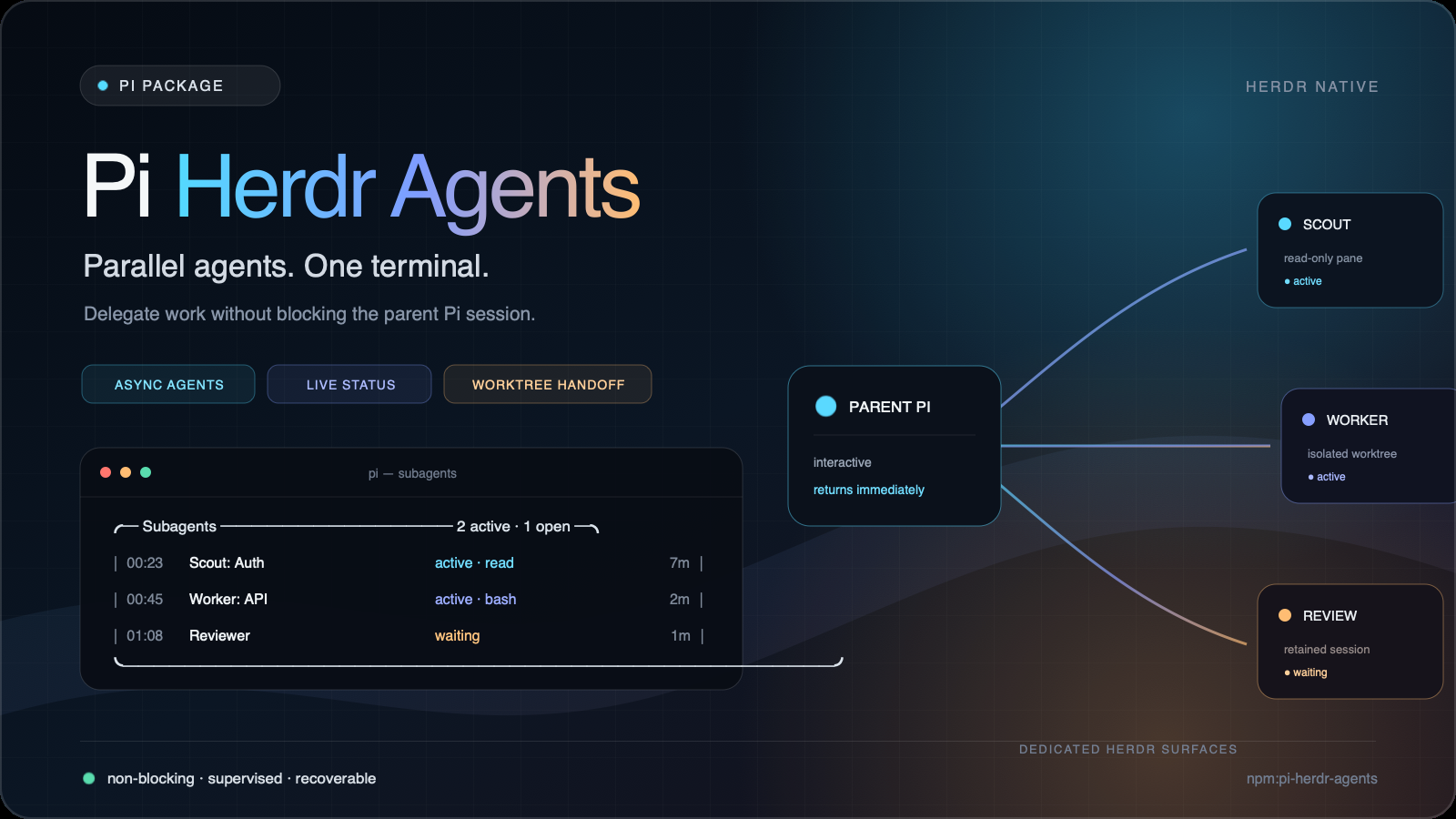
Agents: the tool list is in What's Included and the operating guide is
skills/pi-herdr-agents/SKILL.md. Contributors: readAGENTS.md.
Asynchronous subagents for Pi, running exclusively in Herdr.
Delegate investigation, implementation, and review without blocking the parent session. Each child runs as a real Pi process in its own Herdr surface; results return automatically when the child finishes.
Features
- Non-blocking delegation —
subagentacknowledges launch immediately while the parent keeps working. - Parallel execution — run independent scouts, workers, and reviewers at the same time.
- Live supervision — track process and turn state in Pi's subagent widget; interrupt one child turn without destroying its session.
- Managed worktrees — isolate writing agents in retained Herdr workspaces with explicit Git ownership and recovery details.
- Conversation handoff — continue the active Pi conversation in a new worktree with
/worktreewhile preserving the parent session. - Pack-neutral roles — use project or global definitions and installable role packs; this package ships no default roles or workflows.
- Persistent specialists — retain one policy-bound Pi session for sequential, turn-based tasks.
Requirements
Other terminal multiplexers are not supported. Session startup skips worktree inventory to avoid blocking Pi initialization; use /worktree list or worktree_list to inspect managed worktrees. Outside Herdr, explicit inventory tools still report unavailable inspection as unknown. Worktrees isolate Git checkouts, not processes or permissions; child agents and installed Pi packages run with your user account's access.
Install
Install from npm:
pi install npm:pi-herdr-agentsInstall project-locally or try it for one run:
pi install -l npm:pi-herdr-agents
pi -e npm:pi-herdr-agents
Then start Pi inside Herdr:
herdr
pi
Restart or /reload Pi after installation. Review package source before installing any Pi package.
Upgrading from 2.x? Bundled roles and several commands moved out. See 3.0.0 release notes.
Contents
- Requirements, Install, Safety and uninstall
- Quick start, Release notes, How it works
- What's Included: tools, commands, the operating skill, role packs
- Async Subagent Flow: status, configuration, model routing
- Spawning Subagents, Persistent specialists, Interrupting, Cancelling
- The
/worktreeWorkflow, Custom Agents, Tool Access Control - Development, License
Safety and uninstall
- Child agents are real Pi processes running with your user account's permissions, inside Herdr panes. Worktrees isolate Git checkouts, not processes or permissions.
- The extension creates Herdr panes, tabs and managed worktrees only when a launch asks for them. It never pushes, merges, opens pull requests, deletes branches or removes worktrees on its own; cleanup is an explicit parent action (worktree cleanup).
- What it writes:
$PI_CODING_AGENT_DIR/herdr-agents/config.json(only through/subagents-initor the writer tool, never on startup); per-launch artifacts under the parent session'sartifacts/<session-id>/directory beside Pi's session store, which hold the child's full task text and anysystemPromptas Markdown files, activity snapshots and worktree manifests; and the child's own Pi session file. A managed worktree that carries its own.pi/agentdirectory receives that child's session inside the checkout. Treat task text as potentially sensitive when you share or inspect those files. - To uninstall: first list and remove any retained worktrees while the extension is still loaded (
/worktree list, then/worktree remove <target>), because those commands leave with the package. Then runpi remove npm:pi-herdr-agents, and delete$PI_CODING_AGENT_DIR/herdr-agents/and theartifacts/directories above if you no longer want the configuration and launch records.
Quick start
This package is an execution host and ships no agent roles. Named roles come
from your project or global definitions or from an installed
role pack. The scout examples below assume one of
those provides scout; see Migrating from bundled roles.
A bare launch without agent needs no role.
Ask Pi to delegate naturally:
Use two scouts in parallel to map the authentication flow, then summarize their findings.Or launch a named role directly:
/subagent scout Analyze the authentication module and report relevant files and risksFor an isolated writing task:
/worktree auth-fix Implement the approved authentication fix and run the focused testsPi can also call the tool directly:
subagent({ name: "Auth scout", agent: "scout", model: "<provider>/<fast-tier-id>", thinking: "low", task: "Map the authentication flow" });
subagent({ name: "DB scout", agent: "scout", model: "<provider>/<fast-tier-id>", thinking: "low", task: "Map the session schema" });
// A bare launch needs no installed role.
subagent({ name: "Auth summary", model: "<provider>/<fast-tier-id>", thinking: "low", task: "Summarize the authentication flow" });
// All return immediately; each result comes back independently.
Use ordinary panes for read-only agents. A single or sequential writer can work in the parent checkout; give each parallel independent writing agent a unique managed worktree. The parent acts as coordinator: decompose work, give each child one bounded outcome with its goal, allowed files, verification, and commit instruction, and keep dependent writes sequential. Children are leaves by default; the parent owns integration and final verification. See Worktree subagents.
Release notes
CHANGELOG.md is generated from Git history on each release.
Hand-written upgrade notes for breaking releases live here.
3.0.0
3.0.0 makes the host pack-neutral. It also adds conditional task-model writes
(expectedConfigRevision, an advisory lock, and the reported configRevision),
the pi-herdr-agents operating skill, and subagent_cancel.
Breaking changes. The package no longer ships the seven former bundled roles,
/plan and its plan skill, or /skill:orchestrate; these moved to optional role
packs. /iterate, /btw, and /btw-close were removed without replacement.
roles.bundled is now a deprecated no-op. A named launch of a role that no
definition or installed pack supplies now fails before Herdr creates a pane or
worktree.
Migration.
- Install
pi-herdr-rolesfor the six generic roles (scout,planner,worker,reviewer,adversarial-reviewer,visual-tester),/plan, and/skill:orchestrate. - Install
pi-herdr-pstackfor thepoteto-modemethodology skill and command. It ships no named roles; its delegates are bare. - Remove
roles.bundledfrom$PI_CODING_AGENT_DIR/herdr-agents/config.json. - Alternatively, copy a former role's definition into
.pi/agents/or the global agents directory to keep it without a pack.
See Migrating from bundled roles for the full mapping and pack-compatibility notes.
How it works
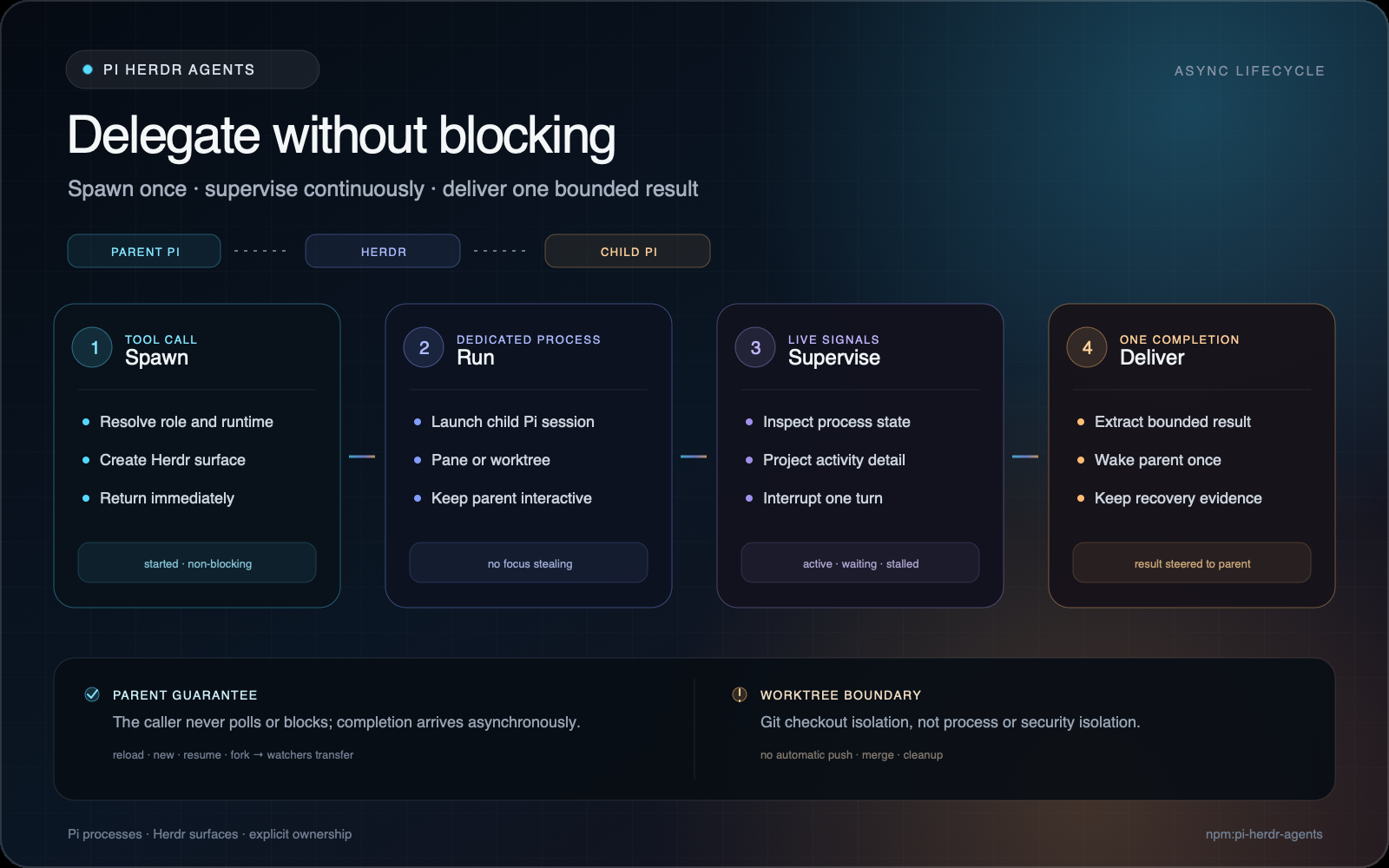
A subagent call selects the target checkout, reuses its Herdr workspace, and gives the child a pane in an extension-owned Agents tab. Four panes fit in each tab by default; overflow opens another tab in the same workspace. A worktree is created only when explicitly requested for checkout isolation. The call launches a child Pi session and returns started. The parent watcher combines Herdr process state with child activity details and projects the result into a live widget:
╭─ Subagents ──────────────────── 1 active · 1 open ─╮
│ 00:23  Scout: Auth (scout)        active · read 7m │
│ 00:45  Reviewer (reviewer)              waiting 2m │
╰────────────────────────────────────────────────────╯
When the child completes, the parent receives one bounded subagent_result message and starts a new turn with that result in context. Disposable ordinary panes close after result delivery; Herdr removes a tab when its last pane closes. Persistent specialists keep their pane between tasks, and managed worktree roots return to retained interactive shells. Callers never need to poll, tail session files, or wait in a shell loop.
Troubleshooting completion delivery
If a child finishes but the parent returns an empty or unrelated response, first verify that the result reached the parent session:
jq -c 'select(.type == "custom_message" and .customType == "subagent_result")' "$PI_SESSION_FILE" | tail -1If the entry exists, spawning and result extraction worked; investigate parent wake-up and model-facing delivery rather than the child process. Completion wake-ups must contain the bounded result directly—do not send a separate message that merely tells the parent to look at an adjacent custom message.
Git package refs are pinned. To move an installed development copy back to the current main, install that ref explicitly and reload the active Pi session:
pi install git:github.com/giuseppecrj/pi-herdr-agents@main
# Then run /reload inside Pi.
Smoke-test delivery with an autonomous subagent instructed to return one exact marker. Success means the marker itself—not only a generic wake-up notice—automatically appears in the parent turn.
Subagent tabs, panes, and worktree workspaces are created without stealing keyboard focus. Launch commands target child panes by explicit ID, so focus and command delivery are independent. If a fresh or resumed launch fails, the extension closes the ordinary pane that it created and preserves the original launch error. It does not close a caller-supplied surface, and managed worktree workspaces remain retained on failure. Note: the interactive option controls parent status notifications, not terminal focus.
What's Included
Extensions
Subagents — 10 parent-session tools + 3 commands, plus 2 child-only tools:
| Tool | Description |
|---|---|
subagent |
Spawn a sub-agent in a dedicated herdr pane (async — returns immediately) |
subagent_interrupt |
Interrupt a running Pi-backed subagent's current turn |
subagent_cancel |
Cancel a running ordinary subagent: no fallback, one cancelled result after confirmed termination |
subagent_send |
Deliver a follow-up task to an idle persistent specialist |
subagent_stop |
Gracefully stop a persistent specialist after its active task settles |
subagents_list |
List available agent definitions |
worktree_list |
Parent-only inspect-only inventory of managed worktrees and cleanup blockers |
worktree_remove |
Parent-only explicit removal by target path, branch, or workspace ID; optional preserve: true commits dirty state first |
subagent_resume |
Resume a previous Pi-backed sub-agent session in a new ordinary pane (async) |
subagents_write_task_models |
Parent-only internal tool that validates and atomically writes models.tasks preferences, optionally conditional on expectedConfigRevision |
| Skill | Description |
|---|---|
pi-herdr-agents |
Operating guide for this host: launching, supervising, interrupting, cancelling and resuming children, worktrees, persistent specialists, model routing and configuration. Loaded by agents on demand; see skills/pi-herdr-agents/SKILL.md |
| Pi child-only tool | Description |
|---|---|
caller_ping |
Ask the parent for help; ordinary children exit, persistent specialists stay alive |
subagent_done |
Mark an interactive child complete and exit; autonomous agents auto-exit |
| Command | Description |
|---|---|
/worktree <name> [task] |
Continue this session in a new managed worktree (/worktree list lists them) |
/subagent <agent> <task> |
Spawn a named agent directly (/subagent list lists available agents) |
/subagents-init [preferences] |
Draft task-category model preferences from the live authenticated registry, with optional ranking preferences |
Taxonomy and discovery
This package distinguishes directly runnable agent roles, Pi-native skills, and authenticated Pi runtimes. A multi-stage user outcome may be a command or skill that composes roles; it is not itself an agent role.
The host's own orchestration surfaces are:
| Surface | Entry point | Behavior |
|---|---|---|
| Delegation | subagent, /subagent <agent> <task> |
Launches one bare or named child; results return automatically. |
| Worktree handoff | /worktree <name> [task], /worktree list |
Forks the active conversation into a managed worktree. |
Planning, review, and other multi-stage workflows belong to role packs and skills, not to this package. See ADR-0002, ADR-0009, and ADR-0013.
Roles and role packs
This package is a pack-neutral execution host: it ships no agent roles, no
/plan command, and no planning or review skills. Its one skill,
pi-herdr-agents, is a general operating guide for the host. A named launch resolves
agent from project definitions, global definitions, and roles registered by
installed role packs, in that precedence order (see below). An empty catalog is
valid. A bare launch without agent always works. An explicitly named role that
is missing or invalid fails before Herdr creates a pane or worktree; it is never
silently replaced by a bare agent.
All subagents execute through Pi. Claude models remain available through normal
Pi provider/model routing. Legacy role definitions that contain cli fail before
Herdr creates a pane or worktree; remove cli and cli-model, then select an
authenticated Pi provider/model-id.
Role packs own their roles' prerequisites, such as a required skill, and must document them. This package does not install role packs or prerequisites.
Migrating from bundled roles
Earlier versions bundled seven roles and two workflows. They have moved to
separately installed packs or have been removed. Nothing is installed
automatically, and your global and project role files and config.json are not
modified.
| Former bundled surface | Status | Destination |
|---|---|---|
scout, planner, worker, reviewer, adversarial-reviewer, visual-tester roles |
Moved | pi-herdr-roles role pack |
/plan command and its plan skill |
Moved | pi-herdr-roles |
/skill:orchestrate and its adversarial-review resources |
Moved | pi-herdr-roles |
poteto role |
Removed; replaced by the poteto-mode skill and /poteto-mode command |
pi-herdr-pstack |
/iterate |
Removed, not relocated | Call subagent({ name, task, fork: true, interactive: true }) directly |
/btw, /btw-close |
Removed, not relocated | None |
roles.bundled setting |
Deprecated no-op | Remove it from config.json |
Both destination packs are experimental, unpublished candidates; their install
sources and compatible host versions are not final. Install a role pack with
pi install like any Pi package and enable it beside this extension; a role pack
stays inert without it. Older versions of this package that still bundle these
roles, /plan, or orchestrate collide with the replacement packs: a bundled
role rejects a same-named pack role, and Pi resolves duplicate commands and
skills by discovery order. Setting roles.bundled: false on an older host only
removes its roles, not its command or skill. Upgrade the host instead of
combining an older host with the replacement packs.
Existing models.agents preferences keyed by role name keep applying when a
pack or definition supplies that name. To keep a former role without installing
a pack, copy its definition into .pi/agents/ or the global agents directory.
Roles use model defaults from config.json when configured; otherwise
they inherit the parent model. Thinking defaults still come from agent
frontmatter or the parent level. This resolution chain remains available as a
fallback, but orchestrators should explicitly set each child's exact
authenticated provider/model-id and supported thinking level. Select the
model tier first: fast for bounded mechanical work and recon, mid for ordinary
implementation or review, and frontier for architecture, security, hard
diagnosis, or adversarial review. Then select thinking within that model's
supported range. Cross-family independent review requires a reviewer from a
different model family than the author. For ordinary review, prefer a different
authenticated model family. When no other authenticated model family is
available, ordinary review may use a same-family reviewer in a fresh standalone
session. Disclose that this review is context-isolated, not cross-family
independent. Cross-family verification must not use this fallback. A stronger
model in the same family is a quality escalation, not cross-family
independent review. Family is the independence boundary; project policy may
separately require a different provider.
Discovery loads definitions in package → global → project order, so effective
priority remains project (.pi/agents/) > global
($PI_CODING_AGENT_DIR/agents/, defaulting to ~/.pi/agent/agents/) >
package. Package definitions are the roles contributed by installed Pi role
packs; there is no bundled layer. Both subagents_list and /subagent list show each
visible definition's source; contributed roles include their package identity,
for example (package:@acme/security-roles). A hidden higher-priority definition
still suppresses a visible lower-priority definition.
Custom roles and installable role packs are the package's main extension points. See Custom Agents for the complete create, package, verify, and launch workflow.
Async Subagent Flow
1. Agent calls subagent()          → returns immediately ("started")
2. Sub-agent runs in herdr pane    → widget shows live status
3. User keeps chatting             → main session fully interactive
4. Sub-agent finishes              → result steered back as a normal completion/failure
5. Main agent processes result     → continues with new context
Multiple subagents run concurrently — each steers its result back independently as it finishes. Active watchers survive parent /reload, /new, /resume, and /fork transitions, so completion is delivered into the replacement session. Quitting Pi still stops parent-side delivery. The live widget above the input tracks every agent still in flight:
╭─ Subagents ──────────────────── 1 active · 2 open ─╮
│ 01:23  Scout: Auth (scout)             active · read 7m │
│ 00:45  Reviewer (reviewer)                   stalled 4m │
│ 00:12  Scout: DB (scout)                      starting… │
╰─────────────────────────────────────────────────────────╯
Completion messages render with a colored background and are expandable with Ctrl+O. Results larger than 16,000 characters are abbreviated in the parent context while preserving their beginning, conclusion, and session path; the complete result remains in the child session. The extension includes that bounded result and a continuation instruction directly in the single custom subagent_result message that triggers or steers Pi, avoiding empty turns caused by a separate context-free wake-up. The renderer uses the unadorned bounded result from structured details. Completed rows are removed from the widget as soon as their result is delivered or suppressed.
In-progress status updates
The widget projects each sub-agent from a process + turn lifecycle:
- Herdr pane inspection is the coarse authority for whether the child process is present and whether Herdr reports it as idle, working, blocked, or done.
- Child activity snapshots enrich the label with Pi-only detail (tool name, streaming, etc.) when available.
- Session JSONL is still used for transcript, resume, lineage, and result extraction — not for liveness.
Projected labels include:
starting— launched; pane/activity confirmation is still settlingactive— processing work (agent turn, provider request, streaming, or tool execution)blocked— Herdr reports the child as blockedwaiting— turn finished; the process is intentionally open for more input or another stageinterrupted— the current turn was cancelled (Escape /subagent_interrupt); the process stays open and is not treated as active processingstalled— pane inspection is unhealthy long enough that the parent can no longer trust the runrunning— fallback when only coarse process presence is known (e.g. non-Pi backends)finalizing— completion was observed and delivery is in progress; the process elapsed timer freezes herecancelling…/cancel unconfirmed— asubagent_cancelis terminating the run, or its termination could not be confirmed and the run stays live
The widget header counts active vs open:
- active —
active,starting,running, orblocked - open — everything else still tracked (
waiting,interrupted,stalled,finalizing, …)
When activeCount === 0 (every tracked row is open), the border uses an amber accent. Process elapsed time (MM:SS on the left) freezes when the process reaches finalizing/completed/failed. Interrupt does not freeze that process clock; the interrupted state shows its own duration on the right while the process remains open.
A fixed internal watchdog marks a run as stalled when pane inspection fails or the pane disappears without a completion sidecar; valid long-running active or waiting states do not become stalled just because time passes. When a run enters stalled or recovers from it, the parent agent receives a steer message so it can react. All other status transitions stay in the widget only.
Interactive subagents stay silent. Long-running user-driven subagents (for example, an interactive planning role or a bare interactive: true fork) do not wake the parent session on stalled/recovered transitions — the user is working directly in the subagent's pane, and a steer message there would just burn an orchestrator turn on a no-op "still waiting" ping. The widget still updates normally, and activity snapshots are still recorded/classified regardless of the interactive setting. By default, agents with auto-exit: true are treated as autonomous and get stall pings; agents without it are treated as interactive and stay quiet. Override per-agent with interactive: true|false in frontmatter, or per-spawn with interactive: true|false on the tool call.
Configuration
The durable user configuration is $PI_CODING_AGENT_DIR/herdr-agents/config.json,
defaulting to ~/.pi/agent/herdr-agents/config.json. It is not read from the
installed package root, so npm and git package upgrades do not overwrite it.
Create it by copying the installed package's config.json.example, or run
/subagents-init to seed and draft model task preferences. This is a breaking
migration: manually move an existing package-local config.json to this path,
or re-run /subagents-init.
{
  "status": {
    "enabled": true
  },
  "models": {
    "agents": {}
  },
  "persistent": {
    "maxAgents": 3
  },
  "supervision": {
    "forcePolling": false,
    "hangWarningMinutes": 15
  },
  "panes": {
    "mode": "grouped",
    "direction": "right",
    "maxPerTab": 4
  }
}
If config.json is absent, status, role, pane, and persistent-specialist settings fall back to config.json.example.
Model routing does not read the example: no model overrides apply until a real
config.json exists.
The copyable example is model-neutral, so it works without requiring credentials for a specific provider. To configure models, replace the empty section with exact IDs from your authenticated model catalog:
{
  "models": {
    "default": "your-provider/your-default-model",
    "agents": {
      "scout": "your-provider/your-fast-model",
      "reviewer": "your-provider/your-review-model"
    },
    "tasks": {
      "coding": ["your-provider/your-coding-model"],
      "review": ["your-provider/your-review-model"],
      "recon": ["your-provider/your-fast-model"],
      "qa": ["your-provider/your-qa-model"],
      "architecture": ["your-provider/your-architecture-model"],
      "docs": ["your-provider/your-docs-model"]
    },
    "tasksMeta": {
      "generatedAt": "2026-09-17T00:00:00Z",
      "method": "research"
    }
  }
}
models.tasks candidates are ordered exact authenticated IDs. Use
task:<category> only in the subagent tool's model argument; it is not
valid in frontmatter or model defaults. Cross-family independent review requires
a reviewer from a different model family than the author. For ordinary review,
prefer a different authenticated model family. When no other authenticated
model family is available, ordinary review may use a same-family reviewer in a
fresh standalone session. Disclose that this review is context-isolated, not
cross-family independent. Cross-family verification must not use this fallback.
Use an exact authenticated
shortlist provider/model-id when the
authoring family is known; task:review does not establish independence. Family
is the independence boundary; project policy may separately require a different
provider. This is guidance, not extension enforcement.
Run /subagents-init [preferences] to draft task-model preferences. For example:
/subagents-init Prefer capability over price for implementation; keep recon inexpensiveThe command supplies a sanitized snapshot of all available models from the active session registry, including extension-registered providers, exact IDs, display names, reported base token costs, context/output limits, input modalities, reasoning, and supported thinking levels. Safe extension-registration and auth-source metadata is included when Pi exposes it; credentials, endpoints, and raw auth labels are not. Configured authentication does not prove account access or a successful request. Missing costs remain unknown; reported zero does not mean free, and OAuth does not establish subscription billing. The brief uses compact JSON without truncating models and reports its model count and JSON character count (not a token estimate); large catalogs still consume context. This is the current synchronous snapshot: a dynamic provider whose initial catalog refresh has not completed might be absent. Init does not refresh providers or probe the network for availability.
The draft considers current saved task, default, and per-agent preferences. Optional command arguments set ranking preferences. Otherwise it favors capability for substantive work and efficiency for bounded reconnaissance and test execution. Categories describe work, not complexity tiers:
| Category | Work |
|---|---|
coding |
Implementation workers |
review |
Code reviewers |
recon |
Reconnaissance scouts |
qa |
Software and test runners |
architecture |
Planning and diagnosis |
docs |
Documentation workers |
Init asks the agent to research major candidates across providers using primary
sources, disclose uncertainty and notable exclusions, and avoid duplicate
upstream models across routes unless deliberate redundancy is explained. Display
names help identify candidates but, like aliases, do not prove upstream
equivalence; research is still required. Price or context size alone is not
quality evidence. It reports registry-only when
search is unavailable or yields no usable evidence; no live model probes run.
The writer validates and atomically replaces models.tasks and tasksMeta,
preserving unrelated settings. Its tool schema accepts partial nonempty
categories (omitted categories are removed), rejects empty tasks: {} input,
and rejects exact duplicate refs within a category after trimming;
IDs remain case-sensitive. Its result includes normalized saved tasks,
tasksMeta, configPath, missingCategories, and configRevision. Init requests all six categories
and a before/after table based on that saved result, not the unsaved draft. It
must explain missing categories or changed choices; with no available models,
it must report the limitation without writing.
Optional expectedConfigRevision makes a write conditional on the config the
proposal was read from. A revision is sha256: followed by 64 lowercase hex
digits of the SHA-256 of the exact config.json bytes (not normalized JSON or
only models.tasks), or the literal missing when the file is absent. Any byte
change, including whitespace or unrelated settings, makes the revision stale; a
missing revision rejects a file that now exists, and an existing revision
rejects a file that was removed. A stale revision fails with Stale task model config revision without replacing configuration: re-read, re-propose, and
re-approve rather than retrying. Malformed revisions, including null and empty
strings, fail closed. Omitting the field keeps the unconditional write. A write
to a missing file still seeds from the packaged config.json.example.
configRevision is the revision of the exact bytes written and can serve as the
next precondition.
Every writer call, conditional or not, holds an exclusive config.json.lock
sibling while it reads one snapshot, checks the revision, and atomically renames
a private temporary file into place. A held lock fails immediately with Task model config writer busy; there are no waits or retries. The lock is never
broken automatically: after a crash, the error names the recorded owner and
reports when that process is no longer running, and you remove the lock only
after confirming that no writer is active. Each call removes only its own lock
and temporary file. This lock is advisory: it serializes cooperating writers
but cannot constrain a text editor or another process that ignores it. The
revision check detects changes made before the snapshot is read; it is not a
filesystem transaction against arbitrary external writers.
task:<category> values select subagent models; they are not slash commands and
do not change the parent model. Ordered authenticated candidate plans resolve
before launch. Ordinary nonpersistent runs can retry later candidates after
launch failure or after a running child settles with a provider/agent error,
not after a completed negative task result. Persistent specialists do not
advance after a running-child error. This is not per-step routing; worktrees
use the first authenticated candidate only, without fallback retries.
Shortlists do not enforce reviewer independence. Cross-family independent
review requires a reviewer from a different model family than the author. For
ordinary review, prefer a different authenticated model family. When no other
authenticated model family is available, ordinary review may use a same-family
reviewer in a fresh standalone session. Disclose that this review is
context-isolated, not cross-family independent. Cross-family verification
must not use this fallback. Another route to the same family is not
independent review. Family is the independence boundary; project policy may
separately require a different provider. Run /reload (or start a new session)
after writing preferences.
Set persistent.maxAgents to the maximum concurrently retained persistent specialists. It defaults to 3; a persistent spawn at the cap is rejected before Herdr creates a pane or workspace, and no specialist is evicted.
roles.bundled is deprecated and has no effect because this package ships no
roles. Existing true and false values are accepted so that current
configuration keeps loading; a parent session reports one warning per extension
load naming the file and asking you to remove the key. The extension never
rewrites the file. Other values remain configuration errors, as do unknown keys
under roles. Registered role packs are the entire package layer, and global and
project definitions keep their precedence over them.
Supervision transport
On supported local filesystems, supervision uses file wake-ups plus one shared 4.8-second pane reconciliation. A wake-up only prompts fresh evidence collection; it never establishes a result by itself. While any child's wait for that check is parked, the coordinator's file watches stay referenced, so the sidecar is still observed when the parent has no other event-loop work. The reference is released when the wait settles, is aborted, or its child is unregistered. With no parked wait, the watches stay unreferenced and do not keep the process running. If the watcher or shared pane inspection becomes unavailable, supervision quietly returns to the legacy one-second polling cadence. No caller action is required.
Set supervision.forcePolling to true in the durable user config.json to
disable wake-ups and use that legacy cadence deliberately. The setting is read
when the coordinator is created, so run /reload after changing it.
subagents_list reports the active transport mode (wake+batch,
polling(forced), or polling(fallback)) and watcher count.
supervision.hangWarningMinutes defaults to 15; set it to 0 to disable
no-progress advisories. For example, this keeps the default transport and sets
a 30-minute advisory budget:
{
  "supervision": {
    "forcePolling": false,
    "hangWarningMinutes": 30
  }
}
While a child projects active or blocked, the parent compares durable session
JSONL and activity-snapshot updates against this budget. An advisory is warning-only, fires once per no-progress episode, and
never interrupts, kills, retries, or restarts a child. It identifies blocked-tool (an outstanding tool call may still complete),
truncated-turn (an observed toolUse stop with no tool call; its cause is unknown), or
generic-no-progress when neither condition is established, then
includes the session path and manual recovery options. Ordinary children can be
interrupted, cancelled with subagent_cancel, or, after termination, resumed or
newly spawned. Persistent
ordinary-pane specialists can be interrupted or stopped with subagent_stop and
replaced; they cannot be resumed. Managed-worktree children, including persistent
ones, retain their workspace and continue there only after the previous process
has exited; do not use subagent_resume or start a concurrent writer. Interactive children stay
quiet just as they do for stalled/recovered notices; their widget state still
updates. A later durable update clears the episode and sends the corresponding
recovered notice for non-interactive children.
polling(fallback) means at least one tracked child is using per-child polling;
other children can still use wake+batch.
A Linux manual benchmark on 2026-09-06 used isolated Herdr panes held pending,
20-second windows, and the extension's completion/supervision seams. At 10
children across three rotated rounds, wake+batch averaged 2.20 CLI launches/s
versus 14.20 for forced polling (84.5% fewer); mean evidence-to-resolver
latency was 3.2 ms versus 449.0 ms, and the largest reconciliation probe gap
was 4.82 s. The benchmark measures /proc CPU ticks for the supervisor and
isolated Herdr tree, not parent-model latency; raw samples are written to
/tmp/issue29-bench/ by test/bench/supervision-bench.mjs.
panes.mode defaults to "grouped" when omitted. Ordinary public subagent and subagent_resume launches, including bare forks, fill extension-owned Agents, Agents 2, etc. tabs in the target checkout's existing workspace. panes.maxPerTab is a positive safe integer, defaults to 4, and counts all live panes in each owned tab, including user-added panes and retained shells. Overlapping launches in one parent respect this cap. It is independent of persistent.maxAgents.
Checkout matching uses Herdr's canonical worktree.checkout_path and includes descendant directories. Shell working directories do not establish workspace ownership. If no checkout matches (including non-Git directories), placement uses the caller's workspace; overflow never creates a workspace. A reviewer with cwd set to a managed checkout joins that workspace without creating another worktree. Resume placement uses the saved session's cwd.
Explicit panes.mode: "tab" preserves one new tab per ordinary child in the caller's workspace. Explicit "split" preserves splits of the stable parent pane. panes.direction is "right" (default) or "down" and applies to grouped and legacy splits. maxPerTab does not affect these legacy modes. Managed worktrees retain their separate workspaces.
Ownership is tracked by returned pane/tab/workspace IDs, never labels. Separate parent processes own separate groups; /reload preserves a parent's in-memory ownership, but a full restart does not adopt old tabs. Placement never moves existing panes or renames user tabs. Background launches preserve focus; Herdr may resize sibling panes when splitting or closing. User-added panes are never closed by automatic tab cleanup. An owned tab remains reusable while user panes remain, even after all child panes close.
Run /reload after changing role, model, or pane settings.
models.default sets the model for subagents that do not specify a model.
models.agents sets per-agent defaults, keyed by the agent name passed to
subagent({ agent: ... }). Explicit model tool arguments take precedence,
followed by agent frontmatter, per-agent config, the global default, and finally
the parent model. Model values must be exact authenticated provider/model-id
references. A value can contain an ordered comma-separated fallback list, for
example provider/preferred, provider/fallback. The tool argument also accepts
task:<category> as its complete value (not in a list), for configured
coding, review, recon, qa, architecture, or docs preferences. The extension validates every
candidate before launch, then launches later candidates only after the selected
child settles with a provider/agent error. Pi owns any automatic transient
retrying inside that child; the extension does not infer retry counts or
permanence from the error text. A later candidate that launches after a parent
/reload, /new, /resume, or /fork uses the live parent session for its
artifacts and lineage, as completion delivery does. Its candidate list and
thinking level stay those of the original call. The original parent directory
and process directory remain the bases for directory resolution. Role files are
read again for each attempt, so a changed role cwd can redirect a fallback
when the tool call did not specify cwd. If no live parent context is available,
that candidate fails without launching. A completed child result, including a
negative task result, never switches models. Completion metadata reports the
requested candidate, every attempted candidate, the model actually used, and
each raw model failure in attempt order when fallbacks are tried.
A catalog-listed model and configured authentication do not prove that the
active provider account can use that model. Providers may reject an account /
model combination only when the request is made. The completion preserves each
raw provider reason with its model and suggests checking account access,
spawning a new subagent with a supported model, or choosing an appropriate
configured fallback. subagent_resume does not select a model and should be
used only after the session's stored model is usable. Persistent session sidecars fail closed: v1 does not resume or revive a stopped or crashed specialist; retain its evidence and spawn a new specialist. The completion does not
claim a permanent failure or a retry count that Pi has not exposed. Reliable
structured permanence and retry counts require an upstream Pi/ExtensionAPI
diagnostics seam for final provider errors and retry outcomes.
config.json is durable user state under the Pi agent directory and is loaded
when the extension starts. Run /reload after changing it. Package-root
config.json files are ignored; move them manually or re-run /subagents-init.
Spawning Subagents
Examples that set agent assume a role pack or a project/global definition
supplies that role; this package ships none.
// Explicit fast-tier runtime for bounded reconnaissance
subagent({ name: "Scout", agent: "scout", model: "<provider>/<fast-tier-id>", thinking: "low", task: "Analyze the codebase..." });

// Force a full-context fork for this spawn
subagent({ name: "Fix", fork: true, model: "<provider>/<mid-tier-id>", thinking: "medium", task: "Fix the bug where..." });

// Explicit frontier-tier runtime for architecture work
subagent({ name: "Planner", agent: "planner", model: "<provider>/<frontier-tier-id>", thinking: "high", task: "Work through the design with me" });

// Explicit mid-tier runtime with a custom working directory
subagent({ name: "Designer", agent: "game-designer", model: "<provider>/<mid-tier-id>", thinking: "medium", cwd: "agents/game-designer", task: "..." });

// Isolated ticket branch in a Herdr-managed Git worktree
subagent({
  name: "Ticket 123",
  agent: "worker",
  model: "<provider>/<mid-tier-id>",
  thinking: "medium",
  worktree: { branch: "ticket/123", base: "main" },
  task: "Implement ticket 123, test it, and commit the result",
});
Parameters
| Parameter | Type | Default | Description |
|---|---|---|---|
name |
string | required | Short stable child label; coordinated groups use <task>-<role>[-n] (widget and pane title) |
task |
string | required | Task prompt for the sub-agent |
agent |
string | — | Load defaults from agent definition |
fork |
boolean | — | Override the child session mode: true forces fork, false forces standalone. Omit to inherit the agent session-mode frontmatter |
persistent |
boolean | false |
Keep one specialist session alive for sequential tasks; follow-ups use subagent_send only |
interactive |
boolean | derived | Mark this spawn as interactive (don't wake the parent on stall/recovery). Defaults to the agent's interactive frontmatter, otherwise the inverse of auto-exit. |
model |
string | configured or parent | Exact authenticated provider/model-id, ordered fallback list, or whole-value task:<category> (coding, review, recon, qa, architecture, docs). Task routing is tool-only; worktrees use its first authenticated candidate. Resolution is tool argument → agent frontmatter → per-agent config → global config → parent |
thinking |
string | parent level | Pick the model tier first, then set thinking within that model's range: minimal/low for bounded mechanical work, medium for ordinary implementation or review, high+ for architecture, security, or hard diagnosis. Omitting still inherits the parent level; this is a discouraged fallback for orchestrated children. |
systemPrompt |
string | — | Role text for a bare spawn, delivered as a role block at the top of the child's first message (not the system prompt); dropped for fork: true children. Named agents keep their definition body |
skills |
string | — | Comma-separated skill names |
tools |
string | — | Comma-separated tool names |
cwd |
string | — | Working directory, or source repository when worktree is set (see Role Folders) |
worktree |
object | null | — | Isolated Herdr-managed Git worktree; requires branch, with optional base (committed HEAD by default). Omit or pass null to use an ordinary pane in cwd when a client requires the property. |
A bare spawn's systemPrompt is not passed to Pi as a system prompt. The host
prepends it as a role block to the child's first message, which is delivered
through a task artifact file referenced with @path. A full-context fork
(fork: true) receives only the raw task, so its systemPrompt is dropped. Set
fork: false when a bare child must receive reference or role text through
systemPrompt.
Naming coordinated children
Before launching a new group, choose a short task slug and label each new child
<task>-<role>[-n], such as login-api or login-test2. Roles are plan,
research, ui, api, build, test, review, browser, security,
perf, and merge. Leave existing labels unchanged. After the final launch,
print name | agent kind | role | model | worktree and use each name in
prompts, handoffs, and results.
Isolated worktree runs
Use one worktree per parallel independent writing task; a single or sequential writer can work in the parent checkout, and read-only agents use ordinary panes. Omit worktree for an ordinary pane; clients whose generated tool schema requires every property may send worktree: null with the same effect. cwd selects the source Git repository, branch must be unique, and base is resolved to an exact commit before creation. If cwd is a linked checkout, Herdr provisioning uses the principal checkout while the requested checkout supplies the base SHA and manifest provenance. A successful launch from that linked checkout does not itself authorize cleanup there: cleanup checks the canonical principal/source repository under the invoking parent session's cwd, not manifest.sourceCwd or shared Git identity. If cleanup is needed, start the parent Pi session rooted at the principal checkout or an ancestor containing it, then use the normal explicit cleanup flow; changing directories inside an existing Pi session does not change its session cwd. If base is omitted, the source checkout's committed HEAD is used. Parent-checkout changes that have not been committed are not copied.
Choose a worktree from the task, not from a role name: the extension emits no
role-specific worktree warnings. Read-only scouting and review normally use an
ordinary pane; to inspect or review an existing worker result, start an ordinary
child in that retained worktree path. Do not infer that a role cannot write
because its tools omit write or edit: a read,bash allowlist is not an
enforced read-only boundary because shell commands can mutate files. Report-only
roles must restrict Bash to safe inspection and avoid artifact-generating
verification in the reviewed checkout. Herdr worktree workspaces persist until
explicitly removed.
The child starts at the returned worktree root. Tell writing agents to test and commit when you want a commit-based handoff, and tell them not to push, merge, switch branches, or remove the worktree. The parent owns review and integration.
Successful, failed, and help-requesting worktree runs retain their workspace and root shell. A reviewer's disposable pane can close without closing that root, tab, or checkout. Completion includes the worktree path, Herdr workspace, branch, base/head SHAs, commits ahead, changed and untracked files, and clean/dirty/conflicted state. Here, clean means no uncommitted files; the branch may still contain commits. If Git inspection fails, state is reported as unknown rather than guessed.
An ownership manifest is written under the parent session's artifacts/<session-id>/worktree-runs/ directory before Herdr creates resources. V1 does not automatically recover watchers after a full process restart, and subagent_resume does not reattach the managed worktree lifecycle.
The extension does not push, create a PR, merge, cherry-pick, or remove the worktree or branch automatically. For task selection, lifecycle states, review commands, failure recovery, and safe cleanup, read Worktree subagents. The research report records the rationale and deferred roadmap.
Persistent specialists
Set persistent: true on a subagent launch to create one logical specialist with one v1 session generation. Its resolved tools, denied tools, model, thinking level, and optional worktree binding are snapshotted at launch and do not change when work is sent later. subagents_list shows each live specialist's logical ID, generation ID, state, completed-task count, and effective policy.
The initial task and each subagent_send({ id|name, message }) task are delivered exactly once with a task ID. A specialist accepts one task at a time. Sends while it is working are recorded as rejected-busy; no queue is retained. After a task result arrives, it is idle and accepts the next task. A persistent child's caller_ping records a help request but keeps the session alive; answer with subagent_send.
Use subagent_stop({ id|name }) to request graceful shutdown. If a task is active, stop becomes stop-pending and the task reaches its terminal outcome first. The parent reports stopped only after process-exit evidence is confirmed, then closes an ordinary pane it created and releases the name. If confirmation times out, the specialist is stalled in an unconfirmed-stop state: subagent_send rejects follow-up work while retaining evidence. Request subagent_stop again to make another bounded exit check, or spawn a new specialist. A pane or process disappearance without a stop directive produces one facts-only crash notice; persistent sessions cannot be resumed in v1, so spawn a new specialist. There is no automatic restart, replay, or revival.
A persistent specialist with a worktree holds that lease for its entire lifetime. It cannot be re-bound to another checkout. Otherwise it runs in an ordinary pane.
Interrupting a running subagent
Use subagent_interrupt to cancel the active turn of a running Pi-backed subagent:
subagent_interrupt({ id: "abcd1234" });
// or
subagent_interrupt({ name: "Scout" });
This sends Escape to the child pane, cancelling the in-progress model turn. The subagent session stays alive — the pane, session file, and background polling all remain intact. After the interrupt, the widget immediately labels the child as interrupted (counted as open, not active processing). Stale pre-interrupt activity snapshots are ignored so a lagging Herdr/active reading cannot overwrite the interrupt. The process elapsed timer keeps running because the pane is still open; only the interrupted-state duration freezes relative to the interrupt request. If the child starts work later, newer observations return it to active; completion, failure, and caller_ping still flow through normally.
id and name are each optional, but execution requires one usable target: an exact running ID or an exact, unambiguous display name. When both are supplied, id is used. Duplicate names are rejected.
This is a turn-level interrupt, not a method for forcibly terminating a subagent session. To end the run, use subagent_cancel.
Cancelling a running subagent
Use subagent_cancel to end one ordinary (non-persistent) managed run, including an interrupted one:
subagent_cancel({ id: "abcd1234" });
// or
subagent_cancel({ name: "Scout" });
Target resolution matches subagent_interrupt: an exact running ID or an exact, unambiguous display name. Persistent specialists are rejected; use subagent_stop, whose graceful v1 semantics are unchanged.
The cancel intent is recorded before anything is aborted or killed. From then on the run never advances its model shortlist, retries, or recovers, even when terminating the pane makes the watcher observe a lost pane, and even when a fallback launch was already in flight. The result reports one status:
| Status | Meaning |
|---|---|
confirmed |
Termination is confirmed. One cancelled result is delivered automatically. |
requested |
A launch or fallback acquisition is still in flight. Its owner is terminated as soon as it is acquired; no later model is tried. |
unconfirmed |
Termination failed (the error is reported). The run stays live, owned, and supervised, and nothing is delivered or cleaned up. Call subagent_cancel again to retry. |
already-terminal |
The run already took a natural result or was retired; nothing was cancelled. |
Repeated cancels join an in-flight termination and keep the first request time. The parent receives exactly one subagent_result whose details carry error: "cancelled" and a cancellation record (requestedAt, termination, confirmedAt). Its message says the run was cancelled and lists any models already attempted. It is never presented as a provider failure. A child's natural result taken before the cancel stays authoritative. A cancel while a provider error is still eligible for fallback wins and stops that fallback.
Termination follows surface ownership:
- Ordinary pane: the pane is closed. Confirmation is Herdr reporting it absent; closing a Herdr pane terminates its terminal session, but this is not a separate OS process check. Other panes, tabs, and user panes are never closed.
- Managed worktree: the retained root pane, workspace, checkout, branch, commits, and manifest are kept. At launch, the child records its own process identity (PID, kernel start time, boot ID, and PID namespace) beside its session; the parent accepts it only while that process is alive in the parent's PID namespace as the Herdr pane shell or a descendant of it. SIGTERM goes only to that identity, re-verified immediately before the signal. Confirmation requires that identity to no longer exist, or the pane to be gone while it is not known alive. Command-line text and Herdr's foreground list are never evidence, because Pi rewrites its process title. A live identity (for example a suspended Pi), or one whose SIGTERM fails while it is still alive, leaves termination
unconfirmedeven if the pane is gone. An identity that was not captured (including on non-Linux hosts), is unreadable, or whose PID now names another process is never signalled and leaves terminationunconfirmedunless pane absence confirms it. Every Herdr query and capture wait is bounded by the cancel's deadline (5 seconds); an answer that arrives after the deadline is ignored, even if it settles before the timer runs, and never changes a reported outcome. A retry re-checks, and if the launch capture expired it captures the identity again within its own deadline. The manifest becomescancelledonly after confirmed termination (a parent shutdown while unconfirmed records the plain shutdown state), and the normal worktree handoff is delivered. No Git cleanup is performed. See Worktree subagents.
Do not poll after cancelling; the cancelled result arrives as a steer message. Design rationale: ADR-0014.
The package ships one host-owned skill, pi-herdr-agents, a general operating guide covering launching, lifecycle control, persistent specialists, worktrees, and configuration. Live tool descriptions and this README remain authoritative.
caller_ping — Child-to-Parent Help Request
The caller_ping tool lets a Pi-backed subagent request help from its parent agent. Ordinary children exit and the parent can resume them with subagent_resume. Persistent specialists record a help-request outcome, stay alive, and accept a reply through subagent_send.
caller_ping parameters:
message(required): What you need help with
subagent_resume parameters (Pi-backed sessions):
sessionPath(required): Path to the child session.jsonlfilename(optional): Display name for the resumed pane (defaults toResume)message(optional): Follow-up prompt to send after resumingautoExit(optional): Whether the resumed session should auto-exit after its next response fully settles. Defaults totruefor autonomous follow-up work; setfalsewhen resuming for an interactive handoff.
Each public child stores a session-adjacent versioned launch-policy sidecar. Public resume restores its resolved tool allowlist and denied subagent tools rather than looking up the current role, so later role changes cannot widen a child. An intentionally unrestricted launch remains unrestricted (no --tools argument); a restricted launch restores its exact allowlist. The autoExit override still controls whether subagent_done is available, while caller_ping remains available. Missing, malformed, or unsupported policy fails closed before a pane is created with recovery guidance. Public resume rejects managed-worktree child sessions; use their retained workspace instead. Unknown policy owners, including legacy workflow sidecars, fail closed.
Interaction flow:
- Child calls
caller_ping({ message: "Not sure which schema to use" }) - Ordinary child sessions exit (like
subagent_done); persistent specialists stay alive. - Parent receives a steer notification: "Sub-agent Worker needs help: Not sure which schema to use"
- The parent resumes an ordinary child with
subagent_resume, or replies to a persistent specialist withsubagent_send. - The child picks up with the parent's guidance
Example:
// Inside a worker subagent
await caller_ping({
  message: "Found two conflicting migration files — should I use v1 or v2?"
});
// Session exits here. Parent receives the ping, then resumes this session
// with guidance like "Use v2, v1 is deprecated"
Note:
caller_pingis only available inside Pi-backed subagent contexts. Calling it from a standalone Pi session returns an error. For a worktree child, the help handoff retains the workspace, butsubagent_resumedoes not reattach worktree tracking; continue the work in the retained workspace.
Child-context hint (PI_SUBAGENT_ID)
Every fresh or resumed child launched by this extension, including fork: true
children and persistent specialists, runs with PI_SUBAGENT_ID set to its run
ID. The extension uses it to register the child protocol tools and to omit
parent-only surfaces (worktree_list, worktree_remove,
subagents_write_task_models, and /subagents-init). A /worktree <name>
handoff starts an ordinary interactive Pi session and does not set it. Pi's own
/fork and /clone run in the same process and keep that process's
environment: the variable is absent in a top-level session and still present
inside a child.
Role packs may read PI_SUBAGENT_ID as a context hint, for example to avoid
restoring parent-only session state inside a delegated child. It is not an
authentication or security boundary: any process can set it, and shell commands
and nested processes a child runs inherit it, including a pi process started
from the child's Bash tool. Do not grant or deny privileges based on it. There
is no other parent/child protocol.
The /worktree Workflow
/worktree <worktree> [task] creates a Herdr-managed worktree from the current committed branch and launches a new interactive Pi session there with the active conversation branch. The original session remains available. Use /worktree list or worktree_list({}) to inspect managed worktrees, including cross-session orphans, whose canonical source repositories are inside the session's cwd subtree. This is a new-process handoff, not an in-place move of the existing shell or Pi process.
The destination workspace is focused only after Pi startup is confirmed. Every fresh launch, including the handoff, sets PI_HERDR_AGENTS_SESSION to its session file; confirmation requires a Pi process in the root pane with the worktree cwd whose launch-time environment carries that value. Pi rewrites its process title, so command-line text is never evidence. Nothing inside Pi reads the variable, and it is not a child-context hint. Confirmation reads Linux /proc; see Worktree subagents.
Explicit worktree cleanup
Parent sessions can call worktree_remove({ target: "<path|branch|workspace-id>", preserve: true }) or /worktree remove <target> [--preserve]. Preservation is optional and never implied: dirty work is blocked unless explicitly committed first or preserved as a WIP commit. The result reports its SHA even if removal later fails or is refused. A failed preservation commit restores the pre-preservation index and never proceeds to removal. Inventory and removal reports disclose exact ignored-file counts: enumeration is streamed rather than buffered as one listing. Ignored files do not block cleanup and are not captured by preservation; failed counting still blocks removal.
Eligibility is rechecked at removal time: canonical source-repository cwd containment, registered linked checkout, no detected process holder, known live child, or persistent lease, and clean Git state with no untracked files or conflicts. A successful launch from a linked checkout does not itself authorize its removal; cleanup uses the canonical principal/source repository under the invoking parent session's cwd, not manifest.sourceCwd or shared Git identity. Start the parent Pi session rooted at that principal checkout or an ancestor containing it, then use normal explicit cleanup; cd inside an existing Pi session does not change the session cwd. A source repository that is a Git submodule is located through the core.worktree setting of its shared Git directory under the superproject's .git/modules, not through that directory's parent. Unknown inspection, identity disagreements, detached HEAD, locked checkouts, and initialized submodules block removal. Out-of-scope repositories are never eligible. Open worktree workspaces use Herdr removal. The source repository's primary workspace is never closed automatically. If this process recorded that worktree creation appeared to open it and a read taken just before the report still shows it untouched, removal adds wX appears to have been opened by worktree creation; if you haven't used it, close it with herdr workspace close wX; a missing or wrong-typed field, another open workspace for the repository, another session, or a restarted process reports nothing. Orphans use Git removal and registration pruning after checkout absence is verified. Owned reachable manifests are marked removed; manifests from other sessions are not required or rewritten. Stale removed manifests never govern a recreated checkout. Missing or dangling manifest paths do not affect unrelated checkouts; undecidable or conflicting manifest identity still blocks removal. A failed manifest update after removal is reported as a warning. Symlinked ancestors are supported; checkout symlinks escaping the canonical managed root are blocked. Process inspection covers observable same-user processes across sessions, regardless of runtime name, exempting only Herdr-confirmed idle retained shells, never runtimes at the same PID. Unreadable individual process details produce non-blocking warnings without an override flag; scanning continues so another observable holder still blocks removal. Human and structured inventory/removal results disclose incomplete coverage, including warnings seen before a later recheck or failure. Same-user inspection is permission-limited, and other-user processes are not inspected: a protected process could hold the checkout undetected. Warnings aggregate counts and bounded PID samples, not commands or environments. Linux uses /proc; macOS uses same-user lsof cwd records and warns for unreadable individual records. Unsupported platforms, failed global enumeration (including a failed lsof with partial output), and other unverifiable eligibility evidence still block removal. Cleanup Git and Herdr calls have 30-second timeouts.
A worktree launch may add three synchronous Herdr snapshots (worktree list before create, worktree list after create, and pane list for the opened primary), each bounded at 3 seconds, 9 seconds if all three run to their timeouts. A failed snapshot claims nothing and is returned as a launch diagnostic, shown in the subagent acknowledgement and the /worktree notice; it is not written to the console. Claims are kept only in this process and are not written to the manifest. Ordinary non-worktree launches add no Herdr calls. Explicit removal adds a primary-workspace report only when this process holds a claim for the removed source repository: worktree list, workspace get, and pane list, each asynchronous and bounded at 3 seconds, taken after the checkout is removed. That is at most three calls and 9 seconds of wall time, without blocking the event loop. These report calls sit on top of the existing cleanup Git and Herdr calls, which stay at 30 seconds each.
Cleanup never deletes or rewrites branches, uses force flags, or runs automatically. It never closes the source repository's primary workspace. Session startup does not scan worktree inventory, avoiding blocking Pi initialization; use /worktree list or worktree_list for an explicit inventory. Child sessions retain /worktree list and /worktree <name>, but receive neither cleanup tools nor the remove subcommand. Their repository-local listing labels detached entries (detached HEAD); a detached sibling does not prevent inspection of named branches. See cleanup and recovery for details.
Custom Agents
Custom agent roles are the package's primary extension mechanism. Create one when a child needs a reusable, bounded responsibility such as scouting, implementation, or review. If the new concept instead describes a multi-stage user outcome, make it a workflow, command, or Pi skill that composes roles; do not disguise a workflow as an agent definition.
1. Choose the scope
| Scope | Location | Use when |
|---|---|---|
| Project | .pi/agents/<name>.md |
The role belongs to one repository |
| Global | $PI_CODING_AGENT_DIR/agents/<name>.md |
The role should be available everywhere; the default root is ~/.pi/agent |
| Role pack | An installed Pi package's registered roles/ directory |
The role should be independently installable and shareable |
The filename stem is the launch key. name frontmatter is optional because it
defaults to the filename stem. If supplied, keep it identical so overrides remain
predictable; role packs reject mismatches.
2. Create the definition
---
description: Reviews a bounded change for concrete security vulnerabilities
thinking: high
tools: read, bash
system-prompt: append
session-mode: standalone
spawning: false
auto-exit: true
---

# Security Reviewer

Review only the requested change. Trace trust boundaries and affected callers.
Report concrete findings with file and line references, exploit conditions,
severity, and the smallest safe correction. Do not modify files.
Omit model to use models.agents.<name>, then models.default, then the
parent model. Put model in frontmatter only when the role itself needs a
specific exact authenticated provider/model-id.
tools is passed to Pi's --tools allowlist and may name any registered
built-in, extension, or custom tool. Listing a tool does not install its
extension. Use one non-empty inline comma-separated scalar, such as
tools: read, grep; do not use YAML lists, containers, quotes, or comments.
Omitting tools intentionally leaves the role unrestricted. Likewise, skills
names must already be discoverable by Pi; this package does not install role
prerequisites.
3. Verify and launch
/subagent list
/subagent security-reviewer Review the authentication changes against main
Or call the tool directly:
subagent({
  name: "Security review",
  agent: "security-reviewer",
  task: "Review the authentication changes against main.",
});
Agent files are read when definitions are listed or launched, so creating or
editing one normally does not require /reload. Installing, removing, updating,
or changing the extension code of a role pack uses Pi's normal /reload flow.
Publish a role pack
A role pack is an ordinary Pi package with Markdown definitions and a tiny extension that registers their directory through Pi's public inter-extension event bus:
security-roles/
├── package.json
├── extension.ts
└── roles/
    └── security-reviewer.md
{
"name": "@acme/security-roles",
"version": "1.0.0",
"keywords": ["pi-package"],
"type": "module",
"pi": {
"extensions": ["./extension.ts"]
},
"peerDependencies": {
"@earendil-works/pi-coding-agent": "*"
}
}import { fileURLToPath } from "node:url";
const roles = fileURLToPath(new URL("./roles", import.meta.url));
export default (pi: any) => {
const unsubscribe = pi.events.on(
"pi-herdr-subagents:roles:discover:v1", // stable protocol identifier
(request: { apiVersion: number; register(path: string): void }) => {
if (request.apiVersion === 1) request.register(roles);
},
);
pi.on("session_shutdown", unsubscribe);
};Install both packages through Pi; the role pack remains inert if
pi-herdr-agents is absent:
pi install npm:pi-herdr-agents
pi install npm:@acme/security-roles
Registration is synchronous and accepts one absolute Markdown file or a
directory whose direct .md children are roles. The bridge must unsubscribe on
session_shutdown as shown so removed or updated packages do not survive a
reload. A copyable package lives in examples/role-pack/.
The host reads and validates
the files, derives package name/version from the nearest package.json, and
reports invalid paths, missing descriptions, filename/name mismatches, and
package-layer collisions in the listing surfaces.
Registered role packs form the whole package layer and have no priority over one another: duplicate role names from multiple role packs are disabled with a diagnostic rather than resolved by extension load order. Use a global or project definition for an intentional override.
See ADR-0003 for the registration seam, collision rules, and rejected alternatives.
Authoring checklist
- The role has one bounded responsibility and a clear report or handoff contract.
- The filename stem is the role name; if
nameis present, it matches the stem. descriptionstates the role's input/output responsibility.toolsandskillscontain only installed, necessary capabilities.- Leaf roles set
spawning: false. - Autonomous roles set
auto-exit: true; interactive roles leave it off. - Generic roles omit
modelunless a particular runtime is functionally required. /subagent listshows the expected source and a smoke launch succeeds.
Capability declarations are strict: use the unquoted, unindented keys
tools:, deny-tools:, and spawning: exactly once when present. Declare
tools and deny-tools as non-empty inline comma-separated scalars, and
spawning as exactly true or false. YAML lists, containers, multiline
values, quotes, comments, empty values, duplicates, noncanonical key spelling,
and invalid booleans are rejected. A role with an invalid capability declaration
is excluded from discovery, and an exact-name launch reports the diagnostic
before creating a Herdr pane or worktree. Other unsupported or unknown
frontmatter may still be ignored.
Compare definitions against the reference below and verify them with
/subagent list plus a smoke launch.
Frontmatter Reference
| Field | Type | Description |
|---|---|---|
name |
string | Optional explicit agent name used in agent: "my-agent"; defaults to the filename stem and must match it in role packs |
description |
string | Shown in subagents_list output |
model |
string | Optional exact authenticated Pi model default or ordered comma-separated fallback list; omit to use per-agent config, global config, then the parent |
thinking |
string | Optional Pi thinking default (off through max); omit to inherit the parent |
system-prompt |
string | append passes the agent body through Pi's appended system prompt; replace replaces Pi's default system prompt. Without this field, the body is included in the task wrapper |
tools |
string | One non-empty inline comma-separated Pi --tools allowlist under the exact unquoted key tools:; may contain any registered built-in, extension, or custom tool name. Omit to leave unrestricted. YAML lists, containers, multiline values, quotes, comments, noncanonical keys, and duplicates are rejected. |
skills |
string | Comma-separated installed skill names to auto-load. Use this plural form for new definitions; legacy project/global definitions using singular skill remain compatible. |
session-mode |
string | Default child-session mode: standalone, lineage-only, or fork |
spawning |
boolean | Set exactly false to deny all subagent-spawning tools under the exact unquoted key spawning:. Only one true or false declaration is accepted. |
deny-tools |
string | One non-empty inline comma-separated pi-herdr-agents tool list to suppress under the exact unquoted key deny-tools:; this is not a universal cross-extension deny list. YAML lists, containers, multiline values, quotes, comments, noncanonical keys, and duplicates are rejected. |
auto-exit |
boolean | Auto-shutdown after Pi fully settles when the latest assistant turn does not end with stopReason: "aborted" — no subagent_done call needed. User input does not permanently disable auto-exit. Recommended for autonomous roles; not for interactive ones the user drives. Also determines the default value of interactive (see below). |
interactive |
boolean | Override whether stall/recovery transitions wake the parent session. Defaults to the inverse of auto-exit: autonomous agents (auto-exit: true) are non-interactive and get stall pings; agents without auto-exit are interactive and stay quiet. Explicit values take precedence. |
persistent |
boolean | Keep this role's specialist session open between tasks. Follow-up work uses subagent_send; persistent specialists cannot be resumed in v1. |
cwd |
string | Default working directory. Absolute paths are unambiguous; relative agent-frontmatter paths resolve from Pi's agent config directory (PI_CODING_AGENT_DIR or ~/.pi/agent), not the project root |
disable-model-invocation |
boolean | Hide a role from discovery surfaces like subagents_list. The definition remains directly invocable by exact name via subagent({ agent: "name", ... }). |
Discovery still resolves precedence before visibility filtering. If a project-local hidden agent has the same name as a visible global or role-pack agent, the hidden project agent wins and the lower-precedence agent does not appear in subagents_list.
session-mode
Choose how a subagent session starts:
standalone— default fresh session with no lineage link to the callerlineage-only— fresh blank child session withparentSessionlinkage, but no copied turns from the callerfork— linked child session seeded with the caller's prior conversation context
lineage-only is useful when you want session discovery and fork lineage UX to show the relationship later, but you do not want the child to inherit the parent's turns.
fork: true on the tool call forces fork mode; fork: false forces standalone mode. Omitting fork inherits the agent's frontmatter session-mode.
---
name: planner
session-mode: lineage-only
---
auto-exit
When set to true, the agent session shuts down on Pi's agent_settled event unless the latest assistant message has stopReason: "aborted" — no explicit subagent_done call is needed.
Behavior:
- Low-level
agent_endevents do not close the session because Pi may still retry, compact and retry, or process a queued continuation. - After
agent_settled, a normal or error stop exits, while an aborted stop stays open. - User input does not permanently disable auto-exit; the latest settled assistant stop reason determines whether the session exits.
- The modeHint injected into the agent's task is adjusted accordingly: autonomous agents see "Complete your task autonomously." rather than instructions to call
subagent_done
When to use:
- ✅ Autonomous roles, such as scouting, implementation, or review, that run to completion
- ❌ Interactive roles or
interactive: trueforks where the user drives the session
---
name: scout
auto-exit: true
---
interactive
Controls whether status transitions (stalled, recovered) wake the parent session with a steer message.
Default: the inverse of auto-exit. Autonomous agents (auto-exit: true) are non-interactive and ping the parent on stall/recovery; named agents without auto-exit are interactive and stay quiet. Bare spawns have no agent definition and default to autonomous auto-exit behavior; they become interactive only when the call passes interactive: true.
Why it exists: Interactive agents can run for minutes or hours while the user thinks, types, and reads in the subagent's pane. Child snapshots still update the widget, but stalled/recovered supervision messages rarely need to wake the parent for user-driven sessions. Skipping the steer keeps the parent quiet until the child actually finishes.
When to override:
- Set
interactive: falseon an agent that doesn't auto-exit but you still want stall pings for - Set
interactive: trueon an autonomous agent you'd rather check on yourself
---
name: planner
# interactive defaults to true because auto-exit is not set
---
Or per spawn:
subagent({ name: "Scout", agent: "scout", interactive: true, task: "..." });Tool Access Control
Without a restrictive tools allowlist or spawning policy, a sub-agent can spawn further sub-agents. Control this with frontmatter:
spawning: false
Denies all subagent lifecycle tools (subagent, subagent_interrupt, subagent_cancel, subagent_send, subagent_stop, subagents_list, subagent_resume):
---
name: worker
spawning: false
---
deny-tools
Fine-grained control over tools registered by pi-herdr-agents:
---
name: focused-agent
deny-tools: subagent
---
Recommended Configuration
| Role shape | spawning |
Rationale |
|---|---|---|
| Leaf (scouting, implementation, review, QA) | false |
Performs one bounded responsibility without delegation. |
| Coordinator | true |
Delegates bounded children; a multi-wave coordinator sets auto-exit: false so automatic child-result steers drive each wave, then calls subagent_done. |
| Interactive collaborator | (default) | May delegate factual gaps while the user drives the session. |
Each role pack documents the settings of the roles it ships.
Role Folders
The cwd parameter lets sub-agents start in a specific directory with its own configuration:
project/
├── agents/
│   ├── game-designer/
│   │   └── CLAUDE.md          ← "You are a game designer..."
│   ├── sre/
│   │   ├── CLAUDE.md          ← "You are an SRE specialist..."
│   │   └── .pi/skills/        ← SRE-specific skills
│   └── narrative/
│ └── CLAUDE.md ← "You are a narrative designer..."subagent({ name: "Game Designer", cwd: "agents/game-designer", task: "Design the combat system" });
subagent({ name: "SRE", cwd: "agents/sre", task: "Review deployment pipeline" });Set a default cwd in agent frontmatter. Use an absolute path for a project directory; relative frontmatter paths are resolved from Pi's agent config directory:
---
name: game-designer
cwd: /absolute/path/to/project/agents/game-designer
spawning: false
---
Tools Widget
Every sub-agent session displays a compact one-line tools widget summarizing available and denied tools:
[scout] — 12 tools · 4 deniedDevelopment
Code map
The maestro seams remain inside one npm package with the same Pi extension entry point. Pi is the sole real harness and Herdr the sole real surface provider; fakes are for conformance tests only.
pi-extension/subagents/index.ts— Pi composition root: tools/commands, role-pack event bridge, host policy, widgets, and parent delivery.pi-extension/subagents/model-registry.ts,config-path.ts— permanent host-local SDK capability glue and configuration-path conventions.maestro/core/— seam interfaces/types, activity and lifecycle projection, status, routing, wake-ups, and supervision.maestro/core/roles/discovery.ts,maestro/core/config/— role discovery, config loaders with injected directories, and task-model init prompt logic.maestro/core/worktree.ts,maestro/core/worktree-cleanup.ts— manifest schema/state, handoff types, and cleanup eligibility/formatting.maestro/adapters/pi/— Pi launch, completion, session I/O, activity files, model SDK glue, and registry projection behindPiHarnessAdapter;child/subagent-done.tsimplements the child protocol.maestro/surfaces/herdr/—HerdrSurfaceProvider, Herdr CLI driver, and terminal scripts/placement.maestro/runtime/— run ownership, controls/retries, observation, delivery-gated cleanup, Pi composition, worktree operations/handoff, and task-model init composition.maestro/adapters/fake/,maestro/surfaces/fake/,test/maestro/— conformance fakes, seam tests, and the import dependency-rule test.
See ADR-0012, the glossary, and the documentation map.
Run local checks:
npm ci
npm test
npm run lint
npm pack --dry-run
npm run lint needs Node.js 22.18+ (or 22.6–22.17 with NODE_OPTIONS=--experimental-strip-types) because oxlint imports TypeScript directly: its configuration, oxlint.config.ts, and the JavaScript plugin it loads, tools/oxlint/anti-slop/index.ts. Without type stripping, oxlint fails before linting with Unknown file extension ".ts". This is a contributor tooling requirement, not a runtime requirement for package users.
Run the required end-to-end suite from inside Herdr:
npm run test:integrationStart the Herdr server with Node.js 22.19+ on its PATH, because test panes inherit the server's environment, not the test runner's: Pi 1.0.0 needs Node.js 22.19+ and crashes at startup on versions older than 22.15.
The deterministic suite launches real Pi sessions, Herdr panes, and worktrees without provider credentials. The optional live-provider smoke test is not a merge gate:
PI_TEST_MODEL="openai-codex/gpt-5.6-luna" PI_TEST_TIMEOUT=180000 \
  npm run test:integration:live
See RELEASING.md for versioning, trusted publication, and release verification.
Acknowledgements
This package builds on earlier open-source work by HazAT/pi-interactive-subagents and 0xRichardH/pi-herdr-subagents. The sub-agent status supervision and turn-only interruption features were inspired by RepoPrompt's sub-agent snapshot polling and run cancellation features.
License
MIT, see LICENSE. Copyright notice retained from the upstream lineage (HazAT).