pi-hledit
Pi wrapper for hledit hash-anchored file edits. Rejects stale writes before they happen for AI coding agents.
Package details
Install pi-hledit from npm and Pi will load the resources declared by the package manifest.
$ pi install npm:pi-hledit- Package
pi-hledit- Version
1.1.5- Published
- Jul 11, 2026
- Downloads
- 2,468/mo · 1,306/wk
- Author
- dabitoo
- License
- MIT
- Types
- extension
- Size
- 217.6 KB
- Dependencies
- 2 dependencies · 1 peer
Pi manifest JSON
{
  "extensions": [
    "./index.ts"
  ],
  "image": "https://raw.githubusercontent.com/dabito/pi-hledit/main/docs/demo/pi-hledit.png"
}Security note
Pi packages can execute code and influence agent behavior. Review the source before installing third-party packages.
README
pi-hledit


Hashline edit support for Pi: hledit hash-anchored file editing tools for AI coding agents.
pi-hledit is a thin wrapper — it registers a single pi tool that shells out to the hledit CLI. All edit-safety behavior described below lives in hledit itself.
Demo
Animated stale-edit demo (underlying hledit CLI):
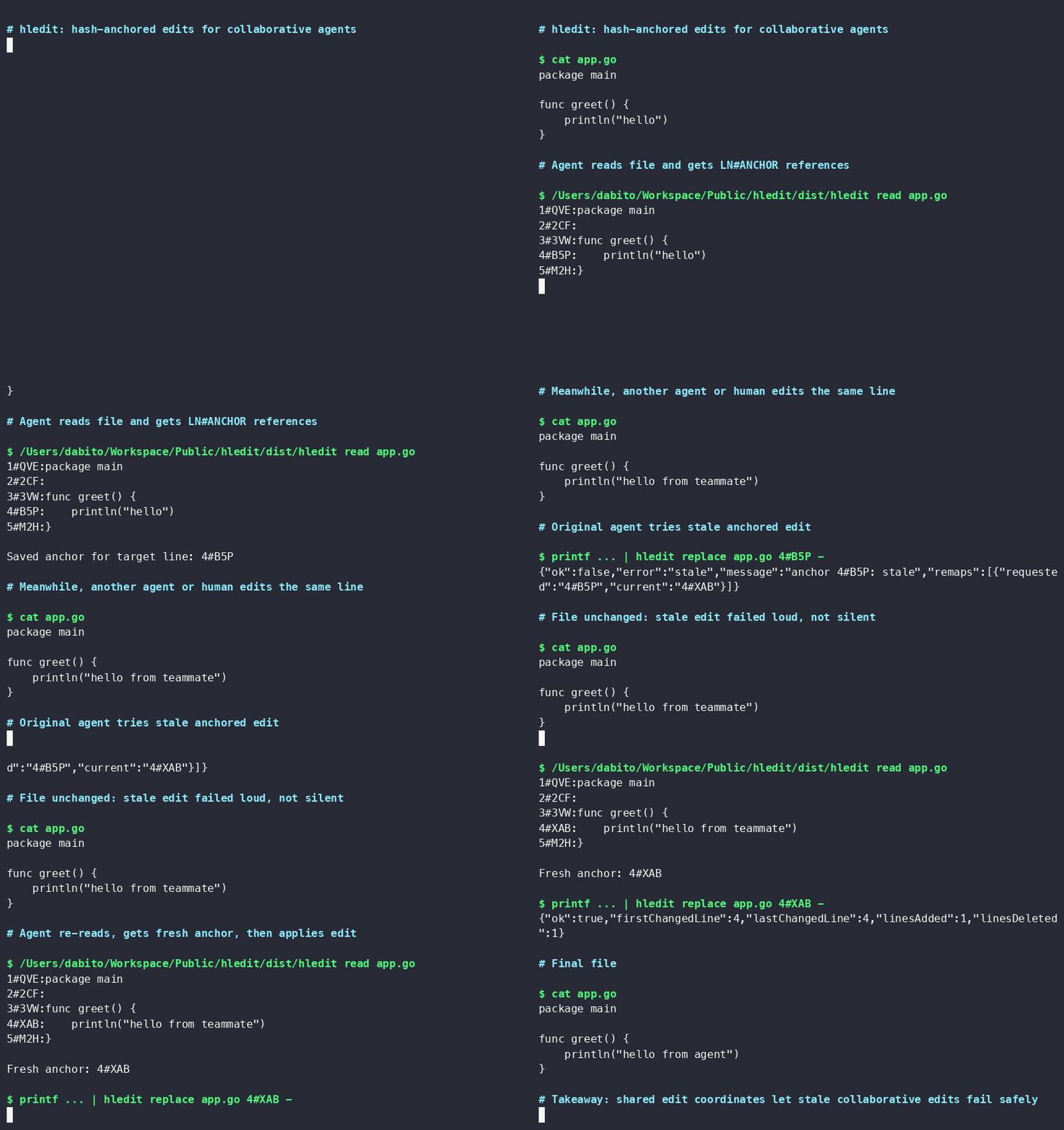
The GIF shows hledit read producing LN#ANCHOR references, a stale edit rejected with {"ok":false,"error":"stale"}, then a successful edit after re-reading a fresh anchor. Source: hledit's README.
Related packages
hledit— the standalone Go CLI this extension wraps. Usable directly without Pi.
Install
Requirements
- Go toolchain and the hledit CLI — install it first:
go install github.com/dabito/hledit@latest
Compatibility notes:
- Line delta summaries (
Lines: +N -M) requirehledit >= 1.2.4. Olderhleditversions still work; they just omit the line delta summary.
Make sure hledit is on PATH for pi, or set HLEDIT_BIN:
export HLEDIT_BIN="$HOME/go/bin/hledit"
Then install the pi extension:
pi install npm:pi-hledit
Then reload or restart pi:
/reload
Alternative: install from git
pi install git:github.com/dabito/pi-hledit
Verify
/hledit-status
By default the extension runs hledit from PATH. If pi cannot find it, set HLEDIT_BIN before starting pi. /hledit-status also shows the active diff rendering config.
What it does
Registers a single hledit tool for pi agents:
- read — read a file with LN#HASH anchors for stale-safe editing
- edit — replace, insert, delete, or replace a range by anchor
- batch — apply multiple edits atomically in one call
- grep — filter lines by substring to reduce token usage
Successful
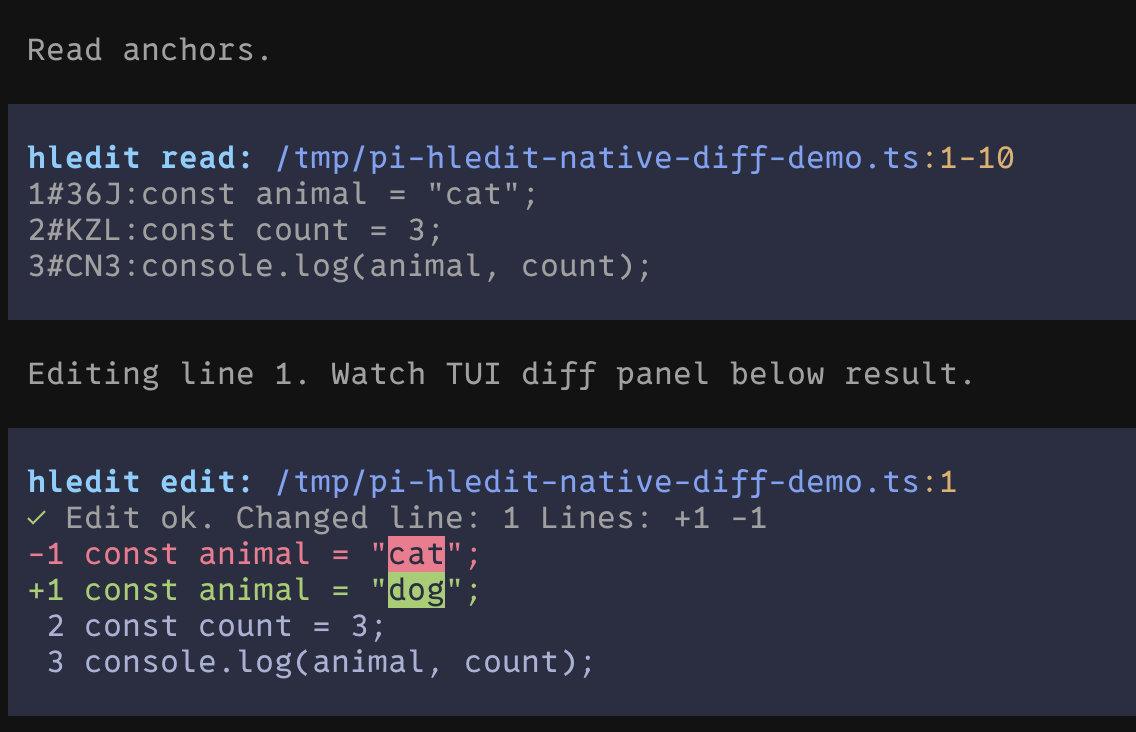
editandbatchcalls render a compact UI-only diff through Pi's nativerenderDiffUI. Model-facing tool output stays metadata-only.
Diff rendering config
Diff rendering is UI-only and can be tuned with environment variables before starting pi:
| Env var | Default | Description |
|---|---|---|
PI_HLEDIT_DIFF_MAX_LINES |
80 |
Max rendered diff lines, including the omission marker. Minimum accepted value: 3. |
PI_HLEDIT_DIFF_CONTEXT |
2 |
Context lines around changed ranges. Minimum accepted value: 0. |
PI_HLEDIT_DIFF_MAX_CELLS |
40000 |
Max LCS comparison cells before diff body is omitted. Minimum accepted value: 1. |
Invalid values fall back to defaults.
Run /hledit-status inside pi to see the effective diff config after environment defaults/overrides are applied.
Tool parameters
| Param | Ops | Description |
|---|---|---|
op |
all | read, edit, or batch |
path |
all | File path, resolved from pi cwd |
offset |
read | 1-indexed start line for ranged reads; default 1 when ranged |
limit |
read | Max lines for ranged reads; default 2000 when ranged |
grep |
read | Substring filter for read output; still line-capped, not byte-capped |
action |
edit | replace, insert, delete, or replace-range; default replace unless end_anchor/legacy after imply otherwise |
anchor |
edit/batch | Start LN#HASH anchor from latest read |
end_anchor |
edit/batch | End LN#HASH anchor for range replace/delete |
content |
edit | Replacement/inserted content; delete uses empty stdin |
after |
edit | With action:'insert', insert after anchor; omitted means insert before |
edits |
batch | JSON array of batch edits using op, anchor, optional end_anchor, and lines |
hledit CLI has a --context option for some reads. This wrapper currently exposes offset, limit, and grep, not --context.
Examples
Read anchors:
{ "op": "read", "path": "src/file.ts", "offset": 1, "limit": 80 }
Replace one line:
{ "op": "edit", "path": "src/file.ts", "action": "replace", "anchor": "12#NKA", "content": "const ok = true;" }
Insert before or after an anchor:
{ "op": "edit", "path": "src/file.ts", "action": "insert", "anchor": "12#NKA", "content": "const added = true;" }
{ "op": "edit", "path": "src/file.ts", "action": "insert", "anchor": "12#NKA", "after": true, "content": "const added = true;" }
Delete a line:
{ "op": "edit", "path": "src/file.ts", "action": "delete", "anchor": "12#NKA" }
Replace a range:
{ "op": "edit", "path": "src/file.ts", "action": "replace-range", "anchor": "12#NKA", "end_anchor": "18#VRC", "content": "new block" }
Batch edits use wrapper-friendly fields. pi-hledit translates them to the CLI-native {"edits":[{"pos":"..."}]} request before spawning hledit batch. Prefer a structured edits array; the legacy JSON string form remains supported during transition.
{
  "op": "batch",
  "path": "src/file.ts",
  "edits": [
    { "op": "replace", "anchor": "12#NKA", "lines": ["const ok = true;"] },
    { "op": "delete", "anchor": "20#ABC", "end_anchor": "22#CDE", "lines": [] },
    { "op": "insert", "anchor": "30#EFG", "lines": ["const added = true;"] }
  ]
}
Legacy string form:
{
  "op": "batch",
  "path": "src/file.ts",
  "edits": "[{\"op\":\"replace\",\"anchor\":\"12#NKA\",\"lines\":[\"const ok = true;\"]}]"
}
Why hash-anchored editing?
Traditional text-matching edits fail silently when the file changes between read and write. Hash anchors detect stale context before any write, and reject stale writes before they happen — the agent gets an error and can re-read, instead of silently patching the wrong line.
Behavior notes
- Plain
{op:'read'}(nooffset/limit/grep) is bounded: it defaults tooffset:1,limit:2000, same as an explicit ranged read. grepfilters which lines are returned but the result is still line-capped bylimit, not byte-capped — a match set larger thanlimitis truncated with a pagination hint fromhledit, not silently dropped.action:'delete'sends empty content (empty stdin) tohledit; there is no separate delete-specific field.- Batch insert is insert-before only — the current
hledit batchCLI has no insert-after field.
Failure modes
- Stale anchor — the target line changed since the anchor's
read. The edit is rejected with an error instead of writing to the wrong line; re-read and retry with a fresh anchor. - Malformed batch JSON — the
editsstring fails to parse; the tool returns an actionable error naming the expected shape rather than spawninghledit. - hledit not found — if
HLEDIT_BIN/PATHdon't resolve to the CLI, the tool returns the install hint (go install github.com/dabito/hledit@latest).
Limitations
- This wrapper does not expose
hledit's--contextflag; onlyoffset,limit, andgrepare exposed for reads. - Batch edits are applied by a single
hledit batchinvocation (validate-all-then-write), not by this wrapper independently — atomicity guarantees come from the CLI, not from pi-hledit's own code. - No sandboxing beyond what
hledititself does: paths are resolved relative to pi's cwd and passed through to the CLI as-is.
Development
npm test # typecheck, contract tests, lint
Contract tests live in test/contract.test.ts and cover read-arg building, edit action resolution, batch translation, and the registered tool's rendering.